The Mad Emperor's Occult Prague
Listen
Open in Spotify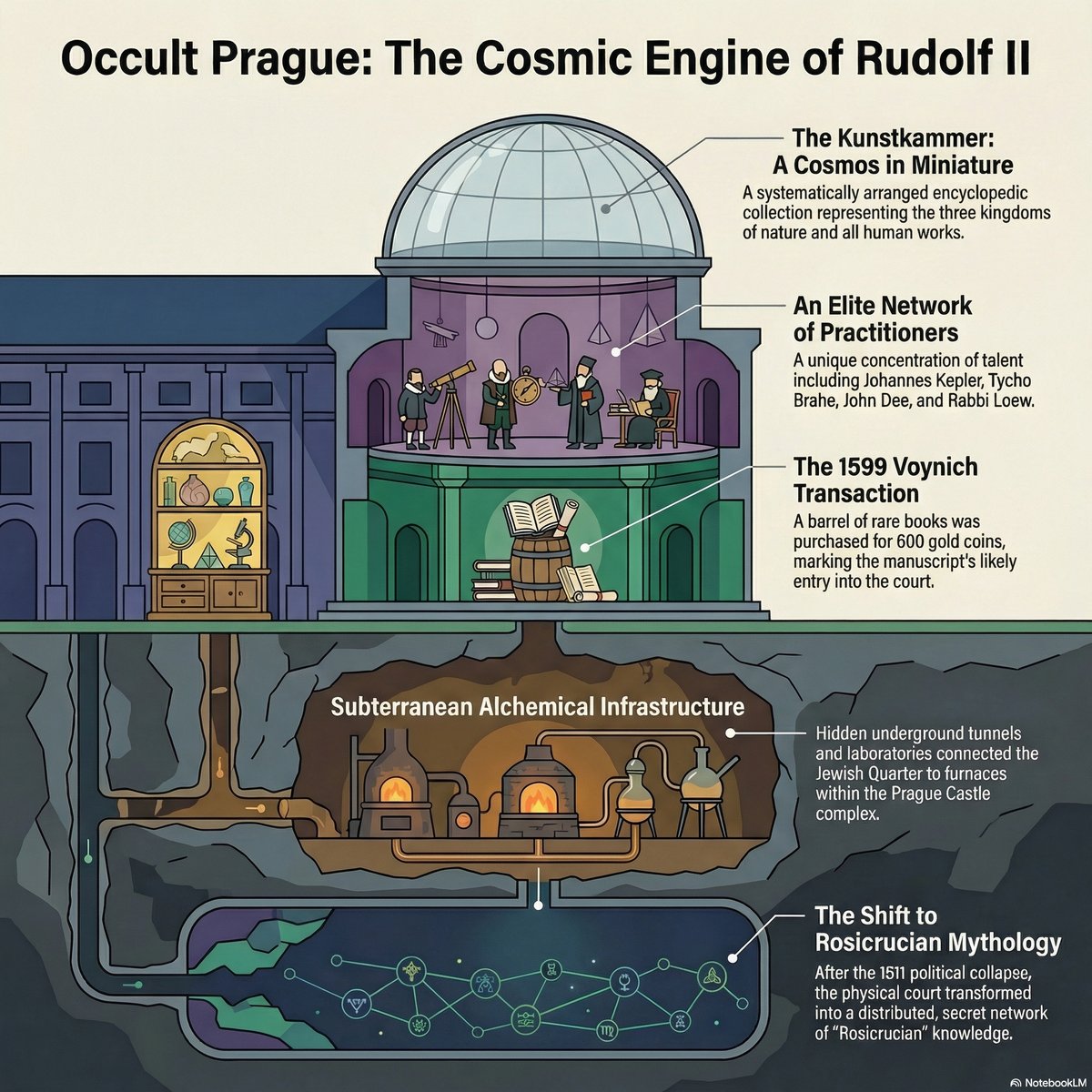
Show Notes
# EP013: The Mad Emperor's Occult Prague
Summary
Rudolf II turned Prague into the most concentrated hub of occult and scientific research in European history — and then his mind fell apart and it all scattered. Kepler, Brahe, John Dee, Rabbi Loew, Michael Maier — they all converged on a single court because a single emperor had the wealth and the tolerance to fund them. The Voynich Manuscript almost certainly entered this collection in 1599, purchased for 600 gold coins from a barrel of rare books. When Rudolf was deposed in 1611 and the political order collapsed by 1620, the network didn't just end — it dispersed. Scholars fled, libraries were looted, and the centralized patronage model proved exactly as fragile as every previous version. What replaced it was the Rosicrucian model: distributed, anonymous, and built to survive without a patron. This episode traces how one emperor's court became the catalyst for modern Western esotericism.
Show Notes
- Rudolf II and the Prague Court — Holy Roman Emperor from 1576 to 1612, Rudolf moved the imperial capital from Vienna to Prague and turned it into an unprecedented center for alchemy, astronomy, Kabbalah, and occult research. His tolerance for heterodox inquiry was both the court's greatest strength and its fatal dependency.
- The Concentration of Talent — Tycho Brahe (imperial astronomer), Johannes Kepler (his successor), John Dee and Edward Kelley (Enochian practitioners), Rabbi Judah Loew (Kabbalist and legendary Golem creator), Michael Maier (Rosicrucian apologist) — all present in Prague within overlapping decades. No other court in European history assembled this density of esoteric and scientific talent.
- The 1599 Voynich Transaction — Recent scholarship places the Voynich Manuscript's entry into Rudolf's collection around 1599, purchased for 600 gold ducats from a physician's barrel of rare books. This connects the manuscript directly to the court that housed Dee, Kelley, Brahe, and Kepler.
- The Kunstkammer — Rudolf's cabinet of curiosities was a systematically arranged encyclopedic collection representing the three kingdoms of nature and all human works — a cosmos in miniature. The Voynich Manuscript would have fit perfectly within this framework.
- The 1611-1620 Collapse — Rudolf's deposition in 1611, followed by his death in 1612, and the outbreak of the Thirty Years' War in 1618 destroyed the political structure that held the network together. The Battle of White Mountain in 1620 ended Bohemian independence entirely.
- Cascade Dispersal — The court's collapse didn't destroy the knowledge — it scattered it. Scholars fled to courts across Europe, carrying manuscripts, correspondence, and techniques. The dispersal pattern directly prefigures the distributed architecture described in the Rosicrucian manifestos.
- From Patronage to Brotherhood — The Fama Fraternitatis appeared in 1614, two years after Rudolf's death. The timing is exact. The Rosicrucian model — anonymous, decentralized, built to survive without institutional protection — is the architectural answer to the fragility that killed every previous patronage network.
Sources & References
- Rudolf II — imperial court records and collection inventories
- Tycho Brahe — observatory records, Prague (1599-1601)
- Johannes Kepler — Astronomia Nova (1609), composed in Prague
- John Dee — Prague diaries (1583-1589)
- Peter Marshall — The Magic Circle of Rudolf II (2006)
- R.J.W. Evans — Rudolf II and His World (1973)
Maxwell's Pendulum: The Plan
Research Brief
Summary
Prague under Rudolf II (r. 1576-1612) was the single densest concentration of occult, alchemical, astronomical, and Kabbalistic practitioners in European history. The emperor moved his capital from Vienna in 1583, built a northern wing at Prague Castle to house a Kunstkammer of encyclopedic ambition, and over twenty-four years assembled a court that included John Dee, Edward Kelley, Tycho Brahe, Johannes Kepler, Rabbi Judah Loew ben Bezalel, Michael Maier, Jacobus Horcicky de Tepenec, Tadeáš Hájek, Oswald Croll, Anselmus Boetius de Boodt, and Martin Ruland the Younger, among others. Into this environment, in 1599, arrived a barrel of books from the physician Carl Widemann, containing what Stefan Guzy's 2023 Hofkammer analysis identifies as the probable transaction matching the Voynich Manuscript's recorded purchase price of 600 gold coins. Rudolf's abdication in 1611, his death in 1612, and the cascade that followed -- the Defenestration of 1618, the election and defeat of Frederick V, the Battle of White Mountain in 1620 -- destroyed the institutional structure that had held this network together and scattered its members across Europe. Two years after Rudolf's death, the Fama Fraternitatis appeared. The Rosicrucian manifestos described, in mythological register, the kind of network Rudolf's court had been in historical register. The manuscript survived, passed through Horcicky, Baresch, Marci, and Kircher to the Jesuits. Everything else dispersed. This brief treats Prague as the subject rather than the backdrop, and subjects it to the same density test that Florence failed in Round 11.
1. Rudolf's Court: The Full Picture
The Emperor
Rudolf II was born in Vienna on July 18, 1552, the eldest surviving son of Emperor Maximilian II and Maria of Spain.1 He was sent at age eleven to the Spanish court of Philip II, where he spent eight formative years (1563-1571) absorbing the rigid Counter-Reformation Catholicism and the elaborate court ritual of the Escorial.2 The Spanish years left two permanent marks: a lifelong commitment to Catholicism that was nonetheless far more tolerant than his Habsburg relatives would have preferred, and a deep melancholy that contemporaries attributed variously to the Spanish atmosphere, to hereditary disposition, or to a syphilitic infection possibly contracted in his youth.3 He succeeded his father as Holy Roman Emperor in 1576.
Rudolf was, by temperament and by political calculation, a collector. R.J.W. Evans's 1973 study, Rudolf II and His World, remains the standard English-language biography and presents the emperor as a man whose intellectual ambitions were genuine but whose capacity for governance deteriorated steadily from the 1590s onward.4 He avoided public appearances. He never married, though he maintained a long relationship with Katharina Strada, daughter of his antiquary Jacopo Strada, with whom he had several children.5 He developed what the Hektoen International medical history journal describes as "a pathological mistrust of those around him" and retreated increasingly into his collections, his laboratories, and his melancholy.3
The question of Rudolf's mental state matters for the Plan because it shaped the court's structure. Rudolf's withdrawal from governance created a power vacuum that his brother Matthias exploited ruthlessly, but it also created an intellectual space in which practitioners of esoteric disciplines operated with unusual freedom. Rudolf's court was tolerant not because Rudolf held progressive views about intellectual liberty, but because Rudolf was too absorbed in his collections and too paralyzed by his melancholy to enforce orthodoxy. The tolerance was a byproduct of dysfunction. This is the paradox at Prague's center: the most intellectually concentrated court in Europe was held together by a man who was falling apart.
The Move to Prague
In 1583, Rudolf moved the imperial capital from Vienna to Prague.6 The reasons were partly strategic -- Vienna was vulnerable to Ottoman attack, and Prague sat at the center of the wealthy Bohemian crown lands -- and partly temperamental. Prague was larger than Vienna, more cosmopolitan, and further from the watchful eyes of Rudolf's family.6 The move transformed Prague into one of the leading cultural centers on the continent. The Metropolitan Museum of Art's essay on Rudolfine Prague notes that the city became "a center of European art and culture" during Rudolf's three decades of residence.7
The Kunstkammer
The Kunstkammer was Rudolf's central project and the physical expression of his intellectual ambition. Between 1587 and 1605, he built the northern wing of Prague Castle specifically to house the growing collection.8 When the wing was completed, the collection occupied a series of vaulted chambers: three rooms roughly 60 meters long by 5.5 meters wide, connected to a main chamber 33 meters long.9 The inventory, compiled between 1607 and 1611 by Daniel Fröschl, Rudolf's court painter and successor to Octavio Strada as imperial antiquarian, survives in the library of the Fürst of Liechtenstein in Vaduz, having been rediscovered after the Second World War.9
The Kunstkammer was not a haphazard cabinet of curiosities. It was, as the Habsburg family's own historical website notes, "systematically arranged in an encyclopaedic fashion," organized to represent "the three kingdoms of nature and the works of man."8 The collection included over 470 paintings (works by Dürer, Brueghel, Titian, Correggio, and Rudolf's court painters Giuseppe Arcimboldo, Bartholomäus Spranger, and Hans von Aachen); 69 bronze figures; several thousand coins and medals; 179 ivory objects; 50 objects of amber and coral; 600 vessels of agate and crystal; 174 works of faience; 403 "Indian curiosa"; 185 works of precious stone; over 300 mathematical instruments; and uncut diamonds.10 The collection also included a menagerie of exotic animals, botanical gardens, and Rudolf's personal gemological collection, curated by Anselmus Boetius de Boodt, who published his Gemmarum et Lapidum Historia in 1609, classifying over 600 minerals from direct observation.11
The Kunstkammer was, in functional terms, a model of the cosmos in miniature. It was also the context in which the Voynich Manuscript would have been received. A manuscript written in an undeciphered script, illustrated with unidentifiable plants and unrecognizable astronomical diagrams, would not have been an anomaly in this environment. It would have been a particularly interesting specimen.
The Art
Rudolf's court painters -- Arcimboldo, Spranger, Hans von Aachen, Joseph Heinz, Adriaen de Vries, and Roland Savery -- practiced a Northern Mannerist style that suited their patron's temperament.12 Arcimboldo's composite portraits (faces assembled from fruit, vegetables, books, or animals) were not merely clever. They expressed the Kunstkammer philosophy: that the world's components could be rearranged to reveal hidden structures. Spranger specialized in mythological scenes with erotic content presented through the veil of classical allegory.12 Von Aachen arrived in 1592 and became Rudolf's preferred portraitist.12 The art collection's emphasis on encoding, allegory, and the interpenetration of natural forms is consistent with the broader intellectual culture of the court: everything at Rudolf's Prague operated on at least two levels simultaneously.
The Laboratories
Rudolf maintained alchemical laboratories within Prague Castle and, according to archaeological evidence discovered during renovation following the 2002 Prague floods, a network of underground tunnels connecting laboratories in the Jewish Quarter to the castle complex.13 Archaeologists uncovered hidden chambers containing furnaces, glass retorts, ceramic crucibles, and traces of chemical residues that had been sealed for centuries.13 Rudolf himself worked experiments in a personal laboratory on the castle hill, earning him the nicknames "the Mad Emperor" and "the Crazy Alchemist."14
The Golden Lane (Zlatá ulička), the narrow street along the northern wall of Prague Castle, has a popular reputation as the "street of alchemists," but the historical reality is more mundane. The lane was built in the 16th century to house the king's guards and goldsmiths, not alchemists.15 The alchemical laboratories were located elsewhere -- primarily in the Mihulka Powder Tower within the castle complex and in the underground network noted above.13 The Golden Lane legend is tourist mythology; the real laboratories were less picturesque but more consequential.
Political Context and the Letter of Majesty
Rudolf's political position was unique and precarious. As Holy Roman Emperor, he was nominally the most powerful ruler in Europe. In practice, his withdrawal from governance left him increasingly isolated. In 1605, his family forced him to cede control of Hungarian affairs to his brother Matthias.16 Matthias then rallied support from disaffected Hungarian and Austrian nobles, and Rudolf was progressively stripped of his territories: Hungary, Austria, and Moravia fell to Matthias between 1605 and 1608.16
In a desperate attempt to retain Bohemia, Rudolf issued the Letter of Majesty on July 9, 1609, granting religious tolerance to Bohemian Protestants and Catholics alike and effectively creating a Bohemian Protestant State Church.17 This was not an act of liberal principle. It was a political transaction: Rudolf traded religious freedom for political support. The Letter of Majesty would become one of the most consequential documents of the 17th century, because its alleged violation by Ferdinand II's representatives would provide the legal pretext for the Defenestration of Prague in 1618.17
Rudolf's court was thus simultaneously the most intellectually concentrated and the most politically vulnerable in Europe. The density of practitioners depended on imperial patronage. The patronage depended on an emperor who was losing his territories, his authority, and his mind. The court's brilliance was inseparable from its fragility.
2. Key Figures at Court
John Dee and Edward Kelley (Prague, 1584-1586)
John Dee arrived in Prague in August 1584 with Edward Kelley, his scryer and collaborator in the Enochian angelic communications.18 They had been conducting sessions since March 1583, during which Kelley reported visions of a 21-lettered angelic alphabet and received texts that became the Liber Loagaeth (Book of the Speech of God) and the Claves Angelicae (Angelic Keys) -- 48 poetic verses received in Krakow in 1584.19 The Enochian system constituted a complete constructed language with its own alphabet, grammar, and vocabulary exceeding 1,000 words.19
Dee and Kelley were received at Prague Castle with what contemporary accounts describe as "much royal largesse."18 In 1586, Kelley reportedly performed an alchemical transmutation of mercury into gold before Rudolf, or at least convinced the emperor that he had done so.18 But Rudolf withheld sustained patronage, and the pair's activities attracted the attention of the papal nuncio Germanico Malaspina, Bishop of San Severo, who on March 27, 1587 summoned them to defend themselves against charges of necromancy.20 Dee handled the hearing diplomatically; Kelley reportedly infuriated the nuncio by criticizing the conduct of Catholic priests.20 The result was their effective expulsion from Prague.
They found refuge with the wealthy Bohemian magnate Vilém of Rožmberk (William of Rosenberg) at Třeboň in southern Bohemia, where they continued their work.20 It was at Třeboň, on December 19, 1586, that Kelley reportedly performed his first documented alchemical transmutation.20 Dee returned to England in 1589. Kelley remained in Bohemia, where his career took a darker turn.
Kelley's separate trajectory matters for the Plan. After Dee's departure, Kelley continued as an alchemist in Bohemian service. Rudolf elevated him to nobility. But when Kelley failed to produce the promised alchemical gold, Rudolf had him arrested in May 1591 and imprisoned at Křivoklát Castle for killing an official named Jiří Hunkler in a duel -- though the imprisonment is widely understood as retaliation for alchemical failure.21 Released in 1595 after agreeing to resume alchemical work, Kelley failed again and was reimprisoned at Hněvín Castle in Most.21 He died in late 1597 or early 1598, reportedly from injuries sustained in an escape attempt -- he fell from a wall and broke his leg in three places.21 An alternative account from Simon Tadeáš, Rudolf's geologist, claims Kelley poisoned himself before his wife and children on November 1, 1597.21
Kelley's imprisonment and death illustrate the operational reality beneath the court's intellectual veneer. Rudolf's patronage was not disinterested. He expected results. When the alchemists failed to deliver, the patron became a jailer. This dynamic would repeat, in political rather than alchemical register, when Rudolf himself was imprisoned by Matthias's forces in 1611.
Tadeáš Hájek (1525-1600)
Hájek requires treatment before the more famous figures because he was the court's gatekeeper. A Czech naturalist, astronomer, and physician who served Rudolf from 1576 until his death in 1600, Hájek's primary function was vetting the alchemists who arrived at Prague from across Europe.22 Because of his "wide natural historical knowledge and honesty," as Ivo Purš and Vladimír Karpenko note in their 2016 volume Alchemy and Rudolf II, Hájek was the evaluator who determined which practitioners gained access to the emperor.22
Hájek hosted John Dee and Edward Kelley at his own house during their Prague sojourn.22 He was in scientific correspondence with Tycho Brahe and played a critical role in persuading Rudolf to invite Brahe (and later Kepler) to Prague.22 He died on September 1, 1600, one year after Brahe's arrival and the same year Kepler joined the court. Hájek was, in institutional terms, the mechanism by which the court's intellectual density was constructed. Without his evaluation and advocacy, the concentration of talent at Prague would have been different -- possibly less impressive, certainly less coherent.
Tycho Brahe (Prague, 1599-1601)
Brahe arrived in Prague in 1599, having left Denmark after a falling-out with the new king Christian IV. Rudolf appointed him Imperial Court Astronomer and provided him with the castle at Benátky nad Jizerou, 50 kilometers from Prague, where Brahe established a new observatory.23 After roughly a year at Benátky, Rudolf brought him back to Prague, where he worked in the Nový Svět (New World) quarter, Prague's neighborhood of alchemists.24
Brahe was not merely an astronomer. He called his studies "ars pyronomica" and maintained active alchemical interests alongside his astronomical observations.24 His observational data, the most precise in the pre-telescopic era, would become the foundation for Kepler's laws of planetary motion. When Johannes Kepler arrived in Prague in February 1600, he came initially as Brahe's assistant.25
Brahe died on October 24, 1601, at the age of 54. The circumstances of his death became one of the great medical mysteries of early modern history. The traditional account involves a banquet at which Brahe refused to leave the table to urinate (court etiquette forbade departure before the host), resulting in a burst bladder. Mercury poisoning was long suspected, and hair analysis did reveal elevated mercury levels.26 However, the definitive 2010 exhumation study -- conducted by a Danish-Czech team that sampled beard, bones, and teeth -- ruled mercury poisoning out. Three different quantitative chemical methods showed mercury concentrations "not sufficiently high to have caused his death."26 The study concluded that the mercury traces likely came from "precipitation of mercury dust from the air during his long-term alchemistic activities."26 The cause of death was most likely uremia from acute kidney failure.26
Brahe's death left his observational data in the hands of Kepler, his instruments in the hands of the court, and his reputation in the hands of history. His presence at Prague, however brief, established the court as a center of both astronomical precision and alchemical experimentation -- a combination that the university system would have found contradictory but that Rudolf's court found natural.
Johannes Kepler (Prague, 1600-1612)
Kepler arrived in Prague in 1600 and, upon Brahe's death in 1601, succeeded him as Imperial Mathematician.25 His primary obligation was to provide astrological advice to the emperor -- a duty that Kepler, who took a dim view of predictive astrology while still believing in astrology's broader cosmological significance, performed with characteristic ambivalence.25 His tenure in Prague was the most productive period of his career: he published Astronomia Nova in 1609, containing his first two laws of planetary motion, and began work on the Rudolphine Tables, the star catalogue and planetary tables that would not be completed until 1627.27
Kepler's personal beliefs place him at the intersection of the court's scientific and esoteric cultures. He rejected the kind of detailed horoscope-casting that Rudolf's court employed, but he believed that planetary configurations reflected divine harmonies with real influence on terrestrial affairs.25 He was, in the Plan's terms, a practitioner who straddled the boundary between what the later Enlightenment would separate into science and occultism. That boundary did not exist at Rudolf's Prague. Kepler's presence there was not anomalous; it was characteristic.
After Rudolf's abdication in 1611 and death in 1612, Matthias confirmed Kepler's position and salary as Imperial Mathematician but allowed him to relocate to Linz, where he served as District Mathematician.28 He published the Harmonices Mundi (1619, containing the third law of planetary motion) and finally completed the Rudolphine Tables in 1627, printing them in Ulm after the Thirty Years' War disrupted his plans to print in Linz.28 The Tables were published in time for the Frankfurt book fair -- the same commercial infrastructure that distributed Maier's Rosicrucian publications a decade earlier.
Rabbi Judah Loew ben Bezalel, the Maharal (1525-1609)
On February 23, 1592, Rabbi Loew had an audience with Emperor Rudolf II at Prague Castle.29 He was accompanied by his brother Sinai and his son-in-law Isaac Cohen; Prince Bertier was present with the emperor.29 The contemporary account comes from David Gans's Zemach David (1592), written by the Maharal's disciple: Rudolf "received him with a welcome and merry expression, and spoke to him face to face, as one would to a friend."29
The substance of the meeting is unrecorded. Contemporary accounts describe the topics discussed as "sealed, hidden and concealed" -- language that, as the Plan has already noted, signals Kabbalistic content.30 Rudolf reportedly sat behind a screen while Bertier and Loew discussed mysticism, then joined the conversation personally, intrigued.30 The rabbi and his entourage were permitted to keep their hats on, an unusual concession for commoners in the imperial presence.30
The Golem legend -- that Rabbi Loew created a clay figure and animated it to protect Prague's Jewish community -- is not attested in any Hebrew work published in the 16th, 17th, or 18th centuries, including the Maharal's own eulogies.31 Gans's Zemach David does not mention the Golem. The legend appears to be a German literary invention of the early 19th century.31 What is documented is that the emperor and the rabbi met, that the subject was esoteric, and that the conversation was considered too sensitive to record. Whatever passed between them remained, as Casaubon noted in Round 1, occult in the most literal sense.
Michael Maier (Prague, 1608-1611)
Maier arrived in Prague around 1608 and was appointed Rudolf's personal physician (Leibarzt) between 1609 and 1611, receiving hereditary nobility.32 He is described in the Furnace and Fugue digital humanities project as serving "the melancholy emperor who felt he had been 'bewitched,' such was his fascination with alchemy and the occult arts."32
The Plan has already established Maier as the hinge between Rudolf's court and the Rosicrucian movement. What this research adds is the detail of his departure. By April 1611, Rudolf's political position had collapsed and the emperor was effectively imprisoned in his own castle.33 Maier left Prague that month -- before the formal abdication on May 23, 1611, and well before Rudolf's death on January 20, 1612.33 He traveled to England via the Netherlands, spending time with the scholar Petrus Carpenterius in Rotterdam before arriving in London, where he remained for approximately five years.33
Maier's English sojourn is more significant than the Plan has acknowledged. In London, he formed connections with Robert Fludd, the physician and Rosicrucian sympathizer; Ben Jonson, the dramatist; and Inigo Jones, the architect.33 This places Maier at the exact intersection of the Plan's English axis: the network connecting Dee's Prague activities to the London intellectual world through Fludd, Bacon, and the theater. Maier's Arcana arcanissima (1613 or 1614) was printed by Johann Theodor de Bry in Oppenheim but "actively promoted and circulated among Maier's English contacts."33
After returning to Germany, Maier published his major Rosicrucian defenses: Silentium post Clamores (1617), defending the Brotherhood's silence in the face of public clamor for initiation; Themis Aurea (1618), expounding the Brotherhood's laws; and Atalanta Fugiens (1617), the extraordinary alchemical emblem book containing 50 emblems with 50 accompanying musical fugues -- a multimedia work integrating visual, textual, and musical encoding.34 He also helped organize the publication of Fludd's works in Frankfurt.33
Maier died in 1622, having set out for Holstein to deliver an aurum potabile to Duke Friedrich of Schleswig-Holstein-Gottorf.33 He died at Rostock, the Plan's most concrete example of the post-Prague dispersal: a court physician who became a Rosicrucian publisher who died as a traveling alchemist, his patron eleven years dead, the court long dissolved, the tradition continued in print because the institution that had sustained it in person no longer existed.
Jacobus Horcicky de Tepenec (1575-1622)
Horcicky was a Bohemian pharmacist who served as Rudolf's personal doctor and imperial chemist.35 In 1607, in gratitude for curing the emperor of a grave illness, Rudolf ennobled him with the title "de Tepenec," after the medieval Tepenec Castle near Olomouc.35 Horcicky maintained a laboratory and herb garden at Smíchov (then a village outside Prague's walls) and at the Clementinum's botanical garden, where he distilled his popular Aqua Sinapis ("water of mustard," likely a reference to his own name -- Hořčický derives from hořčice, mustard; his Latin name Sinapius carries the same meaning).35
The signature reading "Jacobi de Tepenecz" on folio 1r of the Voynich Manuscript, visible only under ultraviolet light, is the most direct physical link between the manuscript and Rudolf's court.36 However, the attribution is contested. Jan Hurych's 2003 discovery of a document bearing Horcicky's authentic signature revealed discrepancies with the folio 1r inscription, leading to suggestions that the signature was added later -- possibly even by Wilfrid Voynich himself to enhance the manuscript's provenance.36 Recent multispectral imaging (2024) has revealed additional features on folio 1r, including what appears to be a 17th-century decoding attempt in the right margin, attributed on paleographic grounds to Johannes Marcus Marci based on comparison with Marci's 1640 handwriting.37
Horcicky died on September 25, 1622, from injuries sustained in a fall from a horse the previous year.35 The question of how the manuscript passed from Horcicky to Georg Baresch remains undocumented. Rudolf died in 1612 still owing money to Horcicky, and it is possible that the manuscript was given (or simply taken) as partial payment of that debt.36
Other Figures at Court
Oswald Croll (c. 1560-1608): A Paracelsian physician who settled in Prague and composed his principal work, the Basilica Chymica (1609), while frequenting Rudolf's court.38 Croll's work on chemical philosophy connected Paracelsian medicine to the broader alchemical program at Prague.
Anselmus Boetius de Boodt (1550-1632): A Flemish artist, mineralogist, physician, and musician who served as Rudolf's personal physician from 1583 and as principal curator of the Kunstkammer.11 His Gemmarum et Lapidum Historia (1609) classified over 600 minerals and established modern gemology alongside Georgius Agricola's earlier work. He also compiled detailed painted albums of flora and fauna, now scattered across European collections.11
Martin Ruland the Younger (1569-1611): A German physician and alchemist who practiced at Rudolf's court and was ennobled by the emperor in 1608.39 His Lexicon Alchemiae (1612), a comprehensive dictionary of alchemical terms, was cited extensively by Carl Jung in his 20th-century writings on alchemy -- an improbable survival of Rudolfine intellectual culture through psychoanalytic reception.39
The cumulative picture is of a court that functioned as an unintentional research institute. The practitioners were drawn by patronage and held by a combination of genuine intellectual excitement and the emperor's willingness to fund work that no other European ruler would support. The court had no formal structure for its esoteric activities -- no enrolled students, no statutes, no curriculum. Access was regulated informally, through figures like Hájek who vetted arrivals. The institutional model was closer to the Florentine Academy than to Alexandria: patronage-dependent, personality-driven, and catastrophically vulnerable to the patron's fall.
3. Voynich Provenance at Prague
The Guzy Finding (2023)
Stefan Guzy's systematic analysis of Rudolf II's Hofkammer (Imperial Chamber) records constitutes the most significant advance in Voynich provenance scholarship since Wilfrid Voynich's 1912 acquisition.40 Guzy examined the well-preserved accounting books of the Hofkammer in Vienna and Prague, working through approximately 7,000 journal entries, of which he identified 126 book transactions spanning Rudolf's reign from 1576 to 1612 (with only the years 1578-1580 missing).40
Among these 126 transactions, only one matches the purchase price recorded in Marci's 1665 letter to Kircher: a 1599 transaction in which the physician Carl Widemann sold a consignment of books described as "remarkable/rare" (selzam) to the emperor for 500 silver taler, equivalent to approximately 600 gold florin.41 A related record dated February 25, 1600, references a barrel of books described as unusual, purchased in Augsburg and shipped to Hans Popp, Rudolf's chamberlain in Prague.41
The identification of Widemann as the seller opens the Rauwolf connection that the Plan has already documented: Widemann lived in the Augsburg household of the botanist Leonhard Rauwolf, who had traveled extensively in the Near East collecting plant specimens in the 1570s-1580s.42 Widemann began selling books to the emperor immediately after the deaths of Rauwolf and his widow, who had no children, suggesting he inherited or acquired Rauwolf's library.42
The Chain of Custody
The documented provenance chain through Prague runs as follows:
1599: The Widemann transaction. The barrel of books arrives at Rudolf's court. If Guzy's identification is correct, the Voynich Manuscript enters the Kunstkammer.41
1607: Horcicky is ennobled. At some point, the manuscript comes into his possession -- either as a gift from Rudolf, as payment for debts the emperor owed him, or through some other undocumented transfer. The ultraviolet signature on folio 1r links his name to the manuscript, though the handwriting match is disputed.36
1622: Horcicky dies. The manuscript's whereabouts between his death and Baresch's first known letter to Kircher (1637) are undocumented -- a gap of fifteen years.35
1637: Georg Baresch, a Prague alchemist and antiquities collector (1585-1662), writes to Athanasius Kircher, having learned of Kircher's publication of a Coptic dictionary and his claimed decipherment of Egyptian hieroglyphs.43 Baresch sends sample pages from the manuscript and describes his belief that it contains Egyptian medical science. This letter is lost, but its existence is confirmed by a later reference.43
1639: Baresch's surviving letter to Kircher, the earliest confirmed mention of the manuscript. Baresch summarizes the illustrations, presents his theory of Egyptian origin, and requests Kircher's help with decipherment.43 Kircher apparently expressed interest in acquiring the book, which Baresch refused to yield.43
1665 (or 1666): Johannes Marcus Marci, rector of Charles University in Prague, sends the manuscript to Kircher with a cover letter dated August 19. Marci states that, according to his late friend Raphael Mnishovsky (a tutor in the Bohemian language to Ferdinand III), the book had been purchased by Rudolf II for 600 ducats.44 Marci also notes that Roger Bacon was believed to be the author, though this attribution has not survived modern scrutiny.44
1912: Wilfrid Voynich purchases the manuscript from the Jesuit College at Frascati, near Rome, where it had been stored after traveling through the Jesuit institutional network from Kircher's possession at the Collegio Romano.44
What Guzy Adds
Beyond the Widemann identification, Guzy's work establishes the broader landscape of Rudolf's book acquisitions. The 126 transactions include gifts (for which Rudolf often gave small amounts of money in return), purchases, and commissioned works.40 The scope of these transactions provides context: Rudolf was an active, systematic acquirer of books and manuscripts, and the Voynich's arrival in a barrel of books from a physician-bibliophile in Augsburg would have been one transaction among many. The manuscript's extraordinariness would have been evident only upon examination, not upon receipt.
The Horcicky Signature Controversy
The folio 1r inscription deserves separate treatment because it has become a fault line in Voynich provenance studies. The name "Jacobi de Tepenecz" was first detected under ultraviolet light by several researchers, and it has been the primary physical evidence linking the manuscript to Rudolf's court.36 Jan Hurych's 2003 discovery that the signature does not match a known exemplar of Horcicky's handwriting introduced the possibility that the inscription was added by someone other than Horcicky -- either a later owner recording provenance or, in the most skeptical interpretation, by Voynich himself to enhance the manuscript's market value.36
The 2024 multispectral imaging study adds a new dimension. The discovery of what appears to be a Marci-era decoding attempt on the same folio suggests that the manuscript was actively studied in the mid-17th century, consistent with the Baresch-Marci-Kircher correspondence.37 If the Horcicky signature is genuine but not in Horcicky's hand, it may represent a provenance notation added by Baresch or another later owner -- a common practice in early modern manuscript custody.
4. The Cascade Collapse (1611-1620)
Rudolf's Fall
Rudolf's abdication on May 23, 1611, was not voluntary. His brother Matthias had been stripping him of territories since 1605, and by April 1611, Matthias's army held Rudolf effectively prisoner in Prague Castle.16 Rudolf ceded the Bohemian crown and retained only the empty title of Holy Roman Emperor. He died on January 20, 1612, in Prague Castle, reportedly of melancholy -- though, as noted, this Habsburg medical term covered a range of conditions.3 Matthias was elected Holy Roman Emperor five months later.16
The Dispersal
Rudolf's death triggered the dispersal of the court network. The pattern matches the Florentine cascade collapse that the Plan documented in Round 11 (Florence 1492-1499), but with different timing and a different institutional context.
Brahe was already dead (1601). Hájek was dead (1600). Croll was dead (1608). Ruland was dead (1611). Dee had returned to England in 1589. Kelley was dead (1597/1598). Of the major figures, the survivors scattered:
Kepler relocated to Linz, where Matthias confirmed his salary but the intellectual community that had surrounded him in Prague did not follow.28 Maier departed for England in April 1611, before the formal abdication, and spent five years in London before returning to Germany to publish from Frankfurt and Oppenheim.33 Horcicky remained in Prague -- he was, after all, a Bohemian -- but died in 1622 from a riding injury.35 The Kunstkammer remained at Prague Castle, increasingly neglected by Matthias, who had no interest in his brother's esoteric collections.10
The Letter of Majesty and Its Destruction
The political cascade that followed Rudolf's death moved through a series of escalating crises:
1617: Ferdinand of Styria (the future Ferdinand II), a zealous Counter-Reformation Catholic, was designated king-elect of Bohemia.
1618 (May 23): Protestant nobles, accusing Ferdinand's representatives of violating the Letter of Majesty, threw two imperial regents (Vilém Slavata and Jaroslav Martinic) and their secretary Philip Fabricius out of a window of Prague Castle's council room.45 All three survived -- the Catholics attributed this to angelic intervention, the Protestants to the dung heap below. The Defenestration of Prague triggered the Bohemian Revolt.45
1619 (November): The Bohemian estates rejected Ferdinand and elected Frederick V, Elector Palatine, as their king. Frederick was a Calvinist who had married Elizabeth Stuart, daughter of James I of England, in 1613.46 Frances Yates identified Frederick's court at Heidelberg as the political expression of the "Rosicrucian Enlightenment" -- a union of Protestant political power with Hermetic-Kabbalistic intellectual ambition.47 Frederick's court chaplain Abraham Scultetus was a driving force behind the Calvinist project in Bohemia.46
1620 (November 8): The Battle of White Mountain. The forces of the Catholic League under Bucquoy and Count Tilly defeated the Protestant army of Christian of Anhalt outside Prague in less than two hours.48 Frederick fled into exile, earning the mocking title "Winter King" for his single season on the Bohemian throne.48 Ferdinand II entered Prague, revoked the Letter of Majesty -- reportedly tearing up the original document with his own hands -- and inaugurated the systematic recatholization of Bohemia.49
The Recatholization
The aftermath was catastrophic. Ferdinand's 1624 patent allowed only the Catholic religion in Bohemia.49 Five-sixths of the Bohemian nobility went into exile; their lands were confiscated.49 The Czech-speaking aristocracy was destroyed and replaced by a German-speaking Catholic elite.49 Bohemia's population fell from approximately 3,000,000 to 800,000 by the end of the Thirty Years' War.50
The Swedish Looting (1648)
The final destruction came at the war's end. The Battle of Prague in July-November 1648, the last military action of the Thirty Years' War, resulted in the Swedish capture of Prague Castle and the systematic looting of what remained of Rudolf's Kunstkammer.10 A Swedish inventory of 1652 lists 472 paintings taken from Prague.10 The cream of the artworks were taken into exile by Queen Christina of Sweden, and after her death in 1689 were dispersed through the Orléans Collection, which was eventually sold in London after the French Revolution -- scattering Rudolf's paintings across British collections.10
The looting completed what Rudolf's abdication had begun. The physical collection that had been the court's tangible expression was now distributed across Sweden, Austria, and eventually much of Western Europe. In 1782, the remnants still at Prague Castle were sold off.10
The Rosicrucian Manifestos and the Court's Afterlife
The timeline demands attention:
- Rudolf abdicates: May 23, 1611
- Rudolf dies: January 20, 1612
- Fama Fraternitatis in manuscript circulation: c. 1610 (Adam Haselmayer's reply was printed in 1612, indicating he had seen a manuscript copy in Tyrol in 1610)51
- Fama published: 1614
- Confessio Fraternitatis: 1615
- Chemical Wedding of Christian Rosenkreutz: 1616
- Maier's Silentium post Clamores: 1617
- Approximately 400 published responses: 1614-162051
The Fama's manuscript circulation overlaps with the final years of Rudolf's reign. Haselmayer saw a copy in Tyrol in 1610, when Rudolf was still alive but politically finished. This means the Rosicrucian publishing project was conceived and begun while the court network still technically existed, but was already in terminal decline.
The Plan has already established (Round 2) that the structural parallels between Rudolf's court network and the Rosicrucian brotherhood are not merely similar but "in organizational terms, identical." Both operated through personal relationships rather than institutional affiliation. Both communicated in specialized vocabularies and cipher. Both pursued a synthesis of disciplines. Both believed in ancient concealed knowledge. Both collected and transmitted manuscripts. What changed between 1612 and 1614 was not the project but the architecture: "A centralized network with a patron became a distributed network without one."
This research brief adds one refinement: the transition was not sudden. Maier left Prague in April 1611, months before the formal abdication. The Fama was circulating by 1610. The court's intellectual inhabitants began evacuating the institutional structure before it formally collapsed. The Rosicrucian manifestos were not a response to the court's destruction. They were preparations for survival after a destruction that the participants could see coming.
Current Scholarship on Yates
Frances Yates's The Rosicrucian Enlightenment (1972) argued that the Rosicrucian movement was a predicate for Enlightenment-era science, rooted in the Hermetic-Kabbalistic culture that flowered at Rudolf's Prague and Frederick's Heidelberg.47 Current scholarship treats Yates's thesis with respectful revision rather than wholesale rejection. The connection between Hermetic culture and early modern science is broadly accepted; what is challenged is the degree of organizational coherence Yates attributed to the movement. The Rosicrucian manifestos may have been literary productions rather than organizational documents. But the intellectual culture they described -- the synthesis of alchemy, astrology, Kabbalah, and medicine in a framework of initiated secrecy -- was real, and it was housed, for three decades, in Prague.
5. Numbers, Dates, and Intervals: The Density Test
Florence failed the density test in Round 11: dedicated research produced no new Tier 1 signatures. The Plan requires the same honesty applied to its most important node. The following catalogs every significant number in the Prague material and tests it against the Plan's anchor dates (1267, 1421, 1614, 1637) and tracked numbers (126, 154, 216, factorial sequence).
Key Prague Dates
| Date | Event |
|---|---|
| 1552 | Rudolf II born (July 18) |
| 1576 | Rudolf becomes Holy Roman Emperor |
| 1583 | Capital moved to Prague; Hájek serves from this year; de Boodt arrives |
| 1584 | Dee and Kelley arrive at Prague (August) |
| 1586 | Kelley's reported transmutation; papal nuncio hearing (March 1587) |
| 1589 | Dee departs for England |
| 1591 | Kelley arrested (May) |
| 1592 | Rabbi Loew meets Rudolf (February 23); von Aachen arrives |
| 1597/8 | Kelley dies |
| 1599 | Brahe arrives; Widemann barrel transaction |
| 1600 | Kepler arrives (February); Hájek dies (September 1) |
| 1601 | Brahe dies (October 24) |
| 1607 | Horcicky ennobled; Kunstkammer inventory begins |
| 1608 | Maier arrives; Croll dies; Ruland ennobled |
| 1609 | Letter of Majesty (July 9); Kepler publishes Astronomia Nova; de Boodt publishes Gemmarum |
| 1611 | Rudolf abdicates (May 23); Maier departs (April); Ruland dies (April 23) |
| 1612 | Rudolf dies (January 20) |
| 1614 | Fama Fraternitatis published |
| 1618 | Defenestration (May 23) |
| 1620 | Battle of White Mountain (November 8) |
| 1622 | Horcicky dies; Maier dies |
| 1627 | Rudolphine Tables published |
| 1637 | Baresch's first letter to Kircher |
| 1648 | Swedish looting of Prague Castle |
Intervals Against Plan Anchors
From 1267 (Opus Majus): - 1267 to 1552 (Rudolf born) = 285 - 1267 to 1583 (capital moved) = 316 - 1267 to 1584 (Dee arrives) = 317 - 1267 to 1592 (Loew-Rudolf meeting) = 325 - 1267 to 1599 (barrel arrives) = 332 - 1267 to 1612 (Rudolf dies) = 345
None match tracked numbers.
From 1421 (Voynich mean carbon date): - 1421 to 1552 = 131 - 1421 to 1583 = 162 - 1421 to 1584 = 163 - 1421 to 1592 = 171 - 1421 to 1599 = 178 - 1421 to 1600 = 179 - 1421 to 1607 = 186 - 1421 to 1611 = 190 - 1421 to 1612 = 191 - 1421 to 1620 = 199 - 1421 to 1637 = 216 (ALREADY IN PLAN -- Tier 1)
The 216-year interval from 1421 to 1637 (Voynich to Baresch) is already the Plan's central Gevuric interval. No new Tier 1 intervals emerge from the Prague dates against 1421.
From 1614 (Fama Fraternitatis): - 1614 to 1552 = 62 (backward: Rudolf's birth) - 1614 to 1583 = 31 (backward) - 1614 to 1584 = 30 (backward: Dee's arrival) - 1614 to 1592 = 22 (backward: Loew-Rudolf meeting) -- 22 = Hebrew alphabet count, Tier 4 vocabulary - 1614 to 1599 = 15 (backward: barrel arrival) - 1614 to 1600 = 14 (backward) - 1614 to 1601 = 13 (backward: Brahe's death) -- 13 = Echad/Ahavah, already flagged as part of Fibonacci thread - 1614 to 1607 = 7 (backward: Horcicky ennobled) -- 7 = base-rate (Tier 4 vocabulary) - 1614 to 1608 = 6 (backward: Maier arrives) -- 6 = 3!, first factorial - 1614 to 1609 = 5 (backward: Letter of Majesty) - 1614 to 1611 = 3 (backward: abdication) - 1614 to 1612 = 2 (backward: Rudolf's death) -- 2 = 2!, second factorial - 1614 to 1618 = 4 (forward: Defenestration) - 1614 to 1620 = 6 (forward: White Mountain) -- 6 = 3!
From 1637 (Baresch letter): - 1637 to 1599 = 38 (backward: barrel) -- 38 = 2 x 19 (Chavah factor, already noted) - 1637 to 1612 = 25 (backward: Rudolf's death) - 1637 to 1622 = 15 (backward: Horcicky and Maier die) - 1637 to 1620 = 17 (backward: White Mountain) - 1637 to 1648 = 11 (forward: Swedish looting)
Intra-Prague Intervals
- Dee arrives to barrel arrives: 1584 to 1599 = 15
- Dee arrives to Fama: 1584 to 1614 = 30
- Loew-Rudolf meeting to Fama: 1592 to 1614 = 22
- Barrel to Rudolf's death: 1599 to 1612 = 13
- Barrel to Fama: 1599 to 1614 = 15
- Barrel to Baresch: 1599 to 1637 = 38
- Horcicky ennobled to Fama: 1607 to 1614 = 7
- Maier arrives to Fama: 1608 to 1614 = 6
- Rudolf dies to Fama: 1612 to 1614 = 2
- Abdication to Defenestration: 1611 to 1618 = 7
- Abdication to White Mountain: 1611 to 1620 = 9
- White Mountain to Baresch: 1620 to 1637 = 17
- Rudolf's death to Baresch: 1612 to 1637 = 25
- Rudolf born to Rudolf dies: 1552 to 1612 = 60 (= 5 x 12, sexagesimally available)
- Dee arrives to Kepler arrives: 1584 to 1600 = 16
- Capital moved to abdication: 1583 to 1611 = 28 -- 28 = perfect number, Genesis 1:1 letters, Tier 4 vocabulary
Structural Counts
- Court practitioners cataloged in this brief (named individuals with documented presence): 13 (Dee, Kelley, Hájek, Brahe, Kepler, Loew, Maier, Horcicky, Croll, de Boodt, Ruland, Spranger, von Aachen) -- 13 = Echad/Ahavah, Tier 4 vocabulary
- If we restrict to esoteric practitioners (excluding court painters): 11
- Kunstkammer inventory years: 1607-1611 = 4 years
- Guzy's book transactions: 126 (ALREADY IN PLAN -- Tier 1)
- Paintings looted 1648: 470 (no correspondence) / Swedish inventory: 472
- Mathematical instruments looted: 300+ (no correspondence)
- De Boodt minerals classified: 600+ (no useful correspondence)
- Published Rosicrucian responses 1614-1620: approximately 400 (no correspondence)
Density Test Verdict
Prague produces zero new Tier 1 signatures. The two Tier 1 numbers already associated with Prague (126 book transactions, 216-year Voynich-to-Baresch interval) were identified in earlier rounds. Dedicated research into the Prague material generates no additional tracked-number signatures at the Tier 1 level.
Near-misses: the 28-year span from capital move to abdication (1583-1611) touches a Tier 4 vocabulary number. The 22-year interval from Loew-Rudolf to Fama touches another vocabulary number. The small factorials (2, 6) appear as intervals between Prague events and the Fama, but these are base-rate by the Plan's own criteria.
The density test result is identical to Florence: density-as-artifact. The tracked numbers associated with Prague were identified when the Plan was looking at Prague from outside (Rounds 1-6). When Prague is examined directly and systematically, no new signatures appear. This is the same finding that Round 11 produced for Florence. The tracked numbers are properties of the Plan's existing chronological structure, not properties that emerge from dedicated investigation of the cities where the events occurred.
This is an honest finding. The Plan's most important node behaves exactly as its most promising node did: richly connected to existing signatures, generative of no new ones.
6. Connections to the Plan
The Cascade Collapse Parallel: Florence vs. Prague
The Plan has named this pattern "cascade collapse": a patronage-dependent knowledge network terminates when the patron falls. The two documented instances are:
Florence 1492-1499: Lorenzo de' Medici dies (1492). Medici exiled (1494). Pico and Poliziano die -- possibly of arsenic poisoning (1494). Bonfire of the Vanities (1497). Savonarola executed (1498). Ficino dies (1499).52
Prague 1611-1622: Rudolf abdicates (1611). Rudolf dies (1612). Defenestration (1618). White Mountain (1620). Horcicky and Maier die (1622).
The structural parallels: Both networks were organized around a single patron (Lorenzo, Rudolf). Both depended on patronage rather than institutional structure. Both collapsed immediately when patronage was withdrawn. Both produced a dispersal of texts and practitioners that outlived the institution. Ficino's correspondence (1495) preserved Florentine intellectual connections across Europe after the Academy's collapse; Maier's publications (1613-1622) preserved Rudolfine intellectual content across Europe after the court's collapse.
The structural differences: Florence's collapse was faster (seven years from Lorenzo's death to Ficino's) and more lethal (possible poisoning of Pico and Poliziano). Prague's collapse was slower (eleven years from Rudolf's abdication to the deaths of Horcicky and Maier) and more politically catastrophic (it triggered the Thirty Years' War). Florence's collapse produced private correspondence as its survival mechanism; Prague's collapse produced public manifestos (the Rosicrucian texts) and published treatises (Maier, Fludd). The difference in survival medium reflects the difference in communication technology: the printing press had become, by 1614, the natural vehicle for distributed knowledge transmission.
The Three Institutional Models
The Plan has identified three models of knowledge preservation: Alexandria (public accumulation), the Rosicrucian vault (concealed preservation), and the Florentine Academy (patronage network). This brief was directed to determine whether Rudolf's court constitutes a fourth model or a variant of the Florentine model.
The answer is clear: Rudolf's court is a variant of the Florentine model, not a fourth type. Both are patronage-dependent networks with no independent institutional survival mechanism. Both collapse when the patron falls. Both rely on personal relationships rather than formal organizational structure. The difference is scale and scope: Rudolf's court was larger, richer, and more diverse in its intellectual range than Ficino's circle. But the failure mode is identical.
However, Prague adds something that Florence does not: a documented transition from the patronage model to the vault model. The Rosicrucian manifestos represent exactly this transition. A centralized network with an address (Prague Castle) becomes a distributed network without one (the Brotherhood of the Rosy Cross). The knowledge practices continue; the container changes shape. Florence's collapse produced letters. Prague's collapse produced a mythology of concealment. The vault trope, which the Plan has tracked from the Emerald Tablet through the Fama to the Black Pullet, was born -- or at minimum, was reborn for the modern period -- in the collapse of Rudolf's court.
The Five-Channel Convergence Through Dee
The Plan has claimed that Dee connects five tracks. From this research, the five channels that converge through Dee's presence at Prague can be documented as follows:
-
Constructed language: Dee's Enochian system -- a complete artificial language with 21 characters, 1,000+ word vocabulary, and its own grammar -- demonstrates that the construction of undecipherable linguistic systems was an active, prestigious project in the Voynich's environment.19
-
Angelic/Kabbalistic communication: Dee's scrying sessions with Kelley claimed contact with angelic entities and employed Kabbalistic frameworks. The Loew-Rudolf meeting (1592) confirms Kabbalistic practice at the highest level of the court.2930
-
English intellectual networks: Dee connects Prague to London, and through London to Fludd, Bacon, and the theater world. Maier's English sojourn (1611-1616) later reinforces this connection, creating a documented Prague-London-Frankfurt circuit.33
-
Alchemical practice: Kelley's transmutation claims and imprisonment demonstrate the court's investment in operative alchemy. Brahe's "ars pyronomica," Croll's chemical philosophy, and Ruland's alchemical dictionary confirm the breadth of alchemical activity.243839
-
Manuscript/book acquisition: Dee's presence at the court coincides with the institutional infrastructure (the Kunstkammer, the Hofkammer book transactions, Hájek's vetting function) that would later receive the Voynich Manuscript via Widemann's barrel.4041
Mode 9 in Reverse: Density Before Diffusion
The Black Pullet (Round 12) showed Mode 9: a tradition diffusing into commercial emptiness, where formal symbols survive but interpretive substrate is lost. Prague is the opposite condition. At Prague, the tradition is at its maximum concentration: every channel is populated, every discipline is represented, the patron funds everything, the practitioners interact daily. The Voynich Manuscript sits in the Kunstkammer surrounded by people who, if anyone could read it, might be able to. The Enochian language sits in Dee's journals, a parallel artificial linguistic system created in the same rooms. The Kabbalistic tradition is actively practiced by both the Maharal and the emperor. The alchemical tradition is physically instantiated in laboratories beneath the castle.
This is the inverse of diffusion. If Mode 9 is the tradition's entropy (maximum dispersal, minimum meaning), then Prague represents the tradition's negentropy (maximum concentration, maximum potential meaning). The question the Plan cannot yet answer is whether the concentration at Prague was generative -- whether the proximity of all these practitioners to the manuscript and to each other produced anything -- or merely coincidental -- whether the manuscript sat in the Kunstkammer like the nautilus cups and the unicorn horns, admired but inert.
The density test suggests the latter. Prague produces no new tracked-number signatures. The manuscript generated no documented commentary from the court's practitioners. No alchemist, astronomer, or Kabbalist at Rudolf's court mentions an indecipherable manuscript in any surviving text. The silence is either evidence that the manuscript was not significant within the network, or it is evidence that the network's communication practices were sufficiently effective at concealment that no record leaked. The Plan cannot distinguish between these possibilities with the available evidence.
Footnotes
-
Rudolf II biography: https://en.wikipedia.org/wiki/Rudolf_II,_Holy_Roman_Emperor ↩
-
Rudolf's Spanish education: https://www.metmuseum.org/essays/prague-during-the-rule-of-rudolph-ii-1583-1612 ↩
-
Rudolf's mental health and medical history: https://hekint.org/2026/03/16/the-troubled-mind-of-emperor-rudolf-ii-1552-1612/ ↩↩↩
-
Evans, R.J.W. (1973). Rudolf II and His World: A Study in Intellectual History, 1576-1612. Oxford University Press. Review: https://academic.oup.com/ahr/article-abstract/81/1/182/200370 ↩
-
Rudolf's personal life: https://en.wikipedia.org/wiki/Rudolf_II,_Holy_Roman_Emperor ↩
-
Move of capital to Prague: https://english.radio.cz/1583-rudolf-ii-moves-seat-habsburg-monarchy-vienna-prague-8796981 ↩↩
-
Metropolitan Museum essay on Rudolfine Prague: https://www.metmuseum.org/essays/prague-during-the-rule-of-rudolph-ii-1583-1612 ↩
-
Kunstkammer description and organization: https://www.habsburger.net/en/chapter/kunst-und-wunderkammer-emperor-rudolf-ii ↩↩
-
Kunstkammer inventory (Fröschl, 1607-1611): https://www.voynich.nu/extra/inventory.html ↩↩
-
Kunstkammer contents and Swedish looting: https://en.wikipedia.org/wiki/Rudolf_II,_Holy_Roman_Emperor; looting details: https://www.academia.edu/46508634/The_Looting_of_Prague_1648 ↩↩↩↩↩↩
-
Anselmus Boetius de Boodt: https://en.wikipedia.org/wiki/Anselmus_de_Boodt; https://www.lindahall.org/about/news/scientist-of-the-day/anselmus-de-boodt/ ↩↩↩
-
Rudolf's court painters (Arcimboldo, Spranger, von Aachen): https://www.habsburger.net/en/chapter/rudolf-ii-patron-arts-and-collector ↩↩↩
-
Underground laboratories and 2002 flood discovery: https://www.wonderfulmuseums.com/museum/speculum-alchemiae-museum-prague/; https://mini-adventures.com/speculum-alchemiae-prague-alchemy-lab/ ↩↩↩
-
Rudolf's personal laboratory: https://prague-now.com/history/alchemists-rudolph-ii/ ↩
-
Golden Lane history and mythology: https://thirdeyetraveller.com/things-to-do-golden-lane-prague/; https://www.praguecastletickets.com/golden-lane-prague-castle/ ↩
-
Rudolf's conflict with Matthias: https://en.wikipedia.org/wiki/Rudolf_II,_Holy_Roman_Emperor; https://www.habsburger.net/en/chapter/rudolf-ii-mental-problems-and-gradual-loss-power ↩↩↩↩
-
Letter of Majesty (1609): https://www.britannica.com/topic/Letter-of-Majesty; https://en.wikipedia.org/wiki/Letter_of_Majesty ↩↩
-
Dee and Kelley in Prague: https://magicbohemia.com/john-dee-in-bohemia/ ↩↩↩
-
Enochian language and system: https://en.wikipedia.org/wiki/Enochian; https://en.wikipedia.org/wiki/Enochian_magic ↩↩↩
-
Papal nuncio hearing and Třeboň: https://en.wikipedia.org/wiki/Edward_Kelley; https://magicbohemia.com/edward-kelleys-bohemian-adventures/ ↩↩↩↩
-
Kelley's imprisonment and death: https://en.wikipedia.org/wiki/Edward_Kelley; https://www.lrb.co.uk/the-paper/v23/n08/charles-nicholl/the-last-years-of-edward-kelley-alchemist-to-the-emperor; https://prague.eu/en/home/discover/prague-phenomenon/prague-stories/edward-kelley-wizard-from-england/ ↩↩↩↩
-
Tadeáš Hájek: https://en.wikipedia.org/wiki/Thaddaeus_Hagecius; Alchemy and Rudolf II volume: https://www.voynich.nu/papers/Alchemy_RZ-RP_2016.pdf ↩↩↩↩
-
Brahe in Prague and Benátky: https://en.wikipedia.org/wiki/Tycho_Brahe; https://projekter.au.dk/en/tycho-brahe/braheprague ↩
-
Brahe as alchemist and ars pyronomica: http://www.progetto.cz/tycho-brahe-astronomo-e-alchimista-alla-corte-di-rodolfo-ii/?lang=en ↩↩↩
-
Kepler in Prague: https://en.wikipedia.org/wiki/Johannes_Kepler; https://www2.hao.ucar.edu/education/scientists/johannes-kepler-1571-1630 ↩↩↩↩
-
Brahe death investigation and 2010 exhumation: https://projekter.au.dk/en/tycho-brahe/pressreleases/mercury-poisoning-ruled-out-as-cause-of-tycho-brahes-death; https://www.sciencedaily.com/releases/2012/11/121115133420.htm ↩↩↩↩
-
Rudolphine Tables: https://en.wikipedia.org/wiki/Rudolphine_Tables; https://www.britannica.com/topic/Rudolphine-Tables ↩
-
Kepler after Prague: https://en.wikipedia.org/wiki/Johannes_Kepler; https://www.dpma.de/english/our_office/publications/milestones/greatinventors/johanneskepler/index.html ↩↩↩
-
Rabbi Loew and Rudolf, David Gans's account: https://en.wikipedia.org/wiki/Judah_Loew_ben_Bezalel; https://www.newworldencyclopedia.org/entry/Judah_Loew_ben_Bezalel ↩↩↩↩
-
Meeting details ("sealed, hidden and concealed"): https://www.think.cz/english/history/throwbackthursday-rabbi-loew-meets-emperor-rudolf-ii/; https://www.chabad.org/library/article_cdo/aid/111877/jewish/Rabbi-Judah-Loew-The-Maharal-of-Prague.htm ↩↩↩↩
-
Golem legend as 19th-century literary invention: https://en.wikipedia.org/wiki/Judah_Loew_ben_Bezalel; https://www.ynetnews.com/jewish-world/article/s1s6k3ocgx ↩↩
-
Maier as Rudolf's physician: https://furnaceandfugue.org/front-matter/getacquainted/maier/; https://en.wikipedia.org/wiki/Michael_Maier ↩↩
-
Maier's departure, English sojourn, and later career: https://en.wikipedia.org/wiki/Michael_Maier; https://trailofthegreenman.com/characters/michael-maier/; https://furnaceandfugue.org/front-matter/getacquainted/maier/ ↩↩↩↩↩↩↩↩↩
-
Atalanta Fugiens: https://atalantachf.omeka.net/exhibits/show/about/sectionone/firstpage; Silentium post Clamores: https://www.hermetics.net/media-library/rosicrucianism/the-real-history-of-the-rosicrucians/x-rosicrucian-apologists-michael-maier/ ↩
-
Horcicky de Tepenec biography: https://en.wikipedia.org/wiki/Jacobus_Horcicky_de_Tepenecz; https://prabook.com/web/jakub.sinapius/2148676 ↩↩↩↩↩↩
-
Horcicky signature and Hurych controversy: https://en.wikipedia.org/wiki/Voynich_manuscript; https://voynich.fandom.com/wiki/Jacobus_Sinapius; https://www.voynich.nu/extra/sinapius_books.html ↩↩↩↩↩↩
-
2024 multispectral imaging findings: https://manuscriptroadtrip.wordpress.com/2024/09/08/multispectral-imaging-and-the-voynich-manuscript/ ↩↩
-
Oswald Croll: https://www.academia.edu/30809240/; Alchemy and Rudolf II volume: https://www.voynich.nu/papers/Alchemy_RZ-RP_2016.pdf ↩↩
-
Martin Ruland the Younger: https://en.wikipedia.org/wiki/Martin_Ruland_the_Younger ↩↩↩
-
Guzy, S. (2023). "Book Transactions of Emperor Rudolf II, 1576-1612: New Findings." https://ceur-ws.org/Vol-3313/paper16.pdf ↩↩↩↩
-
Guzy findings reported in The Art Newspaper: https://www.theartnewspaper.com/2023/01/13/unknown-history-of-600-year-old-coded-voynich-manuscript-revealed-by-researcher; The History Blog: https://www.thehistoryblog.com/archives/66173 ↩↩↩↩
-
Widemann-Rauwolf connection: https://www.thehistoryblog.com/archives/66173 ↩↩
-
Baresch letters and correspondence: https://en.wikipedia.org/wiki/Georg_Baresch; https://www.voynich.nu/letters.html ↩↩↩↩
-
Marci letter and provenance chain: https://en.wikipedia.org/wiki/Voynich_manuscript; https://beinecke.library.yale.edu/collections/highlights/voynich-manuscript; https://www.voynich.nu/history.html ↩↩↩
-
Defenestration of Prague (1618): https://www.britannica.com/event/Defenestration-of-Prague-1618; https://origins.osu.edu/milestones/may-2018-out-window-religion-politics-and-defenestration-prague ↩↩
-
Frederick V biography: https://en.wikipedia.org/wiki/Frederick_V_of_the_Palatinate ↩↩
-
Yates, Frances A. (1972). The Rosicrucian Enlightenment: https://www.goodreads.com/book/show/369848.The_Rosicrucian_Enlightenment; discussed at https://aetherczar.substack.com/p/the-rosicrucian-enlightenment ↩↩
-
Battle of White Mountain: https://en.wikipedia.org/wiki/Battle_of_White_Mountain; https://bellum.cz/en/battle-of-white-mountain.html ↩↩
-
Recatholization of Bohemia: https://en.wikipedia.org/wiki/Bohemian_Revolt; https://socialsci.libretexts.org/Courses/Mizzou_Academy/AP_European_History/06:_Religious_Wars/6.06:_The_Thirty_Years'_War ↩↩↩↩
-
Bohemian population collapse: https://www.unexpectedtraveller.com/thirty-years-war/; https://en.wikipedia.org/wiki/Battle_of_Prague_(1648) ↩
-
Fama Fraternitatis publication history and Haselmayer: https://en.wikipedia.org/wiki/Fama_Fraternitatis ↩↩
-
Florentine cascade collapse (from Plan Sections 26 and Round 11 research): see research/011-renaissance-florence.md ↩
-
Voynich manuscript general reference: https://beinecke.library.yale.edu/collections/highlights/voynich-manuscript ↩
-
Czech Center Museum on Rudolf II: https://www.czechcenter.org/blog/2021/7/1/7q9enwx9t33fqnij3qqswfpo8p07a7 ↩
-
Rudolf II and the Golden City: https://www.habsburger.net/en/chapter/rudolf-ii-and-golden-city ↩
-
Prague Castle tourism and history: https://prague.eu/en/objevujte/museum-of-alchemists-and-magicians-of-old-prague-muzeum-alchymistu-a-magu-stare-prahy/ ↩
-
Kunstkammer as Wunderkammer: https://www.europeana.eu/en/stories/cabinets-of-curiosities-and-the-wunderkammer-of-rudolf-ii-in-prague ↩
-
The Studiolo of Rudolf II: https://www.academia.edu/40261770/The_Studiolo_of_Rudolf_II_at_Prague_Castle ↩
-
Alchemy at the House at the Stone Lamb: https://magicbohemia.com/alchemy-at-the-house-at-the-stone-lamb/ ↩
-
Confessio Fraternitatis: https://en.wikipedia.org/wiki/Confessio_Fraternitatis ↩
-
Chemical Wedding: https://en.wikipedia.org/wiki/Chymical_Wedding_of_Christian_Rosenkreutz ↩
-
Hortus Palatinus and Rosicrucian garden: https://en.wikipedia.org/wiki/Hortus_Palatinus ↩
-
Rudolf II at EBSCO Research Starters: https://www.ebsco.com/research-starters/history/rudolf-ii ↩
-
Quillette essay on Rudolf as alchemist emperor: https://quillette.com/2022/05/27/the-alchemist-emperor-of-prague/ ↩
-
Peter Marshall's The Magic Circle of Rudolf II: https://petermarshall.net/books/books-the-court-of-rudolf-ii-in-prague/ ↩
-
Brahe's death investigation (Prague.fm): https://www.prague.fm/292859/what-really-caused-the-mysterious-death-of-astronomer-tycho-brahe/ ↩
-
Brahe death (magicbohemia): https://magicbohemia.com/the-death-of-tycho-brahe-the-astrologer-to-rudolf-ii/ ↩
-
Kelley as alchemist (Britannica): https://www.britannica.com/biography/Edward-Kelly ↩
-
Baresch (prabook): https://prabook.com/web/georg.baresch/2298225 ↩
-
Maier (prabook): https://prabook.com/web/michael.maier/3756998 ↩
-
Maier at Encyclopedia.com: https://www.encyclopedia.com/people/philosophy-and-religion/other-religious-beliefs-biographies/michael-maier ↩
-
Letter of Majesty primary text: https://ghdi.ghi-dc.org/sub_document.cfm?document_id=4501 ↩
-
Rudolf II Encyclopedia.com: https://www.encyclopedia.com/humanities/encyclopedias-almanacs-transcripts-and-maps/rudolf-ii-1552-1612-king-hungary-and-bohemia-holy-roman-emperor ↩
-
Voynich MS history (voynich.nu): https://www.voynich.nu/history.html ↩
-
Prinke and Zandbergen, "The Voynich MS in Rudolfine Prague": https://www.voynich.nu/papers/Alchemy_RZ-RP_2016.pdf ↩