
The Fake Zoroaster Behind Western Magic
Listen
Show Notes
# EP014: The Fake Zoroaster Behind Western Magic
Summary
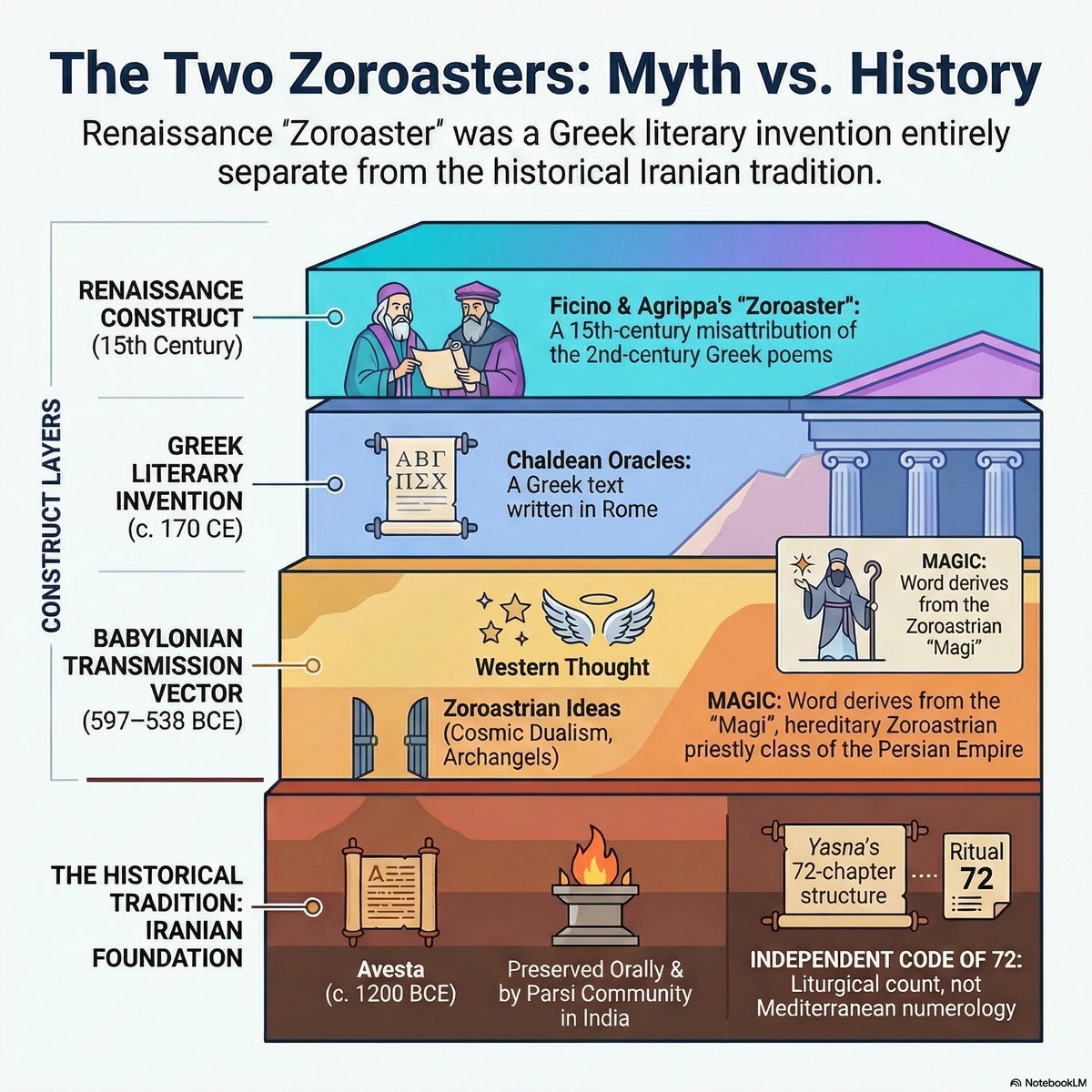
Every Renaissance magician cited Zoroaster as the father of ancient wisdom. None of them were reading Zoroaster. They were reading the Chaldean Oracles — a 2nd-century Greek text that got falsely attributed to the Persian prophet in 1438 and then passed through Ficino, Pico, and the entire Hermetic revival as authentic ancient Persian theology. Meanwhile, the actual Zoroastrian tradition — the Avesta, the Yasna, the living Parsi faith — followed a completely separate transmission path through Sassanid compilation and Indian preservation, and had nothing to do with any of it. This episode untangles the real Zoroaster from the fake one, traces how Zoroastrian dualism and angelology genuinely influenced Jewish thought during the Babylonian captivity, and confirms that the 72-chapter structure of the Yasna is an independent liturgical construction — not a link to Western occult numerology.
Show Notes
- The Chaldean Oracles — A 2nd-century CE Greek philosophical text, likely composed by Julian the Theurgist. Falsely attributed to Zoroaster in 1438 by George Gemistos Plethon, who brought it to Florence and launched its career as a foundational text of Renaissance magic.
- The 1438 Misattribution — Plethon presented the Chaldean Oracles to Italian scholars as authentic Zoroastrian wisdom. Ficino and Pico built on this attribution, placing "Zoroaster" at the head of the prisca theologia — the chain of ancient sages. The entire pedigree rests on a pseudepigraphon.
- The Real Avestan Tradition — The actual Zoroastrian scriptures were compiled during the Sassanid period (3rd-7th century CE) from older oral traditions. After the Arab conquest of Persia, the tradition survived primarily through the Parsi community in Gujarat, India. It has its own scholarship, its own transmission history, and no connection to the Renaissance Hermetic project.
- The Yasna's 72 Chapters — The central Zoroastrian liturgical text contains exactly 72 chapters. The numerical analysis confirms this is an independent liturgical construction — the number reflects the structure of the ritual calendar, not a shared signal with the 72 demons of the Goetia or the 72 Names of God.
- Zoroastrian Influence on Judaism — The genuine historical influence: during the Babylonian captivity (6th century BCE), Jewish thought absorbed Zoroastrian concepts of cosmic dualism, angelology, resurrection, and a final judgment. These ideas entered Judaism through direct cultural contact, not through texts.
- Pseudepigraphy as Pedigree — The Zoroaster case is a textbook example of Mode 1 concealment: a text gains authority not through its actual content but through its attributed author. The Chaldean Oracles became powerful because they carried the name of Zoroaster, not because they contained Zoroastrian thought.
- Two Separate Histories — The episode's core distinction: there is a Greek pseudepigraphon that powered Western esoteric pedigrees, and there is a historical Iranian faith with its own survival story. They share a name. They share almost nothing else.
Sources & References
- Chaldean Oracles (2nd century CE) — attributed to Julian the Theurgist
- George Gemistos Plethon — presentation at Council of Florence (1438-1439)
- The Yasna — 72-chapter Zoroastrian liturgical text
- Mary Boyce — Zoroastrians: Their Religious Beliefs and Practices (1979)
- Ruth Majercik — The Chaldean Oracles: Text, Translation, and Commentary (1989)
- Marsilio Ficino — prisca theologia framework
Maxwell's Pendulum: The Plan
Research Brief
Summary
Zoroastrianism is the deepest test the Plan has attempted in the Iranian/Persian direction. The central question is precise: when Ficino, Pico, and Agrippa cited "Zoroaster" at the head of their prisca theologia, were they transmitting genuine Zoroastrian doctrine, or were they transmitting a late antique Greek pseudepigraphon that bore the name "Zoroaster" but had no meaningful contact with the actual Iranian religious tradition? The answer is unambiguous. The Renaissance "Zoroaster" is almost entirely a product of the Chaldean Oracles, a set of roughly 227 surviving hexameter fragments composed in Greek around 170 CE by Julian the Chaldean and his son Julian the Theurgist, subsequently adopted as quasi-scripture by the Neoplatonists Iamblichus and Proclus, preserved in an 11th-century Byzantine manuscript by Michael Psellos, and then attributed to Zoroaster for the first time by George Gemistos Plethon at the Council of Florence in 1438-1439. The attribution traveled from Plethon to Ficino to Pico to Agrippa to Francesco Patrizi, each generation inheriting the pseudepigraphic label without independent verification. The actual Zoroastrian tradition, centered on the Avesta and its 17 Gathas, traveled through an entirely separate transmission chain: oral preservation in the Achaemenid and Parthian periods, Sassanid-era compilation, near-destruction in the Arab conquest of 637-651 CE, and survival via the Parsi community in Gujarat. These two "Zoroasters" never intersected. The Renaissance figure is a Greek construction; the historical tradition is an Iranian one. This is the same structural finding as the Van Bladel correction in Round 10: the label and the content traveled by different routes.
The distance test for Tier 1 signatures (126, 154, 216) returns the expected result: absence. Zoroastrian material produces no new Tier 1 hits. The Yasna's 72-chapter structure is the most significant numerical finding, but 72 is already classified as a Constructed Number in the Plan's framework, and the evidence suggests the Yasna's 72 is an independent liturgical count rather than part of the same design tradition that produced the Goetia's 72 demons or the Septuagint's 72 translators. Zoroastrianism's most consequential contribution to the Plan's genealogy is not numerical but conceptual: the Babylonian captivity vector (597-538 BCE) transmitted Zoroastrian ideas about cosmic dualism, angelology, and eschatology into Jewish thought, establishing a Persian substrate beneath the Book of Watchers and the apocalyptic tradition that the Plan has been tracking since its earliest rounds.
1. Zoroaster and the Prisca Theologia
The prisca theologia is the Renaissance doctrine that a single divine wisdom was transmitted through a chain of ancient sages before arriving at Plato. Ficino, drawing on late antique sources, constructed the standard version of this chain: Zoroaster, Hermes Trismegistus, Orpheus, Pythagoras, Plato.1 Zoroaster sits at the head of the sequence, the first link, the putative origin of all subsequent esoteric transmission. This is the position that needs to be tested.
What Ficino Actually Cited
Ficino's knowledge of "Zoroaster" came through two channels. The first was the Chaldean Oracles, which he received via the Greek manuscript tradition that Plethon brought to Florence. The second was a set of general attributions in Pliny the Elder, Diogenes Laertius, and other ancient encyclopedists who listed Zoroaster as the inventor of "magic" (magia), a claim that derived from the Greek semantic drift of the term "magus" rather than from any specific Zoroastrian text.2 Ficino did not read Avestan. He did not possess any Avestan text. He had no access to the Gathas, the Yasna, or any other component of the actual Zoroastrian scriptural corpus. His "Zoroaster" was entirely a creature of the Greek literary tradition.
What Pico Actually Cited
Pico della Mirandola's 900 Theses (1486) included a section of conclusions "according to the theology of Zoroaster and his Chaldean commentators."3 In his Perugia period, Pico reportedly received "Chaldean books...of Esdras, of Zoroaster and of Melchior, oracles of the magi, which contain a brief and dry interpretation of Chaldean philosophy, but full of mystery."4 His Kabbalist theology in the Conclusions drew from "gentile wisdom of ancient theologians including Orpheus, Pythagoras, Zoroaster and Chaldean prophets."4 One of Pico's conclusions states that "a saying of Zoroaster can be explained from the mind of Proclus, according to which it is read among the Greeks, although among the Chaldeans it is read differently."4 This is revealing: Pico acknowledges that his "Zoroaster" is the version "read among the Greeks," which is the Chaldean Oracles as filtered through Neoplatonic commentary. He knows this is a mediated text. But his system requires the Zoroastrian attribution to remain intact because the prisca theologia's authority depends on its antiquity, and Zoroaster was understood to be older than Hermes.
What Agrippa Actually Cited
Cornelius Agrippa's De Occulta Philosophia (1531/1533) names Zoroaster among the founders of magic: "Zamolxis and Zoroaster...were so famous that many believed they were the inventors of magic."5 Agrippa's treatment is encyclopedic rather than textually specific. He draws on Ficino's prisca theologia framework and on the accumulated attributions from ancient sources. He cites Zoroaster alongside Pythagoras, Ptolemy, Plato, and Aristotle as sources for his tripartite system of natural, celestial, and intellectual magic.5 But like Ficino and Pico, Agrippa had no direct contact with any Zoroastrian scripture. His "Zoroaster" is the same Greek literary figure.
The Plethon Attribution: The Critical Link
The pseudepigraphic attribution of the Chaldean Oracles to Zoroaster can be traced to a specific moment. George Gemistos Plethon (c. 1355-1452/1454), the Byzantine Neoplatonist, attended the Council of Florence in 1438-1439 as part of the Byzantine delegation negotiating Church union.6 During the council, when his services were not needed for theological debate, Plethon gave lectures on Plato, Aristotle, and the Chaldean Oracles.6 Plethon's manuscript of the Oracles originally belonged to Michael Psellos (1018-c.1078), the 11th-century Byzantine scholar who had preserved and commented on them.7
Plethon was the first Platonist to identify Zoroaster as the author of the Oracles.7 This attribution became "crucial for the reception and interpretation of the Oracles in Renaissance and modern esotericism."7 The chain is direct: Psellos preserved the text in Byzantine Constantinople; Plethon carried it to Florence and attached the Zoroastrian attribution; Ficino absorbed it into his prisca theologia; Pico cited it in his 900 Theses; the attribution propagated through every subsequent Renaissance magician who cited "Zoroaster."
The Chaldean Oracles were actually written in Rome around 170 CE by Julian the Chaldean and his son Julian the Theurgist.8 They are Greek hexameter verses presenting a hierarchical cosmology of divine fire, demiurgic intellect, and world-soul, heavily influenced by Middle Platonic philosophy. They have no meaningful connection to the Avestan tradition, to the Gathas, or to Zoroastrian ritual practice. The "Chaldean" label itself is a prestige attribution, associating the text with Babylonian/Persian wisdom without any demonstrable Babylonian or Persian content.8
Verdict on the Prisca Theologia's Zoroaster
The Renaissance "Zoroaster" is a pseudepigraphic projection. The Chaldean Oracles are a 2nd-century CE Greek text attributed to Zoroaster only from 1438 onward. The actual Zoroastrian tradition, based on the Avesta, traveled through an entirely separate channel. This is structurally identical to the Van Bladel correction in Round 10, which established that the Sabians of Harran transmitted astral theology and De Imaginibus, not the Corpus Hermeticum. Here, the correction is: the Chaldean Oracles transmitted Greek Neoplatonic cosmology in Zoroastrian packaging, not Zoroastrian content. The label traveled from Plethon; the content traveled from Julian the Theurgist. Two separate vectors, one misleading attribution.
2. The Chaldean Oracles: Structure and Neoplatonic Reception
The Chaldean Oracles survive only as fragments, roughly 227 hexameter lines preserved primarily in quotations by Neoplatonic commentators.8 No complete text survives. The fragments present a cosmological system in which the supreme deity (the "Father" or "Paternal Intellect") emanates a second intellect (the Demiurge), who in turn produces the material cosmos. The system includes a "fire" theology, a triadic structure of Father-Power-Intellect, and ritual instructions for theurgic ascent to the divine.9
The Neoplatonic Transmission Chain
The Oracles' reception among Neoplatonists was not uniform. Plotinus (204-270 CE) and Porphyry (c. 234-305 CE) accorded them limited significance.9 The decisive turn came with Iamblichus (c. 245-c. 325 CE), who "treated these 2nd century CE prophetic verses as scripture alongside Plato, using them to ground his theurgical system in divine revelation rather than philosophy alone."9 Iamblichus wrote an extensive commentary on the Oracles (now lost) and made their revealed theology integral to his thought.10 His advocacy of theurgy, the idea that ritual actions rather than philosophical contemplation alone could achieve union with the divine, was grounded in the Oracles' own instructions for ritual practice.
Proclus (412-485 CE) inherited and consolidated the Iamblichean position. He described theurgy as "a power higher than all human wisdom embracing the blessings of divination, the purifying powers of initiation and in a word all the operations of divine possession."9 By the 5th century, the Chaldean Oracles had achieved a status in Neoplatonic schools comparable to that of Plato's Timaeus: a foundational text defining the school's cosmology and ritual orientation.9 Proclus wrote a commentary on the Oracles (now lost, like Iamblichus's), and his surviving works contain extensive quotations that form one of our primary sources for reconstructing the text.39 The Pseudo-Dionysius the Areopagite (late 5th/early 6th century), whose works profoundly influenced medieval Christian mysticism, adopted theurgic terminology from the Chaldean Oracles via Proclus, creating a channel through which Neoplatonic ritual vocabulary entered Christian theological discourse.40
The Byzantine preservation followed. Michael Psellos (1018-c. 1078), the polymathic Byzantine scholar, collected and commented on the Oracles in two treatises, producing the manuscript tradition that would carry them into the Renaissance.7 Psellos treated the Oracles as philosophical curiosities rather than as scripture; his commentaries analyze their cosmological claims without the reverence that Iamblichus and Proclus had shown.41 Critically, Psellos did not attribute the Oracles to Zoroaster; that was Plethon's innovation, and it transformed a learned Byzantine antiquarian exercise into the foundational text of the Renaissance prisca theologia.
The Chaldean Oracles' transmission chain is thus: Julian the Chaldean/Julian the Theurgist (Rome, c. 170 CE) -> Porphyry and Iamblichus (3rd-4th c. CE, elevated to quasi-scriptural status) -> Proclus (5th c. CE, systematized within Neoplatonic theology) -> Pseudo-Dionysius (late 5th c., filtered into Christian mysticism) -> Psellos (11th c., Byzantine scholarly preservation) -> Plethon (1438-1439, Zoroastrian attribution added) -> Ficino, Pico, Patrizi (Renaissance reception). At no point in this chain does anyone with knowledge of the Avestan tradition participate. The text is Greek throughout.
Patrizi's Expansion
Francesco Patrizi (1529-1597) gave the Oracles their most ambitious Renaissance treatment. His Nova de universis philosophia (1591) was structured around four parts: Panaugia (on light), Panarchia (on first principles), Pampsychia (on souls), and Pancosmia (on mathematics and natural science).11 Patrizi expanded the collection of Chaldean Oracle verses from 60 to 320, published under Zoroaster's name as the first appendix to his work.11 He calculated that Zoroaster lived 1,758 years before the death of Plato, placing him around 2,105 BCE, a figure that served his argument for the extreme antiquity of the prisca theologia.11 The work was placed on the Index shortly after publication.12
Patrizi's edition is significant for the Plan because it represents the terminal point of the pseudepigraphic chain: by 1591, the "Zoroastrian" attribution had generated a 320-verse compendium presented as the founding scripture of Western philosophy. The inflation from Plethon's handful of fragments to Patrizi's 320 verses shows the attribution producing textual growth: once the label was attached, material accumulated around it.
The English reception came later. Thomas Stanley's 1661 edition, "The Chaldaick Oracles of Zoroaster," brought the material into English for the first time, drawing on Patrizi's collection and the Byzantine manuscript tradition.42 Stanley's edition was consulted by the Cambridge Platonists and later by Thomas Taylor (1758-1835), whose translations of Neoplatonic texts formed the primary English-language access point to this material through the 19th century.43 By this point, the pseudepigraphic attribution was so deeply embedded that only the emergence of modern philological criticism in the 19th century began to disentangle the Chaldean Oracles from genuine Zoroastrian literature.
3. The Historical Zoroastrian Tradition
The Avesta
The Avesta is the Zoroastrian sacred text corpus, surviving in a redaction that represents roughly one-quarter of the Sassanid-era compilation.13 Its major divisions are:
The Yasna (72 chapters, called hāitis), the primary liturgical text, containing prayers, hymns, and ritual instructions. Within the Yasna are embedded the 17 Gathas (Yasna 28-34, 43-51, 53), the oldest texts in the Avestan corpus, attributed directly to Zoroaster himself and composed in Old Avestan, a language closely related to Rigvedic Sanskrit.13 The Gathas are the only texts with a plausible claim to represent Zoroaster's own words.
The Visperad (extensions to the Yasna for seasonal festivals), the Vendidad (also Videvdat, the priestly code dealing with purity laws and mythological material), the Yashts (hymns to individual divine figures), and the Khorda Avesta (a compilation of shorter prayers for daily use).13
The 72-Chapter Structure
The Yasna's 72-chapter count is directly relevant to the Plan's treatment of 72 as a Constructed Number. The Plan has tracked three prior instances of 72: the Septuagint was translated by 72 scholars (per the Letter of Aristeas), Pico's 900 Theses divide into groups with numerological significance including 72, and the Goetia adjusted its demon count from 69 to 72 to match the Shem HaMephorash's 72-letter divine name.14
Is the Yasna's 72 independently generated or part of the same design tradition? The evidence points toward independent generation. The Yasna is described as "composed at different times and by different authors," the product of "editorial work of scholar-priests whose goal it was to create a unified liturgical text."15 One scholarly analysis explains the 72 as "the result of two cycles in the long liturgy: one based on the number 6 (72 = 6 x 12), with high points in every third group of 6 (in the hāitis 18, 54 and 72), and a second one based on the number 9 (72 = 9 x 8)."15 The text may be "the product of a uniform editorial project drawing on inherited liturgical elements, or some sort of agglutinative process whereby over a long period of time the text was gradually expanded."15
This suggests the 72 is a liturgical-structural number generated by the internal logic of Zoroastrian ritual practice, not by contact with the Mediterranean numerological tradition that produced the Septuagint's 72 translators or the Goetia's 72 demons. The two 72s are convergent, not genealogically related. This is consistent with the Plan's existing classification: 72 is a Constructed Number, meaning it appears in systems where designers chose it rather than counted it. The Yasna's 72 appears to be a fourth independent instance of construction, strengthening the classification without requiring a transmission link.
Zoroaster's Dating
There is no scholarly consensus on the dating of Zoroaster. The range spans from approximately 1500 BCE to 600 BCE. Mary Boyce used linguistic and socio-cultural evidence to place Zoroaster between 1500 and 1000 BCE, based on the similarity between Old Avestan and Rigvedic Sanskrit (c. 1700-1100 BCE) and the Stone-Bronze Age pastoral society the Gathas describe.16 Others, using archaeological and historical evidence, argue for the early Achaemenid period (7th-6th centuries BCE).16 The current scholarly center of gravity is approximately 1000-1200 BCE, though this remains contested.17
For the Plan, the dating matters because it determines whether Zoroaster is chronologically prior to the earliest material in the Timeline (the Book of Watchers at "3rd c. BCE") by centuries or by a millennium. Either way, Zoroaster predates the Plan's tracked European window (1267-1637 CE) by a vast margin, placing him in the same deep-origin category as the Egyptian and Mesopotamian material.
The dating also matters for the Babylonian captivity vector. If Zoroaster lived c. 1100 BCE, then Zoroastrian religious concepts had roughly five centuries to develop and institutionalize before the Judean exiles arrived in Babylon in 597 BCE. If the later dating (c. 600 BCE) is correct, then Zoroaster would have been roughly contemporary with the exile itself, and the tradition the exiles encountered would have been a newer one. The earlier dating makes the transmission hypothesis more plausible, because a more established tradition is more likely to have shaped an encounter than a recently founded one.44
The Achaemenid Religious Context
The Achaemenid Empire (550-330 BCE) under Cyrus, Darius, and their successors practiced a form of Zoroastrianism that is imperfectly understood, because the Achaemenid inscriptions use general Iranian religious vocabulary rather than specifically Avestan terminology.45 Darius I's Behistun inscription invokes Ahura Mazda as the supreme deity but does not mention Zoroaster by name.45 The Persepolis Fortification Tablets, administrative records from the reign of Darius I, document offerings to various Iranian deities and mention the Magi as ritual specialists, confirming their institutional role.46 Whether Achaemenid religion was "Zoroastrian" in the strict sense of following Zoroaster's Gathas, or a broader Iranian polytheism in which Ahura Mazda was supreme, remains debated. For the purposes of the Plan, what matters is that the religious environment the Judean exiles encountered in the 6th-5th centuries BCE included the core Zoroastrian concepts (Ahura Mazda as supreme deity, cosmic conflict between truth and falsehood, Magi as a priestly class) regardless of the precise theological label.
Avesta Transmission History
The Avesta's transmission chain is a concealed-knowledge narrative in its own right:
Oral period (pre-Achaemenid through Achaemenid, before 330 BCE): The texts were transmitted orally within priestly lineages. No written Avestan texts from this period survive, and modern scholarship generally rejects pre-Sassanid written versions.18 The oral transmission was remarkably precise: the Gathas' complex meter and linguistic features were preserved across centuries of recitation.
Alexander's conquest (330 BCE) and the burning legend: The Denkard (9th century CE) states that Alexander "took the Zand and sent it to Rome, he burnt the Avesta, and divided the land of Iran among 90 heads of families."18 The Ardāy Wirāz Nāmag adds that the Avesta "had been placed in Pābak's (city of) Istaxr in the Fortress of Archives" and that Alexander "carried them off and burnt them."18 The Tansar-nāma claims Alexander burned "1200 ox-hides" of Zoroastrian scripture at Istaxr.18 However, there is no Achaemenid-era source supporting these claims. No physical evidence of pre-Sassanid written Avestan texts exists. Modern scholarship treats the burning legend as a later Zoroastrian tradition establishing Alexander as the archetype of the foreign destroyer, analogous to the role the Babylonian destruction of the Temple plays in Jewish historical memory.18
Parthian partial assembly (1st c. BCE to 3rd c. CE): Some compilation activity occurred, but the evidence is thin.
Sassanid compilation (3rd-7th centuries CE): The full Avesta was compiled under Sassanid royal sponsorship, traditionally associated with the high priest Tansar (under Ardashir I, r. 224-242 CE) and Adurbad Mahraspand (under Shapur II, r. 309-379 CE).19 The Sassanid Avesta is described in the Denkard as comprising 21 nasks (books), organized in three groups of seven, mirroring the 21-word Ahuna Vairya prayer.20
Arab conquest and aftermath (637-651 CE onward): Ctesiphon fell in March 637 CE after a siege of three months. The Battle of Nahavand (642 CE) effectively ended organized Sassanid military resistance.47 The last Sassanid emperor Yazdegerd III was killed in 651 CE in Merv, a fugitive in his own former empire.21 Zoroastrians were initially given dhimmi status as "People of the Book," but subsequent centuries brought systematic discrimination, the jizya tax, social stigmatization as najis (ritually impure), forced conversion, and destruction of fire temples.21 The transformation was not instantaneous: large-scale conversion to Islam occurred primarily between the 8th and 10th centuries, driven by economic incentives (tax relief for converts), social pressure, and periodic episodes of active persecution.48 Most of the 21-nask Avesta was lost during this period; only approximately one-quarter survives in the redaction we possess today.13
The scale of textual loss is difficult to overstate. Of the 21 nasks described in the Denkard, substantial portions of only three survive intact: the Yasna (nask 1), the Visperad (nask 2), and the Vendidad (nask 20).49 The remaining nasks are known only through the Denkard's summaries and occasional quotations in later Zoroastrian literature. This is comparable to losing three-quarters of the Hebrew Bible and reconstructing the missing portions from an encyclopedia's chapter summaries.
4. Zoroastrian Influence on Jewish Thought: The Babylonian Captivity Vector
This is potentially the most significant finding for the Plan's genealogy. The Babylonian captivity (597-538 BCE) placed the Judean elite in direct contact with the Zoroastrian religious world for roughly sixty years.
Historical Context
Nebuchadnezzar II deported the Judean elite to Babylon in two waves: 597 BCE (King Jehoiachin and the court) and 586 BCE (after the destruction of Solomon's Temple).22 In 538 BCE, Cyrus the Great conquered Babylon and issued the Edict of Cyrus permitting the Jews to return to Jerusalem and rebuild the Temple.22 Cyrus was a Zoroastrian, or at least a ruler who operated within Zoroastrian institutional structures. The Cyrus Cylinder, though its religious language is Babylonian rather than Zoroastrian, establishes that Cyrus presented himself as a restorer of religious traditions, not their destroyer.23
The exile period was formative for what became Second Temple Judaism. The synagogue as an institution may have originated during the exile as a substitute for Temple worship. The Torah may have received its final editorial shape during or shortly after this period. And several theological innovations that distinguish postexilic from preexilic Judaism have documented parallels in Zoroastrianism.
Specific Transmission Candidates
Cosmic dualism: Preexilic Israelite religion is generally described by scholars as henotheistic or monolatrous, with Yahweh as the supreme deity but without a developed theology of a cosmic adversary. Zoroastrianism, by contrast, is structured around the opposition of Ahura Mazda (Wise Lord) and Angra Mainyu/Ahriman (Destructive Spirit). The postexilic development of Satan as a distinct figure, moving from the "adversary" (ha-satan) of Job (a member of the divine court testing humans at God's direction) to the cosmic opponent of later apocalyptic literature, parallels the Zoroastrian model.24 Scholars identify Persian contact during and after the Babylonian exile as "a key factor in Satan's hardening into an opposition figure."24
Angelology: The Zoroastrian Amesha Spentas are six (or seven, counting Spenta Mainyu) divine emanations of Ahura Mazda: Vohu Manah (Good Mind), Asha Vahishta (Best Truth), Khshathra Vairya (Desirable Dominion), Spenta Armaiti (Holy Devotion), Haurvatat (Wholeness), and Ameretat (Immortality).25 With Ahura Mazda or Spenta Mainyu, they form a group of seven. The Jewish archangel system, which becomes prominent in postexilic literature, shows structural parallels: seven chief archangels (Michael, Gabriel, Raphael, Uriel, and others, with the count varying by source) corresponding functionally to the seven Amesha Spentas.26 The angels "Michael and Gabriel assumed bigger and more defined roles after the exile, and the concept of angels in Jewish books changed and became more complex."26
Eschatology: Preexilic Israelite religion lacked a developed eschatology. The dead went to Sheol, a "dull, Hades-like place."26 The postexilic period introduced bodily resurrection, final judgment, and a moralized afterlife with rewards and punishments. These concepts have well-developed Zoroastrian parallels: the Frashokereti (renovation of the world), the Chinvat Bridge (bridge of judgment), and the detailed eschatological timeline in which good triumphs over evil at the end of cosmic history.26
The Book of Watchers Connection
The Plan has tracked the Book of Watchers (1 Enoch 6-16) at "3rd c. BCE" in its Timeline. If the Zoroastrian-to-Jewish transmission through the Babylonian captivity vector is accepted, then the Book of Watchers' concealed-knowledge archetype (the Watchers descending to teach forbidden arts, their offspring the Nephilim bringing chaos, divine judgment and imprisonment) may have a Persian substrate. Scholarly analysis identifies "key parallels between the origin of evil narratives in both Zoroastrianism and the Book of the Watchers, with eschatological themes including final judgment significantly developed in both traditions, suggesting mutual influences."27 The cosmic dualism, the angelic hierarchies, and the apocalyptic framework that the Book of Watchers deploys are precisely the elements that scholarship has identified as Zoroastrian-influenced developments in postexilic Judaism.27
This does not mean the Book of Watchers is a Zoroastrian text. It means that the conceptual vocabulary it uses, the categories of angel and demon, forbidden knowledge and divine judgment, cosmic combat and eschatological resolution, was shaped by sixty years of direct contact between Judean exiles and Zoroastrian culture during the Babylonian captivity. The Plan's concealed-knowledge archetype, in this reading, has a Persian root that precedes its Jewish literary expression by two to three centuries.
Counterarguments and Scholarly Caution
The Zoroastrian-influence thesis is not universally accepted. Some scholars argue that the parallel concepts (dualism, angelology, eschatology) could have developed independently within the internal logic of Israelite religion, particularly in response to the trauma of exile and the destruction of the First Temple.50 Others note the difficulty of establishing direct textual dependence: the Gathas and the Book of Watchers do not share specific vocabulary or narrative motifs, only structural themes.50 The dating problem compounds the difficulty: if the Gathas are as late as some scholars argue (6th century BCE), then the Zoroastrian tradition may not have been sufficiently developed at the time of the exile to have served as a source.51
The most cautious scholarly position is that Zoroastrian concepts provided a "catalyst" or "template" for developments that were already latent within Israelite thought, rather than being the sole or direct cause of those developments.52 The exile placed a community under extreme stress in a new cultural environment; the concepts they developed in response may have drawn on Zoroastrian models without being copies of them. For the Plan's purposes, even this cautious formulation is significant: it means the conceptual architecture of Jewish apocalypticism, including the concealed-knowledge archetype, was shaped in part by contact with Iranian religious ideas, whether as direct borrowing or as catalytic influence.
5. The Magi: From Zoroastrian Priests to "Magic"
Etymology
The word "magic" derives from the Magi. Old Persian maguš designated the hereditary Zoroastrian priestly class.28 The term entered Greek as magos (μάγος), initially meaning a Persian priest or wise man. Herodotus (5th century BCE) described the Magi as a Median tribe that had become the priestly caste of the Persian Empire, responsible for sacrifices, dream interpretation, and divination.28 By the Hellenistic period, "magos" had undergone semantic drift: from Zoroastrian priest to any practitioner of Persian supernatural arts, then to any practitioner of supernatural arts whatsoever. The Latin derivatives "magus" and "magia" completed the transition, giving European languages their word for "magic."29
This etymology is consequential for the Plan. Every "magic" the Plan has tracked, from the Solomonic tradition through the grimoires to Agrippa's De Occulta Philosophia, etymologically traces to the Zoroastrian priesthood. The word itself is a fossil record of the transmission chain. When Agrippa titled his work On Occult Philosophy, he was using a vocabulary whose original referent was the ritual practice of Zoroastrian fire priests at the Achaemenid court.
The semantic drift was not innocent. As the Greek magos expanded from "Persian priest" to "supernatural practitioner," it carried with it an implicit claim that all supernatural knowledge originated in Persia. This is the linguistic basis for the prisca theologia's placement of Zoroaster at the head of the sage chain. The word itself argued the case before any Renaissance philosopher made it explicitly.53 Pliny the Elder, writing in the 1st century CE, opens his discussion of magic in Naturalis Historia XXX with the claim that Zoroaster was the first magician, a claim that subsequent writers repeated so often it became axiomatic.54 The word "magician" thus embeds a historical claim (Persian origin of supernatural knowledge) that the Renaissance thinkers inherited as an unexamined premise.
Historical Function
The Magi's historical function was specific: they were ritual specialists who maintained sacred fires, performed animal sacrifices, chanted liturgical texts (including the Yasna), interpreted dreams, and served as court astrologers.28 Their astronomical expertise was genuine. The Magi at the Parthian court were heirs of Babylonian mathematical astronomy, the same tradition that produced the sophisticated observational records and predictive methods that later reached Greece through figures like Berossus (3rd century BCE).30
The Magi in Matthew 2:1-12
The "wise men from the East" (magoi apo anatolon) who followed a star to Bethlehem are, in the scholarly consensus, Zoroastrian priest-astrologers from Persia or Parthia.31 Matthew's Gospel does not specify their number (the tradition of three comes from the three gifts: gold, frankincense, and myrrh), their names (Caspar, Melchior, and Balthasar are medieval additions), or their status as kings (that conflation comes from Psalm 72:10-11 and Isaiah 60:3, applied retrospectively).31
The placement of Zoroastrian practitioners at the birth of Christianity has implications for the Plan's network. When Dee, who worked within a Christianity-adjacent framework, cited Zoroaster among the ancient sages, he was invoking a figure whose representatives, per canonical scripture, had recognized the Christ. This lent the Zoroastrian inheritance a specifically Christian legitimacy that other pagan traditions could not claim. The Magi's presence in Matthew was, in effect, a scriptural warrant for the prisca theologia.
The Magi also connect to the Plan's astronomical thread. Their reported ability to identify and follow a celestial event (the "star") places them in the same tradition of astronomical expertise that the Plan has tracked through Brahe and Kepler at Rudolf's court.55 The Magi at the Parthian court were the direct heirs of Babylonian mathematical astronomy, the tradition that produced the precise observational records and predictive ephemerides that underpin Greek astronomy from Hipparchus onward.56 When Kepler calculated the triple conjunction of Jupiter and Saturn in Pisces in 7 BCE as a possible explanation for the Star of Bethlehem (in his 1614 De Vero Anno, published in the same year as the Plan's Fama Fraternitatis anchor date), he was, in a sense, completing a circle: a Rudolfine court astronomer applying mathematical techniques descended from Babylonian astronomy to explain an event attributed to Zoroastrian astronomer-priests.57
6. The Zoroastrian-Sabian Overlap
The Sabians of Harran, documented in Rounds 9-10, operated in the same Mesopotamian-Persian sphere as the Magi. Harran sits on the border of the old Seleucid/Parthian territories, in upper Mesopotamia, a zone where Babylonian, Persian, and Greek cultural traditions intersected for centuries.32
Shared Territory, Distinct Traditions
The Sabians' planetary temple system, in which temples were dedicated to the seven classical planets and astral worship formed the core of religious practice, has documented parallels with both Babylonian religion and Zoroastrian cosmology.32 The seven planetary deities worshipped at Harran are primarily Babylonian in origin (Sin, Shamash, Ishtar, Nabu, Nergal, Marduk, Ninurta), but the framework of seven as a cosmic governance structure also appears in Zoroastrian thought, where the seven Amesha Spentas serve as cosmic governors alongside Ahura Mazda.25
The question is whether the Sabians' astral theology shows specifically Zoroastrian influence or whether both traditions draw independently on the common Mesopotamian substrate. The evidence points toward the latter: Harran's astral religion appears to be a survival of Babylonian astral worship that persisted into the Islamic period, with Zoroastrian elements present as overlay rather than foundation.32 Thabit ibn Qurra's De Imaginibus, the key talismanic text in the Plan's transmission chain, draws on Babylonian astrological technique rather than on Zoroastrian ritual practice.
This finding parallels the Van Bladel correction from Round 10 but extends it. Van Bladel established that the Sabians transmitted astral theology, not the Corpus Hermeticum. The Zoroastrian test now establishes that the Sabian astral theology itself was primarily Babylonian rather than Zoroastrian. The three traditions (Babylonian, Zoroastrian, Sabian) operated in overlapping geographic territory but maintained distinct theological cores. The Plan's transmission chain from Harran, specifically De Imaginibus, traces back to Babylonian mathematical astronomy and astral religion, not to Zoroastrian fire worship or Avestan cosmology.58 The Zoroastrian contribution to the Mesopotamian religious landscape was real but operated through different channels than the ones the Plan has been tracking.
Zurvanite Zoroastrianism
Zurvanism, a Sassanid-era variant of Zoroastrianism (approximately 226-651 CE), posited a supreme deity Zurvan (Time/Fate) above both Ahura Mazda and Angra Mainyu.33 Where orthodox Zoroastrianism treats Ahura Mazda as the one uncreated god, Zurvanism made him one of a pair of twins born from Zurvan's primordial unity. This was considered heretical within Zoroastrianism because it undermined both the supreme status of Ahura Mazda and the doctrine of free will.33
Zurvanism's relevance to the Plan lies in its cosmological structure. Zurvan's worship "is bound up with speculations about astrology and the world-year," possibly reflecting "contact between Zoroastrianism and Greco-Babylonian astrological speculations."34 Zurvanism emphasized planetary governance and fate, themes that overlap with the Sabians' astral theology. However, Zurvanism "enjoyed royal sanction during the Sassanid era (226-651 CE) but no traces of it remain beyond the tenth century."33 Its influence on the Sabian tradition, if any, would need to be documented through textual evidence that does not currently exist. The connection remains plausible but undemonstrated.
7. Numerical Density Test
Methodology
Apply the Plan's standard density test: search for appearances of 126, 154, and 216 in Zoroastrian structural numbers, date intervals against the Plan's anchor dates (1267, 1421, 1614, 1637), and Zoroastrian cosmological numbers.
Structural Numbers of the Avesta
The primary structural numbers in the Avestan corpus are:
- 72: chapters of the Yasna (addressed above as Constructed Number)
- 17: Gathas within the Yasna
- 21: nasks of the Sassanid Avesta, organized in three groups of seven20
- 5: major divisions of the surviving Avesta (Yasna, Visperad, Vendidad, Yashts, Khorda Avesta)
- 30: Yashts in the Yasht collection
- 22: chapters of the Vendidad
None of these (17, 21, 5, 30, 22) are Tier 1 signatures. 22 is Tier 4 vocabulary (the Hebrew alphabet's letter count, the Major Arcana count). 21 is Tier 4 (Tarot's Major Arcana excluding The Fool in some counting systems, and the blackjack number). Neither produces a Tier 1 hit.
Date Intervals
Testing Zoroastrian historical dates against the Plan's anchor dates:
Zoroaster's estimated date (using the scholarly center of gravity, c. 1100 BCE): - 1100 BCE to 1267 CE = 2,367 years - 1100 BCE to 1421 CE = 2,521 years - 1100 BCE to 1614 CE = 2,714 years - 1100 BCE to 1637 CE = 2,737 years
None produce 126, 154, or 216.
Fall of the Sassanid Empire (651 CE): - 651 to 1267 = 616 - 651 to 1421 = 770 - 651 to 1614 = 963 - 651 to 1637 = 986
No Tier 1 hits.
Alexander's conquest of Persia (330 BCE): - 330 BCE to 1267 CE = 1,597 - 330 BCE to 1421 CE = 1,751 - 330 BCE to 1614 CE = 1,944 - 330 BCE to 1637 CE = 1,967
No Tier 1 hits.
Plethon's Zoroaster attribution at Florence (1439 CE): - 1439 to 1267 = -172 (Plethon is later) - 1439 to 1421 = 18 (Tier 4 vocabulary) - 1439 to 1614 = 175 - 1439 to 1637 = 198
No Tier 1 hits. The 18-year interval to 1421 is Tier 4 only.
Patrizi's Nova de universis philosophia (1591): - 1591 to 1267 = -324 - 1591 to 1421 = -170 - 1591 to 1614 = 23 - 1591 to 1637 = 46
No Tier 1 hits.
Composition of the Chaldean Oracles (c. 170 CE): - 170 to 1267 = 1,097 - 170 to 1421 = 1,251 - 170 to 1614 = 1,444 - 170 to 1637 = 1,467
No Tier 1 hits.
Cyrus's Edict / End of Babylonian Captivity (538 BCE): - 538 BCE to 1267 CE = 1,805 - 538 BCE to 1421 CE = 1,959 - 538 BCE to 1614 CE = 2,152 - 538 BCE to 1637 CE = 2,175
No Tier 1 hits.
Zoroastrian Cosmological Numbers
Zoroastrian cosmology operates on a 12,000-year cosmic cycle divided into four ages of 3,000 years each.35 The Bundahishn describes six primordial creations: sky, water, earth, plants, animals, and humanity.35 Three saviors (Ushidar, Ushidar-mah, and Saoshyant) appear at 1,000-year intervals in the final age.35
Key cosmological numbers: 12,000 (cosmic total), 3,000 (world-age), 6 (creations), 7 (Amesha Spentas including Spenta Mainyu), 21 (nasks, mirroring the Ahuna Vairya), 72 (Yasna chapters).
None of 12,000, 3,000, 6, or 7 are Tier 1 signatures. 7 is Tier 4 vocabulary.
Intra-Zoroastrian Intervals
- Gathas composition (c. 1100 BCE) to Chaldean Oracles composition (c. 170 CE) = approximately 1,270 years (close to 1,267 but this is the wrong kind of hit: it is a distance to an anchor date, not a structural number; and "approximately 1,270" is not 1,267)
- Cyrus's edict (538 BCE) to Alexander's conquest (330 BCE) = 208 years
- Alexander's conquest (330 BCE) to Sassanid compilation under Ardashir I (c. 230 CE) = approximately 560 years
- Sassanid compilation (c. 230 CE) to Arab conquest (651 CE) = approximately 421 years
No Tier 1 hits.
Density Test Verdict
Zero new Tier 1 signatures. Zoroastrianism produces no appearances of 126, 154, or 216 in its structural numbers, cosmological architecture, or date intervals against the Plan's anchor dates. This is the expected result based on the established pattern: the temporal geography thesis holds. Tier 1 signatures remain confined to the European chronological window (1267-1637 CE) and do not appear at origin points (Alexandria), relay stations (Harran), testing distances (Florence, Prague), or, now, the deep Persian/Iranian antiquity that the prisca theologia claims as its headwater.
The 72-chapter Yasna is the only notable numerical finding, and it strengthens the Constructed Number classification rather than producing a new Tier 1 hit.
8. The Concealed-Knowledge Dimension
The Arab Conquest as Knowledge-Destruction Event
The Arab conquest of Persia (637-651 CE) and its aftermath constitute a knowledge-destruction event comparable in scale to the fall of Alexandria's Library, though distributed over centuries rather than concentrated in a single catastrophe. The Sassanid Avesta comprised 21 nasks; approximately three-quarters are now lost.13 Fire temples were destroyed or converted to mosques. The priestly class that maintained the oral and written tradition was dispersed or forced to convert.21
In the Plan's concealed-knowledge taxonomy, this is best classified as Mode 6 (involuntary concealment through external force). The Zoroastrian community did not choose to conceal its texts; the texts were destroyed or scattered by a conquering power that imposed a different religious framework. This parallels the Swedish looting of Rudolf's Kunstkammer in 1648 (Mode 6, as classified in Round 13), though at a vastly larger scale and with religious conversion rather than military plunder as the primary mechanism.
The Parsi Dispersal
The Parsi community represents the survival vector. The Qissa-i Sanjan ("Story of Sanjan"), composed in 1599 CE by the Parsi priest Bahman Kaikobad, narrates the migration: after the fall of the Sassanid Empire in 642 CE, Zoroastrian refugees departed from Greater Khorasan, spent 15 years at a port near Bushire, then sailed for India, spent 19 years on the island of Div in southern Saurashtra, and finally landed in Gujarat.36 The dating of the actual arrival is estimated between the 8th and 10th centuries CE.36
The Parsi community preserved the surviving Avestan texts, maintained fire temples, and transmitted the priestly traditions that the Arab conquest had disrupted in Iran. This is a Mode 1 (voluntary concealment/preservation) response to a Mode 6 event: the community deliberately preserved and transported its sacred knowledge in response to external destruction. The structure is identical to the Plan's Rosicrucian vault model (concealed preservation of a tradition threatened by external forces), except that the Parsi case is historically documented rather than mythological.
The Parsi preservation was remarkably successful within its limitations. The community maintained the liturgical use of Avestan, a language no longer spoken in daily life, for over a millennium. The fire temples (atash behrams) in Gujarat and Mumbai continued the Zoroastrian ritual tradition without interruption.59 But the preservation was partial: the Parsis saved the texts they used in active liturgical practice (primarily the Yasna, Visperad, and Vendidad) while the non-liturgical nasks, already rare, were lost. This is a characteristic feature of Mode 1 preservation: the tradition selects for transmission the material it uses, not the material it merely possesses. The Denkard's summaries of lost nasks represent the awareness of what was not saved.60
The Qissa-i Sanjan's date of composition (1599 CE) places it within the Plan's European chronological window. This is coincidental but worth noting: the same year Giordano Bruno was arrested in Venice (1592, with his trial concluding in his execution in 1600), and seven years after Patrizi published his expanded "Zoroastrian" Chaldean Oracles (1591), the Parsi community in India was composing its foundational narrative about the preservation of actual Zoroastrian tradition. The two "Zoroasters," the pseudepigraphic European one and the genuinely preserved Iranian one, were both being actively constructed in text during the same decades, unaware of each other.61
The Denkard as a Recovery Text
The Denkard (9th-10th century CE) is a Zoroastrian encyclopedia that devotes its 8th and 9th books to describing the contents of the 21 nasks of the Avesta, including summaries of nasks that are no longer extant.20 It is "the single most valuable source of information on this religion aside from the Avesta."20 The Denkard is, in functional terms, a text whose primary purpose is to preserve the memory of a larger corpus that has been largely destroyed. It provides summaries, chapter outlines, and doctrinal descriptions of texts that its authors could still partially access but that they evidently feared would be lost entirely.
In the Plan's framework, the Denkard is a catalog of what was lost: a document that describes the shape of an archive it can no longer fully recover. This is the inverse of the Rosicrucian vault narrative. Where the Rosicrucian story claims a hidden archive exists and will someday be opened, the Denkard admits that the archive has been largely destroyed and attempts to preserve at least its outline. The Rosicrucian vault promises future recovery; the Denkard records past loss. Both are responses to the same structural problem: how to maintain a tradition when the physical texts that embody it are threatened or gone.
The Magi's Esoteric Knowledge
Ancient sources describe the Magi as possessing secret teachings transmitted within the priestly caste. Herodotus, Pliny, and later writers attribute various forms of hidden knowledge to the Magi: astronomy, dream interpretation, ritual technique, and knowledge of the cosmos.28 However, distinguishing genuine Magian esoteric practices from later Greek and Roman projections is methodologically difficult. The Greek literary tradition had strong incentives to attribute secret wisdom to exotic Eastern priests, and the "Magian wisdom" described in Greek sources may reflect Greek fantasies about Persian priesthood as much as actual Zoroastrian practices. The Chaldean Oracles themselves are an extreme example of this projection: a Greek text that claims Persian/Chaldean authority without possessing any demonstrable Persian or Chaldean content.
In the Plan's concealed-knowledge taxonomy, the Magi's alleged secret knowledge represents Mode 3 (pseudepigraphic concealment): the attribution of hidden wisdom to a priestly caste whose actual practices are poorly documented, allowing later traditions to fill the gap with their own content under the Magian label.
9. Flags for Diotallevi
-
72 as Constructed Number (fourth instance): The Yasna's 72-chapter count appears to be independently generated through liturgical-structural logic (6 x 12 and 9 x 8 cycles), not through contact with the Mediterranean tradition. If Diotallevi confirms this as a genuine fourth instance of the Constructed Number type, it strengthens the classification: 72 is a number that multiple independent traditions select as a structural organizer. The mechanism of selection differs (liturgical cycling in the Yasna, gematria in the Shem HaMephorash, textual inflation in the Goetia), but the result converges.
-
The seven-structure: Six Amesha Spentas plus Ahura Mazda (or plus Spenta Mainyu) equals seven. Seven archangels in postexilic Jewish tradition. Seven planetary deities at Harran. The Plan has 7 as Tier 4 vocabulary. Diotallevi should assess whether the convergence of Zoroastrian, Jewish, and Sabian seven-structures represents a single transmission chain or multiple independent appeals to the same organizational number.
-
21 nasks mirroring the 21-word Ahuna Vairya: This is a documented case of a structural number being chosen to match a pre-existing sacred text, which is the same mechanism as the Goetia's 72. The Sassanid editors organized the Avesta into 21 nasks because the Ahuna Vairya prayer has 21 words. This is construction, not counting.
-
12,000-year cosmic cycle: Zoroastrian cosmology operates on 4 x 3,000 = 12,000. The Plan does not currently track 12,000 or 3,000, but these are products of Tier 4 vocabulary (3 x 4 x 1,000 and 4 x 3 x 1,000). Diotallevi should assess whether this is significant or merely the unremarkable presence of small sacred numbers in cosmological frameworks.
-
Mode classification for the Arab conquest: I have provisionally classified the post-conquest Zoroastrian experience as Mode 6 (involuntary/external force) with a Mode 1 (voluntary preservation) response via the Parsi dispersal. Diotallevi should verify this is consistent with the taxonomy's definitions and assess whether any refinement is needed.
10. Flags for Round 15 (Porta Alchemica)
-
Fire symbolism: Zoroastrianism's central symbol is fire (Atar), understood as the embodiment of divine truth (Asha) and cosmic order.37 The European alchemical tradition is saturated with fire symbolism, from calcination to the philosophical furnace. If the Porta Alchemica (c. 1680) displays fire imagery, the Zoroastrian heritage of that imagery should be considered, though the transmission would be heavily mediated (Zoroastrian fire symbolism -> Greek descriptions of Magian fire worship -> Renaissance associations of Zoroaster with prismatic/fire wisdom -> alchemical fire symbolism).
-
The Magi as alchemical ancestors: The Greek word for "magic" derives from the Magi, and the European alchemical tradition consistently traced its origins to ancient Eastern sources, including Persian ones. Carl Jung noted the connection between the Zoroastrian Haoma tree (growing in the cosmic ocean) and the Arab alchemical philosophical tree.38 Francis Barrett (18th century) explicitly credited Zoroaster with influencing alchemy.38 If the Porta Alchemica's symbols include references to "Zoroaster" or to Magian wisdom, this would be the pseudepigraphic Zoroaster (the Chaldean Oracles tradition) rather than the historical one.
-
Planetary deities: Zurvanism's emphasis on planetary governance and the seven-planet structure has parallels in alchemical planetary metal correspondences (Sun/gold, Moon/silver, Mars/iron, Mercury/quicksilver, Jupiter/tin, Venus/copper, Saturn/lead). The Porta Alchemica, if it features planetary symbols, would be drawing on a tradition whose deep roots include both Babylonian astral religion and Zurvanite Zoroastrian cosmology, though the proximate sources would be the standard European alchemical repertoire.
Footnotes
-
Hanegraaff, Wouter J. "Esotericism and the Academy: Rejected Knowledge in Western Culture." Cambridge University Press, 2012. See also the Stanford Encyclopedia of Philosophy entry on Ficino: https://plato.stanford.edu/entries/ficino/ ↩
-
Pliny the Elder, Naturalis Historia XXX.1-2, attributes the invention of magic to Zoroaster. Diogenes Laertius, Lives of the Eminent Philosophers, Proem 1-9. See overview at: https://en.wikipedia.org/wiki/Magi ↩
-
Pico della Mirandola, Conclusiones, 1486. Stanford Encyclopedia of Philosophy: https://plato.stanford.edu/entries/pico-della-mirandola/ ↩
-
Farmer, S.A. "Syncretism in the West: Pico's 900 Theses (1486)." See overview and analysis at: https://www.academia.edu/46239104/PICOS_900_THESES_TOWARDS_A_NEW_EDITION See also: http://scihi.org/pico-della-mirandola-theses/ ↩↩↩
-
Agrippa, Heinrich Cornelius. De Occulta Philosophia Libri Tres (1531/1533). See online text at: https://www.esotericarchives.com/agrippa/agrippa1.htm See also overview at: https://publicdomainreview.org/essay/agrippa-occult-philosophy/ ↩↩
-
Plethon at the Council of Florence: see George Gemistos Plethon entry at Springer Nature Link: https://link.springer.com/rwe/10.1007/978-1-4020-9729-4_183 ↩↩
-
Stausberg, Michael. "The Chaldean Oracles of Zoroaster, Hekate's Couch, and Platonic Orientalism in Psellos and Plethon." Aries 6.2 (2006): 158-177. https://brill.com/view/journals/arie/6/2/article-p158_2.xml See also: https://www.academia.edu/199081/The_Chaldean_Oracles_of_Zoroaster_Hekate_s_Couch_and_Platonic_Orientalism_in_Psellos_and_Plethon ↩↩↩↩
-
Chaldean Oracles overview: https://en.wikipedia.org/wiki/Chaldean_Oracles See also Majercik, Ruth. "The Chaldean Oracles: Text, Translation, and Commentary." Brill, 1989. ↩↩↩
-
Iamblichus and the Neoplatonic reception: Stanford Encyclopedia of Philosophy: https://plato.stanford.edu/entries/iamblichus/ See also: https://en.wikipedia.org/wiki/Theurgy ↩↩↩↩↩
-
Stang, Charles M. "From the Chaldean Oracles to the Corpus Dionysiacum: Theurgy between the 3rd and 6th centuries." https://www.academia.edu/3482156/From_the_Chaldean_Oracles_to_the_Corpus_Dionysiacum ↩
-
Patrizi's Nova de universis philosophia and the Chaldean Oracles: Hankins, Valery. "Francesco Patrizi and the Oracles of Zoroaster." Prometheus Trust: https://prometheustrust.co.uk/article/francesco-patrizi-and-the-oracles-of-zoroaster-the-use-of-chaldean-oracles-in-nova-de-universis-philosophia/ See also: https://www.academia.edu/44727011/Francesco_Patrizi_and_the_Oracles_of_Zoroaster ↩↩↩
-
Francesco Patrizi, Stanford Encyclopedia of Philosophy: https://plato.stanford.edu/entries/patrizi/ ↩
-
Avesta structure and surviving portions: https://en.wikipedia.org/wiki/Avesta See also Encyclopaedia Iranica: https://www.iranicaonline.org/articles/yasna/ ↩↩↩↩↩
-
Plan internal reference: the-plan.md, Constructed Numbers section. ↩
-
Yasna structure and the 72-chapter count: https://en.wikipedia.org/wiki/Yasna See also Encyclopaedia Iranica YASNA entry: https://www.iranicaonline.org/articles/yasna/ See scholarly analysis in: https://www.cambridge.org/core/journals/iranian-studies/article/abs/how-many-chapters-does-the-yasna-of-the-seven-chapters-have/D11B16630E536AFB544DC05B532D7269 ↩↩↩
-
Mary Boyce on Zoroaster's dating: see Zoroastrians: Their Religious Beliefs and Practices (Routledge, 1979). Overview at: https://en.wikipedia.org/wiki/Zoroaster ↩↩
-
Encyclopaedia Iranica, "ZOROASTER ii. GENERAL SURVEY": https://www.iranicaonline.org/articles/zoroaster-ii-general-survey/ ↩
-
Alexander and the burning of the Avesta: Encyclopaedia Iranica, "ALEXANDER THE GREAT ii. In Zoroastrian Tradition": https://www.iranicaonline.org/articles/alexander-the-great-ii/ See also: https://www.worldhistory.org/Avesta/ ↩↩↩↩↩
-
Sassanid compilation of the Avesta: https://en.wikipedia.org/wiki/Sasanian_Avesta See also: https://www.avesta.org/denkard/denkard.htm ↩
-
The Denkard and the 21 nasks: https://en.wikipedia.org/wiki/Denkard See also Britannica: https://www.britannica.com/topic/Denkart See detailed nask summaries at: https://www.avesta.org/denkard/dk9sbe.html ↩↩↩↩
-
Arab conquest of Persia and Zoroastrian persecution: https://en.wikipedia.org/wiki/Persecution_of_Zoroastrians See also Encyclopaedia Iranica: https://www.iranicaonline.org/articles/zoroastrianism-02-arab-conquest-to-modern/ See also: https://en.wikipedia.org/wiki/Muslim_conquest_of_Persia ↩↩↩
-
Babylonian captivity: https://www.britannica.com/event/Babylonian-Captivity See also: https://en.wikipedia.org/wiki/Babylonian_captivity ↩↩
-
The Cyrus Cylinder: British Museum collection. See: https://en.wikipedia.org/wiki/Return_to_Zion ↩
-
Development of Satan as opposition figure under Persian influence: "Satan Made Me Do It! The Development of a Satan Figure as Social-Theological Diagnostic Strategy." Scielo South Africa: https://scielo.org.za/scielo.php?script=sci_arttext&pid=S1010-99192017000200010 See also: https://scielo.org.za/scielo.php?script=sci_arttext&pid=S1017-04992013000300013 ↩↩
-
Amesha Spentas: https://en.wikipedia.org/wiki/Amesha_Spenta See also Britannica: https://www.britannica.com/topic/amesha-spenta ↩↩
-
Zoroastrian influence on Jewish angelology, eschatology, and afterlife concepts: https://efiretemple.com/from-amesha-spentas-to-archangels-zoroastrian-roots-of-islamic-angelology/ See also overview of scholarly consensus at: https://connectparanormal.net/2026/02/08/the-evolution-of-angels-from-zoroastrianism-to-abrahamic-faiths/ ↩↩↩↩
-
Book of Watchers and Zoroastrian parallels: "Zoroastrian Themes in the Book of the Watchers." https://www.academia.edu/50066309/Zoroastrian_Themes_in_the_Book_of_the_Watchers_ See also: https://www.cais-soas.com/CAIS/Religions/non-iranian/Judaism/Persian_Judaism/book5/pt4.htm ↩↩
-
Magi: etymology and historical function. https://en.wikipedia.org/wiki/Magi See also Britannica: https://www.britannica.com/topic/Magi ↩↩↩↩
-
Semantic drift from magus to magic: see New World Encyclopedia: https://www.newworldencyclopedia.org/entry/Magi ↩
-
Magi as heirs of Babylonian mathematical astronomy: see discussion in the context of the Star of the Magi at: https://www.academia.edu/3174862/The_Star_of_the_Magi_Lore_and_Science_in_Ancient_Zoroastrianism_the_Greek_Magical_Papyri_and_St_Matthews_Gospel ↩
-
Biblical Magi: https://en.wikipedia.org/wiki/Biblical_Magi See also: https://biblearchaeologyreport.com/2022/12/22/who-were-the-magi/ ↩↩
-
Sabians of Harran and the Mesopotamian-Persian sphere: Plan internal reference (Rounds 9-10). See also: https://en.wikipedia.org/wiki/Sabians ↩↩↩
-
Zurvanism: https://en.wikipedia.org/wiki/Zurvanism See also Britannica: https://www.britannica.com/topic/Zurvanism See also Encyclopaedia Iranica: https://www.iranicaonline.org/articles/zurvanism/ ↩↩↩
-
Zurvan and astrological speculation: https://www.newworldencyclopedia.org/entry/Zurvanism See also: https://www.cais-soas.com/CAIS/Religions/iranian/zurvanism.htm ↩
-
Zoroastrian cosmology: 12,000-year cycle and world ages. https://www.hinduwebsite.com/zoroastrianism/cycles.asp See also: https://www.hinduwebsite.com/zoroastrianism/cosmology.asp ↩↩↩
-
Parsi migration and the Qissa-i Sanjan: https://en.wikipedia.org/wiki/Qissa-i_Sanjan See also: https://en.wikipedia.org/wiki/Parsis ↩↩
-
Zoroastrian fire symbolism: https://efiretemple.com/zarathustra-the-first-flame-origins-and-historical-influences-of-zoroastrian-fire-symbolism/ See also Britannica on Zoroastrian practices: https://www.britannica.com/topic/Zoroastrianism/Practices-and-institutions ↩
-
Zoroastrianism and alchemy: Carl Jung on the Haoma tree and the alchemical philosophical tree; Francis Barrett on Zoroaster's influence on alchemy. See overview at: https://efiretemple.com/zarathustra-the-first-flame-origins-and-historical-influences-of-zoroastrian-fire-symbolism/ ↩↩
-
Proclus's quotations from the Chaldean Oracles in his surviving works (especially the Commentary on the Timaeus and Platonic Theology) are among the primary sources for reconstructing the lost text. See: https://plato.stanford.edu/entries/iamblichus/ and https://en.wikipedia.org/wiki/Chaldean_Oracles ↩
-
Stang, Charles M. "From the Chaldean Oracles to the Corpus Dionysiacum: Theurgy between the 3rd and 6th centuries." https://www.academia.edu/3482156/From_the_Chaldean_Oracles_to_the_Corpus_Dionysiacum ↩
-
Psellos's treatment of the Chaldean Oracles: see discussion in Stausberg (2006), note 7 above. Also: https://brill.com/view/journals/arie/6/2/article-p158_2.xml ↩
-
Stanley, Thomas. The Chaldaick Oracles of Zoroaster (1661). Text available at: https://www.esotericarchives.com/oracle/oraclesj.htm ↩
-
On Thomas Taylor's translations and their influence, see: https://en.wikipedia.org/wiki/Thomas_Taylor_(neoplatonist) ↩
-
On the relationship between Zoroaster's dating and the plausibility of transmission to exilic Judaism, see the discussion in: https://www.academia.edu/54910401/Discuss_the_question_of_Zoroastrian_influence_on_Judaism ↩
-
Achaemenid inscriptions and religion: Encyclopaedia Iranica, "ZOROASTER ii. GENERAL SURVEY": https://www.iranicaonline.org/articles/zoroaster-ii-general-survey/ See also: https://en.wikipedia.org/wiki/Zoroastrianism ↩↩
-
Persepolis Fortification Tablets and evidence for Magian ritual practice: see the overview in Boyce, Mary. "Zoroastrians: Their Religious Beliefs and Practices." Summary at: https://en.wikipedia.org/wiki/Magi ↩
-
Battle of Nahavand (642 CE): https://en.wikipedia.org/wiki/Muslim_conquest_of_Persia ↩
-
Gradual Islamicization of Persia: Encyclopaedia Iranica, "ZOROASTRIANISM ii. Historical Review: from the Arab Conquest to Modern Times": https://www.iranicaonline.org/articles/zoroastrianism-02-arab-conquest-to-modern/ ↩
-
Surviving nasks of the Avesta: https://en.wikipedia.org/wiki/Sasanian_Avesta See also Denkard summaries at: https://www.avesta.org/denkard/dk9sbe.html ↩
-
Scholarly caution on Zoroastrian influence: see discussion in "Discuss the question of Zoroastrian influence on Judaism": https://www.academia.edu/54910401/Discuss_the_question_of_Zoroastrian_influence_on_Judaism ↩↩
-
Dating problem and the transmission hypothesis: see the range of views summarized at: https://en.wikipedia.org/wiki/Zoroaster#Date ↩
-
"Catalyst" model of Zoroastrian influence on Judaism: see overview at: https://jeremypaytonbooks.com/2024/06/19/influence-zoroastrianism-early-christian-thought/ See also: https://www.thecollector.com/how-zoroastrianism-influenced-christianity/ ↩
-
On the linguistic embedding of the Persian-origin claim in the word "magic": see discussion at: https://www.newworldencyclopedia.org/entry/Magi ↩
-
Pliny the Elder, Naturalis Historia XXX.1-2. Text available at: https://www.perseus.tufts.edu/hopper/ ↩
-
On the Magi as astronomer-priests: https://biblearchaeologyreport.com/2022/12/22/who-were-the-magi/ ↩
-
Babylonian mathematical astronomy and its transmission to Greece: see the discussion of Berossus and the Chaldean astronomical tradition at: https://en.wikipedia.org/wiki/Babylonian_astronomy ↩
-
Kepler's De Vero Anno (1614) and the Star of Bethlehem: see Colin Humphreys, "The Star of Bethlehem" (1995). Overview of competing astronomical theories at: https://en.wikipedia.org/wiki/Star_of_Bethlehem ↩
-
On the distinction between Babylonian and Zoroastrian contributions to the Mesopotamian religious landscape, see the discussion of Sabian Harran in the context of broader Near Eastern astral religion: https://en.wikipedia.org/wiki/Sabians ↩
-
Parsi fire temples and liturgical continuity: https://en.wikipedia.org/wiki/Zoroastrianism_in_India ↩
-
On the selective nature of Parsi textual preservation (liturgical texts preserved, non-liturgical texts lost): https://en.wikipedia.org/wiki/Sasanian_Avesta ↩
-
The Qissa-i Sanjan's composition date (1599 CE) is documented at: https://en.wikipedia.org/wiki/Qissa-i_Sanjan The coincidence with Patrizi's 1591 publication is the present author's observation. ↩
-
On Kepler's 1614 publication and its relationship to the Fama Fraternitatis's publication in the same year: Plan internal reference, the-plan.md Timeline. ↩
-
Goodfellow, Caleb Stanton. "Restoring the Chapter Count of the Original Avesta." Zoroastrian Association: https://zoroastrian.org/wp-content/uploads/2025/07/Goodfellow-Restoring-the-Chapter-Count-of-the-Original-Avesta-final.pdf ↩
-
On the reception history of the Chaldean Oracles from antiquity to the Renaissance: Tanaseanu-Döbler, I. "Towards a Reception History of the Chaldaean Oracles." International Journal of the Classical Tradition (2020). https://link.springer.com/article/10.1007/s12138-020-00562-3 ↩
-
The six creations in Zoroastrian cosmology (sky, water, earth, plants, animals, humanity): https://www.hinduwebsite.com/zoroastrianism/cosmogony.asp ↩
-
Zoroastrian eschatology: the three saviors (Ushidar, Ushidar-mah, Saoshyant) and the Frashokereti: https://www.iranchamber.com/religions/articles/zoroastrian_myth_end.php ↩
-
The Bundahishn as primary source for Zoroastrian cosmological narrative: https://en.wikipedia.org/wiki/Bundahishn ↩
-
On Herodotus's description of the Magi as a Median tribe: Herodotus, Histories I.101. See: https://en.wikipedia.org/wiki/Magi ↩
-
The Chinvat Bridge (Bridge of Judgment) in Zoroastrian eschatology: https://en.wikipedia.org/wiki/Chinvat_Bridge ↩
-
On the Frashokereti (renovation of the world) as the Zoroastrian eschatological culmination: https://en.wikipedia.org/wiki/Frashokereti ↩
-
Medieval naming of the Magi (Caspar, Melchior, Balthasar): first documented in the 6th-century Excerpta Latina Barbari. See: https://en.wikipedia.org/wiki/Biblical_Magi ↩
-
On Zoroastrian-Christian contact in the early centuries CE, including Armenian Christianity's specific interactions with Zoroastrian institutions: https://en.wikipedia.org/wiki/Zoroastrianism ↩