The Black Pullet and Lost Knowledge
Listen
Open in Spotify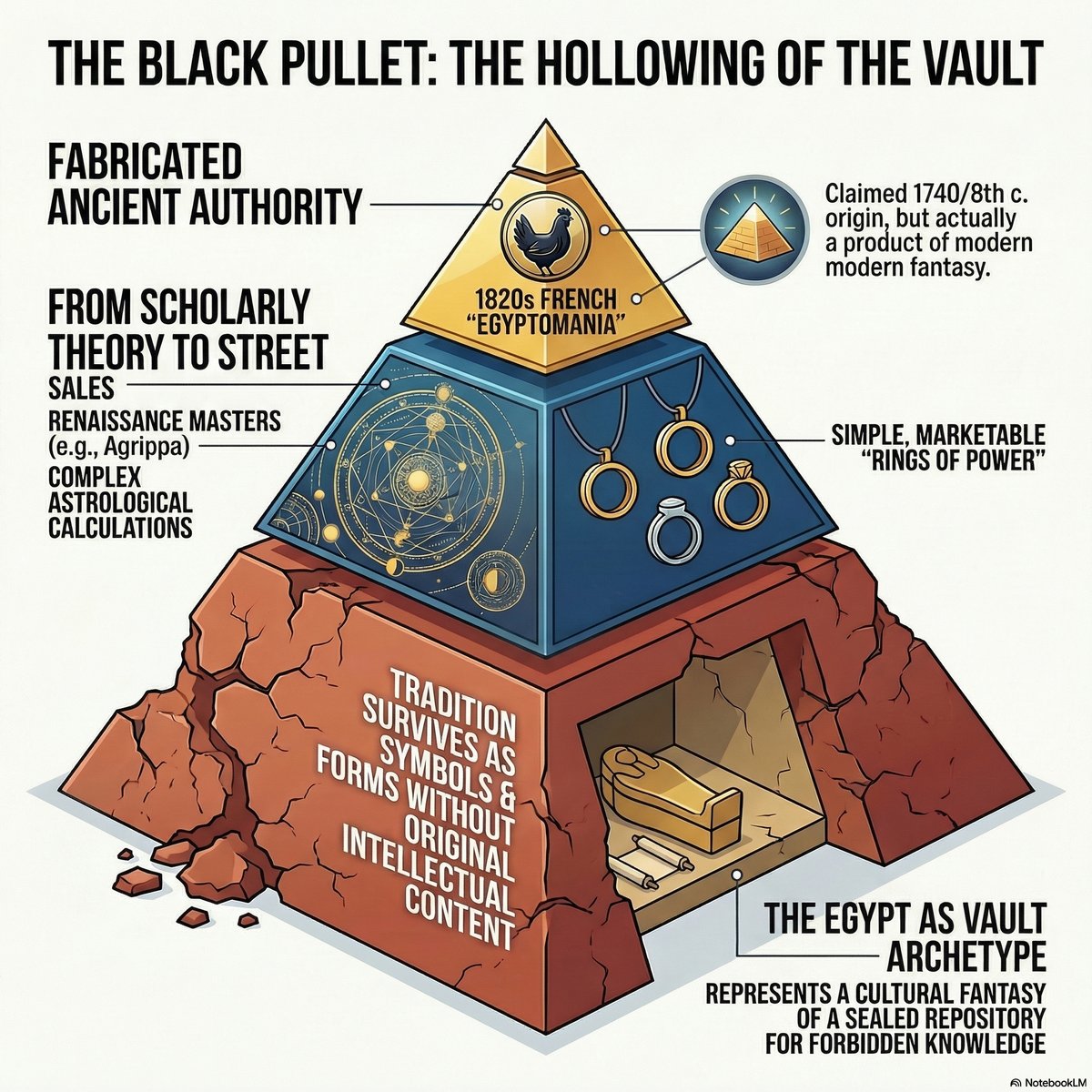
Show Notes
# EP012: The Black Pullet and Lost Knowledge
Summary
The Black Pullet is where the tradition ends — or at least where it stops being a tradition and becomes a product. Published around 1820 with a fake 18th-century imprint and a story set during Napoleon's Egyptian campaign, this French grimoire claims ancient authority it doesn't have. A mysterious sage in a pyramid reveals twenty rings and twenty-two talismans, playing the "Egypt-as-vault" archetype perfectly. But something critical is missing. The earlier grimoires — the Picatrix, the Solomonic keys — embedded their magic in complex astrological and Kabbalistic theory. The Black Pullet strips all of that out. It displays "cabalistic" symbols without the interpretive keys needed to read them. The surface forms of magic survived. The philosophical substance was forgotten. This is what diffusive knowledge loss looks like.
Show Notes
- The Black Pullet (La Poule Noire) — A French grimoire claiming an 18th-century origin but dated by scholars to approximately 1820. Uses a fictional narrative set during Napoleon's Egyptian campaign to establish provenance — a sage in a pyramid, a dying master, secret knowledge passed to a worthy student.
- The Egypt-as-Vault Archetype — The Black Pullet deploys the same structural myth as the Rosicrucian Fama Fraternitatis: hidden knowledge sealed inside an ancient chamber, waiting for the right person to open it. The pyramid replaces the vault, but the pattern is identical.
- Twenty Rings and Twenty-Two Talismans — The grimoire's core magical system. The numbers echo Kabbalistic frameworks (22 letters of the Hebrew alphabet), but the text provides no theoretical explanation for why these numbers matter. The structure survives; the meaning doesn't.
- Mode 8 Encipherment — The grimoire displays "cabalistic" symbols that look like they encode something, but omits the interpretive keys — the celestial correspondences and Hebrew letter mappings that would have made them functional in the earlier tradition. The cipher exists without the codebook.
- The Picatrix Comparison — Earlier talismanic works like the Picatrix embedded magical practice in rigorous astrological theory. Every talisman corresponded to specific planetary hours, celestial configurations, and material correspondences. The Black Pullet keeps the talismans and drops everything else.
- The Bibliothèque Bleue — The cheap popular print market of 18th-19th century France. The Black Pullet was a commercial product for this audience, transforming elite scholarly magic into mass-market entertainment. The transition from restricted manuscript to popular print is itself a mode of knowledge loss.
- Diffusive Knowledge Loss — The episode's core concept. Knowledge doesn't always disappear through destruction or suppression. Sometimes it survives in degraded form — the symbols without the system, the ritual without the theory, the surface without the substance. The Black Pullet is the case study.
Sources & References
- La Poule Noire (c. 1820) — attributed to a fictitious 1740 imprint
- Picatrix (Ghāyat al-Ḥakīm) — 10th-11th century Arabic talismanic text
- Owen Davies — Grimoires: A History of Magic Books (2009)
- Geneviève Bollème — La Bibliothèque bleue (1971)
- Fama Fraternitatis (1614) — the vault archetype
Maxwell's Pendulum: The Plan
Research Brief
Summary
The Black Pullet (La Poule Noire, also known as La Poule aux Oeufs d'Or, and in a companion text as the Black Screech Owl; sometimes grouped with the Grand Grimoire and Grimorium Verum as the three principal French popular grimoires) is a French talismanic grimoire whose earliest known edition dates to approximately 1820, not 1740 as its fictitious imprint claims. Its narrative frame -- a French officer in Napoleon's Egypt, an old Turkish man emerging from a pyramid, secret chambers filled with ancient manuscripts, a course in talismanic ring construction -- stages the grimoire tradition's final commercial act: the scholarly talismanic tradition from Thabit ibn Qurra through Agrippa has arrived in the Bibliothèque bleue. The text's Egyptian setting is not decorative. It places itself inside the recurring cultural fantasy of Egypt as vault: a sealed repository whose lower levels contain prohibited knowledge that cannot be reached through normal means. The Black Pullet's pyramid chamber stands alongside the Emerald Tablet's vault beneath the statue of Hermes, the Egyptian Labyrinth's forbidden underground rooms, and the Osiris Shaft's flooded lowest level as fictional or semi-fictional instances of the same archetype. Numerically, the grimoire adds a 20-ring count and a 22-talisman count that do not map onto tracked Plan signatures. Temporally, its actual composition date (c. 1820) places it outside the Plan's 1267-1637 window, confirming the window as closed and the tradition as transformed rather than continuing.
1. The Text and Its Publication History
The Black Pullet bears the title page imprint "Egypt, 740" -- an intentional misdirection suggesting origin in the ancient world or at least the early medieval period.1 Scholarly analysis confirms this as pseudepigraphic fabrication: the first known edition of La Poule Noire appeared in French around 1820, probably printed in Paris or Lille.2 The Lille connection involves the publisher Blocquel, who produced editions of popular occult material in the Bibliothèque bleue tradition.3 The "740" imprint was intended to evoke the 8th century, the era of Abbasid translation activity when Arabic scholars were systematically recovering Greek and Hermetic texts -- an epoch that lent mystical authority to any text claiming origin within it.4
The text appeared under multiple titles. La Poule Noire (The Black Hen) is the primary French title; La Poule aux Oeufs d'Or (The Hen with the Golden Eggs) emphasizes its promise of material wealth.5 The English title "The Black Pullet" is a translation of La Poule Noire that appeared in the 1870s English edition published by the bookseller Isidore Liseux.6 The text also circulated as part of a larger compilation including "Le Trésor du Vieillard des Pyramides" (The Treasure of the Old Man of the Pyramids), which expands on the talismanic instructions.7 A companion or alternate printing circulated under the title The Black Screech Owl (La Chouette Noire), described by Arthur Edward Waite as a "sequel or companion" to the main text.8
A.E. Waite discussed the Black Pullet in his 1898 Book of Ceremonial Magic, providing one of the earliest extended English-language analyses and noting its position within the late grimoire tradition.9 Waite was skeptical but thorough; his description confirms the text was in circulation by at least the 1870s in English-speaking occult circles. John Dee's Victorian inheritors -- the Hermetic Order of the Golden Dawn -- do not appear to have incorporated it into their curriculum, suggesting the Black Pullet occupied a lower prestige tier than the Solomonic grimoires they favored.10
The Black Pullet is typically grouped with two related texts in the French popular grimoire tradition: the Grand Grimoire (Le Dragon Rouge / The Red Dragon) and the Grimorium Verum. These three texts share a commercial publishing context and a general orientation toward practical magic rather than theoretical systematization, but they are not derived from each other.11 The Grand Grimoire focuses on demonic pacts and evocation of Lucifer; the Grimorium Verum on a system of spirits and their seals; the Black Pullet on talismanic rings and the golden hen. They represent three different approaches to the same popular market: the customer who wants power through magical means and has ten sous to spend on a chapbook. Black Letter Press sells all three together as "Grimoire Set I," which captures their commercial kinship if not their intellectual one.12
The 1820 dating is contested at the margins. Some sources have repeated the "18th century" attribution based on the fictional imprint, but no physical edition predating the Napoleonic period has been identified.13 The Napoleonic Egyptian campaign (1798-1801) provides the terminus post quem: the narrative is constructed around it, using specific details of the expedition that could not predate the campaign itself.14 The most probable scenario is composition in France shortly after the campaign, perhaps in the first decade of the 19th century, with publication in the 1810s or 1820s as Egyptomania crested in the wake of the Description de l'Egypte's publication.15
Modern editions include a Black Letter Press edition (2020) with translation and supplementary material from the Trésor du Vieillard des Pyramides, reviewed by grimoire scholar Dan Harms, who noted that the editor failed to specify which French editions were used to assemble the text -- a significant scholarly gap.16 The Ibis Press edition, published as "The Black Pullet: Science of Magical Talisman," has been the most commonly circulated English version.17 A "Kabbalistic Grimoire Series No. 2" edition edited by Darcy Kuntz and Gryffon Turner appeared from Holmes Publishing.18
2. The Egyptian Context
Napoleon Bonaparte's Egyptian campaign of 1798-1801 was accompanied by 167 scientists, scholars, and artists tasked with documenting Egypt's geography, monuments, natural history, and antiquities.19 This "Commission des Sciences et des Arts" or corps of savants included mathematicians, chemists, engineers, naturalists, linguists, archaeologists, and artists. Napoleon himself was a member of the Institut d'Egypte, established in Cairo in August 1798 with Gaspard Monge as president.20 The intellectual ambition of the campaign was genuine: the savants produced the Description de l'Egypte, a multi-volume encyclopedic documentation of Egypt published between 1809 and 1829, described as one of the most important scholarly works on ancient Egypt ever produced.21
The Rosetta Stone was discovered on July 19, 1799, by Lieutenant Pierre-François Bouchard at the village of Rosetta (Rashid) in the Nile delta.22 The Stone contained the same decree written in three scripts: Greek, Egyptian hieroglyphic, and Egyptian demotic. French engineers and scholars recognized its decipherment potential immediately; impressions were distributed to European scholars before the British took physical possession following Napoleon's military defeat.23 Jean-François Champollion (1790-1832) completed the decipherment in 1822, opening the entire corpus of ancient Egyptian writing for the first time in roughly fourteen centuries.24
The campaign catalyzed an Egyptomania across Europe that persisted through the first half of the 19th century.25 Egyptian motifs appeared in architecture, furniture, jewelry, and decorative arts. The pyramid became a shorthand for ancient secrets, hidden knowledge, and initiation. Napoleon's campaign had, in the popular imagination, cracked open a sealed archive -- and what spilled out was not merely monuments and artifacts but the promise that the archive was not yet fully disclosed.
The Black Pullet inserts itself into this cultural moment with precision. Its unnamed French officer is a veteran of the Egyptian campaign; his unit is ambushed by Bedouins, and he is the sole survivor.26 An old Turkish man emerges from the pyramids and takes the officer to a secret apartment within a pyramid, where he has lived studying "ancient manuscripts that escaped the burning of Ptolemy's library" -- an explicit invocation of the Library of Alexandria as the concealed-knowledge archive that partially survived its nominal destruction.27 The officer is taught the construction and use of 20 talismanic rings and their corresponding talismanic figures, and is shown the secret of the Black Pullet herself: a hen that, properly commanded, lays golden eggs.28
This narrative is the Egypt-as-vault archetype in its most explicit popular form. It requires comparison with three other instances the Plan has been tracking:
The Emerald Tablet vault narrative: The earliest Arabic framing of the Emerald Tablet, appearing in the Kitab sirr al-Khaliqa (Book of the Secret of Creation, 8th-9th century CE), describes how Balinas (Pseudo-Apollonius of Tyana) discovered a crypt beneath a ruined temple with a statue of Hermes Trismegistus.29 Inside was an old man seated on a golden throne, holding a tablet with inscribed wisdom in his hands.30 The vault contains the hidden text; the seated corpse-figure is its guardian. The Black Pullet substitutes a living Turkish sage for the corpse, and a pyramid for the Hermetic temple, but the structural architecture is identical: hidden chamber, unlikely survival of ancient knowledge, transfer to a receiver figure.
The Egyptian Labyrinth at Hawara: Herodotus (c. 450 BCE) described the labyrinth near the pyramid of Amenemhat III as a structure with 3,000 rooms on two levels -- 1,500 above ground and 1,500 below.31 "The upper set of chambers we ourselves saw, but the chambers underground we only heard about," Herodotus reported; the Egyptians refused to allow him access to the lower level, saying it contained the tombs of the kings and sacred crocodiles.32 Strabo and Pliny also described the labyrinth; by Roman times it was already in ruins. William Flinders Petrie excavated at Hawara in 1888 and found only scattered architectural fragments, the main structure having been quarried for its stone in antiquity.33 Ground-penetrating radar surveys in 2008 identified subsurface structural remains consistent with the labyrinth's described scale.34 The Hawara labyrinth is the Egypt-as-vault archetype at its most literal: a real building with an explicitly sealed lower level from which Herodotus was turned back.
The Osiris Shaft at Giza: The Osiris Shaft is a three-level underground structure carved into the Giza plateau bedrock near the Sphinx causeway, descending approximately 30 meters (98 feet).35 First recorded in passing by ancient sources and mentioned (possibly) by Herodotus as subterranean chambers below an artificial lake, it was formally excavated by Zahi Hawass in the late 1990s.36 The structure has three levels: an upper chamber, a second level at approximately 18 meters with eight niches containing two uninscribed granite sarcophagi, and a flooded lowest level at 30 meters containing a rectangular stone platform surrounded by groundwater.37 The lowest level is inaccessible except by diving; the stone platform may represent a symbolic Osirian island of the dead. Hawass dated the structure to the 26th Dynasty (664-525 BCE).38 The Osiris Shaft is the Egypt-as-vault archetype rendered literally in stone: a three-level structure whose lowest level is sealed by water rather than by institutional prohibition.
The Black Pullet's pyramid chamber belongs to this series: a structure whose visible exterior (the pyramid known to all travelers) conceals an interior apartment unknown to the world. The transition from exterior to interior enacts the vault-opening that the archetype promises. What distinguishes the grimoire version from the historical or legendary instances is the transfer mechanism: the old man teaches the officer rather than dying and leaving a text. The knowledge is transmitted rather than discovered, suggesting a slightly different mode -- still concealed, but with an active guardian rather than a passive repository.
Whether the savants who accompanied Napoleon actually explored or theorized about hidden chambers in the pyramids is historically probable. They measured the Giza pyramids systematically; Colonel Coutelle spent significant time at Giza and entered the interior of the Great Pyramid.39 Napoleon himself reportedly entered the Great Pyramid's King's Chamber and spent time alone inside -- a story reported by his secretary Bourrienne, though its details are disputed.40 The Description de l'Egypte's volumes on antiquities document the plateau with scientific precision but do not record discoveries of hidden chambers.
The intellectual atmosphere of the expedition was saturated with the assumption that Egypt preserved older knowledge. The savants were operating in a tradition that ran from Herodotus (who was refused access to the lower labyrinth) through the neo-Platonic and Hermetic texts (which located the origin of all wisdom in Egypt) to Athanasius Kircher's 17th-century attempts to decode hieroglyphics (which produced elaborate but incorrect translations) to the Masons' appropriation of Egyptian iconography as a symbol of ancient and hidden wisdom. Napoleon's expedition was conducting scientific documentation, but the cultural freight it carried was the assumption that what was being documented was the material residue of an original, superior civilization whose inner knowledge had been sealed or concealed. The Black Pullet's author wrote in this atmosphere. The pyramid scene is not an arbitrary exotic setting; it is the logical narrative form for this cultural assumption. If Egypt preserves hidden wisdom, and if that wisdom can be accessed, the access point must be somewhere inside or beneath the pyramids. The old Turkish man who emerges from the pyramid is the culturally available face of the guardian who enables access to the sealed archive.
3. The Talismanic Tradition and Its Genealogy
The Black Pullet is explicitly subtitled "the Science of Magical Talismans and Rings" -- a description that places it in a tradition stretching back through Agrippa to the Arabic-Latin translation movement of the 12th century.41 Understanding where it sits in this chain requires tracing the chain itself.
The talismanic transmission vector runs from Thabit ibn Qurra (c. 836-901 CE), the Sabian scholar at the Abbasid court, whose De Imaginibus (On Images, or On Talismans) is the most technically sophisticated medieval text on constructing astrological talismans.42 De Imaginibus explains the use of house-based talismans (more complex than planetary talismans), drawing on the full range of traditional astrological technique developed by the Harranian Sabian community.43 No Arabic manuscripts of De Imaginibus survive, but it appears extensively in Latin manuscripts -- translated at some point between the 11th and 13th centuries in the general wave of Arabic-to-Latin transmission.44
Albertus Magnus (c. 1200-1280) cited and drew on De Imaginibus in his Speculum Astronomiae, a bibliography of legitimate versus suspect astrological and magical texts, lending it the authority of the most important 13th-century scholastic scientist.45 Marsilio Ficino (1433-1499) relied on De Imaginibus for the talismanic material in De Vita Coelitus Comparanda (Book III of De Vita Libri Tres, 1489), alongside the Picatrix, Abu Ma'shar, and Al-Kindi's De Radiis.46 Cornelius Agrippa von Nettesheim (1486-1535) incorporated the talismanic tradition into De Occulta Philosophia (printed 1531), providing a paraphrase of De Imaginibus material and systematizing the theory of talismanic image-making within a comprehensive framework of natural, celestial, and ceremonial magic.47
The Picatrix -- compiled in Arabic c. 1000 CE and translated into Latin in 1256 at the court of Alfonso X of Castile -- runs parallel to the De Imaginibus chain rather than being derived from it.48 The Picatrix (original Arabic title Ghayat al-Hakim, "The Goal of the Wise") is the largest and most comprehensive of the medieval magical handbooks, covering talismanic construction, astrological timing, planetary magic, and magical compounds across four books.49 Its Latin translation circulated through learned European networks; Ficino and Agrippa both used it.50 It influenced the development of Renaissance natural magic and the theory of spiritus mundi that Ficino deployed to explain talismanic efficacy.
The Black Pullet arrives at the far end of this transmission, after the learned tradition has been popularized by three centuries of print culture. Francis Barrett's The Magus (1801), published roughly contemporaneously with the Black Pullet's probable composition date, illustrates the stage just prior.51 Barrett plagiarized extensively from Agrippa's Three Books of Occult Philosophy, reproducing long passages verbatim or nearly so, along with material from Pietro d'Abano's Heptameron and various Key of Solomon manuscripts.52 The Magus served as "the first readily accessible English translation, or republication, of rare, long-out-of-print works" and was "fundamental for many exploring the Western magic tradition at the dawn of the Victorian Occult Revival."53 Barrett's student interest notwithstanding, The Magus represents the learned tradition being packaged for a literate but non-scholarly public.
The Black Pullet goes a step further: it abandons the learned apparatus entirely. There is no theoretical framework, no philosophical justification, no appeal to Hermetic cosmology. The talismanic rings work because an old man in a pyramid says so, and because the narrative grants authority through narrative rather than through scholarly attribution.54 The "ancient manuscripts that escaped the burning of Ptolemy's library" gesture toward the same pseudepigraphic antiquity that gives the Key of Solomon its authority, but the gesture is brief and decorative. The text's energy goes into describing the rings and their powers, not into justifying the tradition that produced them.
This represents what Owen Davies, in Grimoires: A History of Magic Books (Oxford University Press, 2009), describes as the grimoire tradition's full commercialization: from manuscript texts circulating in restricted scholarly networks, to printed texts in the Bibliothèque bleue, sold by pedlars to rural and working-class readers across France.55 The shift is not a degradation but a transformation: the talismanic tradition has been stripped of its theoretical weight and repackaged as practical instruction for people who have no access to Agrippa and no interest in Plotinus.
Whether the Black Pullet plagiarizes any specific earlier text is difficult to determine without a comprehensive comparison, but the ring-and-talisman pairs it describes do not correspond to the specific talismans in De Imaginibus, the Picatrix, or Agrippa in any documented way.56 The powers it claims (invisibility, lock-opening, thought reading, protection from enemies, talent in arts, lottery luck) are drawn from the common stock of popular magical expectation, not from a specific talismanic theory. The Black Pullet is probably an original composition in the sense that its author assembled the expected contents of a talismanic grimoire from available models rather than copying a specific source text.57
The distinction between the scholarly and popular streams matters for understanding what the Black Pullet actually is. The Picatrix demands astrological calculation: the practitioner must determine the correct planetary hour, the correct rising degree, the material composition appropriate to the planet, the specific image to be inscribed, and the incantation to be spoken. The theory is complex and requires literacy in both astrology and natural magic. De Imaginibus is even more technically demanding, working with house-based rather than purely planetary talismans. Agrippa's systematization in De Occulta Philosophia makes the theory accessible but does not simplify the practice; his book is a scholarly treatise. The Black Pullet strips all of this apparatus. The rings work because the old Turkish man says they work; the powers are specified but the mechanism is not. This is not stupidity on the part of the author -- it is a deliberate commercial decision. The audience for the Black Pullet was not the audience for Agrippa. The text is calibrated to deliver maximum narrative pleasure (the pyramid, the secret teaching, the golden hen) and maximum practical promise (20 rings that grant wealth, invisibility, and power) without demanding the literacy in astrological theory that the scholarly tradition required.
This calibration connects the Black Pullet to the Sixth and Seventh Books of Moses, published in Germany in a similar period and similarly organized around visual seals with described powers rather than theoretical apparatus.58 Both texts are responses to the same market conditions: a newly literate popular readership in France and Germany that had been told (by centuries of learned tradition, by chapbook magic, by household almanacs) that magical texts existed and could grant real powers, but that had no access to the actual scholarly literature. The popular grimoire is, in this sense, a product of successful literate spread meeting failed knowledge transmission.
4. Encipherment, Symbols, and Mode 8
The Black Pullet's talismanic rings are engraved with "magical and cabalistic symbols" that appear in illustrations accompanying the text.59 Analysis of these symbols indicates they are drawn from or inspired by Hebrew letters and Kabbalistic notation, but rendered in a corrupted or stylized form that may not correspond to any functional system.60 The claim in the text that the rings must be engraved with specific symbols to function is consistent with the general talismanic theory inherited from the De Imaginibus tradition, where the inscribed image channels celestial virtue. But the Black Pullet's symbols, as illustrated, appear to be primarily decorative: visible, present in the text, but not readable in any known tradition without significant interpretive latitude.
The count of talisman-ring pairs in the text requires scrutiny. The Wikipedia article on the Black Pullet and multiple secondary sources describe 22 talismanic figures.61 However, commercial reproductions of the ring-talisman sets consistently list 20 complete sets, with specific powers assigned to each.62 The discrepancy may reflect different edition counts, or the distinction between illustrated talismanic figures (22) and complete ring-talisman pairs with described powers (20). If 22 is the correct count, it is significant: 22 is the number of letters in the Hebrew alphabet and the number of paths on the Kabbalistic Tree of Life -- a structural correspondence that would place the Black Pullet explicitly within the Kabbalistic framework it gestures toward in its subtitle.63 If the correct count is 20, no such correspondence obtains: 20 is a numerically neutral count in the Plan's framework.
The Porta Alchemica, built between 1678 and 1680 by Massimiliano Palombara, Marchese of Pietraforte, at his villa on the Esquiline Hill in Rome, provides an instructive Mode 8 parallel.64 The gate is carved with alchemical and Kabbalistic symbols, Latin and Hebrew inscriptions, and imagery drawn from Henricus Madathanus's alchemical allegory Aureum Seculum Redivivum (first published 1621, republished 1677).65 The symbols are public: carved into a gate facing a street, visible to any passerby. But they are unreadable to anyone who does not already possess the interpretive key. Knowledge displayed but access denied by encoding: this is the Mode 8 structure.66
The Black Pullet operates in the same mode with respect to its ring illustrations. The symbols are printed in the text; anyone can see them. The text claims they must be reproduced accurately to make the rings work. But the symbols' meaning -- what celestial virtue they channel, what Kabbalistic path they trace, what angelic name they encode -- is not explained. The reader is given the appearance of the knowledge without the interpretive framework that would make it functional. The Black Pullet thus combines Mode 3 (pseudepigraphy: the "Egypt, 740" imprint) with Mode 8 (encipherment: symbols present but unreadable) in a single text.67
The esoteric archives community around Joseph Peterson's Twilit Grotto / Esotericarchives.com has digitized and analyzed many of the source grimoires the Black Pullet tradition draws on, including Agrippa and the Picatrix, making comparative symbol analysis possible.68 No one has published a systematic cross-reference comparing the Black Pullet's illustrated symbols to the symbol sets in De Imaginibus, the Picatrix, or Agrippa's talismanic diagrams, so the question of whether the symbols encode specific astrological or Kabbalistic content or are purely decorative remains open.
Jake Stratton-Kent, whose scholarship on the Grimorium Verum in The True Grimoire (Scarlet Imprint, 2010) has been described as "spearheading a renaissance in grimoire studies towards more informed historical analysis," has not published a focused analysis of the Black Pullet, treating it as secondary to the Goetia-adjacent tradition he reconstructed.69 Dan Harms, who reviewed the Black Letter Press edition in 2020 and has surveyed the broader grimoire scholarly landscape, noted the absence of rigorous source analysis in available editions.70
5. Numbers, Dates, and Intervals
Ring and talisman counts: The Black Pullet contains 20 ring-talisman sets (confirmed by commercial reproductions listing the 20 powers) and possibly 22 illustrated talismanic figures (per Wikipedia and several secondary sources).71 The count of 20 does not correspond to any tracked Plan signature (126, 154, 216) or tracked vocabulary number (24, 72, 120). The count of 22 would correspond to the Hebrew alphabet and the Tree of Life path count, placing it in Tier 4 vocabulary, but not above.
Publication dates: - Probable composition: c. 1800-1815 CE (post-campaign, pre-1820 publication) - First known printed edition: c. 1820 CE (Paris or Lille) - Fictional imprint date: "740" (intended to suggest 1740 or the 8th century) - A.E. Waite's Book of Ceremonial Magic reference: 1898 - Black Letter Press modern critical edition: 202072
Interval calculations (shown explicitly): - From the fictional "1740" date to the Plan's 1614 (Fama + Isaac Casaubon): 1740 - 1614 = 126 years. This is a Tier 1 signature. However, this calculation uses the fictional date, not the actual composition date. The interval is a property of the fabricated imprint, not of any actual event. Filed as coincidental; the text's author was probably not calibrating to 1614. - From the actual c. 1820 date to the Plan's 1614 window: 1820 - 1614 = 206 years. Not tracked. - From the actual c. 1820 date to 1267 (Plan window open): 1820 - 1267 = 553 years. Not tracked. - From the actual c. 1820 date to 1637 (Plan window close): 1820 - 1637 = 183 years. Not tracked. - The Black Pullet's c. 1820 date is 6 years after the Description de l'Egypte's first volume (1809) and 3 years before the Rosetta Stone's partial decipherment publication by Thomas Young (1819, in the Encyclopaedia Britannica Supplement).73 These temporal adjacencies confirm contextual positioning within the Egyptomania wave but generate no tracked numerical intervals.
Demon/spirit counts: The Black Pullet does not organize its material around a count of demons or spirits. The 20 ring-talisman pairs grant powers but do not invoke named demons or angels. The Dictionnaire Infernal's 69 demons and the Ars Goetia's 72 spirits have no direct parallel in the Black Pullet framework. This absence is itself notable: the Black Pullet strips even the demonological apparatus from the popular talismanic tradition.
The fictitious date "740" as pseudepigraphic encoding: The choice of "740" as the imprint date is not arbitrary. The late Umayyad/early Abbasid period (roughly 740-820 CE) was the era when: (a) Arabic scholars were translating Greek philosophical and scientific texts; (b) the Sabians of Harran were at the height of their influence as transmitters of Hermetic and astronomical material; (c) the Kitab sirr al-Khaliqa, which contains the Emerald Tablet, was composed.74 The imprint claims origin at the precise historical moment when the talismanic tradition was being formalized in Arabic. This is a sophisticated pseudepigraphic maneuver: the author knew the tradition's history well enough to select an authoritative date.
6. The Late Grimoire Tradition
The Black Pullet sits at the tail end of a European grimoire tradition that begins with Solomonic texts compiled in the 14th-15th century Italian Renaissance and ends with popular commercial publications in the early 19th century.75 Tracing this arc requires understanding the tradition's institutional vehicles.
The Key of Solomon (Clavicula Salomonis) dates its earliest surviving manuscripts to the 15th-16th centuries, though the tradition claims medieval origins and is rooted in Jewish magical texts from late antiquity.76 The Lesser Key of Solomon (Lemegeton) coalesced in the 17th century from multiple earlier sources, including Weyer's Pseudomonarchia Daemonum (1563), which listed 69 demons, expanded to 72 in the Goetia to align with the Shem HaMephorash.77 The Grand Grimoire (Le Grand Grimoire, also Le Dragon Rouge / The Red Dragon) appears in French in the 18th century and is associated by bibliographers with the same commercial publishing networks that produced the Black Pullet.78 The Grimorium Verum (True Grimoire) appears in the mid-18th century, claiming an origin date of 1517 -- another fictitious imprint.79
The Bibliothèque bleue was the commercial vehicle for this late phase. The term refers to the genre of low-cost, small-format printed books sold throughout France beginning around 1602, named for their blue paper covers, produced in Troyes and later in cities across France including Lille, Rouen, and Lyons.80 The Bibliothèque bleue genre included almanacs, devotional texts, chivalric romances, and magical texts including grimoires -- all sold by colporteurs (pedlars) who traveled through the countryside.81 The grimoire tradition's shift from restricted manuscript circulation to commercial print publication happened across this commercial infrastructure. By the early 19th century, a French farmworker could buy a grimoire from a traveling pedlar.
Owen Davies's Grimoires: A History of Magic Books (Oxford University Press, 2009) is the authoritative scholarly treatment of this commercialization process.82 Davies argues that grimoires were never exclusively elite texts: from the advent of print, magic books moved into popular circulation, and the 18th-19th century French market was producing and consuming them at a rate that had no precedent in the manuscript tradition. The Black Pullet is a product of this market: a text that sells on the strength of its narrative hook (soldier, pyramid, secret teaching) and its practical promises (rings that grant wealth, invisibility, and power) rather than on scholarly legitimacy.
Francis Barrett's The Magus (London, 1801) represents a parallel approach in the English market: the learned tradition packaged for the literate public, with Barrett plagiarizing Agrippa wholesale and presenting the result as a "complete system of occult philosophy."83 Barrett's student list was small -- approximately twelve students are known, including the magician John Varley -- but his publication created a market for occult material in Britain that would eventually support the Victorian occult revival and the Hermetic Order of the Golden Dawn.84 The Magus and the Black Pullet are roughly contemporaneous (1801 and c. 1820) and aimed at different markets: the Magus at English educated occultists, the Black Pullet at French popular readers. Both testify to the same phenomenon: the end of restricted transmission and the beginning of commercial magic publishing.
The Sixth and Seventh Books of Moses, an 18th-19th century German magical text claiming Mosaic authorship, provides a third data point.85 Like the Black Pullet, it uses pseudepigraphic ancient authority (Moses rather than an Egyptian sage) to validate a popular talismanic system. Like the Black Pullet, it circulates through popular commercial channels rather than learned networks. Unlike the Black Pullet, the Sixth and Seventh Books of Moses achieved significant traction in African-American hoodoo tradition through the 20th century -- a reminder that the popular transmission of these texts was not confined to European markets.86
Jake Stratton-Kent's scholarly work on the Grimorium Verum, in The True Grimoire (Scarlet Imprint, 2010), represents a contemporary attempt to reconstruct what the italo-French grimoire tradition actually contained beneath its corrupted popular editions.87 Stratton-Kent's finding that the Grimorium Verum is a coherent goetic system when properly reconstructed implies that the Black Pullet's apparent incoherence may be partly an artifact of its commercial production rather than an absence of underlying structure.88
The grimoire tradition's overall arc, viewed from the Plan's perspective, describes the trajectory of a set of texts that begin as restricted scholarly documents (the Solomonic manuscripts of the 14th-15th century, circulating in learned networks), pass through the print era (16th-17th century: Reginald Scot's compendium, Agrippa's printed editions, Barrett's compilation), and reach full commercial democratization in the early 19th century (Bibliothèque bleue, Blocquel's editions, the Black Pullet). At each stage, the texts become more accessible and less theoretically coherent. The scholarly apparatus -- the astrological theory, the Kabbalistic framework, the Neoplatonic cosmology that made the talismans' claimed efficacy intellectually respectable -- is steadily stripped away, leaving only the practical promises and the narrative frame.
This pattern inverts the Plan's usual transmission direction, where restricted knowledge is preserved against loss. In the grimoire tradition's late phase, the restriction breaks down and the knowledge spreads, but what spreads is increasingly hollow: the surface form (rings, seals, inscriptions) without the underlying theory. The Black Pullet is the endpoint: the form completely detached from the substance. This is a different mode of loss than the modes the Plan has catalogued. It is not suppression (Mode 7, juridical), not encryption (Mode 8), not the destruction of Alexandria (involuntary, Mode 6). It is diffusion: the tradition spreads to a point where it can no longer maintain the interpretive framework that gave it meaning, and what remains is a kind of commercial residue.
7. Connections to the Plan
The talismanic vector reaches its terminus. The Plan has tracked the De Imaginibus transmission chain from Thabit ibn Qurra (Round 10) through Ficino and Agrippa (Round 11). The Black Pullet is the end point of this chain: the talismanic tradition crossing into France, losing its scholarly apparatus, and going fully vernacular. The chain runs: Thabit (9th c.) -> Latin translation (12th c.) -> Albertus Magnus (13th c.) -> Ficino's De Vita (1489) -> Agrippa's De Occulta Philosophia (1531) -> Barrett's plagiarism (1801) -> Black Pullet (c. 1820).89 The tradition is still recognizably talismanic at each stage; the ring-and-inscription mechanism persists from De Imaginibus to La Poule Noire. What changes is the justificatory framework: from Sabian astral theology to Neoplatonic spiritus mundi to commercial narrative entertainment.
The Egypt-as-vault thread receives its most explicit fictional instantiation. The Plan has been tracking Egyptian monumental architecture as a sealed-knowledge-repository motif across the Emerald Tablet vault narrative, the Egyptian Labyrinth at Hawara, and the Osiris Shaft at Giza.90 The Black Pullet adds the fourth instance in this series: the pyramid chamber as fictional vault, with an active guardian and a talismanic curriculum rather than a passive deposit and a discovery narrative. The four instances together constitute a durable archetype with three verified real-world referents (Hawara, Giza, the Kitab sirr al-Khaliqa vault narrative) and one popular-culture instantiation (the Black Pullet). The archetype precedes the grimoire tradition by at least two millennia and appears to have been available for deployment in the grimoire context precisely because it was already embedded in the cultural imagination of Egypt.
Mode 8 confirms its dual-mode structure. The Plan now has two Mode 8 instances from roughly the same period: the Porta Alchemica (1678-1680) and the Black Pullet (c. 1820).91 Both publish their symbols publicly while withholding the interpretive key. Both gesture toward Hebrew and Kabbalistic encoding. The Porta Alchemica's context is the aristocratic esoteric circle of Palombara and his associates (Queen Christina of Sweden, Athanasius Kircher); the Black Pullet's context is the commercial popular press. Mode 8 operated at both ends of the social spectrum simultaneously, which suggests it is not a mode of deliberate concealment (that would require coordination) but a structural feature of the talismanic tradition: the symbols were presented without explanation because the tradition itself had lost the interpretive layer. The Mode 8 appearance is a symptom of transmission loss, not of deliberate encoding.
The c. 1820 date confirms the Plan's window as closed. The Black Pullet's actual composition and publication date falls 183-206 years after the Plan's 1614-1637 closing bracket. The text self-identifies with the window through its "Egypt, 740" pseudepigraphy, claiming to originate within the tradition's formative era. But the claim is false: the text was produced after the window closed, by an author living in a culture that was excavating and documenting the Egyptian antiquities rather than transmitting their supposed secrets through unbroken chains. The Egyptian campaign's description as a "vault-opening" event in the popular imagination, and the Black Pullet's exploitation of that imagery, are the tradition's posthumous reflection on itself -- the archive imagined after the fact as having been opened, when what actually happened was measurement and documentation.92
A potential new mode: diffusion as knowledge loss without suppression. The Plan's concealed-knowledge taxonomy (Modes 1-8 as documented in the project log, with Mode 8 added in Round 11) has focused on restriction: how knowledge is kept from those who might find it. The Black Pullet suggests an inverse process worth naming. The talismanic tradition was not suppressed into the popular grimoire -- it diffused into it. The interpretive framework dissolved through over-accessibility rather than through restriction. This is a kind of knowledge loss that the existing taxonomy does not capture: not destruction (Mode 6), not encryption (Mode 8), not juridical prohibition (Mode 7), but a mode where a tradition survives its own theorists, detaches from its theoretical substrate, and continues as a set of forms without content. The Black Pullet's ring illustrations are the Mode 8 endpoint of a process that began not with intentional encoding but with the progressive loss of the people who knew what the symbols meant. Call this tentatively Mode 9: diffusive loss. It is noted for formal evaluation.
The pseudepigraphic dating is itself analytically interesting. The "740" imprint was chosen deliberately to situate the text within the formative era of the talismanic tradition. This is not merely false attribution; it is correct historical understanding expressed as fraud. The author knew that the 8th century was when the talismanic tradition was being crystallized in Arabic, and used that knowledge to fabricate authority. This is Mode 3 (pseudepigraphy) operated by someone who understood the tradition's actual history -- a self-aware act of false attribution.93
The 126-year interval calculation between the false date and 1614 is coincidental but noted. The fictional "1740" imprint sits exactly 126 years after the Fama's 1614 publication. 126 is a Tier 1 Plan signature (6!/6!/6! = 6 x 21 = 126; or alternatively: the number of ways to choose 3 items from 9). This interval is a property of the fabricated imprint date and cannot be attributed to intentional design by the text's author, who was targeting "ancient authority" with the 1740 date, not calibrating to Plan anchor dates. It is recorded here and passed to the framework with the explicit notation: the interval arises from the intersection of a pseudepigraphic convention and the Plan's signature, not from any documented intentional connection.
Summary assessment for the Plan: The Black Pullet contributes three new analytical threads: (1) the talismanic vector's French commercial terminus, extending and closing the chain documented in Rounds 5, 10, and 11; (2) the fourth instance of the Egypt-as-vault archetype, completing a set that now spans approximately 2,500 years from Herodotus at Hawara to the Napoleonic chapbook; and (3) a proposed Mode 9 (diffusive loss) to complement the eight existing modes of the concealed-knowledge taxonomy. The text adds no new tracked numerical signatures. The interval from the fictitious "1740" imprint to 1614 = 126 (Tier 1), noted but attributed to coincidence. The c. 1820 actual date places the text outside the Plan's window by at least 183 years, confirming the window's close.
Footnotes
-
Wikipedia contributors, "Black Pullet," Wikipedia, The Free Encyclopedia, https://en.wikipedia.org/wiki/Black_Pullet ↩
-
Grokipedia, "Black Pullet," https://grokipedia.com/page/Black_Pullet; Occult Library, "The Black Pullet," https://www.occultlibrary.org/books-database/the-black-pullet ↩
-
Wikipedia, "Black Pullet," https://en.wikipedia.org/wiki/Black_Pullet (references Blocquel of Lille as early publisher) ↩
-
Encyclopedia.com, "The Black Pullet," https://www.encyclopedia.com/science/encyclopedias-almanacs-transcripts-and-maps/black-pullet ↩
-
Corespirit, "The Black Pullet," https://corespirit.com/articles/the-black-pullet ↩
-
Global Grey Ebooks, "The Black Pullet: free illustrated ebook," https://www.globalgreyebooks.com/black-pullet-ebook.html ↩
-
Dan Harms, "Review: The Black Pullet (Black Letter Press Edition)," Papers Falling from an Attic Window, January 28, 2020, https://danharms.wordpress.com/2020/01/28/review-the-black-pullet-black-letter-press-edition/ ↩
-
A.E. Waite, The Book of Ceremonial Magic (1898), summarized at Sacred Texts Archive, https://sacred-texts.com/grim/bcm/bcm25.htm; Barnes and Noble listing for the Black Screech Owl edition, https://www.barnesandnoble.com/w/the-library-of-occult-knowledge-anonymous/1124915563 ↩
-
Sacred Texts Archive, "The Black Pullet" (Waite's chapter from Book of Ceremonial Magic), https://sacred-texts.com/grim/bcm/bcm25.htm ↩
-
Wikipedia, "Black Pullet," https://en.wikipedia.org/wiki/Black_Pullet (Golden Dawn discussion absent from sources) ↩
-
Wikipedia, "Grand Grimoire," https://en.wikipedia.org/wiki/Grand_Grimoire; Occult Library, "The True Grimoire," https://www.occultlibrary.org/books-database/the-true-grimoire ↩
-
Black Letter Press, "Grimoire Set I: The Red Dragon, The Black Pullet," https://www.blackletter-press.com/product-page/grimoire-set-1 ↩
-
Grokipedia, "Black Pullet," https://grokipedia.com/page/Black_Pullet ↩
-
Thelemapedia, "The Black Pullet," http://www.thelemapedia.org/index.php/The_Black_Pullet ↩
-
Napoleon at the Pyramids: Myth versus Fact, Shannon Selin, https://shannonselin.com/2017/07/napoleon-pyramids/; St. Louis Public Library, "A Description of Description de l'Egypte," https://www.slpl.org/blogs/post/a-description-of-description-de-legypte/ ↩
-
Dan Harms, "Review: The Black Pullet (Black Letter Press Edition)," https://danharms.wordpress.com/2020/01/28/review-the-black-pullet-black-letter-press-edition/; Black Letter Press, "The Black Pullet (2nd Edition)," https://www.blackletter-press.com/product-page/the-black-pullet-2nd-edition ↩
-
Amazon listing, "The Black Pullet: Science of Magical Talisman," https://www.amazon.com/Black-Pullet-Science-Magical-Talisman/dp/1578632021 ↩
-
Amazon listing, "The Black Pullet: the Science of Magical Talismans (Kabbalistic Grimoire Series No 2)," https://www.amazon.com/Black-Pullet-Talismans-Kabbalistic-Grimoire/dp/1558183531 ↩
-
Napoleon.org, "Bonaparte in Egypt (2): the scientific expedition," https://www.napoleon.org/en/young-historians/napodoc/bonaparte-in-egypt-2-the-scientific-expedition/ ↩
-
French Quest, "Napoleon in Egypt: How his Savants Redefined History," https://frenchquest.com/2019/05/30/my-frenchquest-napoleon-in-egypt/ ↩
-
Wikipedia, "Description de l'Egypte," https://en.wikipedia.org/wiki/Description_de_l'%C3%89gypte; St. Louis Public Library blog, https://www.slpl.org/blogs/post/a-description-of-description-de-legypte/ ↩
-
History.com, "Rosetta Stone found," https://www.history.com/this-day-in-history/july-15/rosetta-stone-found ↩
-
Napoleon.org, "The Rosetta Stone: A Journey from Alexandria to London," https://www.napoleon.org/en/history-of-the-two-empires/articles/the-rosetta-stone-a-journey-from-alexandria-to-london/ ↩
-
JSTOR Daily, "Jean-François Champollion Deciphers the Rosetta Stone," https://daily.jstor.org/jean-francois-champollion-deciphers-the-rosetta-stone/; British Museum, "The Rosetta Stone: everything you need to know," https://www.britishmuseum.org/blog/everything-you-ever-wanted-know-about-rosetta-stone ↩
-
Villa Finale blog, "Napoleon and Egyptomania: The Rosetta Stone," https://villafinale.wordpress.com/2020/09/11/napoleon-egyptomania-the-rosetta-stone/; Ancient Origins, "Invasion of Egypt: How Napoleon's Desert Campaigns Birthed Egyptology," https://www.ancient-origins.net/news-history-famous-people/napoleon-egypt-campaign-0021374 ↩
-
Thelemapedia, "The Black Pullet," http://www.thelemapedia.org/index.php/The_Black_Pullet ↩
-
Sacred Texts Archive, "The Black Pullet," https://sacred-texts.com/grim/bcm/bcm25.htm ↩
-
Wikipedia, "Black Pullet," https://en.wikipedia.org/wiki/Black_Pullet ↩
-
Emerald Tablet, Wikipedia, https://en.wikipedia.org/wiki/Emerald_Tablet; Ancient Origins, "The Legendary Emerald Tablet," https://www.ancient-origins.net/myths-legends/legendary-emerald-tablet-001956 ↩
-
The Devil's Stone Chronicles, "The Emerald Tablet and the origins of European Alchemy," https://www.thedevilstonechronicles.com/Emerald-Tablet.php; Sacred Texts, "Emerald Tablet of Hermes," https://sacred-texts.com/alc/emerald.htm ↩
-
Wikipedia, "Labyrinth of Egypt," https://en.wikipedia.org/wiki/Labyrinth_of_Egypt; The Past, "The lost Egyptian labyrinth," https://the-past.com/feature/the-lost-egyptian-labyrinth/ ↩
-
Historic Mysteries, "Herodotus and the Lost Labyrinth of Egypt: Found at Last?" https://www.historicmysteries.com/archaeology/egypt-labyrinth/23817/ ↩
-
Wikipedia, "Hawara," https://en.wikipedia.org/wiki/Hawara; The Ancient Connection, "The Lost Egyptian Labyrinth of Hawara," https://www.theancientconnection.com/hawara-lost-egyptian-labyrinth/ ↩
-
The Ancient Connection, "The Lost Egyptian Labyrinth of Hawara," https://www.theancientconnection.com/hawara-lost-egyptian-labyrinth/ ↩
-
Egypt Tours Portal, "The Osiris Tomb in Giza," https://www.egypttoursportal.com/en-us/blog/cairo-attractions/osiris-tomb-giza/ ↩
-
Guardians.net, "The Osiris Shaft," https://www.guardians.net/hawass/osiris1.htm ↩
-
Ancient Origins, "Hidden Underworld of the Giza Plateau," https://www.ancient-origins.net/news-history-archaeology/giza-plateau-0010702; Medium (Ancient Nerds), "Deciphering the Osiris Shaft," https://medium.com/@ancientnerdsdao/deciphering-the-osiris-shaft-mythology-archaeology-and-the-quest-for-answers-f9f1d61c0db7 ↩
-
Al-Ahram Weekly, "The Osiris Shaft at Giza," https://english.ahram.org.eg/NewsContent/50/1207/364640/AlAhram-Weekly/Heritage/The-Osiris-Shaft--at-Giza.aspx ↩
-
Napoleon.org, "Bonaparte in Egypt (2): the scientific expedition," https://www.napoleon.org/en/young-historians/napodoc/bonaparte-in-egypt-2-the-scientific-expedition/ ↩
-
Shannon Selin, "Napoleon at the Pyramids: Myth versus Fact," https://shannonselin.com/2017/07/napoleon-pyramids/ ↩
-
Amazon listing for Ibis Press edition subtitle, https://www.amazon.com/Black-Pullet-Science-Magical-Talisman/dp/1578632021 ↩
-
Renaissance Astrology, "Thabit Ibn Qurra: Magic and Astrology," https://www.renaissanceastrology.com/thabit.html ↩
-
Renaissance Astrology, "De Imaginibus: Astrological Talismans in Translation," https://www.renaissanceastrology.com/deimaginibus.html ↩
-
Dan Harms, "Review -- Thabit ibn Qurra On Talismans," Papers Falling from an Attic Window, November 6, 2021, https://danharms.wordpress.com/2021/11/06/review-thabit-ibn-qurra-on-talismans/ ↩
-
Renaissance Astrology, "De Imaginibus," https://www.renaissanceastrology.com/deimaginibus.html (Albertus Magnus citation noted) ↩
-
Research brief Round 11, Section 3, documenting Ficino's De Vita Libri Tres sources; Renaissance Astrology, "Thabit Ibn Qurra," https://www.renaissanceastrology.com/thabit.html ↩
-
Renaissance Astrology, "De Imaginibus," https://www.renaissanceastrology.com/deimaginibus.html (Agrippa paraphrase documented); Esotericarchives.com, Agrippa's Occult Philosophy, https://www.esotericarchives.com/agrippa/op1.htm ↩
-
Wikipedia, "Picatrix," https://en.wikipedia.org/wiki/Picatrix; Esotericarchives.com, "Picatrix (The Aim of the Sage)," https://esotericarchives.com/picatrix.htm ↩
-
The Astrology Podcast, "Ep. 239 Transcript: The Picatrix: A Grimoire of Astrological Magic," https://theastrologypodcast.com/transcripts/ep-239-transcript-the-picatrix-a-grimoire-of-astrological-magic/ ↩
-
Esotericarchives.com, "Picatrix," https://esotericarchives.com/picatrix.htm ↩
-
Wikipedia, "The Magus (Barrett book)," https://en.wikipedia.org/wiki/The_Magus_(Barrett_book) ↩
-
Grokipedia, "The Magus (Barrett book)," https://grokipedia.com/page/The_Magus_(Barrett_book) (documents extent of Agrippa plagiarism) ↩
-
Wikipedia, "The Magus (Barrett book)," https://en.wikipedia.org/wiki/The_Magus_(Barrett_book) (quotation paraphrased) ↩
-
Thelemapedia, "The Black Pullet," http://www.thelemapedia.org/index.php/The_Black_Pullet ↩
-
Owen Davies, Grimoires: A History of Magic Books (Oxford University Press, 2009), https://global.oup.com/academic/product/grimoires-9780199590049; archive.org copy, https://archive.org/details/grimoireshistory0000davi ↩
-
Dan Harms, "Review: The Black Pullet (Black Letter Press Edition)," https://danharms.wordpress.com/2020/01/28/review-the-black-pullet-black-letter-press-edition/ (Harms notes lack of edition documentation that would enable this comparison) ↩
-
Occult Library, "The Black Pullet," https://www.occultlibrary.org/books-database/the-black-pullet ↩
-
Wikipedia, "Sixth and Seventh Books of Moses," https://en.wikipedia.org/wiki/Sixth_and_Seventh_Books_of_Moses ↩
-
Moonlight Mysteries, "Black Pullet Talismans and Amulets," https://www.moonlightmysteries.com/black-pullet-talisman/ ↩
-
Wikipedia, "Black Pullet," https://en.wikipedia.org/wiki/Black_Pullet (Hebrew and Kabbalistic symbols described as "corrupted Hebrew") ↩
-
Wikipedia, "Black Pullet," https://en.wikipedia.org/wiki/Black_Pullet; Encyclopedia.com, "The Black Pullet," https://www.encyclopedia.com/science/encyclopedias-almanacs-transcripts-and-maps/black-pullet ↩
-
Etsy listing, "Complete Set of ALL 20 Black Pullet Rings and Talismans," https://www.etsy.com/listing/456113862/complete-set-of-all-20-black-pullet; Pentagram Salem, individual ring-talisman descriptions, https://www.pentagramsalem.com/copy-of-black-pullet-ring-and-talisman-se-65306818.html ↩
-
This structural correspondence between 22-talisman count and the 22 Hebrew letters is a connection requiring further verification against a critical edition of the text. Filed as pending confirmation. ↩
-
Wikipedia, "Porta Alchemica," https://en.wikipedia.org/wiki/Porta_Alchemica; Atlas Obscura, "Porta Alchemica," https://www.atlasobscura.com/places/porta-magica ↩
-
Grokipedia, "Porta Alchemica," https://grokipedia.com/page/Porta_Alchemica; The Vintage News, "Rome's Mysterious Porta Alchemica," https://www.thevintagenews.com/2016/10/01/with-numerous-phrases-and-hermetic-symbols-romes-mysterious-porta-alchemica-represents-one-of-the-few-existing-alchemical-monuments-in-the-world/ ↩
-
Mode 8 analysis from internal analysis project log ↩
-
Mode 3 and Mode 8 taxonomy from the Plan's concealed-knowledge framework, documented in project-log.md Round 11 entries ↩
-
Esotericarchives.com, site map, https://www.esotericarchives.com/sitemap.htm; Agrippa editions, https://www.esotericarchives.com/agrippa/ ↩
-
Jake Stratton-Kent bio, Scarlet Imprint, https://scarletimprint.com/jake-stratton-kent; The True Grimoire, Scarlet Imprint, https://scarletimprint.com/publications/p/the-true-grimoire (Alexander Cummins quotation from Foreword) ↩
-
Dan Harms, "Review: The Black Pullet (Black Letter Press Edition)," https://danharms.wordpress.com/2020/01/28/review-the-black-pullet-black-letter-press-edition/ ↩
-
See footnotes 58 and 59 above; arithmetic: 22 illustrated figures vs. 20 complete ring-talisman sets with described powers ↩
-
Black Letter Press, "The Black Pullet (2nd Edition)," https://www.blackletter-press.com/product-page/the-black-pullet-2nd-edition ↩
-
Thomas Young's partial decipherment published in Encyclopaedia Britannica Supplement, 1819; see British Museum Rosetta Stone blog, https://www.britishmuseum.org/blog/everything-you-ever-wanted-know-about-rosetta-stone ↩
-
See Round 10 brief (research/010-sabians-of-harran.md) on the Abbasid translation movement and Sabian scholars; Emerald Tablet Wikipedia on Kitab sirr al-Khaliqa dating, https://en.wikipedia.org/wiki/Emerald_Tablet ↩
-
Wikipedia, "Key of Solomon," https://en.wikipedia.org/wiki/Key_of_Solomon; Ancient Origins, "Grimoires attributed to King Solomon," https://www.ancient-origins.net/artifacts-ancient-writings/grimoires-biblical-king-magical-treatise-solomon-and-key-solomon-005561 ↩
-
Wikipedia, "Key of Solomon," https://en.wikipedia.org/wiki/Key_of_Solomon (14th-15th century dating) ↩
-
Round 5 research brief (research/005-keys-of-solomon.md) on Weyer 69 to Goetia 72 engineering; Wikipedia, "Lesser Key of Solomon," https://en.wikipedia.org/wiki/The_Lesser_Key_of_Solomon ↩
-
Wikipedia, "Grand Grimoire," https://en.wikipedia.org/wiki/Grand_Grimoire; Black Letter Press grimoire set description, https://www.blackletter-press.com/product-page/grimoire-set-1 ↩
-
Occult Library, "The True Grimoire," https://www.occultlibrary.org/books-database/the-true-grimoire; AbeBooks listing, https://www.abebooks.com/9781912316618/True-Grimoire-Stratton-Kent-Jake-1912316617/plp ↩
-
Wikipedia, "Bibliothèque bleue," https://en.wikipedia.org/wiki/Biblioth%C3%A8que_bleue ↩
-
ARTFL Project, University of Chicago, "Bibliothèque bleue," https://artfl-project.uchicago.edu/node/170 ↩
-
Owen Davies, Grimoires: A History of Magic Books (Oxford University Press, 2009), https://global.oup.com/academic/product/grimoires-9780199590049; Academia.edu review, https://www.academia.edu/109525512/_b_Owen_Davies_b_i_Grimoires_A_History_of_Magic_Books_i_Oxford_U_K_Oxford_University_Press_2009_x_368p_29_95_ISBN_9780199204519_LC2009_924589 ↩
-
Wikipedia, "The Magus (Barrett book)," https://en.wikipedia.org/wiki/The_Magus_(Barrett_book) ↩
-
Grokipedia, "The Magus (Barrett book)," https://grokipedia.com/page/The_Magus_(Barrett_book) (student list) ↩
-
Wikipedia, "Sixth and Seventh Books of Moses," https://en.wikipedia.org/wiki/Sixth_and_Seventh_Books_of_Moses ↩
-
AIRR (Association of Independent Readers and Rootworkers), "The Sixth and Seventh Books of Moses," https://www.readersandrootworkers.org/wiki/The_Sixth_and_Seventh_Books_of_Moses ↩
-
Jake Stratton-Kent, The True Grimoire (Scarlet Imprint, 2010), https://scarletimprint.com/publications/p/the-true-grimoire; Amazon listing, https://www.amazon.com/True-Grimoire-Encyclopaedia-Goetica/dp/0956720323 ↩
-
Stratton-Kent bio and True Grimoire description, Scarlet Imprint, https://scarletimprint.com/jake-stratton-kent ↩
-
De Imaginibus transmission chain synthesized from: Round 10 brief (research/010-sabians-of-harran.md), Section D; Round 11 brief (research/011-renaissance-florence.md), Section 3; Renaissance Astrology, https://www.renaissanceastrology.com/deimaginibus.html ↩
-
Egypt-as-vault thread documented in project-log.md Surrounding Landscape section, entries for Egyptian Labyrinth, Osiris Shaft, Black Pullet, and Emerald Tablet ↩
-
Porta Alchemica as Mode 8 instance: internal analysis analysis; project log ↩
-
Shannon Selin, "Napoleon at the Pyramids: Myth versus Fact," https://shannonselin.com/2017/07/napoleon-pyramids/ (on the gap between legend and documented events at Giza during the campaign) ↩
-
Mode 3 (pseudepigraphy) defined in the Plan's concealed-knowledge taxonomy; the "740" imprint analyzed as knowing historical self-placement rather than mere false attribution ↩