The Plan: Update 01
Listen
Open in Spotify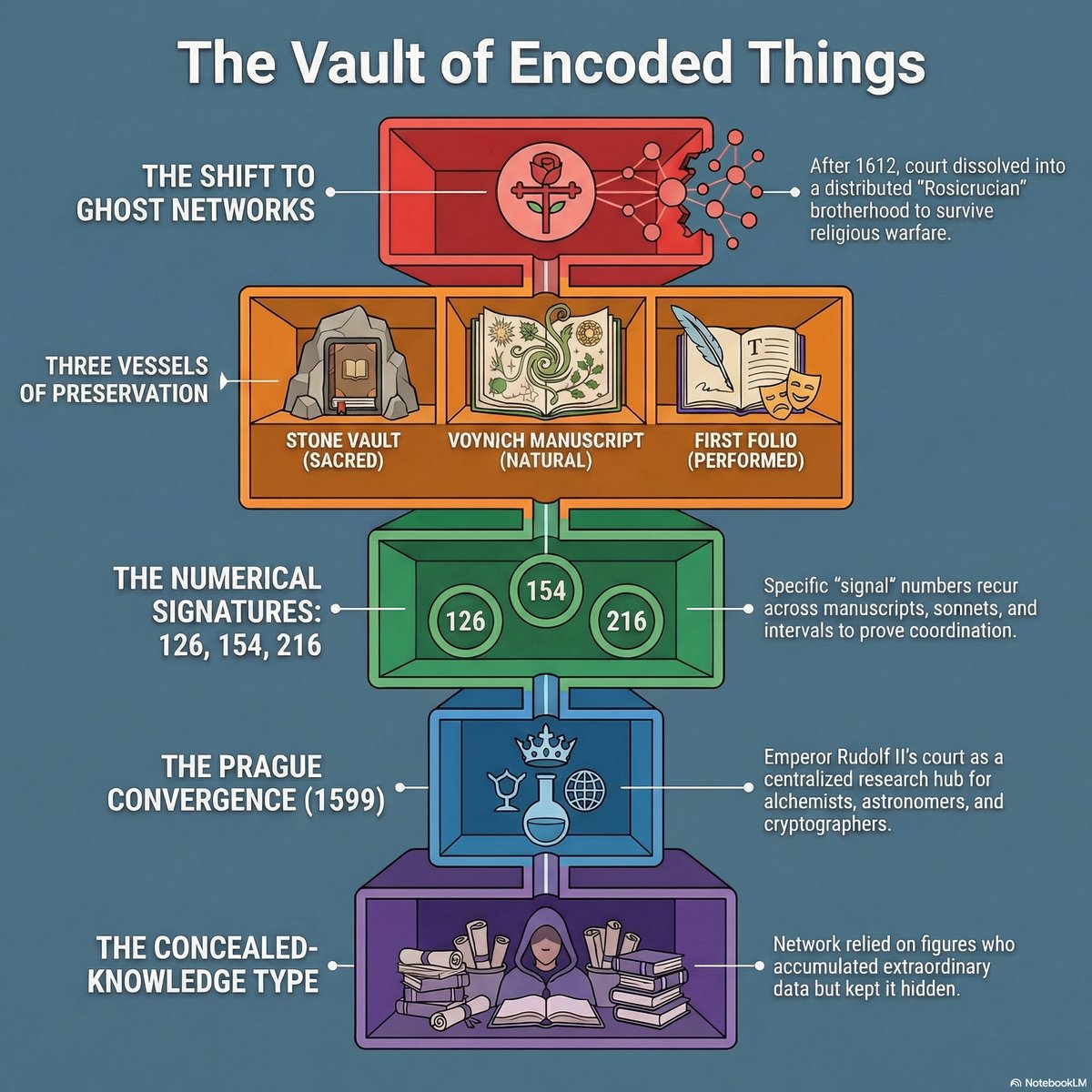
Show Notes
# The Plan: Update 01
Summary
Ten episodes in. This is the first synthesis update — a structural review of what the investigation has established so far and where the numbers actually point. We've traced the Voynich Manuscript to Rudolf II's Prague, mapped three historical models for how hidden knowledge was organized (Alexandria, the patronage networks, the Rosicrucian brotherhood), and identified the three transmission vectors that brought ancient wisdom into Renaissance Florence. The methodology is now clear enough to state plainly: numbers like 7, 24, and 120 are cosmological vocabulary — they appear everywhere because they're architectural. But 126, 154, and 216 are different. They don't appear in control chronologies. They appear exclusively in the 15th-to-17th-century European convergence. That boundary is the finding.
Show Notes
- The Three Network Models — The investigation has identified three distinct architectures for how esoteric knowledge was organized: the open state-funded accumulation of Alexandria; the centralized but fragile patronage networks of Medici Florence and Rudolf II's Prague; and the decentralized distributed brotherhood of the Rosicrucians, which emerged precisely because the patronage model kept collapsing.
- The Three Transmission Vectors — Ancient knowledge reached Renaissance Florence through three independent channels: the Philosophical Vector (the Greek Corpus Hermeticum, preserved in Byzantium, brought to Florence in 1460); the Talismanic Vector (practical astral magic from Alexandria, preserved by the Sabians of Harran, entering Latin Europe before the Mongols destroyed Harran in 1260); and the Kabbalistic Vector (3,500 pages of Hebrew and Aramaic texts translated into Latin for Pico della Mirandola by Flavius Mithridates in 1485).
- The Voynich as Anchor — Beinecke MS 408 remains the anchor artifact: carbon-dated to 1404-1438, documented at Rudolf II's court in 1599, structurally matching the Rosicrucian "Book M" in every substantive detail — an encoded book of botanical illustrations in an unbreakable language.
- Base-Rate Noise vs. Signal — The methodology now has a clear verdict on the common numbers. Seven, 24, 36, and 120 are cosmological vocabulary — they appear in the Rosicrucian vault, in Ming Dynasty architecture, in Revelation, because they reflect ancient planetary and calendrical counting, not a specific signature.
- The Three Genuine Signals — 126, 154, and 216 survive stress-testing against control chronologies. They do not appear in ancient origins or distant cultures. They appear exclusively in the European convergence: 126 (Voynich botanical illustrations / Rudolf II's book transactions / Shakespeare's Fair Youth sonnets); 154 (total Shakespeare sonnets / the Hermetic tradition's mythic lifespan from 1460 to 1614 / the interval from Roger Bacon's Opus Majus to the Voynich's creation); 216 (the interval from the Voynich's creation to its modern appearance / a recurring interval in the grimoire tradition).
- The Temporal Boundary — The core finding: the ancient traditions are real and traveled across continents, but the numerical signatures (126, 154, 216) are an exclusive feature of the 15th-to-17th-century European convergence. The ancient knowledge was the vehicle. The codes were added later, by a Renaissance network using at least seven documented modes of concealment.
- Seven Modes of Concealment — Pseudepigraphy (false attribution), steganography (hidden encoding), institutional suppression, patronage dependency, distributed architecture, deliberate obscurity of language, and posthumous mythologization. These are the documented tools of the network this investigation is mapping.
Sources & References
- Voynich Manuscript — Beinecke MS 408, Yale University
- Corpus Hermeticum — brought to Florence by Leonardo da Pistoia (1460)
- Sabians of Harran — destroyed by Mongols (1260)
- Flavius Mithridates — translations for Pico della Mirandola (1485)
- Fama Fraternitatis (1614) — "Book M" description
- Shakespeare's Sonnets (1609) — 154 total, 126 Fair Youth
Maxwell's Pendulum: The Plan