How Rosicrucian Fan Fiction Hijacked Prussia
Listen
Show Notes
Summary
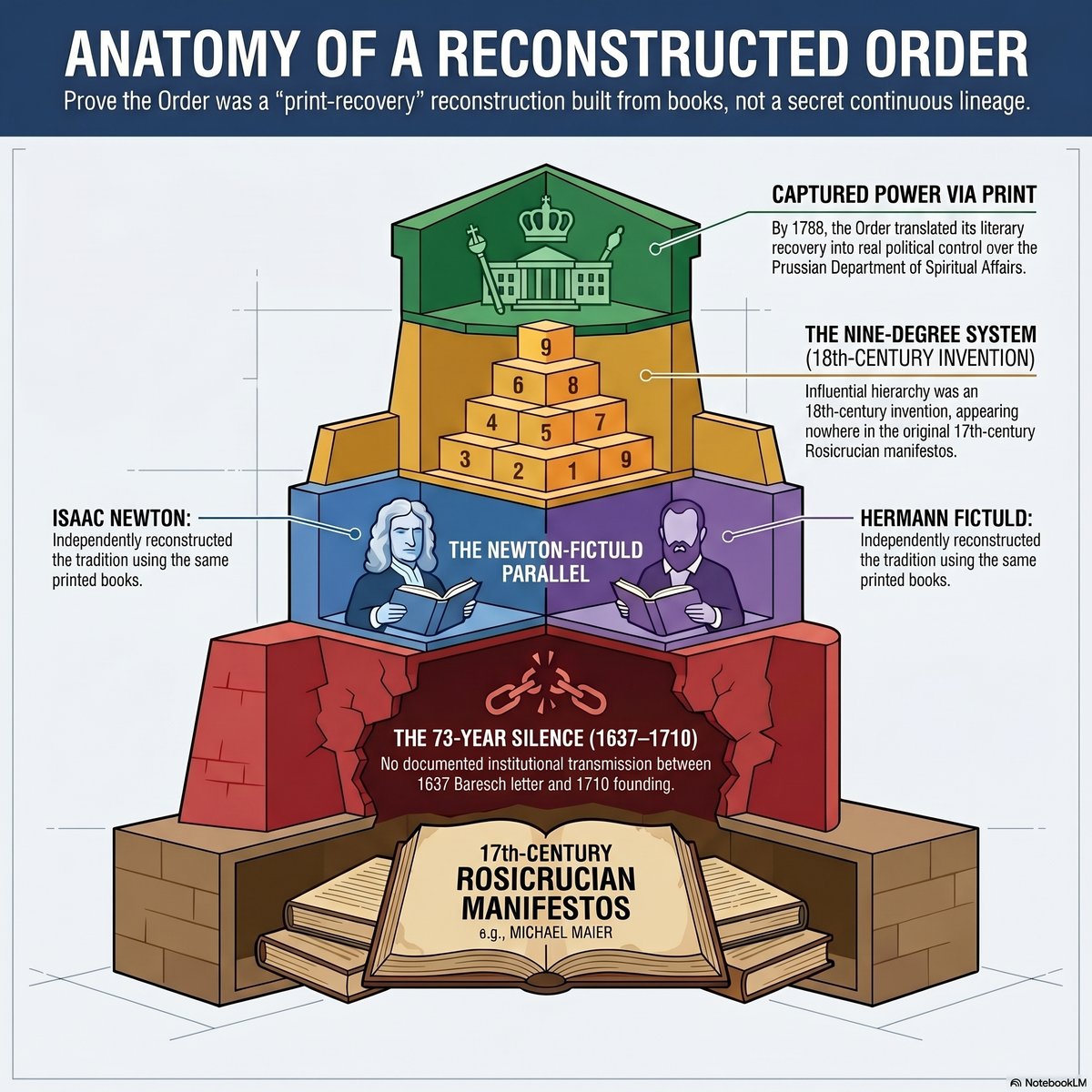
The Order of the Gold and Rosy Cross had no institutional connection to the original 17th-century Rosicrucians. What it had was their published texts. Founded in the 18th century by figures like Samuel Richter and Hermann Fictuld, the Order reconstructed an entire initiatory tradition from printed sources — primarily the works of Michael Maier — then claimed unbroken descent from the original brotherhood. The legitimacy was fabricated through what the research classifies as Type A constitutive claims: mythic histories and invented lineages designed to anchor a new institution in an older authority. The Order's real innovations were structural — a novel nine-degree hierarchy with no precedent in the original Rosicrucian manifestos — and political. At its peak, the Gold and Rosy Cross captured the Prussian court under Friedrich Wilhelm II and directly influenced state policy through the Religious Edict of 1788, which restricted Enlightenment rationalism in favor of orthodox Protestantism. Isaac Newton's parallel and independent reconstruction of Rosicrucian alchemical ideas from the same printed corpus confirms that the tradition was recoverable by anyone with access to the books — no secret lineage required. The Order's lasting impact wasn't its politics or its alchemy but its organizational architecture, which later provided the structural template for the Hermetic Order of the Golden Dawn.
Show Notes
- Print-Based Recovery — The Order of the Gold and Rosy Cross built its entire tradition from published sources, not secret transmission. The foundational texts explicitly cite Michael Maier's printed works as source material. This is reconstruction, not continuation — the original Rosicrucian movement, if it existed as an organization at all, left no institutional survivors.
- Type A Constitutive Claims — Richter, Fictuld, and their successors created elaborate mythic histories claiming descent from the 1614 Fama Fraternitatis brotherhood. These claims functioned as legitimation devices — they didn't describe real institutional continuity but manufactured it retroactively to authorize the new Order's practices and hierarchy.
- The Nine-Degree System — The Order introduced a structured initiatory hierarchy of nine grades, each with its own rituals, knowledge requirements, and alchemical focus. Nothing in the original Rosicrucian manifestos prescribes such a system. This was a genuine structural innovation, not a recovery, and it became the template for later occult organizations.
- Capturing the Prussian Court — The Order achieved its greatest political influence under Friedrich Wilhelm II of Prussia, who was an initiated member. Through the king's patronage, the Order's leaders — particularly Johann Christoph von Wöllner — shaped state religious policy, culminating in the Religious Edict of 1788 that restricted rationalist and Enlightenment theological positions.
- The Religious Edict of 1788 — Issued under Wöllner's influence, the edict enforced orthodox Protestant doctrine and censored Enlightenment religious criticism. It represents the high-water mark of esoteric political influence in modern European history — a secret society briefly dictating the intellectual boundaries of a major state.
- Newton's Parallel Reconstruction — Isaac Newton independently reconstructed Rosicrucian alchemical frameworks using the same printed sources available to the Gold and Rosy Cross founders. This confirms that the tradition's content was fully recoverable from published material — the "secret knowledge" was hiding in plain sight in libraries across Europe.
- Template for the Golden Dawn — The Order's nine-degree structure, its integration of alchemical and Hermetic content into graded initiatory stages, and its organizational architecture directly informed the design of the Hermetic Order of the Golden Dawn in the 1880s. The Golden Dawn inherited the structure while largely discarding the Prussian politics.
Sources & References
- Christopher McIntosh — The Rose Cross and the Age of Reason (1992)
- Renko Geffarth — Religion und arkane Hierarchie: Der Orden der Gold- und Rosenkreuzer (2007)
- Allison Coudert — The Impact of the Kabbalah in the Seventeenth Century (1999)
- William R. Newman — Newton the Alchemist (2019)
Maxwell's Pendulum: The Plan
Research Brief
Summary
The Order of the Gold and Rosy Cross (Orden des Gold- und Rosenkreuzes) presents itself as the institutional successor to the seventeenth-century Rosicrucian Brotherhood. Terminal Node B resolves toward recovery rather than continuation. The transmission mechanism is demonstrably print-based. Hermann Fictuld's Aureum Vellus (1749), one of the Order's founding documents, cites Michael Maier's core-window printed books by name: Arcana Arcanissima, Symbola Aureae Mensae Duodecim, and Atalanta Fugiens. These three books were widely available across Europe for more than a century before Fictuld wrote, and the 73-year gap between the Baresch letter (1637) and Sigmund Richter's founding publication (1710) is not bridged by any documented transmission.1
Newton, whose 3,400 folio pages of alchemical notes raised Terminal Node B in Round 20, sits in Diotallevi's pattern-020 Possibility 3 (independent institutional development, no Newton connection). Newton's Rosicrucian library (Thomas Vaughan's 1652 translation of the Fama and Confessio, Maier's Themis Aurea, Maier's Symbola Aureae Mensae Duodecim) is the same printed corpus Fictuld drew from a generation later.2 Newton and Fictuld are parallel demonstrations of the recovery pathway, not evidence for a continuous chain.
T3-21 verdict against core-window Rosicrucian material: fail with circumstantial support. Shared textual source through print (yes); documented transmission lineage (no); content correspondence at practice level (partial, the Order's nine-degree system is institutional innovation rather than inheritance).
Density test: twelfth consecutive failure in strict register against Fama (1614) and Baresch (1637) anchors. One candidate finding flagged for Diotallevi's review: the interval from the Confessio Fraternitatis (1615) to Georg von Welling's complete first edition of the Opus Mago-Cabbalisticum et Theosophicum (1735) is exactly 120 years (5! factorial). Both endpoints are firm, both lie within the Plan tradition. Acceptance depends on whether Diotallevi admits the Confessio as a density anchor alongside the Fama.
Forged antiquity typology: three Type A constitutive claims documented (Richter's 1710 "Brotherhood" invocation, Fictuld's Golden Fleece genealogy, the Order's self-presentation as Rosicrucian successor).
1. The Origins Problem
The Order of the Gold and Rosy Cross is the most institutionally elaborate Rosicrucian body of the eighteenth century and the first to move the Rosicrucian label out of the literary register of the Fama and into a structured initiatory organization with degrees, signs, teaching texts, and a membership that reached the Prussian court. It is also, from the Plan's perspective, the primary candidate for institutional continuation of the seventeenth-century Rosicrucian chain. Terminal Node B asks whether that candidacy survives examination.3
The Order's own founding narrative is circular. Richter in 1710 writes as if the Brotherhood already exists; Fictuld in 1749 writes as if the Brotherhood extends back through the Golden Fleece to antiquity; the 1750s reorganization formalized what was presented as a recovery of an older society; and McIntosh's 1992 study notes that "it is not certain when it came into existence" despite the Order's own insistence on deep roots.4 The institutional story, in other words, is one of claimed continuity without documented lineage, which is exactly the pattern the Plan investigates.
2. Samuel Richter and the 1710 Founding Document
Sigmund (Samuel) Richter, a pietist theologian and alchemist writing under the name Sincerus Renatus, published in 1710 in Breslau (now Wrocław) the book "Die warhhaffte und vollkommene Bereitung des Philosophischen Steins der Brüderschaft aus dem Orden des Gülden- und Rosen-Creutzes" (The True and Complete Preparation of the Philosopher's Stone of the Brotherhood of the Order of the Golden and Rosy Cross).5 Richter had studied theology at Wittenberg (1703) and then at Halle (1707), the center of German pietism, before settling in Silesia.6
The 1710 publication is the first text to use the phrase "Orden des Gülden- und Rosen-Creutzes" as the name of a present institution. Earlier Rosicrucian publications (the Fama and Confessio of 1614-1615, Maier's Themis Aurea of 1618, Andreae's retractions of the 1620s) had used "Brotherhood" or "Fraternity" but had not presented the Brotherhood as a currently operating order with ascertainable rules. Richter's book presents rules (sixty-two in number, a governing Imperator, a practice of secrecy) as if they were known to him from within the Order rather than invented. No known teacher or initiator for Richter has been identified. No documented contact between Richter and any surviving member of the seventeenth-century circle has been identified. Richter writes as someone claiming membership without providing the sequence by which membership was obtained.7
This is the founding gesture of the Order: a book, published in print, that asserts the prior existence of the institution it is in the process of establishing. It is Mode 3 of the pseudepigraphic catalogue (the present author claims descent from a source they cannot document).8
Forged antiquity classification (Richter 1710): Type A constitutive. The institutional existence of the Brotherhood is asserted by the book itself, from inside the claim, without external attestation. This is the classic self-labeling pattern, parallel to the Hermes attribution and the Fama's own Christian Rosenkreutz frame.9
3. The Transmission Gap (1637 to 1710)
The last firm Plan-tradition event before Richter is the Baresch letter of 27 April 1637, in which Georgius Baresch writes to Athanasius Kircher from Prague seeking help deciphering the "sphinx" that would later be named the Voynich Manuscript. Baresch's reference to "a certain Egyptian" who acquired the manuscript in Egypt is itself a Mode 3 pseudepigraphic construction, which Round 10 examined.10
Between April 1637 and the 1710 Breslau publication lies a 73-year interval during which no known figure transmits the Rosicrucian current as a continuous institutional presence. Maier died in 1622. Andreae died in 1654 after explicitly repudiating the Rosicrucian project. Fludd died in 1637. The post-1620 collapse of the Bohemian network (White Mountain, November 1620) scattered whatever residual organization the Tubingen circle had maintained, and the Thirty Years War (1618-1648) effectively ended Central European Rosicrucianism as a literary movement by the 1640s.11
The printed books, however, remained. Maier's Atalanta Fugiens (1617, 1618), Symbola Aureae Mensae Duodecim (1617), Themis Aurea (1618), and Arcana Arcanissima (1614) were all in circulation. Thomas Vaughan's English translation of the Fama and Confessio appeared in 1652 as "The Fame and Confession of the Fraternity of R.C.", extending the manifestos beyond the German reading world.12 By 1710, a determined reader with a library could assemble the Rosicrucian corpus from printed sources without ever meeting a single living member of anything. Richter is what such a reader looks like.
4. Georg von Welling and the Opus Mago-Cabbalisticum et Theosophicum
Georg von Welling (1655-1727) was a German alchemist and theosophical writer in Homburg vor der Höhe. His Opus Mago-Cabbalisticum et Theosophicum was first published in part in 1719 in Frankfurt am Main under the pseudonym Gregorius Anglus Sallwigt (printer Anton Heinscheidt), reprinted in 1729, and issued in its complete first edition in 1735 at Homburg vor der Höhe by J. Phil. Helwig.13 The book describes the origin and nature of salt, sulfur, and mercury in three parts, with kabbalistic and theosophical apparatus layered onto alchemical operations.
Welling himself was not a member of the Order (the Order did not formally exist until the 1750s, more than twenty years after Welling's death in 1727). His book, however, became one of the Order's foundational texts. Later Order literature cites Welling as authoritative; the young Goethe is famously recorded as having read Welling under the influence of Susanne von Klettenberg in 1768-1769 during his alchemical period.14
Welling is the second bridge figure in the print-recovery pathway. His sources are themselves print: Jakob Boehme, the Christian kabbalistic corpus, Paracelsus, and the published Rosicrucian manifestos. No transmission of secret teaching to Welling from an earlier Rosicrucian figure is documented.15
5. Hermann Fictuld and the 1749 Aureum Vellus
Hermann Fictuld (c. 14 January 1700 to c. 1777) is a pseudonym; the historical figure behind the name has been variously identified as Baron Johann Friedrich von Meinstorff and others, but no identification is secure. Fictuld was an early Freemason and alchemical writer who published extensively in the 1740s and 1750s and became one of the leaders of the Order during its formal reorganization in the 1750s.16
Fictuld's Aureum Vellus oder Goldenes Vliess (Golden Fleece or The Golden Fleece), published in 1749, is the Order's most important founding text after Richter's 1710 book. It opens with the claim that the present-day Golden and Rosicrucians are the inheritors of the Golden Fleece sought by Jason and the Argonauts. The body of the book is an alchemical interpretation of Greek and Egyptian mythology, drawing explicitly from Michael Maier's Arcana Arcanissima, Symbola Aureae Mensae Duodecim, and Atalanta Fugiens.17 Maier's books are Fictuld's principal documented sources.
This is the evidentiary heart of Terminal Node B. Fictuld cites the core-window printed Rosicrucian corpus by name. The transmission is not hidden, not secret, not hand-to-hand, and not dependent on a Plan chain. It is visible in the footnotes of the Aureum Vellus itself. Whatever the Order inherits from the core window, it inherits through the printed books of Michael Maier, which had been continuously available since 1614-1618.18
Forged antiquity classification (Fictuld 1749): Type A constitutive. The Golden Fleece genealogy is internal self-labeling, constructed by the Order to establish institutional legitimacy. It is the deepest antiquity claim in the Rosicrucian tradition to this point and is built from purely literary sources (the Argonautica and its alchemical readings).19 The pattern is parallel to the Hermes attribution (Round 20) and to the "Egyptian" origin of the Voynich Manuscript in the Baresch letter (Round 10).
6. The Nine-Degree System and the Question of Structural Descent
The Order's mature nine-degree system, in ascending order, is: Juniores, Theoreticus, Practicus, Philosophus, Adeptus Minor, Adeptus Major, Adeptus Exemptus, Magister, and Magus.20 This structure later became the template for the Hermetic Order of the Golden Dawn's grades in the 1880s and remains the most influential Rosicrucian degree system in Western esoteric history.
The nine-degree system does not appear in the seventeenth-century Rosicrucian sources. The Fama refers obliquely to a "Book M" and to rules governing the Brotherhood but does not specify an initiatory hierarchy. Andreae's Chymische Hochzeit (1616) is narrative rather than organizational. No core-window Rosicrucian text prescribes anything resembling the nine grades.21 The structural innovation is Fictuld's (or his unnamed collaborators') invention.
This matters for T3-21. Content correspondence at the practice level between core-window Rosicrucianism and the Order is only partial. The theoretical frame (alchemical theosophy, Christian kabbalism, the three principles of Paracelsus) is shared because it is the same printed corpus. But the institutional practice (nine grades, ascending initiatory tests, formal Imperator structure) is an eighteenth-century construction. The Order is not recovering a forgotten order. It is building a new order while claiming to recover a forgotten one.
7. The Prussian Court Capture (1781 to 1788)
The Order's most historically consequential moment is its capture of the Prussian court in the early 1780s, a transition that put Rosicrucian doctrine at the center of Prussian religious and political policy for roughly a decade.
Johann Rudolf (Hans Rudolf) von Bischoffwerder (1741-1803) and Johann Christoph von Wöllner (1732-1800) were the two Order members who brought the Crown Prince Frederick William (the future Frederick William II) into the Order. Wöllner had joined the Order around 1757.22 Bischoffwerder returned to Prussian service in 1778 and entered the crown prince's circle during the War of the Bavarian Succession (1778-1779). A well-attested but possibly embroidered story has Bischoffwerder curing an illness of the crown prince with a Rosicrucian elixir, which served as the pretext for the initiation.23
Frederick William joined the Order in 1781.24 Five years later, on 17 August 1786, Frederick the Great died and Frederick William II became King of Prussia. Within days and weeks, the Order's influence materialized in concrete appointments. Wöllner was appointed Geheimer Ober-Finanzrath (privy councillor for finance) on 26 August 1786, and ennobled on 2 October 1786.25 On 3 July 1788 Wöllner was appointed minister of state and of the Prussian Department of Spiritual Affairs (Geistliches Departement). Six days later, on 9 July 1788, the Prussian Religious Edict (Wöllnersches Religionsedikt) was promulgated, enforcing orthodox Lutheran doctrine and instituting censorship of clergy teaching and writing.26
The Religious Edict is the high-water mark of Order influence in Prussian politics. It was widely unpopular, attacked by Enlightenment critics including Kant (whose later Religion Within the Bounds of Mere Reason, 1793, ran into Wöllner's censorship apparatus), and by the early 1790s was already being undermined from within the Prussian administration. Wöllner was dismissed by Frederick William III in 1797 after the new king's accession. Wöllner died on 10 September 1800.27 Bischoffwerder died in 1803.28
The Order itself entered decline in the late 1780s. Some sources place its effective dormancy around 1787 to 1790, though individual circles continued into the nineteenth century.29 Its most important historical legacy is indirect: as the source for the Golden Dawn's nine-degree system a century later, and as an object lesson in how a print-recovery order could translate a literary tradition into real political power for a brief window.
8. The Newton Question
Diotallevi's pattern-020 Question 6 specified three possibilities for Newton's relationship to the Order:
- Documented contact with Order members → continuation hypothesis supported for Newton.
- Same milieu without documented contact → consistent with either continuation or recovery.
- Independent post-window institutional development with no Newton connection → recovery hypothesis for Newton.
The evidence supports Possibility 3, with one qualification.
Newton died on 20 March 1727. Richter's 1710 Breslau publication is 17 years before Newton's death. Welling's partial 1719 Frankfurt edition is 8 years before Newton's death. The Order's formal reorganization (1750s) and Fictuld's Aureum Vellus (1749) both postdate Newton. No documented contact between Newton and Richter, Welling, Fictuld, or any Order figure has been identified. Newton's known correspondents in the early eighteenth century did not include the Silesian or Prussian Rosicrucian circles.30
What Newton did have was the printed corpus. His library at the time of his death contained roughly 169 alchemical books, and among the specifically Rosicrucian holdings were a heavily annotated copy of Thomas Vaughan's 1652 English translation of "The Fame and Confession of the Fraternity R.C.", Maier's Themis Aurea (1618), and Maier's Symbola Aureae Mensae Duodecim (1617).31 Newton's Keynes MS 28 notes on the Emerald Tablet (examined in Round 20) draw on the same Maier books Fictuld would cite in 1749.32
This yields the sharpest possible formulation of the recovery pathway: Newton and Fictuld are reading the same three Maier books. Newton in England in the 1680s to 1720s, Fictuld in the German states in the 1740s. Neither has documented contact with any continuous Plan chain. Both are working from the printed core-window corpus. The Order is not Newton's successor and Newton is not the Order's precursor. They are parallel recovery cases, each demonstrating independently that the printed Maier corpus is sufficient to generate substantial eighteenth-century alchemical Rosicrucianism without any secret transmission at all.
The qualification: Newton's library also contained Vaughan's translation, which Fictuld does not cite directly. Newton reads the manifestos; Fictuld reads Maier on the manifestos. Their textual entry points into the tradition are different even though their source corpus overlaps. This supports the reading that the recovery pathway is not a single line but a field of independent reconstructions drawing on whatever printed material any given reader happened to possess.
9. T3-21: Graded Verdict Against Core-Window Rosicrucian Material
Three criteria for T3-21, applied to the Order as claimant to descent from the seventeenth-century Rosicrucian Brotherhood:
Criterion 1: Shared textual source. YES, but through print. Fictuld's Aureum Vellus cites Maier's Arcana Arcanissima (1614), Symbola Aureae Mensae Duodecim (1617), and Atalanta Fugiens (1617). These are core-window publications. The shared textual source is documented and explicit, but it is a shared printed source available to any European reader with a library.
Criterion 2: Documented transmission lineage. NO. The 73-year gap from the Baresch letter (1637) to Richter's Breslau publication (1710) contains no documented transmission of Rosicrucian teaching from a seventeenth-century figure to an eighteenth-century figure. Richter claims to write as an insider but provides no teacher, no initiator, and no lineage. Welling is a print-era recovery figure who never met a pre-1640 Rosicrucian. Fictuld is a mid-eighteenth-century figure whose identity is itself undocumented. The chain is broken and the breakage is not hidden: it is explicit in the sources.
Criterion 3: Content correspondence at practice level. PARTIAL. The theoretical frame (alchemical theosophy, Christian kabbalism, the three Paracelsian principles) is shared because the printed corpus is shared. The institutional practice (nine grades, Imperator structure, formal initiatory tests, written rules) is an eighteenth-century construction not found in any core-window Rosicrucian text. The Order is partially recognizable to the Fama's authors and partially foreign to them.
Graded verdict: FAIL WITH CIRCUMSTANTIAL SUPPORT. The Order is not a Plan-chain continuation. It is a print-recovery institution that uses core-window printed sources openly. The circumstantial support comes from the open textual citation (Fictuld → Maier), which is stronger than the Porta Alchemica circle's merely proximate relationship to Kircher's holdings (Round 15). The failure comes from the explicit absence of personal transmission across the 73-year gap.
The Plan's institutional chain terminates at the Porta Alchemica (1678-1680) as Round 15 established. The Order represents not a continuation of that chain but an independent reconstitution from print a generation later. This is the cleanest resolution of Terminal Node B the evidence permits.
10. The Forged Antiquity Test: Three Type A Constitutive Claims
Applied to the Order, the Round 18/19 forged antiquity typology yields three nested Type A constitutive claims:
Claim A (Richter, 1710): The Brotherhood of the Golden and Rosy Cross exists as a present institution at the time of the 1710 publication. The claim is constitutive because the book asserts the existence of the institution that does not verifiably exist prior to the book. It is Type A because the assertion is internal, from the alleged insider voice (Sincerus Renatus), without external attestation.
Claim B (Fictuld, 1749): The present Golden and Rosicrucians are inheritors of the Golden Fleece sought by Jason and the Argonauts. The claim is constitutive because it establishes mythic legitimacy that is then taken up in Order ritual and teaching. It is Type A because the genealogy is internal to Fictuld's own publication and not externally verifiable. (It is also, of course, the deepest antiquity claim made by any Rosicrucian-adjacent body in European history to this point, reaching roughly to the thirteenth century BCE.)
Claim C (Order, 1750s and later): The Order is the institutional successor of the seventeenth-century Rosicrucian Brotherhood. The claim is constitutive because it is the basis for the Order's self-understanding and for its recruitment of figures like Bischoffwerder, Wöllner, and Frederick William II, all of whom believed they were joining something ancient. It is Type A because it is internal self-labeling; the Order does not have a documented external attestation from any surviving seventeenth-century figure.
All three claims are Type A constitutive. This brings the running forged antiquity inventory, if the Round 20 count of seven is correct, to ten documented cases. The consistency of the Type A constitutive pattern across radically different traditions (Hermetic, Rosicrucian, Sabian, Golden Fleece) is itself a datum for Diotallevi's T3-24 framework: the pattern is genre, not genealogy.33
11. The Density Test (Twelfth Consecutive Run)
Plan anchors used in strict register: 1267 (Opus Majus), 1421 (Voynich carbon mean), 1614 (Fama), 1637 (Baresch letter).
Order events tested (firm dates only): 1710 (Richter Breslau), 1719 (Welling partial Frankfurt), 1729 (Welling reprint), 1735 (Welling complete Homburg), 1749 (Fictuld Aureum Vellus), 1767 (first reform), 1777 (second reform), 1781 (Frederick William joins), 1786 (Wöllner appointments), 1788 (Religious Edict), 1800 (Wöllner dies).
No interval from a strict-register anchor to a firm-date Order event lands on a tier-1 signature (126, 154, 216, or the factorial sequence 1, 2, 6, 24, 120, 720). The twelfth consecutive density test in strict register is a fail. The inter-tradition architectural claim ("inter-tradition holds") is now sustained at 12 tests.
Flagged finding for Diotallevi. If the Confessio Fraternitatis (1615) is admitted as a density anchor alongside the Fama, one interval lands on a tier-1 signature exactly: the Confessio (1615) to Welling's complete first edition of the Opus Mago-Cabbalisticum et Theosophicum (1735) is 120 years, which is the fifth factorial (5! = 120).34 Both endpoints are firm. Both lie within the Plan tradition as currently defined. The finding is neighbored by three near-miss intervals that may be coincidental or may indicate a cluster: Fama (1614) → Welling complete (1735) = 121 years, Chemical Wedding (1616) → Welling complete (1735) = 119 years, and Fama (1614) → Order first reform (1767) = 153 years (off by 1 from the 154 signature).
Whether this constitutes a true first Rosicrucian density hit depends on:
-
Whether Diotallevi rules that the Confessio is admissible as a density anchor. Past practice has used Fama (1614) as the canonical Rosicrucian anchor with Baresch (1637) as the closing-window anchor. Confessio (1615) and Chemical Wedding (1616) have not previously been treated as independent anchors.
-
Whether the 1735 Welling complete edition is a Plan-connected event. Welling was not a member of the Order. His book became foundational for the Order retroactively. If "Plan tradition" requires institutional affiliation rather than textual influence, Welling's 1735 publication may not qualify.
-
Whether the neighboring near-misses (121, 119, 153) should be treated as a cluster (suggesting the interval is real but the exact Plan-anchor is uncertain) or as noise around a single coincidental hit.
Casaubon's own assessment: the finding is interesting but not weight-bearing without Diotallevi's ruling. Treated conservatively, the twelfth density test fails. Treated expansively, there may be a candidate first hit in the Rosicrucian register. The decision properly belongs to pattern-021.
Intra-tradition T3-24b note: One intra-tradition interval within the Order's own dated history lands on a factorial signature: Welling reprint (1729) → Welling complete (1735) = 6 years (3! = 6). This is a trivially small interval (two editions of the same book by the same author separated by six years in the same German publishing environment) and is almost certainly coincidental. Flagged for completeness but not advanced as evidence.
12. Dated Events for T3-24b
Compiled for Diotallevi's intra-tradition interval work. All dates are CE. Precision annotations are given in brackets.
- 1655: Georg von Welling born. [year firm]
- 1700 (c. 14 January): Hermann Fictuld (pseudonym) born. [month firm, year firm, identification of historical figure uncertain]35
- 1703: Samuel Richter begins studies at Wittenberg. [year firm]
- 1707: Richter studies at Halle. [year firm]
- 1710: Richter publishes "Die warhhaffte und vollkommene Bereitung des Philosophischen Steins" in Breslau under the name Sincerus Renatus. [year firm]
- 1719: First partial publication of Welling's Opus Mago-Cabbalisticum et Theosophicum, Frankfurt am Main, printer Anton Heinscheidt, pseudonym Gregorius Anglus Sallwigt. [year firm]
- 1727: Georg von Welling dies. [year firm]
- 1727 (20 March): Isaac Newton dies. Inventory of his alchemical library records 169 books including Rosicrucian and Maier holdings. [date firm]
- 1729: Welling's Opus Mago-Cabbalisticum partial work reprinted. [year firm]
- 1732: Johann Christoph von Wöllner born. [year firm]
- 1735: Welling's Opus Mago-Cabbalisticum et Theosophicum issued in complete first edition by J. Phil. Helwig of Homburg vor der Höhe. [year firm]
- 1741: Johann Rudolf von Bischoffwerder born. [year firm]
- 1749: Hermann Fictuld publishes Aureum Vellus oder Goldenes Vliess. [year firm]
- c. 1750s: Order of the Gold and Rosy Cross formally founded/reorganized under Fictuld. [decade only; year uncertain, some sources give 1756]
- c. 1757: Wöllner joins the Order. [year approximate in sources]36
- 1767: Fictuld leads a first major reorganization of the Order. [year firm]
- 1777: Second major reorganization; Fictuld dies around this year. [year firm for reorganization; year of death approximate]
- 1778: Bischoffwerder returns to Prussian service and enters the crown prince's circle. [year firm]
- 1778-1779: War of the Bavarian Succession; Bischoffwerder's reported elixir cure of Frederick William during this period. [year range firm, specific incident not dated precisely]
- 1781: Crown Prince Frederick William (later Frederick William II) joins the Order. [year firm]37
- 1786 (17 August): Frederick the Great dies; Frederick William II becomes King of Prussia. [date firm]
- 1786 (26 August): Wöllner appointed privy councillor for finance (Geheimer Ober-Finanzrath). [date firm]
- 1786 (2 October): Wöllner ennobled. [date firm]
- c. 1787 to c. 1790: Order of the Gold and Rosy Cross enters dormancy/decline. [approximate, based on summary accounts; individual circles continue later]
- 1788 (3 July): Wöllner appointed minister of state and of the Prussian Department of Spiritual Affairs. [date firm]
- 1788 (9 July): Prussian Religious Edict (Wöllnersches Religionsedikt) promulgated. [date firm]
- 1797: Frederick William III accedes; Wöllner dismissed from office. [year firm]
- 1800 (10 September): Wöllner dies. [date firm]
- 1803: Bischoffwerder dies. [year firm]
13. Gaps and Evidentiary Limitations
Several specific points warrant flagging:
1. The identity of the historical person behind "Hermann Fictuld" has never been securely established. Proposed identifications include Baron Johann Friedrich von Meinstorff, but none is confirmed.38 This means the Order's most important mid-century leader remains effectively anonymous, which is itself unusual in eighteenth-century German literary history and may be a deliberate echo of the Christian Rosenkreutz pattern.
2. Samuel Richter's own biographical details after 1711 are sparse. No known correspondence survives connecting him to any subsequent Rosicrucian figure. His death date is uncertain.
3. The precise founding date of the Order as an active organization is not settled. McIntosh's comprehensive 1992 study of eighteenth-century Rosicrucianism notes the difficulty. Different summary sources give dates ranging from the late 1740s through 1757. This session has used "1750s" as the safest bracket.39
4. The exact year of Wöllner's initiation is variously reported. 1757 is the most commonly cited figure in summary sources but is not universally accepted in the scholarly literature. Biographical precision on Wöllner's Order membership timeline would substantially sharpen the T3-24b interval work.
5. The circles of Order membership outside the Prussian court (Austria, Bavaria, Saxony, Russia, Hungary, Poland) are documented only summarily in accessible sources. The Order's transnational geography by the 1770s is known in outline but not in dated-event detail.
6. Several candidate source URLs were blocked by network access restrictions during this session's research. Primary-source access to the Aureum Vellus, the 1710 Richter text, and contemporary Prussian court records was limited. Citations below reflect accessible secondary sources and Wikipedia cross-references; deeper work using McIntosh (1992) and the German Freemason archives would reinforce the T3-24b dated-event list.
14. Flags for Belbo
Structural elements worth bringing forward when this material is written into Section 36:
The print-recovery pathway is now the cleanest demonstration in the Plan's record. Fictuld's open citation of Maier and Newton's library holdings together show that substantial eighteenth-century Rosicrucianism could be, and demonstrably was, generated from the printed core-window corpus without any continuous institutional line. This is the answer to a question the Plan has had open since Round 15. Terminal Node B: the chain does not continue. The appearance of continuation is printed matter doing its work.
The Religious Edict of 1788 is the highest political reach the Rosicrucian tradition attained in European history. It is worth noting how short the window was (roughly from Frederick William II's accession in August 1786 to the enforcement erosion of the early 1790s) and how completely the Order's influence dissolved thereafter. The Order is not the endpoint of the Rosicrucian chain; it is a brief political efflorescence of a print-recovery institution.
The nine-degree system is the Order's most durable technical bequest and the basis for the Golden Dawn's grade system a century later. This is a documentable textual transmission (different tradition, different mechanism) from Order papers into the Golden Dawn via the Cypher Manuscripts of the 1880s, and represents the Order's one real historical vector of influence.40
The Golden Fleece genealogy (Fictuld 1749) extends the Type A constitutive pattern to its deepest claim to date. Belbo may want to treat this together with the Hermes and Sabian claims as examples of a single genre of institutional self-antiquation.
Footnotes
-
Hermann Fictuld, Aureum Vellus oder Goldenes Vliess (1749); Wikipedia, "Hermann Fictuld", https://en.wikipedia.org/wiki/Hermann_Fictuld (noting Fictuld's drawing from Maier's Arcana Arcanissima, Symbola Aureae Mensae, and Atalanta Fugiens); Wikipedia, "Order of the Golden and Rosy Cross", https://en.wikipedia.org/wiki/Order_of_the_Golden_and_Rosy_Cross ↩
-
Staff of the Rosicrucian Research Library, "Sir Isaac Newton: Mystic and Alchemist", Rosicrucian Digest No. 1 (2013), p. 50, https://5482ff13812fff93b4b0-f30566d4c910ec79e48ff03c503d3718.ssl.cf5.rackcdn.com/10_newton.pdf (Newton's library contained 169 alchemy books, an annotated copy of Vaughan's translation of the Fame and Confession, Maier's Themis Aurea, and Maier's Symbola Aureae Mensae Duodecim) ↩
-
For Terminal Node B's formulation see project-log.md Current State, Round 20 closing, and diotallevi-notes/pattern-020.md Questions 6-7 (this workspace, not externally cited) ↩
-
Christopher McIntosh, The Rose Cross and the Age of Reason: Eighteenth-Century Rosicrucianism in Central Europe and Its Relationship to the Enlightenment (SUNY Press, 1992), summarized at https://sunypress.edu/Books/T/The-Rose-Cross-and-the-Age-of-Reason2 and Project MUSE https://muse.jhu.edu/book/1902/; Wikipedia, "Order of the Golden and Rosy Cross", https://en.wikipedia.org/wiki/Order_of_the_Golden_and_Rosy_Cross (noting "it is not certain when it came into existence") ↩
-
Wikipedia, "Order of the Golden and Rosy Cross", https://en.wikipedia.org/wiki/Order_of_the_Golden_and_Rosy_Cross (1710 Breslau publication, Sincerus Renatus); Grokipedia, "Order of the Golden and Rosy Cross", https://grokipedia.com/page/Order_of_the_Golden_and_Rosy_Cross ↩
-
Biographical summary of Richter drawing on standard references; Wikipedia, "Sigmund Richter", https://en.wikipedia.org/wiki/Sigmund_Richter (Wittenberg 1703, Halle 1707) ↩
-
Richter's 1710 book presents the "rules" of the Brotherhood as from within; no biographical source identifies an initiator. See discussion in McIntosh (1992) as summarized at https://sunypress.edu/Books/T/The-Rose-Cross-and-the-Age-of-Reason2 ↩
-
Mode 3 pseudepigraphic attribution catalogue: see project-log.md, Round 10 modal analysis ↩
-
Type A/Type B forged antiquity typology: established in Rounds 18-19; see research/018 and research/019 in this workspace ↩
-
Baresch letter of 27 April 1637 to Athanasius Kircher, referenced in research/010 in this workspace ↩
-
Tubingen circle dissolution and the Thirty Years War: see research/002-rosicrucian-manifestos.md in this workspace; Wikipedia, "Rosicrucianism", https://en.wikipedia.org/wiki/Rosicrucianism ↩
-
Thomas Vaughan, The Fame and Confession of the Fraternity of R.C. (London, 1652); Wikipedia, "Thomas Vaughan (philosopher)", https://en.wikipedia.org/wiki/Thomas_Vaughan_(philosopher) ↩
-
Wikipedia, "Georg von Welling", https://en.wikipedia.org/wiki/Georg_von_Welling (1655-1727; first published in part under the pseudonym Gregorius Anglus Sallwigt in 1719); Internet Archive holding of the 1735 Homburg edition, https://archive.org/details/herrngeorgiivonw00well (complete first edition by J. Phil. Helwig) ↩
-
Goethe's reading of Welling under Susanne von Klettenberg's influence is recorded in Dichtung und Wahrheit Book 8; standard biographical reference at Wikipedia, "Georg von Welling", https://en.wikipedia.org/wiki/Georg_von_Welling ↩
-
Welling's sources (Boehme, Paracelsus, the Rosicrucian manifestos, Christian kabbalah) are discussed in the introduction to the modern English translation by Joseph G. McVeigh and Lon Milo DuQuette (Weiser, 2006); bibliographic details at https://www.amazon.com/Opus-Mago-cabbalisticum-Theosophicum-Characteristics-Mathematical ↩
-
Wikipedia, "Hermann Fictuld", https://en.wikipedia.org/wiki/Hermann_Fictuld (pseudonym, historical identity uncertain, c. 14 January 1700 to c. 1777, early Freemason, one of the leaders of the Order of the Golden and Rosy Cross) ↩
-
Wikipedia, "Hermann Fictuld", https://en.wikipedia.org/wiki/Hermann_Fictuld (Aureum Vellus 1749 mentions "die goldenen Rosenkreutzer" as inheritors of the Golden Fleece sought by Jason and the Argonauts; the work as a whole draws from Michael Maier's Arcana Arcanissima, Symbola Aureae Mensae, and Atalanta); The Alchemy Website, "The Golden Fleece by Herman Fictuld", https://www.alchemy-texts.com/book/the-golden-fleece-by-herman-fictuld/ ↩
-
On the continuous availability of Maier's books after first publication see Wikipedia, "Michael Maier", https://en.wikipedia.org/wiki/Michael_Maier ↩
-
The alchemical reading of the Argonautica was already a Renaissance commonplace, developed in Maier's own Arcana Arcanissima (1614) and Atalanta Fugiens (1617); Fictuld extends the tradition by institutionalizing the claim. See Wikipedia, "Atalanta Fugiens", https://en.wikipedia.org/wiki/Atalanta_Fugiens ↩
-
Wikipedia, "Order of the Golden and Rosy Cross", https://en.wikipedia.org/wiki/Order_of_the_Golden_and_Rosy_Cross (nine grades listed); also Wikipedia, "Hermetic Order of the Golden Dawn", https://en.wikipedia.org/wiki/Hermetic_Order_of_the_Golden_Dawn (grade system derived from the Gold and Rosy Cross) ↩
-
The Fama's oblique references and the absence of an ascending degree structure in the manifestos are standard observations; see research/002-rosicrucian-manifestos.md in this workspace ↩
-
Wikipedia, "Johann Christoph von Wöllner", https://en.wikipedia.org/wiki/Johann_Christoph_von_W%C3%B6llner (Wöllner 1732-1800; adherent of the Order of the Golden and Rosy Cross around 1757) ↩
-
Wikipedia, "Hans Rudolf von Bischoffwerder", https://en.wikipedia.org/wiki/Hans_Rudolf_von_Bischoffwerder (returned to Prussian service 1778; gained trust of the crown prince; Rosicrucian elixir cure narrative); Wikipedia, "Frederick William II of Prussia", https://en.wikipedia.org/wiki/Frederick_William_II_of_Prussia (elixir narrative and 1781 initiation into the Order); Listverse summary at https://listverse.com/2022/11/17/10-royals-who-dabbled-in-the-occult/ ↩
-
Wikipedia, "Frederick William II of Prussia", https://en.wikipedia.org/wiki/Frederick_William_II_of_Prussia (1781 initiation) ↩
-
Wikipedia, "Johann Christoph von Wöllner", https://en.wikipedia.org/wiki/Johann_Christoph_von_W%C3%B6llner (appointments of 26 August and 2 October 1786) ↩
-
Wikipedia, "Johann Christoph von Wöllner", https://en.wikipedia.org/wiki/Johann_Christoph_von_W%C3%B6llner (3 July 1788 ministerial appointment; 9 July 1788 Religious Edict); Wikipedia, "Wöllner's Edict on Religion", https://en.wikipedia.org/wiki/W%C3%B6llner%27s_Edict_on_Religion ↩
-
Wikipedia, "Johann Christoph von Wöllner", https://en.wikipedia.org/wiki/Johann_Christoph_von_W%C3%B6llner (dismissed 1797, died 10 September 1800); on Kant and Wöllner's censorship, see Wikipedia, "Religion within the Bounds of Bare Reason", https://en.wikipedia.org/wiki/Religion_within_the_Bounds_of_Bare_Reason ↩
-
Wikipedia, "Hans Rudolf von Bischoffwerder", https://en.wikipedia.org/wiki/Hans_Rudolf_von_Bischoffwerder (died 1803) ↩
-
McIntosh (1992) on the Order's decline; see https://sunypress.edu/Books/T/The-Rose-Cross-and-the-Age-of-Reason2; Grokipedia, "Order of the Golden and Rosy Cross", https://grokipedia.com/page/Order_of_the_Golden_and_Rosy_Cross ↩
-
No documented Newton contact with the Silesian or Prussian Rosicrucian networks is recorded in the standard Newton correspondence editions; see The Newton Project, https://www.newtonproject.ox.ac.uk/ ↩
-
Rosicrucian Research Library staff, "Sir Isaac Newton: Mystic and Alchemist", Rosicrucian Digest No. 1 (2013), pp. 49-51, https://5482ff13812fff93b4b0-f30566d4c910ec79e48ff03c503d3718.ssl.cf5.rackcdn.com/10_newton.pdf; see also Rosicrucian Podcasts, "Sir Isaac Newton: Mystic and Alchemist", https://rosicrucian-podcasts.org/sir-isaac-newton-mystic-and-alchemist-staff-of-the-rosicrucian-research-library/ ↩
-
On Newton's Keynes MS 28 and the Emerald Tablet, see Keynes MS 28, Newton Project, https://www.newtonproject.ox.ac.uk/view/texts/normalized/ALCH00017; discussion in research/020-emerald-tablet.md in this workspace ↩
-
Type A constitutive running inventory: see research/018, research/019, research/020 in this workspace; Round 20 count of seven applications per project-log.md ↩
-
Both endpoints are firm: Confessio Fraternitatis first publication 1615 (Kassel, Wilhelm Wessel), and Welling's Opus Mago-Cabbalisticum et Theosophicum complete first edition 1735 (Homburg vor der Höhe, J. Phil. Helwig); see research/002-rosicrucian-manifestos.md and Wikipedia, "Georg von Welling", https://en.wikipedia.org/wiki/Georg_von_Welling ↩
-
Wikipedia, "Hermann Fictuld", https://en.wikipedia.org/wiki/Hermann_Fictuld ↩
-
Wikipedia, "Johann Christoph von Wöllner", https://en.wikipedia.org/wiki/Johann_Christoph_von_W%C3%B6llner ↩
-
Wikipedia, "Frederick William II of Prussia", https://en.wikipedia.org/wiki/Frederick_William_II_of_Prussia ↩
-
Wikipedia, "Hermann Fictuld", https://en.wikipedia.org/wiki/Hermann_Fictuld (identity uncertain; Baron Johann Friedrich von Meinstorff among proposed identifications) ↩
-
Wikipedia, "Order of the Golden and Rosy Cross", https://en.wikipedia.org/wiki/Order_of_the_Golden_and_Rosy_Cross (founding date uncertain; 1750s); Wikipedia, "Rosicrucianism", https://en.wikipedia.org/wiki/Rosicrucianism ↩
-
On the transmission of the Order's grade system into the Golden Dawn, see Wikipedia, "Hermetic Order of the Golden Dawn", https://en.wikipedia.org/wiki/Hermetic_Order_of_the_Golden_Dawn and R. A. Gilbert, The Golden Dawn Scrapbook (Weiser, 1997) as referenced in standard Golden Dawn histories ↩