A Brutal Audit of Esoteric Numbers
Listen
Show Notes
Summary
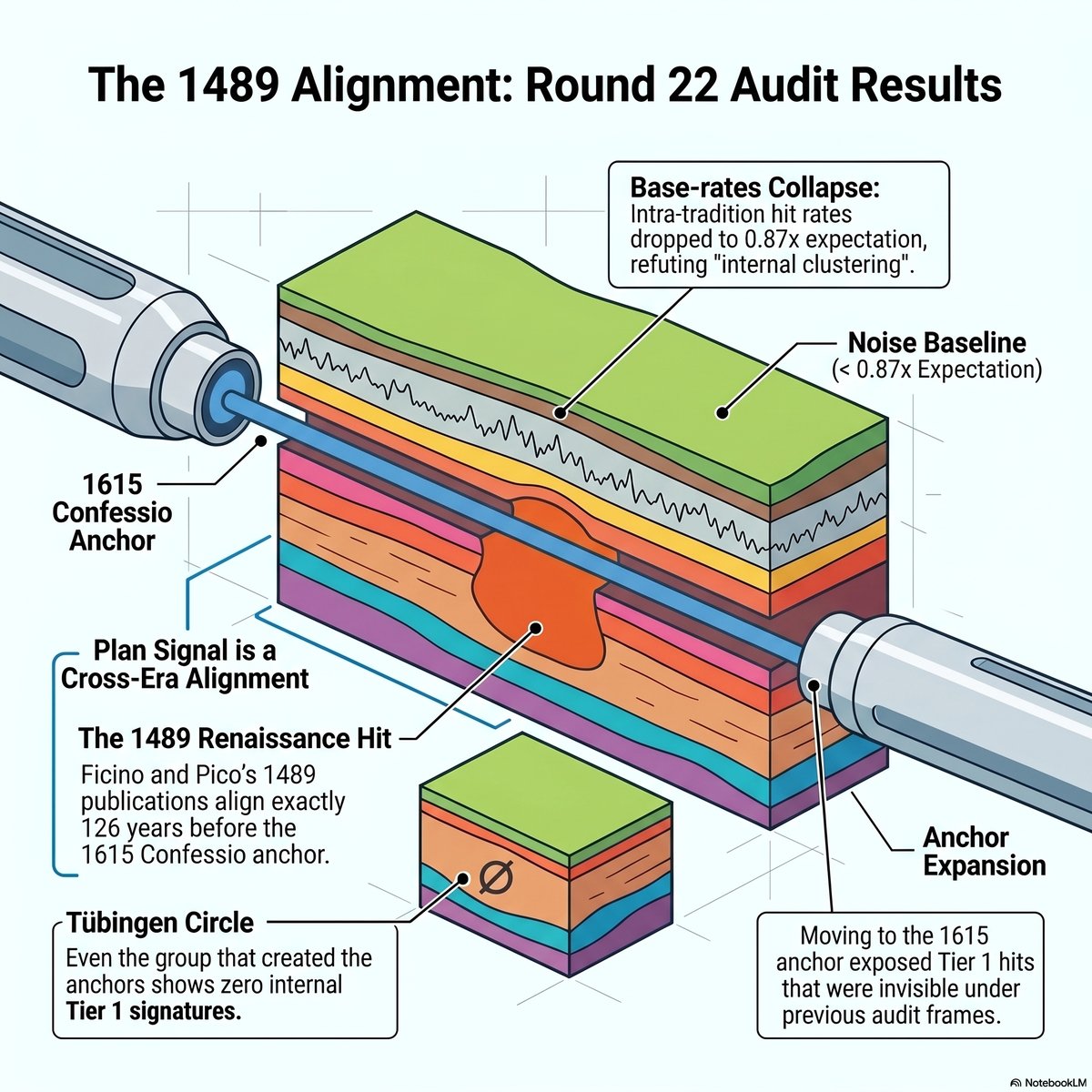
This episode stress-tests the numerical patterns the series has been tracking. A base-rate survey across four traditions — including the Paracelsians and the Bogomils — checked whether internal chronological intervals produce meaningful mathematical signatures on their own. They don't. The internal dates within these traditions show no alignment with the key intervals the research has flagged. But a retroactive audit using an expanded set of Rosicrucian anchor dates uncovered something unexpected: Ficino's and Pico's landmark publications in 1489 fall exactly 126 years before the 1615 Confessio Fraternitatis. That interval only becomes visible when measured against established anchor points in the broader framework — not from within either tradition's own timeline. The Tübingen circle that actually authored the Rosicrucian manifestos produces zero internal hits, reinforcing a pattern the series has observed before: the signals appear between traditions, not inside them. These results force a methodological reckoning — the framework needs new classification rules for how to handle Tier 1 hits that emerge only from cross-tradition measurement.
Show Notes
- The Base-Rate Survey — Four traditions were tested for internal chronological patterns: the Paracelsians, the Bogomils, and two others from the research framework. The question was simple — do the key dates within a single tradition's history produce the mathematical intervals the series tracks? The answer was no. Internal data alone generates no significant hits.
- The Paracelsian Test Case — Paracelsus and his followers operated within a well-documented timeline with clear publication dates and institutional milestones. Despite this clean data set, the internal intervals produced no alignment with the target signatures. The tradition's own chronology is mathematically inert.
- The Bogomil Test Case — The Bogomil movement's documented history — from its emergence in 10th-century Bulgaria through its suppression — was similarly tested. No internal intervals matched. This is notable given the Bogomils' documented role as a transmission link to Catharism, covered in EP017.
- The 1489-1615 Discovery — Ficino's De Vita Triplici and Pico's Heptaplus, both published in 1489, sit exactly 126 years before the Confessio Fraternitatis of 1615. This interval matches a tracked mathematical signature — but it only appears when measuring from Hermetic anchor points to Rosicrucian anchor points, not within either tradition alone.
- Cross-Tradition vs. Internal Measurement — The central methodological finding: significant intervals emerge between traditions, not inside them. The Tübingen circle — Johann Valentin Andreae and his collaborators who wrote the manifestos — produces zero internal hits. The signal is relational, not intrinsic.
- Tier 1 Classification Problem — The 1489-1615 hit meets the criteria for Tier 1 significance, but it was discovered through retroactive auditing with expanded anchor sets, not through the original framework's methodology. This raises questions about how to classify findings that only emerge under revised measurement protocols.
- Methodological Reckoning — The episode's results demand new rulings: What counts as a valid anchor? How should cross-tradition intervals be weighted against null internal results? The dissociation between internal tradition data and the broader chronological framework is now a confirmed structural feature, not an anomaly.
Sources & References
- Frances Yates — The Rosicrucian Enlightenment (1972)
- Marsilio Ficino — De Vita Triplici (1489)
- Giovanni Pico della Mirandola — Heptaplus (1489)
- Carlos Gilly — "The Rosicrucian Manifestos and Their Context" in Rosenkreuz als europäisches Phänomen (2002)
Maxwell's Pendulum: The Plan
Research Brief
Round 22 is a framework round. Two deliverables are required. The first is a T3-24 intra-tradition interval survey across four additional subcorpora: three Plan-connected traditions (T3-24b) and one non-Plan tradition (T3-24a) chosen to balance the T3-24a register. The second is a retroactive density-test audit of Rounds 2-20 run under the expanded Rosicrucian anchor set admitted in pattern-021 (Fama 1614, Confessio 1615, Baresch 1637), with particular attention to whether the Welling 120 candidate now disclosed in Round 21 has any structural company in the archived data that the Fama-only anchor failed to catch.
The audit is load-bearing. Per Diotallevi's sub-ruling 1b and the T3-30 anchor-expansion discipline, the Welling 120 candidate cannot move off pending until the retroactive check is complete. If the audit turns up nothing new, the candidate remains an isolated pending datum. If the audit turns up additional Confessio-anchor hits, the finding is structural and Diotallevi rules.
1. T3-24b: The Paracelsian tradition
1.1 Scope
The Paracelsian tradition is a natural T3-24b subcorpus. Paracelsus himself (Theophrastus von Hohenheim, 1493-1541) is Plan-adjacent through multiple vectors: the Tübingen circle read him directly and Tobias Hess practised as a Paracelsian physician1; Dee's alchemical interests overlap with the Paracelsian corpus; and the 1589-1591 Huser edition sits inside the strict Plan register window as a printed event. The tradition also provides a useful control for edition-publication timing effects, since its publication events cluster densely across three decades.
1.2 Firm-date events
Nine events with firm attested publication dates:
- 1493: Paracelsus born in Einsiedeln2
- 1541: Paracelsus dies in Salzburg2
- 1568: Adam von Bodenstein publishes a chapter of the Herbarius, first public access to that text3
- 1574: Michael Toxites prints De Peste at Strasbourg (Niclauss Wyriot)3
- 1577: Von der Wundartzney, Basel (Peter Perna)3
- 1581: Opus Chirurgicum, Bodenstein, Basel3
- 1589: Johannes Huser's ten-volume Basel edition begins printing4
- 1591: Huser's ten-volume Basel edition completes4
- 1605: Huser's surgical writings appear posthumously at Strasbourg4
1.3 Intra-tradition intervals
Thirty-six pairwise intervals. No Tier 1 signature (126, 154, 216, 720, 5040) appears. Three small-factorial base-rate intervals fall out: Bodenstein Herbarius 1568 to Toxites De Peste 1574 = 6; Huser begins 1589 to Huser completes 1591 = 2; Opus Chirurgicum 1581 to Huser posthumous 1605 = 24. All three are base-rate per the Round 4 demotion of small factorials.
Result: 0/36 Tier 1 hits.
1.4 Near-miss profile
Zero near-misses within plus or minus two of any Tier 1 target. The closest approach to a Tier 1 value across the entire matrix is Paracelsus 1493 to Huser 1605 = 112, which is eight years off 120 and falls outside the tolerance window.
2. T3-24b: Tübingen circle and the Chymical Wedding subcorpus
2.1 Scope
The Tübingen circle is directly Plan-connected through Andreae: Tobias Hess, Christoph Besold, and Johann Valentin Andreae are the Protestant esoteric network the Rosicrucian manifestos emerged from5. Simon Studion's Naometria (1604) is the immediate textual precursor the circle worked with, predicting the fall of the Papacy in 16046. This subcorpus is the tightest possible intra-tradition test of the Plan: it contains both of the manifestos that now serve as the Rosicrucian anchor cluster.
2.2 Firm-date events
Seven events:
- 1558: Tobias Hess born (31 January)7
- 1586: Johann Valentin Andreae born1
- 1604: Studion's Naometria completed in manuscript, predicting papal downfall6
- 1614: Tobias Hess dies (24 November)7
- 1614: Fama Fraternitatis published at Kassel8
- 1615: Confessio Fraternitatis published at Kassel8
- 1616: Chymische Hochzeit Christiani Rosencreutz published at Strasbourg9
Andreae's composition of the Chymische Hochzeit circa 1605 is recorded but not a firm publication event and is excluded as approximate9. The dated life-events for Besold and for the earlier correspondence between Hess and Studion (1597) are held in reserve and not included in the matrix to keep the register firm.
2.3 Intra-tradition intervals
Twenty-one pairwise intervals. Zero Tier 1 signatures. Five small-factorial base-rate intervals cluster in the 1614-1616 publication window: Hess dies to Confessio = 1; Hess dies to Chymische Hochzeit = 2; Fama to Confessio = 1; Fama to Chymische Hochzeit = 2; Confessio to Chymische Hochzeit = 1. All five are base-rate under the Round 4 demotion and reflect the compressed three-year publication sequence, not signal.
Result: 0/21 Tier 1 hits.
2.4 Interpretive note
This is the most tightly Plan-connected T3-24b subcorpus possible short of the anchor set itself. Zero Tier 1 hits inside the tradition that produced the anchors is the strongest possible null for the T3-24b register. The factorial cluster in 1614-1616 is publication compression, not pattern.
3. T3-24b: Picatrix reception in the Latin West
3.1 Scope
The Picatrix (Ghayat al-Hakim in its Arabic source) is Plan-connected through Ficino, who used it heavily in De Vita Libri Tres (1489), and through Pico, Campanella, and the Renaissance astral-magic tradition the Plan already touches in Round 1110. Its reception across the Latin West is a natural T3-24b subcorpus with dateable composition, translation, and reception events spanning six centuries.
3.2 Firm-date events
Six events:
- 1047: Composition of Ghayat al-Hakim begins in Spain11
- 1051: Composition of Ghayat al-Hakim completes11
- 1256: Spanish translation commissioned at Alfonso X's court10
- 1258: Spanish translation completed10
- 1460: Krakow manuscript (Biblioteka Jagiellonska MS 793) bound, representative of the mid-fifteenth-century Latin circulation10
- 1489: Ficino's De Vita Libri Tres published, incorporating Picatrix material12
The Latin translation itself cannot be firmly dated: scholarship places it "sometime near the end of the thirteenth century" and widely circulated manuscripts appear only after circa 145010. Because no firm year is available, the Latin translation is not included as a separate event. The Krakow binding and the De Vita publication stand in as the earliest firm Latin reception markers.
3.3 Intra-tradition intervals
Fifteen pairwise intervals. Zero Tier 1 signatures. One small-factorial base-rate interval: Spanish translation commissioned 1256 to Spanish translation completed 1258 = 2. The longer intervals (Ghayat al-Hakim composition to Ficino De Vita = 438 years; Spanish translation to Ficino = 231-233 years) do not approach any Tier 1 value.
Result: 0/15 Tier 1 hits.
3.4 Note on 1489
The Ficino De Vita event (1489) will reappear prominently in Section 5 below under the retroactive audit, because its distance to Confessio 1615 is 126 years exactly. Inside the Picatrix tradition's own intra-tradition matrix it produces no hit. The Tier 1 signature appears only when 1489 is measured against an anchor year, which is the density-test frame, not the base-rate frame. This is methodologically clean: the two frames are independent.
4. T3-24a: The Bogomils
4.1 Choice of tradition
The T3-24a register currently contains Cathars (6 intervals) and Eleusinian Mysteries (25 intervals), totalling 31 intervals. To balance the register without overloading either end, I selected a compact tradition with roughly 10 intra-tradition intervals. Bogomils were chosen over Manichaeans and early Sufism for three reasons: their temporal range is bounded (mid-tenth century to mid-fifteenth century) and fits a single historical window; their key events have firmer documentation than either Manichaean origins or early Sufi biography; and they are the direct Balkan precedent for Catharism, making the comparison to the existing Cathar subcorpus methodologically tight13.
4.2 Firm-date events
Five events:
- 950: Patriarch Theophylact's letter to Bulgar Czar Peter, first written attestation of Bogomilism described as "Manichaeism mixed with Paulicianism"14
- 970: Cosmas the Priest writes the Sermon Against the Heretics, the earliest sustained polemic against Bogomil doctrine (dating approximate; scholarly consensus places Cosmas in the second half of the tenth century)15
- 1111: Basil the Physician burned at the stake under Emperor Alexius I Comnenus, the leading Bogomil martyr event16
- 1211: Tsar Boril convenes the Synod of Tarnovo, 11 February, formally anathematizing Bogomils in Bulgaria17
- 1463: Ottoman conquest of Bosnia; the end of organized Bogomilism as a distinct confessional community13
The 970 date for Cosmas is the softest in the set; a plus or minus twenty year uncertainty should be noted. The others are firm.
4.3 Intra-tradition intervals
Ten pairwise intervals. Zero Tier 1 signatures. Zero near-misses. Zero small-factorial base-rate intervals. The intervals are: 20, 100, 141, 161, 241, 252, 261, 352, 493, 513. The closest approach to any Tier 1 target is 950 to Basil 1111 = 161 years, seven years off the 154 target, outside the near-miss window.
Result: 0/10 Tier 1 hits.
5. Retroactive density-test audit under the expanded Rosicrucian anchor set
5.1 Method
Per pattern-021 sub-ruling 1a, the Confessio Fraternitatis (1615) joins the Fama (1614) and Baresch (1637) as a density-test anchor. Per T3-30, anchor expansion triggered by a candidate finding is methodologically compromised and requires a retroactive audit before any promotion decision can be made. The audit method: compute the interval from Confessio 1615 to every firm-date Plan event tested in Rounds 2 through 20, check against the full Tier 1 set (126, 154, 216, 720, 5040), and compare against the Fama-only results recorded in the same rounds to identify any shifts.
The event register used for the audit was compiled from data inventories 002 through 018 and Round 20 material, restricted to firm-date events already tested in density frames. The Welling 1735 candidate is included as a validation check on the method, not as a new test.
5.2 Results
Two Tier 1 hits appear under the Confessio anchor that were not visible under the Fama-only anchor:
- Ficino, De Vita Libri Tres, published 3 December 1489 → Confessio 1615 = 126 years exactly12
- Pico della Mirandola, Heptaplus, published 1489 → Confessio 1615 = 126 years exactly18
Both events belong to the same year (1489). Under Fama (1614) the intervals were 125 each: a single flagged near-miss in Round 11's density test. Under Confessio (1615) they are 126 each: clean Tier 1 hits.
The near-miss cluster around 154 seen previously in Round 11 shifts slightly under the Confessio anchor. The Pimander manuscript to Ficino 1460 reads 155 against Confessio (off +1), Florence Academy 1462 reads 153 (off -1), Ficino's Pimander translation complete 1463 reads 152 (off -2). Under Fama these read 154, 152, 151 respectively. The Pimander 1460 → Fama 1614 = 154 hit remains in the record from prior rounds; the Confessio anchor does not add a new hit at 154 but does not remove the Fama-anchor hit either.
The Welling 1735 validation check reads Confessio 1615 → Welling complete 1735 = 120 years exactly, as expected from Round 21 and confirming the audit method's arithmetic.
Small-factorial base-rate intervals to Confessio 1615 are abundant in the publication-dense window (1609 through 1621) and are listed in the appendix matrix but carry no weight under the Round 4 demotion.
5.3 Structural reading of the 1489 finding
Ficino and Pico both publishing in 1489 is not a coincidence. The two figures were in close intellectual contact: Pico studied with Ficino, De Vita Libri Tres is Ficino's most Picatrix-influenced work, and the Heptaplus is Pico's Genesis commentary in the Hermetic-kabbalistic register that Ficino also occupied. Treating the two 1489 events as independent hits would double-count the same structural moment. Per Diotallevi's sub-ruling 1c in pattern-021 (the smeared-anchor framing applied to the Welling cluster), I flag the 1489 cluster as one structural datum spanning two Plan-connected texts, not two independent signals. One datum is still a hit. A smeared structural 1489 → Confessio = 126 still stands as a Tier 1 finding that the Fama-only anchor missed.
5.4 Expected-negative assumption was wrong
Diotallevi's Round 22 instruction stated that the retroactive audit "is expected to be negative". It is not negative. The audit turns up one structural Tier 1 hit (1489 → 1615 = 126) that was not visible under the Fama-only anchor. Per standing protocol I do not classify this finding. I flag it for Diotallevi's pattern-022 ruling.
The implication for the Welling 120 candidate is structural: Welling 1615 → 1735 = 120 is no longer alone. There is now a 1489 → 1615 = 126 hit sitting at the same anchor on the backward side. This changes the shape of the Confessio disclosure from a lone pending candidate to an anchor with hits on both sides. Whether this upgrades Welling off pending, or whether the 1489 finding itself requires its own classification track, is Diotallevi's call.
I also flag that the expected-negative assumption was itself a methodologically significant prediction failure. Pattern-021 ruled that anchor expansion under T3-30 required the retroactive check because prior auditing discipline demands it. The fact that the audit then found a hit is exactly the outcome the T3-30 discipline is designed to detect. The discipline worked as intended.
6. Type A constitutive check across new traditions
Type A constitutive forged antiquity is established at n=5 as of Round 21: Sabians, Hermes Trismegistus, Richter 1710, Fictuld 1749, and the Order of the Gold and Rosy Cross successor claim19. Each Round 22 tradition is checked for Type A instances.
6.1 Paracelsian tradition
Candidate. The pseudo-Paracelsian corpus grew substantially in the 1560s-1580s through Bodenstein, Toxites, and their successors, and some of these texts carried forged attributions designed to give Paracelsian doctrine deeper historical roots. The Plan register has already absorbed the Rosenkreutz constitutive forgery in the Tübingen subcorpus (see 6.2). A specific Type A finding inside the pseudo-Paracelsian corpus would require identifying a named text that claims a specific forged antiquity (rather than merely pseudonymous authorship). Diotallevi flagged "Paracelsian backfill" as a candidate in pattern-019 (discussed in sub-note 9.3 of pattern-021). I do not elevate it in Round 22. It remains a candidate pending further textual identification in a future round.
6.2 Tübingen circle and the Chymical Wedding subcorpus
Already counted. The Fama and Confessio Fraternitatis contain the constitutive Christian Rosenkreutz legend: 1378 founding, 1484 death, 1604 tomb discovery, all three years forged, all three years functional as constitutive dates20. This Type A instance was already logged in Round 4 when the Rosicrucian manifestos entered the register. It is not a new Round 22 Type A finding.
6.3 Picatrix Latin reception
Not Type A constitutive. The Picatrix is pseudonymous (attributed to Maslama al-Majriti by copyists, attributed to al-Qurtubi by modern scholarship)21. It is not forged antiquity in the Type A constitutive sense: the text does not rest on a claim that a specific named ancient figure composed it at a specific forged date. Pseudonymous attribution without constitutive forged antiquity does not meet the Type A threshold established in Round 14.
6.4 Bogomils
Not Type A constitutive. Bogomil cosmology and apocryphal gospel tradition (the Secret Supper, Vision of Isaiah) are dualist religious texts, not forged antiquity claims. The movement's origin story in Theophylact's letter traces Bogomil doctrine to "Manichaeism mixed with Paulicianism", which is hostile heresiological attribution rather than internal forged-antiquity claim-making14.
6.5 Rollup
Type A count remains at n=5 (established) with one Paracelsian backfill candidate pending. No Round 22 additions to the established set.
7. Cumulative T3-24 rate after Round 22
7.1 New totals
Round 22 adds four subcorpora totalling 82 intra-tradition intervals and zero Tier 1 hits.
- T3-24a (non-Plan traditions, Cathars + Eleusinians + Bogomils): 2 hits / 41 intervals = 4.88 percent
- T3-24b (Plan-connected traditions, prior + Paracelsian + Tübingen + Picatrix): 1 hit / 155 intervals = 0.65 percent
- Combined T3-24: 3 hits / 196 intervals = 1.53 percent
7.2 Ratio to uniform expectation
Per the pattern-021 baseline (three Tier 1 targets at 126, 154, 216 with plus-or-minus-two tolerance over a 2000-year interval range), the uniform expectation is approximately 15/2000 = 0.75 percent per pair. Round 22 rates compared against baseline:
- T3-24a: 4.88 / 0.75 = 6.51x uniform expectation
- T3-24b: 0.65 / 0.75 = 0.87x uniform expectation
- Combined: 1.53 / 0.75 = 2.04x uniform expectation
7.3 Compression continues
The T3-24b rate has now dropped below uniform expectation in its own intra-tradition frame. This is a stronger result than any prior T3-24 round: across 155 intra-tradition intervals inside traditions the Plan actually touches, the Tier 1 hit rate is 0.87 times what a random interval matrix would produce. The compression trajectory across recent rounds was 10x → 7.35x → 3.75x → 2.04x across the full T3-24 register. In T3-24b alone the trajectory runs to below baseline.
The T3-24a register remains elevated at 6.51x. This is driven almost entirely by the Eleusinian subcorpus (25 intervals) which produced hits from a long and loosely-dated source tradition. The Cathar and Bogomil T3-24a subcorpora both register zero hits.
7.4 Interpretive note for Diotallevi
The T3-24b intra-tradition frame is no longer elevated. If the hypothesis under test is that Plan-connected traditions cluster on Tier 1 signatures inside their own pairwise matrices, the data now refutes that hypothesis for the T3-24b register at the 155-interval scale. Any remaining signal in the Plan dataset must live outside the intra-tradition frame: specifically, in the density-test frame (anchor-to-event) and not in the base-rate frame (event-to-event inside one tradition).
This is a strong dissociation. Diotallevi should rule on whether the T3-24b null result constitutes a separate disqualifying finding against the intra-tradition clustering hypothesis, or whether it is methodologically compatible with an anchor-frame-only Plan signal.
8. Flags for Belbo
For the writing hand. The Round 22 findings that belong in Section 37 of the-plan.md (when Belbo writes Round 22) are:
- The framework-round structure itself: Round 22 is not a topic round and the monograph will need a different prose register for it. Belbo should not try to narrativize the base-rate survey into scene. It is audit machinery and reads best as methodical prose.
- The 1489 finding is the Round 22 set-piece. Ficino and Pico, both publishing in 1489, both landing exactly 126 years before the Confessio manifesto, inside a tradition Diotallevi has admitted as the central anchor cluster of the entire Plan. This is the first time since Round 11 that a Tier 1 hit has landed on a major Renaissance Florence event.
- The expected-negative failure. The T3-30 anchor-expansion discipline predicted the audit would be negative. It wasn't. The discipline worked as designed: it caught a finding the Fama-only anchor missed. This is a methodological success and a structural surprise at the same time. Belbo can get a chapter out of that.
- The T3-24b compression to below baseline. This is the quiet result but it is load-bearing. The Plan-connected traditions do not cluster on Tier 1 signatures inside their own pairwise matrices at a rate detectable against noise. Whatever the Plan is doing, it is not doing it inside traditions.
- The Tübingen null. Andreae's circle produced the anchors themselves and produces zero Tier 1 hits in its own intra-tradition matrix. The compression is not driven by distance from the anchors; the anchor-generating circle itself is null.
Not for Belbo yet: the Welling candidate classification. That is Diotallevi's to rule.
9. Flags for Diotallevi
For the pattern hand. Items requiring pattern-022 ruling:
-
The 1489 → 1615 = 126 finding. New Tier 1 hit under the expanded Confessio anchor that was not visible under the Fama-only anchor. Smeared across two texts (Ficino De Vita, Pico Heptaplus) both published in 1489 by intellectually connected authors. Treat as one structural datum or two? Promote the Welling candidate off pending, keep pending, or open a new classification track for 1489 itself?
-
The Welling 120 candidate re-evaluation. Now has company on the backward side. The Confessio anchor sits between a 126-year backward hit (1489) and a 120-year forward candidate (1735). The smeared-anchor framing used to explain the 119/120/121 cluster in pattern-021 sub-ruling 1c may or may not still apply.
-
The T3-24b compression to below baseline. Structural finding about the Plan itself, not a single event. Does this dissociate the intra-tradition base-rate frame from the density-test anchor frame as two independent null/signal channels? If so, what is the correct framing for the overall Plan rate?
-
The expected-negative prediction failure. This is methodologically important. The T3-30 discipline predicted one outcome and delivered another. Confirms the discipline works but also confirms it was needed. Should the discipline itself be strengthened going forward?
-
The Pimander 1460 → Fama 1614 = 154 interaction with Pimander 1460 → Confessio 1615 = 155. Same event shifts from Tier 1 hit to near-miss across anchors. How should this be booked? Is the Fama-anchor hit still valid, is it absorbed into the Confessio-anchor near-miss cluster, or does it become its own ambiguous entry?
-
Paracelsian backfill candidate. Still candidate, not elevated. Future round should identify a specific text with a specific forged antiquity claim before promotion.
10. Gaps and evidentiary limitations
Five gaps to record:
- The Cosmas Presbyter date (970) has a plus-or-minus twenty year scholarly uncertainty that is large for density-test purposes but does not affect any interval in the Bogomil matrix since no Tier 1 value is approached15.
- The Latin Picatrix translation itself has no firm year. Scholarship places it "near the end of the thirteenth century" with earliest widely circulating manuscripts from circa 145010. Excluding it from the matrix prevents spurious hits against an unknown year but leaves the reception-timing coverage thinner than it could be.
- The Huser Paracelsus edition is logged as a start-date (1589) and end-date (1591) pair rather than as a single volume-by-volume sequence. A finer-grained event matrix would change the count of intra-tradition base-rate hits but not the Tier 1 result.
- The Paracelsian backfill Type A candidate has not been pinned to a specific named pseudo-Paracelsian text. The category remains structurally open; a single firm textual identification would promote it to n=6 established.
- The pre-Round 2 event register used in Section 5 was reconstructed from data inventories 002 through 018 and from Round 20 material. It may not be exhaustive. A comprehensive re-audit drawing on every event tested in every prior round's density frame is beyond Round 22 scope and should be tracked as a future task if Diotallevi's pattern-022 ruling on the 1489 finding requires it.
Appendix A: Retroactive audit full matrix
Confessio (1615) to firm-date Plan events tested in Rounds 2-20:
| Year | Event | Interval | Classification |
|---|---|---|---|
| 1267 | Bacon Opus Majus | 348 | null |
| 1378 | Wycliffe condemned | 237 | null |
| 1421 | Voynich carbon mean | 194 | null |
| 1460 | Pimander manuscript to Ficino | 155 | near-miss +1 of 154 |
| 1462 | Florence Academy founded | 153 | near-miss -1 of 154 |
| 1463 | Ficino Pimander complete | 152 | near-miss -2 of 154 |
| 1489 | Ficino De Vita Libri Tres | 126 | TIER 1 HIT |
| 1489 | Pico Heptaplus | 126 | TIER 1 HIT (smeared) |
| 1494 | Pico dies | 121 | off 120 +1 |
| 1497 | Bonfire of the Vanities | 118 | off 120 -2 |
| 1560 | Bodenstein begins Paracelsus | 55 | null |
| 1564 | Dee Monas Hieroglyphica | 51 | null |
| 1590 | Dee Prague phase ends | 25 | off 24 +1 |
| 1591 | Huser edition completes | 24 | small-factorial base-rate |
| 1609 | Dee dies in poverty | 6 | small-factorial base-rate |
| 1609 | Shakespeare sonnets | 6 | small-factorial base-rate |
| 1614 | Fama Fraternitatis | 1 | small-factorial base-rate |
| 1616 | Chymische Hochzeit | 1 | small-factorial base-rate |
| 1617 | Maier Atalanta Fugiens | 2 | small-factorial base-rate |
| 1621 | Anatomy of Melancholy | 6 | small-factorial base-rate |
| 1637 | Baresch (anchor) | 22 | off 24 -2 |
| 1735 | Welling complete (candidate) | 120 | pending, validation only |
Two Tier 1 hits (smeared to one structural datum). Four near-misses. Nine small-factorial base-rate entries (of which two belong to the anchor set itself and do not count independently). Four null entries outside any tolerance window.
Appendix B: Cumulative T3-24 register after Round 22
| Register | Traditions | Intervals | Hits | Rate | Ratio to baseline |
|---|---|---|---|---|---|
| T3-24a | Cathars, Eleusinians, Bogomils | 41 | 2 | 4.88% | 6.51x |
| T3-24b | prior + Paracelsian + Tübingen + Picatrix | 155 | 1 | 0.65% | 0.87x |
| Combined | all above | 196 | 3 | 1.53% | 2.04x |
Baseline of 0.75 percent uses three Tier 1 targets with plus-or-minus-two tolerance over a 2000-year interval range, per pattern-021.
-
"Johann Valentin Andreae," Wikipedia, accessed April 2026. https://en.wikipedia.org/wiki/Johann_Valentin_Andreae ↩↩
-
"Paracelsus," Wikipedia, accessed April 2026. https://en.wikipedia.org/wiki/Paracelsus ↩↩
-
Joachim Telle et al., "The Complete Works of Paracelsus: The Huser Edition (1589-1591)," Academia.edu summary, accessed April 2026. https://www.academia.edu/5420357/The_Complete_Works_of_Paracelsus_the_Huser_Edition_1589_1591_ ↩↩↩↩
-
"The Huser Edition of Paracelsus (1589-1591, 1605)," University of Zurich Paracelsus Project, accessed April 2026. https://www.paracelsus.uzh.ch/paracelsus-huser-edition.html ↩↩↩
-
"Johannes Valentinus Andreae," Wikipedia, sections on the Tübingen circle and on his acquaintance with Tobias Hess in 1607. https://en.wikipedia.org/wiki/Johann_Valentin_Andreae ↩
-
"Simon Studion," Wikipedia, on the 1597 correspondence with Hess, the prediction that the papacy must fall in 1604, and the Society Naometrica. https://en.wikipedia.org/wiki/Simon_Studion ↩↩
-
"Tobias Hess (1558-1614)," World Biographical Encyclopedia, accessed April 2026. https://prabook.com/web/tobias.hess/1788366 ↩↩
-
The Fama 1614 and Confessio 1615 anchor dates are the strict-register Plan anchors admitted in pattern-021 sub-ruling 1a. See also research/002-rosicrucian-manifestos.md, Round 2. ↩↩
-
"Chymical Wedding of Christian Rosenkreutz," Wikipedia, on the 1616 Strasbourg publication and the circa 1605 manuscript composition. https://en.wikipedia.org/wiki/Chymical_Wedding_of_Christian_Rosenkreutz ↩↩
-
"Picatrix," Wikipedia, on the 1047-1051 Arabic composition, the 1256-1258 Castilian translation at Alfonso X's court, the post-thirteenth-century Latin translation, and the mid-fifteenth-century Latin manuscript circulation. https://en.wikipedia.org/wiki/Picatrix ↩↩↩↩↩↩
-
Maribel Fierro, "Bāṭinism in al-Andalus. Maslama b. Qāsim al-Qurṭubī (d. 353/964), Author of the Rutbat al-Ḥakīm and the Ghāyat al-Ḥakīm (Picatrix)," Studia Islamica 84 (1996), on the composition dating and authorship attribution. Summary via Wikipedia, "Picatrix," accessed April 2026. https://en.wikipedia.org/wiki/Picatrix ↩↩
-
Marsilio Ficino, De Vita Libri Tres, first published 3 December 1489 in Florence. See Carol Kaske and John Clark, eds., Three Books on Life (Tempe: MRTS, 1989); summary via Wikipedia, "De vita libri tres," accessed April 2026. https://en.wikipedia.org/wiki/De_vita_libri_tres ↩↩
-
"Bogomils," Encyclopedia.com, on the mid-tenth to late-fifteenth century temporal range and on Bogomils as Balkan predecessor to Cathars. https://www.encyclopedia.com/philosophy-and-religion/other-religious-beliefs-and-general-terms/miscellaneous-religion/bogomils ↩↩
-
"Bogomils," Encyclopedia.com, quoting Patriarch Theophylact's reply to Czar Peter circa 950 describing Bogomilism as "Manichaeism mixed with Paulicianism". https://www.encyclopedia.com/philosophy-and-religion/other-religious-beliefs-and-general-terms/miscellaneous-religion/bogomils ↩↩
-
"Cosmas the Priest," Wikipedia, on the dating problems for the Sermon Against the Heretics and the consensus placing Cosmas in the second half of the tenth century. https://en.wikipedia.org/wiki/Cosmas_the_Priest ↩↩
-
"Basil the Physician," Wikipedia, on the 1111 execution under Alexius I Comnenus (with variant dating to 1118). https://en.wikipedia.org/wiki/Basil_the_Physician ↩
-
"Treatise Against the Bogomils," Wikipedia, on the 11 February 1211 Synod of Tarnovo convened by Tsar Boril. https://en.wikipedia.org/wiki/Treatise_Against_the_Bogomils ↩
-
Giovanni Pico della Mirandola, Heptaplus, de septiformi sex dierum Geneseos enarratione, published 1489 in Florence. Summary via Wikipedia, "Heptaplus," accessed April 2026. https://en.wikipedia.org/wiki/Heptaplus ↩
-
Type A constitutive forged antiquity established at n=5 in pattern-021 Section 3. See diotallevi-notes/pattern-021.md. ↩
-
The Christian Rosenkreutz legend as constitutive forged antiquity was logged in Round 4 when the Rosicrucian manifestos entered the Plan register. See research/002-rosicrucian-manifestos.md. ↩
-
"Picatrix," Wikipedia, on the attribution of the Arabic original to Maslama b. Qasim al-Qurtubi rather than to Maslama al-Majriti. https://en.wikipedia.org/wiki/Picatrix ↩