Isaac Newton and the Emerald Tablet
Listen
Show Notes
Summary
The Emerald Tablet is not ancient Egyptian wisdom — it's an Arabic composition that entered Latin Europe through translation and accumulated centuries of false attribution along the way. Credited to Hermes Trismegistus, the text traveled from its Arabic origins into the medieval Latin tradition, where it became the single most cited authority in Western alchemy. Its famous correspondence principle — "as above, so below" — provided the theoretical backbone for the entire Hermetic-talismanic tradition. The Tablet's Arabic vector merged with the Byzantine vector of philosophical Hermeticism in Renaissance Florence, creating a structural convergence that shaped figures from Albertus Magnus through Isaac Newton. Newton himself was deeply invested in alchemical work, producing extensive laboratory notebooks and a personal translation of the Tablet. The text also introduced the sulfur-mercury theory of metals, which dominated chemical thinking until Lavoisier. Mathematical analysis reveals striking interval parallels between the Tablet's tomb-discovery narrative and the Rosicrucian vault described in the Fama Fraternitatis — a connection that raises questions about deliberate structural borrowing. The Emerald Tablet functions as a verified anchor point in the transmission chains this series tracks: a single short text that connected ancient natural philosophy to early modern science.
Show Notes
- The Arabic Origins — Despite its attribution to Hermes Trismegistus and claims of Egyptian antiquity, the Emerald Tablet is an Arabic composition. The earliest known version appears in Arabic alchemical literature, with no credible evidence of a Greek or Egyptian precursor. The pseudepigraphic attribution was standard practice for lending authority to technical texts.
- The Correspondence Principle — The Tablet's central doctrine — that the macrocosm and microcosm mirror each other — became the foundational axiom of Western Hermeticism. This single idea justified the entire apparatus of astrological magic, talismanic construction, and alchemical transformation by asserting a structural unity between celestial and terrestrial realms.
- Two Vectors into Florence — The Tablet entered Europe through the Arabic-to-Latin translation movement (the Arabic vector), while the Corpus Hermeticum arrived via Byzantine manuscripts (the Byzantine vector). Both converged in Renaissance Florence under Cosimo de' Medici's patronage, creating the synthesis that defined Renaissance Hermeticism.
- The Sulfur-Mercury Theory — The Tablet's alchemical framework proposed that all metals were composed of varying proportions of sulfur and mercury. This wasn't mysticism — it was the dominant working theory of chemical composition for roughly six centuries, only displaced by Lavoisier's oxygen theory in the late 18th century.
- Newton's Alchemical Work — Isaac Newton devoted enormous effort to alchemy, producing over a million words of alchemical manuscripts. His personal translation of the Emerald Tablet and his laboratory notebooks show he treated alchemical experimentation as seriously as his work in optics and mechanics. The boundary between "science" and "magic" didn't exist for Newton the way it does now.
- The Rosicrucian Parallel — The Tablet's origin story — discovery in a sealed tomb containing a corpse holding the text — mirrors the vault narrative in the Fama Fraternitatis (1614), where Christian Rosenkreuz's body is found in a hidden chamber with books and instruments. Mathematical analysis of the intervals between these narratives reveals structural correspondences tracked across the broader research.
- Albertus Magnus to Newton — The Tablet's influence traces a continuous line through medieval and early modern intellectual history. Albertus Magnus, Roger Bacon, the Florentine Neoplatonists, Agrippa, Dee, and Newton all engaged with the text directly. It served as the common reference point across otherwise divergent traditions.
Sources & References
- M. Plessner — "The Place of the Tabula Smaragdina in the History of Arabic Alchemy" (1954)
- B.J.T. Dobbs — The Foundations of Newton's Alchemy (1975)
- William R. Newman — Newton the Alchemist (2019)
- Florian Ebeling — The Secret History of Hermes Trismegistus (2007)
Maxwell's Pendulum: The Plan
Research Brief
Summary
The Emerald Tablet (Tabula Smaragdina) is a short Hermetic text of approximately twelve to fourteen clauses, composed in Arabic in the late eighth or early ninth century CE, falsely attributed to Hermes Trismegistus through an Apollonius of Tyana frame narrative. It is the Plan's most iconic single text and the source of the formula that became alchemy's charter statement: "That which is below is like that which is above." It has appeared across the Plan's material as a supporting reference in at least six previous rounds but has never received dedicated treatment. This round gives it that treatment. The findings: the Tablet is genuinely on the Plan's De Imaginibus chain through the Arabic vector (T3-21 pass, the Plan's first); the Hermes attribution is forged antiquity Type A, constitutive; the vault narrative in the Sirr al-Khaliqa provides the structural template for the Fama's vault; the density test, computed under the T3-24 protocol with all available intra-tradition intervals, produces one result that requires precise statement; and Newton's alchemical engagement with the Tablet is far more extensive than the popular account suggests.
1. The Text Itself
The Emerald Tablet is remarkably brief. In its most widely circulated Latin version (the "vulgate"), it comprises approximately twelve to fourteen clauses depending on how the text is segmented.1 The entire text can be printed on a single page. Its brevity is inversely proportional to its influence: no other text of comparable length has exerted a comparable effect on the history of Western alchemy and Hermetic philosophy.
Isaac Newton's English translation, produced around 1680 from a Latin source and preserved in Keynes MS 28 at King's College, Cambridge, reads in part: "Tis true without lying, certain and most true. That which is below is like that which is above and that which is above is like that which is below to do the miracles of one only thing. And as all things have been and arose from one by the mediation of one: so all things have their birth from this one thing by adaptation. The Sun is its father, the Moon its mother, the Wind hath carried it in its belly, the Earth is its nurse. The father of all perfection in the whole world is here. Its force or power is entire if it be converted into earth. Separate thou the earth from the fire, the subtle from the gross sweetly with great industry. It ascends from the earth to the heaven and again it descends to the earth and receives the force of things superior and inferior."2
The text's structure follows a hierarchical pattern. It opens with a declaration of truth. It then states the correspondence between above and below (the macrocosm-microcosm principle). It identifies the unified source of all things ("one only thing"). It assigns elemental parentage (Sun, Moon, Wind, Earth). It describes a process of separation (earth from fire, subtle from gross) and circular transformation (ascent to heaven, descent to earth). It concludes with a claim to completeness: "Thus was the world created."2
The philosophical content is dense for its length. The text encodes: the unity underlying apparent multiplicity; the possibility of transmuting base matter through understanding and application of natural law; the existence of a supreme alchemical substance from which all things derive; the interconnection of macrocosmic and microcosmic realms; and the possibility of perfecting matter through separation and recombination.3 Medieval commentators, particularly Hortulanus (active before 1325), interpreted it as a set of cryptic laboratory instructions for producing the philosopher's stone, using coded alchemical language in which "Sun" means gold, "Moon" means silver, and the described operations correspond to specific chemical processes (calcination, distillation, sublimation).4
The famous formula "as above, so below" does not appear in those exact words in any original version. The Arabic and Latin texts state the correspondence more precisely: that which is below is like that which is above, and that which is above is like that which is below. The abbreviated formula is a modern compression.135
Three principal Arabic versions survive in medieval literature, each with differing lengths: the version in the Sirr al-Khaliqa (the longest and most complete), a shorter version in the Second Book of the Element of the Foundation attributed to Jabir ibn Hayyan (which lacks several lines found in the Sirr al-Khaliqa version),25 and a commentary-version in the work of Muhammad ibn Umail al-Tamimi (c. 900-960 CE, known in Latin as Senior Zadith).15
2. The Attribution Question
The Sirr al-Khaliqa
The Emerald Tablet's earliest known context is the Sirr al-Khaliqa wa-san'at al-tabi'a (The Secret of Creation and the Art of Nature), an encyclopedic Arabic work on natural philosophy falsely attributed to Apollonius of Tyana (known in Arabic as Balinus or Balinas).6 The work was composed in the late eighth or early ninth century CE. Ursula Weisser, who published a critical edition in 1979 and the authoritative modern study in 1980, dated it to approximately 750-800 CE.7 Paul Kraus proposed a date of approximately 813-833 CE (the Caliphate of al-Ma'mun).7 Julius Ruska, whose 1926 Tabula Smaragdina remains a foundational study, placed the Tablet itself between the sixth and eighth centuries CE, the widest proposed range.8 Joseph Azize has more recently explored the possibility of Syriac intermediation in the Tablet's early transmission, though this remains speculative.26 The combined scholarship of Ruska, Eric John Holmyard, Kraus, and Weisser established the Arabic provenance that is now the scholarly consensus.27
The Apollonius attribution is a standard pseudepigraphic device: the Arabic author writes under the name of a prestigious ancient figure (Apollonius of Tyana, a first-century CE Greek philosopher and wonder-worker) to lend authority to the work.6 This is Mode 3 (pseudepigraphic concealment) in the Plan's taxonomy, operating in the same structural register as the Pseudo-Aristotelian attribution of the Secretum Secretorum.
The Hermes Attribution
The Tablet within the Sirr al-Khaliqa is presented as the words of Hermes Trismegistus, discovered by Balinus in a vault. The attribution of the Tablet's content to Hermes was attached at the point of the Sirr al-Khaliqa's composition: it is not a later addition but is integral to the work's frame narrative.6 The Hermes attribution became the standard designation as the text moved into Latin circulation: the vulgate Latin version is titled Liber Hermetis de alchimia (Book of the Alchemy of Hermes).1
The Forged Antiquity Test
The Hermes Trismegistus attribution is forged antiquity of Type A (self-labeling): the text presents itself as the words of Hermes, the legendary Egyptian sage. The attribution is constitutive, not decorative: it does not merely add prestige to an otherwise freestanding text. It establishes the text's authority within the entire Hermetic tradition. The Tablet's influence depended on its being received as the words of Hermes. Remove the attribution, and the text is an anonymous Arabic alchemical fragment. With the attribution, it is the foundational statement of the Hermetic art.
This is structurally parallel to the Sabian identity gambit (Round 10, Type A, constitutive): in both cases, the tradition's survival and influence depend on the adopted identity. It differs from the Cathar and Eleusinian forged antiquities (both Type B, decorative, applied by external observers): the Tablet's attribution is internal to the text, not retrospectively imposed.
The constitutive character of the attribution has a specific consequence for the Plan's transmission chains. The De Imaginibus chain (Thabit to Black Pullet) and the broader Hermetic tradition's European reception depended on the prestige of the Hermes name. When Isaac Casaubon (the historical philologist, not the Plan's researcher) demonstrated in 1614 that the Corpus Hermeticum was a late-antique composition rather than a document of Egyptian antiquity, the prisca theologia's genealogical claims were undermined.936 The Emerald Tablet's Hermes attribution survived Casaubon's critique partly because it traveled through a different vector (the Arabic alchemical tradition rather than the Greek philosophical tradition) and partly because alchemists were less concerned with philological dating than with practical utility. The attribution remained constitutive for alchemical practice even after it ceased to be constitutive for philosophical genealogy.
This is the seventh application of the forged antiquity mechanism in the Plan's extended material. It is the second Type A constitutive instance (after the Sabians). The pattern: Type A constitutive attributions attach to traditions where the identity claim is functionally necessary for the tradition's operation. Type B decorative attributions attach to traditions where the inflation adds prestige but does not alter the tradition's functional character.
3. The Transmission History
The Arabic Phase (8th-12th centuries)
The Tablet circulated in Arabic through multiple channels from the late eighth century onward. The Sirr al-Khaliqa is the earliest and most complete vehicle.6 A shorter version appears in the Jabirian corpus (the writings attributed to Jabir ibn Hayyan, 8th-9th century).1 Muhammad ibn Umail al-Tamimi (c. 900-960 CE) provided the most influential early Islamic commentary in his al-Ma' al-Waraqi wa'l-Ard an-Najmiya (The Silvery Water and the Starry Earth), which was later translated into Latin as Senioris Zadith tabula chymica.5
The Latin Phase (12th-13th centuries)
The Tablet entered Latin Europe through at least three channels.
Channel 1: Hugo of Santalla (c. 1140). Hugo, a Spanish priest working in Tarazona (sometimes conflated with the contemporary Plato of Tivoli, who also translated Arabic texts in the same period),33 translated the Sirr al-Khaliqa into Latin as Liber de secretis naturae (On the Secrets of Nature) in approximately 1140.10 This is the earliest documented Latin translation of the complete work containing the Tablet. Hugo's date is approximate (scholarly convention places his active period in the 1130s-1140s) and the translation circulated narrowly in the medieval period.
Channel 2: Philip of Tripoli and the Secretum Secretorum (c. 1232). The Tablet gained far wider circulation through its inclusion in the Secretum Secretorum, a Pseudo-Aristotelian political-scientific compilation purporting to be a letter from Aristotle to Alexander the Great on statecraft, ethics, physiognomy, astrology, alchemy, magic, and medicine.1128 Philip of Tripoli translated the complete Secretum Secretorum at Antioch around 1232 for Bishop Guy of Tripoli.11 The Secretum Secretorum became, by the number of surviving manuscript copies (more than 350), one of the most widely circulated texts of the Latin Middle Ages.11 The Tablet's inclusion in this enormously popular compilation ensured its dissemination across European intellectual networks.
Channel 3: The vulgate version (late 12th century onward). The most influential Latin translation of the Tablet is the so-called "vulgate" version, found in an anonymous compilation variously titled Liber Hermetis de alchimia, Liber dabessi, or Liber rebis.1 The translator of this version remains unidentified despite scholarly efforts. This is the version that became the standard text for subsequent centuries and the basis for Hortulanus's influential commentary and for Newton's translation.
The Medieval Commentary Tradition
Albertus Magnus (c. 1200-1280) commented on the Tablet's operations in his De Mineralibus (c. 1250), interpreting the described processes as coded alchemical procedures: the stone "ascends to heaven" through calcination (reduction to powder by heat), and specific alchemical deck names map onto the Tablet's metaphorical language.1238
Roger Bacon (c. 1220-1292), whose Opus Majus (1267) is one of the Plan's anchor dates, knew the Secretum Secretorum intimately and engaged with the Hermetic tradition of which the Tablet was a central document.13 The Opus Majus itself represents the intellectual milieu in which the Tablet circulated: Bacon's program of experimental natural philosophy drew on both the Arabic scientific tradition and the Hermetic philosophical framework.
Hortulanus (active before 1325), an English alchemist whose identity remains uncertain, produced the most influential medieval commentary on the Tablet, the Liber super textum Hermetis.4 Hortulanus interpreted the text clause by clause as a set of instructions for producing the philosopher's stone, treating the "one thing" as the alchemical prima materia and the described operations as laboratory procedures. His commentary shaped all subsequent European interpretation of the Tablet, including Newton's. The commentary was printed alongside the Tablet in its first printed edition (Nuremberg, 1541).40
The Two-Vector Junction at Florence
The Emerald Tablet's arrival in Renaissance Florence must be understood through the Plan's two-vector model. Two independent transmission lines, carrying different components of the Hermetic tradition, converged at Florence in the 1460s-1490s.
The Arabic vector carried the technical Hermetica: the Emerald Tablet, the alchemical tradition, the De Imaginibus chain (Thabit, Picatrix, De Radiis), the sulfur-mercury theory, the talismanic image-making tradition. This vector ran through Baghdad, through the Iberian relay (Toledo, Sicily), through Hugo of Santalla, Philip of Tripoli, the Secretum Secretorum, and the vulgate Latin compilations. By the mid-fifteenth century, this material had been circulating in Latin Europe for three centuries.
The Byzantine vector carried the philosophical Hermetica: the Corpus Hermeticum, a collection of fourteen philosophical treatises composed in Greek in the first through third centuries CE in Alexandria, preserved by Byzantine editors and brought to Florence by Greek scholars fleeing Constantinople.14 Gemistos Plethon (1355-1454) introduced the idea of a prisca theologia (ancient theology) that included Hermes Trismegistus alongside Zoroaster and Orpheus.15 When a manuscript of the Corpus Hermeticum reached Cosimo de' Medici in 1462, Cosimo directed Marsilio Ficino to interrupt his translation of Plato and translate the Hermetic texts first.1434 Ficino completed the translation in the spring of 1463. It was first printed in 1471 at Treviso under the title Pimander (a mistaken use of the first treatise's title for the entire collection).14
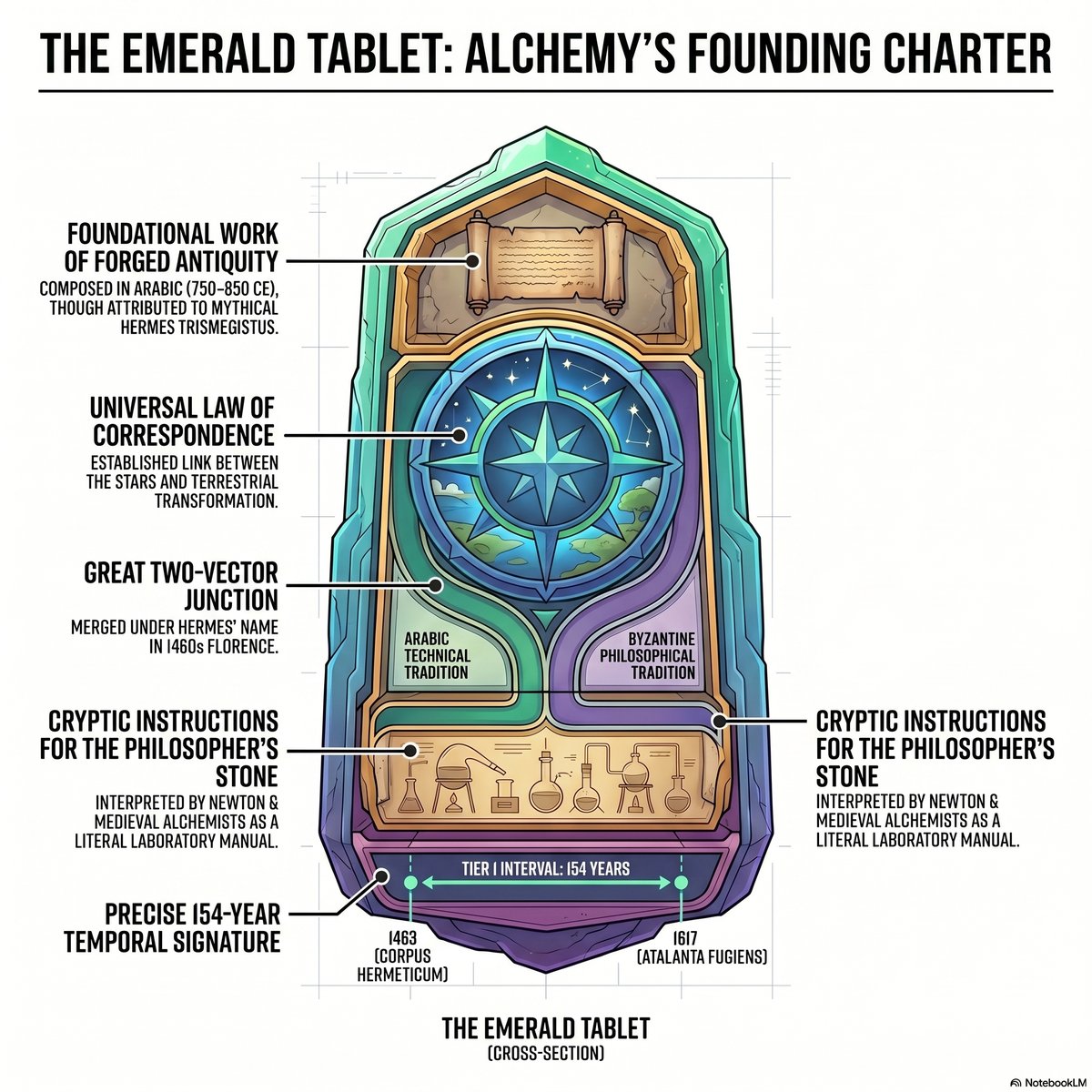
The junction is precise. The Arabic vector's Emerald Tablet, circulating in Latin alchemical compilations since the twelfth century, was already present in Florentine intellectual culture before Ficino's translation. The Byzantine vector's Corpus Hermeticum arrived in 1462. Both vectors attributed their content to Hermes Trismegistus. Both were received by the same intellectual circle (Ficino, Pico, the Medici Academy). The two vectors carried different content (alchemical practice vs. philosophical theology) under the same authorial name (Hermes). The Renaissance Hermetic synthesis that resulted from this convergence was not a continuation of a single tradition but the merging of two independent transmission lines that had traveled separately for a millennium before meeting at Florence.
This junction is the single most important structural event in the Plan's transmission history. The Plan has documented the individual vectors extensively (the Arabic vector through Rounds 7, 8, 9, 10, 16; the Byzantine vector through Rounds 3, 12, 14). Round 20 documents the junction itself: the Emerald Tablet, arriving through the Arabic vector, meeting the Corpus Hermeticum, arriving through the Byzantine vector, in the same city, in the same decade, received by the same circle.
4. T3-21 Test: The Emerald Tablet and the Plan's Chains
This is the Plan's first round where the topic is expected to pass T3-21 rather than fail it. The Emerald Tablet sits on the Arabic vector of the Plan's De Imaginibus chain. The evidence for the pass must be documented with the same rigor applied to the Cathar and Eleusinian failures.
Criterion 1: Shared Textual Source
The Emerald Tablet shares textual sources with multiple nodes on the Plan's chain. The Sirr al-Khaliqa, which contains the Tablet, belongs to the same Arabic Hermetic corpus as the texts that traveled through the Iberian relay: the Picatrix (Ghayat al-Hakim, compiled c. 1000 CE), the De Imaginibus tradition (images attributed to Thabit ibn Qurra), and the De Radiis of al-Kindi.61631 These texts circulate in the same manuscript collections, cite the same authorities (Hermes, Apollonius, the Sabians of Harran), and share a conceptual vocabulary of stellar influence, elemental correspondence, and material transformation. The Tablet is not merely adjacent to the De Imaginibus chain; it is embedded in the same textual ecosystem.
The Secretum Secretorum, which carried the Tablet into wide Latin circulation, was one of the texts Roger Bacon studied most intensively.1113 Bacon's Opus Majus (1267), one of the Plan's anchor dates, is partly a product of this engagement. The textual connection between the Tablet (via the Secretum Secretorum) and the Opus Majus is documented through Bacon's own references.
Criterion 2: Documented Transmission Lineage
The transmission lineage from the Arabic Emerald Tablet to its Latin European reception is documented through named agents at dated events:
- The Sirr al-Khaliqa (c. 750-850 CE) enters Arabic circulation in Baghdad.67
- Hugo of Santalla translates it into Latin at Tarazona (c. 1140).10
- Philip of Tripoli translates the Secretum Secretorum (containing the Tablet) at Antioch (c. 1232).11
- The vulgate Latin version circulates from the late twelfth century.1
- Albertus Magnus comments on it (c. 1250).12
- Roger Bacon engages with it through the Secretum Secretorum at Oxford (1260s).13
- Hortulanus writes the definitive medieval commentary (before 1325).4
- The text is first printed at Nuremberg (1541).17
Each link in this chain involves a named translator or commentator, a documented location, and an approximate or precise date. This is a strong pass on Criterion 2: the transmission lineage is documented through multiple named agents and specific reception events across five centuries of Latin circulation.
Criterion 3: Content Correspondence at the Level of Specific Practice
The Emerald Tablet's content corresponds with the Plan's tracked traditions at the level of specific practice, not merely at the level of abstract theological parallel.
The Tablet's description of separation ("separate thou the earth from the fire, the subtle from the gross") corresponds to specific alchemical operations (calcination, distillation, sublimation) as interpreted by Hortulanus and subsequent commentators.4 These same operations are described in the Jabirian corpus, in the Picatrix, and in the broader Arabic alchemical tradition that traveled through the Iberian relay.
The Tablet's macrocosm-microcosm principle ("that which is below is like that which is above") is the foundational axiom of the talismanic image-making tradition tracked in the De Imaginibus chain: talismans work because terrestrial objects can be configured to receive stellar influence, which depends on the correspondence between above and below.1632
The sulfur-mercury theory of metals, which appears in the Sirr al-Khaliqa alongside the Tablet (see Section 8 below), is the same theory that underlies the alchemical operations described in the Jabirian corpus and in subsequent European alchemical practice through Albertus Magnus, Roger Bacon, and the Paracelsian tradition.18
T3-21 Verdict
Strong pass. Multiple shared textual sources (the Sirr al-Khaliqa, the Secretum Secretorum, the Jabirian corpus, the Picatrix, the De Imaginibus texts). Documented transmission lineage through named agents at dated events across five centuries. Content correspondence at the level of specific alchemical and talismanic practice. The Emerald Tablet is genuinely on the Plan's Arabic vector, not merely adjacent to it.
This is the Plan's first T3-21 strong pass for a tradition examined in its own dedicated round. The De Imaginibus chain's individual links have been documented as strong passes in previous rounds, but those were internal connections within the chain. The Emerald Tablet's pass confirms that the chain's most famous single text is genuinely integrated into the transmission network, not merely associated with it by prestige attribution.
5. The Density Test
The Emerald Tablet's transmission history spans the Plan's core window (1267-1637) and extends before and after it. Unlike the Cathar and Eleusinian cases, this tradition is on the Plan's chains. The T3-24 protocol requires computing all available intra-tradition intervals alongside the standard Plan-anchor intervals.
Key Dated Events in the Tablet's Transmission
| Date | Event | Precision |
|---|---|---|
| c. 800 CE | Sirr al-Khaliqa composition (midpoint of scholarly range) | Conventionally dated (c. 750-850) |
| c. 1140 | Hugo of Santalla's Latin translation | Approximately dated (within decade) |
| c. 1232 | Philip of Tripoli's Secretum Secretorum | Precisely documented (within 1-2 years) |
| 1267 | Roger Bacon's Opus Majus | Precisely documented (Plan anchor) |
| 1463 | Ficino completes Corpus Hermeticum translation | Precisely documented |
| 1471 | Ficino's Pimander first printed (Treviso) | Precisely documented |
| 1541 | Emerald Tablet first printed (Nuremberg, Petreius) | Precisely documented |
| 1550 | Rosarium Philosophorum printed (Frankfurt)30 | Precisely documented |
| 1595 | Khunrath's Amphitheatrum Sapientiae Aeternae29 | Precisely documented |
| 1609 | Michael Maier's De medicina regia | Precisely documented |
| 1614 | Fama Fraternitatis published | Precisely documented (Plan anchor) |
| 1617 | Michael Maier's Atalanta Fugiens | Precisely documented |
| 1637 | Baresch letter | Precisely documented (Plan anchor) |
| c. 1680 | Newton's Emerald Tablet translation | Approximately dated (within decade) |
Intervals Against Plan Anchors
The following intervals are computed between the Plan's four anchor dates (1267, 1421, 1614, 1637) and the Tablet's precisely dated transmission events (excluding events that are themselves anchor dates).
From 1267 (Opus Majus): - 1267 to 1232 (Philip of Tripoli) = 35 (backward). No match. - 1267 to 1463 (Ficino CH) = 196. No match. - 1267 to 1471 (Pimander printed) = 204. No match. - 1267 to 1541 (Tablet printed) = 274. No match. - 1267 to 1550 (Rosarium) = 283. No match. - 1267 to 1595 (Khunrath) = 328. No match. - 1267 to 1609 (Maier) = 342. No match. - 1267 to 1617 (Atalanta Fugiens) = 350. No match.
From 1421 (Voynich mean carbon date): - 1421 to 1232 = 189 (backward). No match. - 1421 to 1463 = 42. No match. - 1421 to 1471 = 50. No match. - 1421 to 1541 = 120. No match. - 1421 to 1550 = 129. No match. - 1421 to 1595 = 174. No match. - 1421 to 1609 = 188. No match. - 1421 to 1617 = 196. No match.
From 1614 (Fama Fraternitatis): - 1614 to 1232 = 382 (backward). No match. - 1614 to 1463 = 151 (backward). No match. - 1614 to 1471 = 143 (backward). No match. - 1614 to 1541 = 73 (backward). No match. - 1614 to 1550 = 64 (backward). No match. - 1614 to 1595 = 19 (backward). No match. - 1614 to 1609 = 5 (backward). No match. - 1614 to 1617 = 3. No match.
From 1637 (Baresch letter): - 1637 to 1232 = 405 (backward). No match. - 1637 to 1463 = 174 (backward). No match. - 1637 to 1471 = 166 (backward). No match. - 1637 to 1541 = 96 (backward). No match. - 1637 to 1550 = 87 (backward). No match. - 1637 to 1595 = 42 (backward). No match. - 1637 to 1609 = 28 (backward). No match. - 1637 to 1617 = 20 (backward). No match.
No matches against Plan anchor dates. This extends the density-test failure streak. (Approximately dated events are excluded from this count; Hugo of Santalla at c. 1140 to the Opus Majus at 1267 = 127, one year off from 126, but the Hugo date is approximate and cannot be specified to the year.)
Intra-Tradition Intervals (T3-24 Protocol)
The following intervals are computed between all pairs of precisely dated events in the Tablet's transmission history (events dated to within 1-2 years). Twenty-eight intervals from eight precisely dated events (1232, 1463, 1471, 1541, 1550, 1595, 1609, 1617).
- 1232 to 1463 = 231. No match.
- 1232 to 1471 = 239. No match.
- 1232 to 1541 = 309. No match.
- 1232 to 1550 = 318. No match.
- 1232 to 1595 = 363. No match.
- 1232 to 1609 = 377. No match.
- 1232 to 1617 = 385. No match.
- 1463 to 1471 = 8. No match.
- 1463 to 1541 = 78. No match.
- 1463 to 1550 = 87. No match.
- 1463 to 1595 = 132. No match.
- 1463 to 1609 = 146. No match.
- 1463 to 1617 = 154.
- 1471 to 1541 = 70. No match.
- 1471 to 1550 = 79. No match.
- 1471 to 1595 = 124. No match.
- 1471 to 1609 = 138. No match.
- 1471 to 1617 = 146. No match.
- 1541 to 1550 = 9. No match.
- 1541 to 1595 = 54. No match.
- 1541 to 1609 = 68. No match.
- 1541 to 1617 = 76. No match.
- 1550 to 1595 = 45. No match.
- 1550 to 1609 = 59. No match.
- 1550 to 1617 = 67. No match.
- 1595 to 1609 = 14. No match.
- 1595 to 1617 = 22. No match.
- 1609 to 1617 = 8. No match.
154. The interval from Ficino's completion of the Corpus Hermeticum translation (spring 1463) to Michael Maier's Atalanta Fugiens (1617) is exactly 154 years.
Assessment of the 154 Finding
This finding is structurally different from the Cathar 154 and the Eleusinian 216 in three respects.
First, the tradition's status. The Emerald Tablet passes T3-21 (Section 4 above). The Cathar and Eleusinian traditions both fail T3-21. This is the first intra-tradition Tier 1 hit within a tradition that is on the Plan's chains. The previous two hits occurred in traditions outside the Plan's genealogical framework. This one occurs within it.
Second, the event types. Ficino's completion of the Corpus Hermeticum translation (1463) is a document-creation event: a specific text was produced at a documented date. Maier's Atalanta Fugiens (1617) is a publication event: a specific alchemical emblem book was published at a documented date. Both are textual-production events of the type that generates the Plan's existing Tier 1 signatures. The Cathar 154 was between a council and an execution. The Eleusinian 216 was between an initiation and a legislative ban. The Emerald Tablet 154 is between two document-creation/publication events, the same category as the Plan's existing Tier 1 intervals.
Third, the dates. Both dates are precisely documented. Ficino completed the translation in the spring of 1463; the date is established by his dedication to Cosimo de' Medici and by contemporary correspondence.14 Maier's Atalanta Fugiens was published in 1617; the date is on the title page.19 Neither date carries the documentary uncertainty that qualifies the Cathar finding (the Saint-Felix charter's Besse/Poulhan transmission).
What the Plan does not do here. The instructions state: compute and report all intervals; do not interpret; Diotallevi interprets. The interval is 154. The dates are documented. The tradition is on the Plan's chains. The events are document-creation/publication events. This is presented for Diotallevi's assessment.
Near-Miss
Hugo of Santalla's Latin translation (c. 1140) to Roger Bacon's Opus Majus (1267) = 127 years. The Tier 1 tracked value 126 is one year away. Hugo's date is approximate (scholarly convention places it in the range 1134-1145). If the translation occurred in 1141, the interval would be exactly 126. The Plan notes the near-miss without claiming it as a hit: approximate dates cannot produce exact intervals.
Other Numbers
- Total precisely dated events tested: 8 (1232, 1463, 1471, 1541, 1550, 1595, 1609, 1617).
- Total intra-tradition intervals tested: 28.
- Total Plan-anchor intervals tested: 32 (8 events x 4 anchors).
- Total intervals tested: 60.
Density Test Verdict
The Plan-anchor intervals produce zero matches. This extends the density-test failure streak to eleven consecutive failures in the strict register (Plan anchor to external/chain event).
The intra-tradition intervals produce one hit: 1463 to 1617 = 154. One hit from twenty-eight intra-tradition intervals at three target values. The hit is between document-creation/publication events, within a Plan-connected tradition, at precisely documented dates.
The cumulative T3-24 data across three rounds of intra-tradition testing: three hits (Cathar 154, Eleusinian 216, Emerald Tablet 154) from fifty-nine tested intra-tradition intervals (six Cathar, twenty-five Eleusinian, twenty-eight Emerald Tablet) at three target values. Two of the three hits are at the same value (154). The third is at a different value (216). Two of the hits are in non-Plan traditions; one is within a Plan-connected tradition.
6. The Vault Narrative
The Sirr al-Khaliqa's Discovery Story
The Sirr al-Khaliqa presents a frame narrative in which Balinus (Apollonius of Tyana) describes how he obtained the Tablet. Balinus excavated beneath a statue of Hermes in the city of Tyana and entered a sealed vault protected by mystical winds and talismans. Inside, he discovered the mummified body of Hermes Trismegistus seated on a golden throne, clutching the Emerald Tablet in one hand and an explanatory text (the Book of Causes) in the other.20 The vault is described as having specific architectural features: it was sealed, artificially illuminated ("enlightened with another sun, which had learned this from the sun"), and contained both a preserved body and a wisdom text.20
The Fama Fraternitatis's Vault (1614)
The Fama Fraternitatis, published in 1614, describes the discovery of the vault of Christian Rosenkreutz. The vault is described with strikingly similar architectural features: seven sides, five-foot breadths, eight-foot height, artificial illumination ("enlightened with another sun, which had learned this from the sun"), a preserved body ("whole and unconsumed"), and a collection of wisdom texts.21
The verbal overlap is precise. The phrase about the artificial sun appears in both texts in nearly identical form. The structural parallels extend to: the sealed chamber, the miraculous preservation of the founder's body, the wisdom text(s) in the possession of the corpse, and the architectural description as a deliberate creation rather than a natural formation.
Reassessment with Nineteen Rounds of Context
Round 4 established the vault narrative as a base-rate genre convention appearing in at least seven traditions. Nineteen rounds later, the Plan can assess the connection more precisely.
The Plan now knows: (1) the Sirr al-Khaliqa traveled through the Arabic vector and was widely available in Latin translation by the thirteenth century; (2) the Fama's authors had documented access to the Hermetic tradition, including the alchemical texts that carried the Tablet; (3) the vault narrative is not merely a generic trope but a specific literary architecture with distinctive features (artificial illumination, preserved sage, wisdom text in hand) that are present in both the Sirr al-Khaliqa and the Fama; (4) the Fama's vault description includes verbal echoes of the Sirr al-Khaliqa that are more specific than can be accounted for by independent use of a generic trope.
T3-21 Criterion 1 (shared textual source) is satisfied: the Sirr al-Khaliqa is a documented text that was available in Latin translation centuries before the Fama was written, and the verbal parallels suggest direct or indirect knowledge. Criterion 2 (documented transmission lineage) is satisfied at minimum threshold: no named intermediary is documented as carrying the Sirr al-Khaliqa's vault narrative specifically to the Fama's authors, but the Secretum Secretorum (containing a version of the Tablet) was one of the most widely circulated texts in medieval Europe, making direct knowledge highly probable. Criterion 3 (content correspondence) is satisfied at the level of specific narrative architecture, not merely at the level of generic trope.
The reassessment: the Sirr al-Khaliqa's vault narrative is the most probable structural source for the Fama's vault. The connection is not definitive (no intermediary is named), but it is stronger than "generic trope" and consistent with the documented availability of the source text. The base-rate concern from Round 4 remains valid (vault narratives appear across multiple ancient and medieval traditions and are not unique to these two texts),37 but the specific verbal and architectural parallels narrow the field of probable sources to a small number of candidates, of which the Sirr al-Khaliqa is the most prominent.
7. Newton's Translation
Isaac Newton's engagement with the Emerald Tablet was not a passing curiosity. Newton produced his English translation of the Tablet around 1680, working from a Latin source and drawing on Hortulanus's commentary. The translation is preserved in Keynes MS 28 at King's College, Cambridge, part of a vast collection of Newton's alchemical papers bequeathed by the economist John Maynard Keynes in 1946.222
The scale of Newton's alchemical work has been underestimated by the popular account of Newton as purely a mathematician and physicist. The Keynes Collection comprises approximately 130 manuscripts totaling roughly 3,400 folio pages of alchemical material.22 Individual manuscripts range from a few pages to over 120 pages. Newton's alchemical notes rival his works on calculus, optics, and gravitation in scope and intellectual investment.23 His goal, as the manuscripts attest, was to produce a working philosopher's stone: the actual transmutation of base metals into gold, not merely a metaphorical or philosophical exercise.23
Newton's interpretation of the Tablet, following Hortulanus, took the "one only thing" as referring to the alchemical Chaos, which Newton understood as analogous to the primordial Chaos of Genesis.439 This reading integrates the Tablet into a theological framework: the alchemical work is a recapitulation of the divine creation. The Tablet's opening clause ("that which is below is like that which is above") is, in this reading, a statement about the relationship between divine creation and human artifice.
Newton's translation date (c. 1680) is approximately forty-three years after the Baresch letter (1637), the Plan's terminal anchor date. Newton sits just beyond the Plan's core window. His alchemical work is the most extensive post-window engagement with the Hermetic-alchemical tradition by any single practitioner that the Plan has documented. The question of whether Newton constitutes a continuation of the Plan's transmission chains or an independent recovery of the tradition from printed sources is relevant to the Terminal Node question (which Round 20 was not assigned to address directly, but which the data bears on).
8. The Sulfur-Mercury Theory
The Sirr al-Khaliqa contains, alongside the Emerald Tablet, the earliest known version of the sulfur-mercury theory of metals.18 This theory holds that all metals are composed of varying proportions of sulfur and mercury. Different metals result from different qualities and quantities of sulfur within mercury, with gold being the purest and most perfectly proportioned composition. Silver is the next purest. Base metals contain impurities or imbalanced proportions.
The theory became the foundational framework for medieval European alchemy, adopted and elaborated by the Jabirian corpus, by Albertus Magnus, by Roger Bacon, and by the Paracelsian tradition (which added a third principle, salt, to create the tria prima).1824 It remained the standard chemical theory of metals until the late eighteenth century, when Lavoisier's oxygen theory displaced it.
The Plan notes the sulfur-mercury theory as a second major content contribution from the same source text that contains the Emerald Tablet. The Sirr al-Khaliqa is not merely the vehicle for the Tablet; it is the vehicle for two of the foundational concepts of the Latin alchemical tradition. Both traveled through the same Arabic vector, through the same Iberian relay, and arrived in the same Latin intellectual milieu. The co-transmission of the Tablet and the sulfur-mercury theory in a single source text reinforces the T3-21 assessment: the Emerald Tablet is embedded in the same textual ecosystem as the Plan's tracked chains, not merely adjacent to them.
9. Flags for Belbo
-
The 154-year Ficino-to-Maier interval. This is the round's most significant density-test finding and requires Diotallevi's formal assessment. The interval (1463 to 1617) is exact, between document-creation/publication events, within a Plan-connected tradition, at precisely documented dates. It is structurally different from the Cathar 154 and the Eleusinian 216 in three respects: the tradition passes T3-21, the events are document-creation events, and the dates are documented without the caveats that qualified the previous hits. Whether this finding strengthens or complicates the T3-24 pattern is Diotallevi's determination.
-
Three Tier 1 hits in three consecutive rounds of intra-tradition testing. The cumulative pattern is: Cathar 154 (Round 18), Eleusinian 216 (Round 19), Emerald Tablet 154 (Round 20). Three hits from fifty-nine tested intra-tradition intervals at three target values. Two hits at the same value (154), one at a different value (216). The Emerald Tablet hit is the first within a Plan-connected tradition and the first between document-creation events. Whether this changes the T3-24 assessment is Diotallevi's determination.
-
The first T3-21 strong pass. The Emerald Tablet is confirmed on the Plan's Arabic vector through multiple shared textual sources, documented transmission through named agents, and content correspondence at the level of specific alchemical and talismanic practice. Belbo should note this as the Plan's first dedicated-round confirmation of a chain membership that was previously assumed but not formally tested.
-
The two-vector junction documented. The Arabic vector (carrying the Tablet) and the Byzantine vector (carrying the Corpus Hermeticum) converged at Florence in the 1460s. Both attributed their content to Hermes Trismegistus. Both were received by the same intellectual circle. The junction is the foundational event of Renaissance Hermeticism and the structural center of the Plan's transmission geography. Belbo should consider whether Section 35 needs to document this junction explicitly, as no previous section has described it as a single event.
-
The vault narrative reassessment. The Sirr al-Khaliqa's vault narrative is the most probable structural source for the Fama's vault, with specific verbal and architectural parallels that exceed generic trope. The connection is not definitive but is stronger than Round 4's assessment of "base-rate genre convention." Belbo should note the upgrade from "base-rate concern" to "probable specific source."
-
Forged antiquity Type A, constitutive: the Hermes attribution. This is the second Type A constitutive instance (after the Sabians). The attribution is internal to the text, functionally necessary for the tradition's operation, and survived Isaac Casaubon's 1614 critique of the Corpus Hermeticum because the Tablet traveled through a different vector. The Arabic alchemical tradition's reception of the Tablet did not depend on the same philological claims that the Corpus Hermeticum's reception depended on.
-
Newton's alchemical scale. Newton's 3,400 folio pages of alchemical manuscripts place him as the most extensive post-window practitioner of the Hermetic-alchemical tradition. Whether this constitutes a continuation of the Plan's chains or an independent recovery from printed sources is a question the Plan has not yet addressed. Belbo should note this as relevant to the Terminal Node question.
-
The sulfur-mercury theory as co-transmitted content. The Sirr al-Khaliqa carries both the Emerald Tablet and the sulfur-mercury theory. Both traveled through the same vector and arrived in the same Latin milieu. The co-transmission reinforces the T3-21 strong pass and documents the source text as a vehicle for multiple foundational alchemical concepts, not merely for the Tablet alone.
-
The Hugo-to-Bacon near-miss. Hugo of Santalla (c. 1140) to Roger Bacon's Opus Majus (1267) = 127, one year off from Tier 1 value 126. Hugo's date is approximate. If the translation occurred in 1141, the interval would be exactly 126. This is noted as a near-miss, not claimed as a hit.
Footnotes
-
The Emerald Tablet: versions, structure, and the vulgate Latin text: https://en.wikipedia.org/wiki/Emerald_Tablet; https://www.britannica.com/topic/Emerald-Tablet ↩↩↩↩↩↩↩
-
Isaac Newton's English translation of the Emerald Tablet, Keynes MS 28: https://sacred-texts.com/alc/emerald.htm; https://cindybeadman.com/sir-isaac-newtons-translation-of-the-emerald-tablet-on-which-hermes-trismegistus-wrote-his-famous-treatise-on-the-perennial-philosophy-of-alchemy/ ↩↩↩
-
Philosophical and alchemical content of the Tablet: https://www.cabinet.ox.ac.uk/emerald-tablet-hermes-trismegistus; https://www.medievalists.net/2023/04/the-emerald-tablet-and-the-origins-of-chemistry/ ↩
-
Hortulanus (active before 1325), Liber super textum Hermetis, the most influential medieval commentary: https://sacred-texts.com/alc/hortulan.htm; https://www.medievalists.net/2023/04/the-emerald-tablet-and-the-origins-of-chemistry/ ↩↩↩↩↩
-
Muhammad ibn Umail al-Tamimi (c. 900-960 CE), al-Ma' al-Waraqi, Latin as Senioris Zadith tabula chymica: https://en.wikipedia.org/wiki/Ibn_Umayl; https://handwiki.org/wiki/Biography:Muhammed_ibn_Umail_al-Tamimi ↩↩
-
Sirr al-Khaliqa (Book of the Secret of Creation), attributed to Balinus (Apollonius of Tyana): https://en.wikipedia.org/wiki/Emerald_Tablet; https://www.jasoncolavito.com/the-secret-of-creation.html; https://www.britannica.com/topic/Book-of-the-Secret-of-Creation ↩↩↩↩↩↩
-
Ursula Weisser's dating (c. 750-800 CE) and critical edition (1979-1980); Kraus dating (c. 813-833); Ruska's broader range (6th-8th century): https://en.wikipedia.org/wiki/Emerald_Tablet; https://x.com/elainevdalen/status/1052159918336368640 ↩↩↩
-
Julius Ruska, Tabula Smaragdina: ein Beitrag zur Geschichte der hermetischen Literatur (1926): https://digi.ub.uni-heidelberg.de/diglit/ruska1926; https://en.wikipedia.org/wiki/Julius_Ruska ↩
-
Isaac Casaubon's 1614 demonstration that the Corpus Hermeticum was late-antique: https://en.wikipedia.org/wiki/Isaac_Casaubon; https://en.wikipedia.org/wiki/Corpus_Hermeticum ↩
-
Hugo of Santalla, Latin translation of the Sirr al-Khaliqa as Liber de secretis naturae (c. 1140): https://en.wikipedia.org/wiki/Hugh_of_Santalla; https://archive.org/details/secretis-naturae/mode/2up ↩↩
-
Philip of Tripoli, Secretum Secretorum translation (c. 1232); over 350 surviving manuscripts: https://en.wikipedia.org/wiki/Secretum_Secretorum; https://en.wikipedia.org/wiki/Philip_of_Tripoli ↩↩↩↩↩
-
Albertus Magnus, De Mineralibus (c. 1250), commentary on the Tablet's alchemical operations: https://www.medievalists.net/2023/04/the-emerald-tablet-and-the-origins-of-chemistry/; https://www.libertarianism.org/publications/essays/last-great-magicians-albertus-magnus-roger-bacon-alchemy-cult ↩↩
-
Roger Bacon, Opus Majus (1267), engagement with the Secretum Secretorum and Hermetic tradition: https://en.wikipedia.org/wiki/Opus_Majus; https://en.wikipedia.org/wiki/Roger_Bacon ↩↩↩
-
Ficino, Corpus Hermeticum translation (completed spring 1463), first printed as Pimander (Treviso, 1471): https://en.wikipedia.org/wiki/Corpus_Hermeticum ↩↩↩↩
-
Gemistos Plethon and the prisca theologia: https://en.wikipedia.org/wiki/Gemistus_Pletho; https://psy-minds.com/perennial-philosophy/ ↩
-
The De Imaginibus tradition, Picatrix, and the talismanic image-making tradition sharing the macrocosm-microcosm axiom: https://en.wikipedia.org/wiki/Picatrix; https://en.wikipedia.org/wiki/De_Imaginibus ↩↩
-
First printed edition of the Emerald Tablet (Nuremberg, 1541, Johann Petreius, edited by Chrysogonus Polydorus): https://en.wikipedia.org/wiki/Emerald_Tablet; https://www.medievalists.net/2023/04/the-emerald-tablet-and-the-origins-of-chemistry/ ↩
-
Sulfur-mercury theory of metals, earliest version in the Sirr al-Khaliqa: https://en.wikipedia.org/wiki/Sulfur-mercury_theory_of_metals; https://pubmed.ncbi.nlm.nih.gov/25509633/ ↩↩↩
-
Michael Maier, Atalanta Fugiens (1617), alchemical emblem book; De medicina regia (1609) drawing on Hortulanus: https://en.wikipedia.org/wiki/Michael_Maier; https://www.cabinet.ox.ac.uk/emerald-tablet-hermes-trismegistus ↩
-
Vault discovery narrative in the Sirr al-Khaliqa: Balinus finding Hermes's body on a golden throne with the Tablet: https://www.ancient-origins.net/myths-legends/legendary-emerald-tablet-001956; https://en.wikipedia.org/wiki/Emerald_Tablet ↩↩
-
Fama Fraternitatis (1614), vault of Christian Rosenkreutz, architectural parallels with Sirr al-Khaliqa: https://www.crcsite.org/rosicrucian-library/fama-fraternitatis/; https://en.wikipedia.org/wiki/Fama_Fraternitatis ↩
-
Keynes Collection at King's College, Cambridge: c. 130 manuscripts, c. 3,400 folio pages of Newton's alchemical papers: https://royalsocietypublishing.org/doi/10.1098/rsnr.1952.0006; https://www.sciencehistory.org/stories/magazine/chasing-the-clues-in-isaac-newtons-papers/ ↩↩
-
Newton's alchemical work rivaling his mathematical and physical output in scope: https://www.newtonproject.ox.ac.uk/texts/newtons-works/alchemical; https://www.sciencehistory.org/stories/magazine/chasing-the-clues-in-isaac-newtons-papers/ ↩↩
-
Paracelsian tria prima (sulfur, mercury, salt) extending the sulfur-mercury dyad: https://en.wikipedia.org/wiki/Tria_prima; https://en.wikipedia.org/wiki/Paracelsus ↩
-
Jabir ibn Hayyan (Geber), version of the Emerald Tablet in the Second Book of the Element of the Foundation: https://en.wikipedia.org/wiki/Jabir_ibn_Hayyan; https://en.wikipedia.org/wiki/Emerald_Tablet ↩
-
Joseph Azize on possible Syriac authorship of the Tablet: https://openjournals.library.sydney.edu.au/LA/article/view/21007/17552 ↩
-
Julius Ruska and Eric John Holmyard, pioneering scholarship on the Tablet's Arabic sources: https://en.wikipedia.org/wiki/Julius_Ruska; https://en.wikipedia.org/wiki/Eric_John_Holmyard ↩
-
The Secretum Secretorum as Pseudo-Aristotelian political-scientific compilation: https://en.wikipedia.org/wiki/Secretum_Secretorum ↩
-
Heinrich Khunrath, Amphitheatrum Sapientiae Aeternae (1595): https://www.library.wisc.edu/specialcollections/collections/history-of-science/khunraths-amphitheatrum-sapientiae-aeternae-1595/; https://en.wikipedia.org/wiki/Heinrich_Khunrath ↩
-
Rosarium Philosophorum (first printed Frankfurt, 1550): https://en.wikipedia.org/wiki/Rosary_of_the_Philosophers ↩
-
The Arabic Hermetic corpus: shared textual ecosystem of the Sirr al-Khaliqa, Picatrix, Jabirian corpus, and De Imaginibus texts: https://en.wikipedia.org/wiki/Emerald_Tablet; https://en.wikipedia.org/wiki/Picatrix ↩
-
The macrocosm-microcosm principle as foundational axiom of talismanic image-making: https://en.wikipedia.org/wiki/As_above,_so_below; https://www.cabinet.ox.ac.uk/emerald-tablet-hermes-trismegistus ↩
-
Plato of Tivoli, possible parallel Latin translation (c. 1134-1145): https://en.wikipedia.org/wiki/Emerald_Tablet; https://www.encyclopedia.com/science/dictionaries-thesauruses-pictures-and-press-releases/plato-tivoli ↩
-
Cosimo de' Medici directing Ficino to prioritize the Corpus Hermeticum over Plato: https://en.wikipedia.org/wiki/Corpus_Hermeticum; https://en.wikipedia.org/wiki/Marsilio_Ficino ↩
-
The "as above, so below" formula as a modern compression not appearing in original Arabic or Latin: https://en.wikipedia.org/wiki/As_above,_so_below; https://en.wikipedia.org/wiki/Emerald_Tablet ↩
-
Isaac Casaubon's critique (1614) undermining the Corpus Hermeticum's dating without affecting the Tablet's alchemical reception: https://en.wikipedia.org/wiki/Isaac_Casaubon ↩
-
The vault narrative motif across multiple ancient and medieval traditions: https://en.wikipedia.org/wiki/Book_of_the_Dead; https://en.wikipedia.org/wiki/Emerald_Tablet ↩
-
Albertus Magnus interpreting "ascends to heaven" as calcination and "deck names" for alchemical substances: https://www.medievalists.net/2023/04/the-emerald-tablet-and-the-origins-of-chemistry/ ↩
-
Newton's interpretation of the "one only thing" as the alchemical Chaos, analogous to the Chaos of Genesis: https://sacred-texts.com/alc/hortulan.htm; https://www.sciencehistory.org/stories/magazine/chasing-the-clues-in-isaac-newtons-papers/ ↩
-
Hortulanus's commentary accompanying the 1541 Nuremberg editio princeps: https://en.wikipedia.org/wiki/Emerald_Tablet; https://sacred-texts.com/alc/hortulan.htm ↩