The Eleusinian Mysteries
Listen
Show Notes
Summary
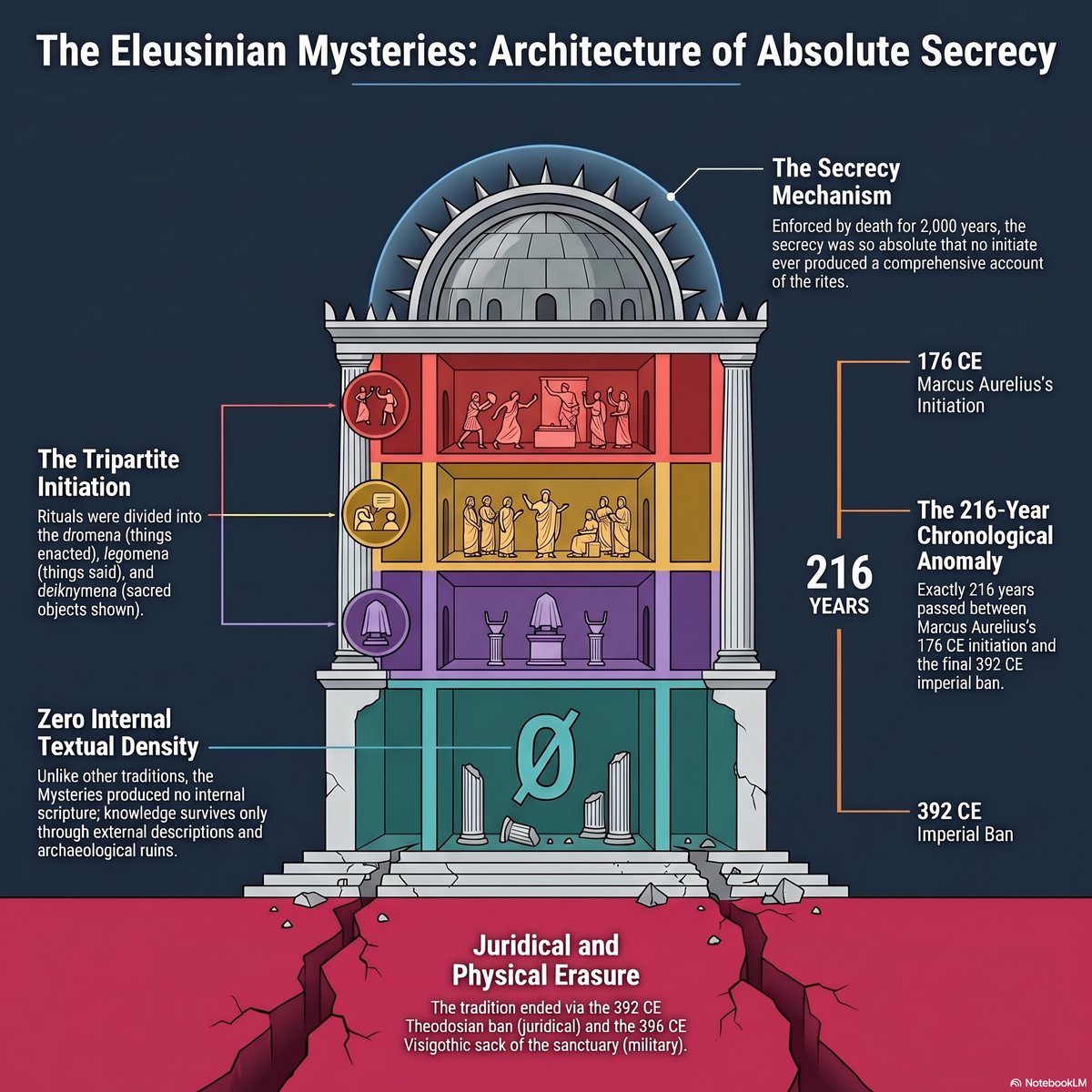
The Eleusinian Mysteries operated for nearly two thousand years and never leaked. No initiate — from Athenian citizens to Roman emperors — broke the oath of silence, making Eleusis the most successful case of voluntary concealment in the historical record. The tradition ended not through internal failure but through external force: the Theodosian edicts banned pagan rites, and Alaric's Visigoths destroyed the sanctuary in 396 CE. While the Mysteries share no genealogical connection to the Hermetic or Kabbalistic transmission chains this series tracks, Renaissance humanists and modern esotericists have repeatedly claimed Eleusis as a source of ancient wisdom. The actual content of the inner rites is permanently lost — we have the mythology, the archaeology, and the external choreography, but the secret itself died with the last initiates. A notable chronological finding places the interval between Marcus Aurelius's initiation and the final imperial ban at 216 years, matching a mathematical signature tracked across the broader research. Eleusis stands as a case study in how total secrecy, combined with juridical suppression, can permanently erase a knowledge tradition from the record.
Show Notes
- Two Millennia of Silence — The Eleusinian Mysteries maintained unbroken secrecy from roughly the 15th century BCE until their destruction in the late 4th century CE. The penalty for revealing the rites was death, but the silence appears to have been maintained through genuine reverence rather than fear alone.
- The Theodosian Edicts and Alaric's Destruction — Emperor Theodosius I's anti-pagan legislation in the 380s-390s CE provided the legal framework for closure. The physical destruction came with Alaric's Visigoths sacking the sanctuary at Eleusis in 396 CE. The combination of juridical ban and military violence ended the tradition completely.
- The Epistemological Paradox — The external facts of Eleusis are well-documented: the Sacred Way procession, the Telesterion's architecture, the kykeon drink, the mythological framework of Demeter and Persephone. But the actual experience inside the hall — the thing that mattered — is entirely unknown. The secrecy succeeded too well for history.
- No Hermetic Genealogy — Despite frequent claims by later esotericists, the Mysteries have no documented connection to the Hermetic-talismanic or Kabbalistic transmission chains. The tradition was indigenous to Attica and operated within Greek and later Roman religious frameworks, not the Egyptian or Near Eastern lineages this series tracks.
- Renaissance Appropriation — Ficino, Pico della Mirandola, and their successors invoked Eleusis as evidence for a prisca theologia — an ancient unified wisdom tradition. The appropriation was rhetorical, not genealogical. The Mysteries lent prestige to Renaissance Hermeticism without actually contributing content to it.
- The 216-Year Interval — The span between Marcus Aurelius's initiation (176 CE) and the final imperial prohibition matches a mathematical signature identified across the broader research. Whether this is coincidence or structural pattern remains an open question.
- Voluntary Concealment as Knowledge Loss — Eleusis presents a distinct category: knowledge lost not through destruction of texts or persecution of scholars, but through the deliberate choice of its holders never to write it down. The tradition's own security protocol guaranteed its eventual extinction once the institutional framework collapsed.
Sources & References
- Walter Burkert — Ancient Mystery Cults (1987)
- George Mylonas — Eleusis and the Eleusinian Mysteries (1961)
- Kevin Clinton — The Sacred Officials of the Eleusinian Mysteries (1974)
- Carl Kerenyi — Eleusis: Archetypal Image of Mother and Daughter (1967)
Maxwell's Pendulum: The Plan
Research Brief
Summary
The Eleusinian Mysteries (c. 1500 BCE to 392/396 CE) are the longest-attested initiatory tradition in the Western world, operating continuously for approximately two millennia before their juridical suppression under Theodosius I and physical destruction by Alaric's Visigoths. Diotallevi assigned this round for three converging reasons: the T3-23 finding (the Cathar 154) demands a second test of a non-Plan tradition at maximum genealogical and temporal distance; the Mysteries provide the Plan's deepest pre-window case and its most conspicuous untested tradition; and Theodosius's edicts offer a second instance of the Mode 7/Mode 6 compound documented in the Cathar round. The findings, in summary: the Mysteries are not connected to the Plan's transmission chains at any point (T3-21 negative); the Neoplatonic and Renaissance appropriations of Eleusinian imagery are proximity without genealogy; the secrecy mechanism is the most successful instance of Mode 1 in the Plan's material; and the density test produces one result that requires precise statement and careful handling.
1. The Secrecy Problem
This section comes first because it conditions everything that follows, as the Inquisition source problem conditioned Round 18. The Eleusinian Mysteries were bound by an absolute prohibition on revealing the secret rites (aporrheta), enforced under Athenian law by the penalty of death.1 For approximately two thousand years, thousands of initiates honored this prohibition. The Telesterion held roughly three thousand people at its peak capacity, and yet no initiate produced a comprehensive account of what occurred inside.2
The result is a tradition documented almost entirely from the outside. What survives is: a mythological foundation narrative (the Homeric Hymn to Demeter, composed c. 650-550 BCE), fragments from initiated authors who respected the secrecy oath (Pindar, Sophocles, Cicero, Plutarch, Aristophanes), hostile accounts from early Christian polemicists who sought to discredit the rites (Clement of Alexandria, Hippolytus of Rome), and the archaeological record of the sanctuary itself.3 Clement's Protrepticus (2.12) preserves what appears to be the initiates' password (synthema): "I fasted; I drank the kykeon; I took out of the chest; having done my task, I put again into the basket, and from the basket again into the chest."31 Pindar wrote that "blessed is he who has seen these things before he goes beneath the earth; for he understands the end of mortal life, and the beginning of a new life given of god."32 Plutarch used the initiation as a metaphor for philosophical enlightenment in multiple works, including the Life of Theseus, Isis and Osiris, and On the Face in the Moon.33 Aristophanes described the procession from Athens to Eleusis but not the inner rites, respecting the secrecy constraint even within the comic genre.34 Herodotus recorded the 55-day truce that allowed safe travel to the Greater Mysteries but, as an initiate, revealed nothing of the ceremony's content.35 Pausanias, also an initiate, provided references to the Mysteries without disclosing the aporrheta.38 Sophocles alluded to the transformative power of the rites without specifying their content.50 The epistemological situation is the inverse of the Cathar case. The Cathars were documented primarily through an adversarial archive produced by the institution that destroyed them. The Mysteries are undocumented primarily because the tradition's own members maintained their oath across millennia. The Cathar source problem is about hostile documentation. The Eleusinian source problem is about successful concealment.
This distinction matters for the Plan's methodology. When the Plan encounters the Cathar source problem, it must ask whether relevant evidence was destroyed by the Inquisition. When the Plan encounters the Eleusinian source problem, it must ask whether relevant evidence was never committed to a transmissible record in the first place. Both problems limit what T3-21 can determine, but by different mechanisms. The Cathar evidence may have existed and been destroyed. The Eleusinian evidence may never have been recorded. In both cases, a T3-21 negative means "no surviving evidence of connection." In the Eleusinian case, the negative carries an additional weight: the secrecy mechanism was designed precisely to prevent the kind of textual documentation that T3-21 requires.
The three components of the initiation experience are known by their Greek names but not by their content. The dromena ("things enacted") were ritualized reenactments, probably involving the myth of Demeter's search for Persephone.4 The legomena ("things said") were short liturgical statements or invocations accompanying the ritual performances.4 The deiknymena ("things shown") were sacred objects displayed by the Hierophant (the chief priest, drawn from the Eumolpidae family) at the climactic moment, emerging from the Anaktoron (the innermost sanctum) in radiant light4649, possibly including a single ear of grain "reaped in silence," as Hippolytus reports.5 The scholarly debate about what the central revelation was remains unresolved: an ear of grain (Hippolytus), a vision of Persephone, a psychedelic experience induced by the kykeon (Wasson, Hofmann, and Ruck's hypothesis), or simply the emotional and sensory impact of the ritual sequence in the darkened Telesterion illuminated by sudden fire.6
George Mylonas, who spent decades excavating Eleusis, concluded that the central secret remained unknown despite all archaeological and textual investigation.2 This is itself a finding: the secrecy mechanism worked. No other tradition in the Plan's material achieved concealment at this scale and duration.
2. Historical Overview: Origins Through Destruction
Mycenaean Origins
The earliest archaeological evidence for cultic activity at Eleusis dates to the Mycenaean period (c. 1600-1100 BCE). Remains of a sacred house and a well from this period have been identified beneath the later sanctuary, though whether these constitute evidence of the Mysteries proper or of an earlier agrarian cult from which the Mysteries developed is debated.7 The conventional scholarly position acknowledges Bronze Age roots while recognizing substantial transformation during the Archaic and Classical periods. Some scholars have questioned whether the Mycenaean remains are cultic rather than secular in character, making the earliest firm date a matter of interpretation rather than documentation.7
The Homeric Hymn and the Archaic Period
The Homeric Hymn to Demeter (c. 650-550 BCE) is the earliest and most important textual source for the Mysteries' foundation myth.3 The hymn describes Demeter's grief at Persephone's abduction by Hades, her arrival at Eleusis in disguise, her revelation of her divinity, and her instruction to the people of Eleusis to build a temple and establish sacred rites.3 The hymn does not describe the rites themselves, only the mythological framework within which they were understood.
Eleusis was incorporated into the Athenian political structure by approximately 600 BCE, when the Greater Mysteries became an official ceremony in the Athenian calendar.8 Peisistratos (ruled c. 550-510 BCE) dramatically elevated the Mysteries' status through state patronage and formal organization, subsidizing their celebration and ensuring their performance with substantial resources.8 The Peisistratid Telesterion, a large square hall with twenty columns, was constructed in the late sixth century BCE.9
The Classical Period
The Persian invasion of 480 BCE destroyed the Telesterion along with the Acropolis of Athens and other sacred sites across Attica.10 The sanctuary was rebuilt in successive phases: a Cimonian reconstruction (c. 470 BCE), then the Periclean Telesterion designed by Iktinos (the architect of the Parthenon), completed approximately 435-421 BCE.9 The Periclean Telesterion, designed by Iktinos (the same architect responsible for the Parthenon), was the largest and most elaborate version of the initiation hall, and it remained the principal structure for the remainder of the Mysteries' active life.40
The Alcibiades scandal of 415 BCE is the most famous breach of the Eleusinian secrecy. On the eve of the Sicilian Expedition, informants accused Alcibiades and companions of parodying the Mysteries during a drunken revel, with Alcibiades donning the robes of the Hierophant and mimicking sacred rituals.11 The scandal became intertwined with the mutilation of the Herms (stone statues of Hermes throughout Athens, desecrated on the night of June 7, 415 BCE), though the two events were likely separate.41 Alcibiades was tried in absentia, condemned to death, his property confiscated, and he was cursed by the Eleusinian priests.11 Whether the parody actually occurred as described, or was fabricated by Alcibiades's political enemies, remains debated.
Aeschylus, the tragic playwright, was accused of revealing Mysteries secrets in his plays. At trial he claimed he was not an initiate and could not have knowingly disclosed the aporrheta. He was acquitted.12 The incident confirms that the prohibition was enforced through the legal system: even an accusation of inadvertent disclosure prompted a formal trial.
The Roman Period
The Roman adoption of the Mysteries extended their reach across the Mediterranean, though the rites remained anchored to the sanctuary at Eleusis.39 Alexander the Great had earlier named a suburb of Alexandria "Eleusis" and established an adaptation of the Mysteries in a Greco-Egyptian context, but this was a transplantation, not a continuation of the original rites.44 Sulla was initiated in 84 BCE.13 The Emperor Hadrian attended the Lesser and Greater Mysteries in 124-125 CE, and was initiated again for the third degree of initiation in September 129 CE.14 The Costoboci (a Sarmatian people) sacked the sanctuary in approximately 170 CE, damaging the Temple of Demeter.15 Marcus Aurelius rebuilt the damaged temple and was initiated together with his son Commodus in 176 CE. Marcus Aurelius was uniquely permitted to enter the Anaktoron (the innermost sanctum), a privilege granted to no other lay person in the documented history of the Mysteries.15
The Emperor Julian ("the Apostate") was initiated during a stay in Athens in approximately 355 CE, making him the last Roman emperor to undergo the rites.16 On February 4, 362 CE, Julian issued an edict guaranteeing freedom of religion and commissioned efforts to restore the Mysteries, but his death in 363 CE ended the attempt.16
The End: Theodosius and Alaric
Theodosius I's anti-pagan legislation proceeded in stages. The Edict of Thessalonica (February 27, 380 CE) made Nicene Christianity the compulsory state religion.17 On February 24, 391 CE, Theodosius forbade attendance at pagan sacrifices and temples.18 In June 391, a rescript to the Egyptian prefect reiterated the ban. On November 8, 392 CE, a comprehensive decree prohibited all forms of pagan worship, including the Eleusinian Mysteries, under heavy penalties (the fine for sacrificing at a temple was twenty-five pounds of gold).1848 This edict, documented in the Codex Theodosianus, constitutes the juridical closure of the sanctuary.42
In 396 CE, Alaric I and his Visigoths invaded Greece, broke through Thermopylae, and destroyed the sanctuary at Eleusis. The contemporary historian Eunapius documented the destruction.19 The Goths plundered residences and the sanctuary before setting everything ablaze.19 By the fifth century CE, a Christian church had been built on the site.36 The Mysteries never recovered.
3. Mode 6 Analysis: Theodosius's Edict as Juridical Destruction
The suppression of the Eleusinian Mysteries is a Mode 6 event: coerced loss of a knowledge tradition through external intervention. The mechanism, however, is not straightforwardly military. It proceeds in two phases, juridical then military, and the distinction is analytically significant.
Phase 1: Juridical Suppression (380-392 CE)
Theodosius's edicts constitute a systematic legal program to eliminate pagan worship across the Roman Empire. The escalation from the Edict of Thessalonica (380 CE, establishing Nicene Christianity as the state religion) through the February 391 edict (forbidding temple attendance) to the November 392 decree (comprehensive ban under heavy financial penalties) represents a twelve-year juridical process.1718 Each edict increased the scope of the prohibition and the severity of the penalties.
The enforcement was not uniform across the empire. In Alexandria, Bishop Theophilus led aggressive implementation: he publicly mocked pagan artifacts, provoked violent clashes between pagan and Christian factions, and with Theodosius's permission destroyed the Serapeum in 391 CE, one of the most significant temple destructions of the era.2043 At Eleusis, the edicts appear to have been sufficient to halt the Mysteries without the kind of bishop-led destruction documented in Alexandria. No specific bishop is documented as having directed the suppression at Eleusis; the juridical mechanism operated through imperial law rather than local ecclesiastical initiative.
Phase 2: Physical Destruction (396 CE)
The Visigothic sack of 396 CE destroyed the physical infrastructure that would have been necessary for any clandestine revival. The Telesterion, the Sacred Way, the residences of the priestly families who administered the rites, and the associated structures were burned.19 The destruction was military, not juridical, but it completed a process that the juridical edicts had begun.
Comparison with the Cathar Mode 7/Mode 6 Compound
The Cathar case (Round 18) established the Mode 7/Mode 6 compound: the Inquisition's juridical apparatus operating as the systematic mechanism of involuntary loss, sustained over decades, producing an adversarial archive that replaced the destroyed tradition's own documentation.
The Eleusinian case shares the juridical mechanism but differs in three structural respects.
First, the scale of the juridical apparatus. The Inquisition was a purpose-built institution designed specifically to identify, interrogate, and destroy a particular heresy. Theodosius's edicts were empire-wide legislation targeting all pagan worship simultaneously, not a focused apparatus aimed at a single tradition. The Mysteries were destroyed not because they were specifically targeted but because they were pagan. The juridical mechanism is broader in scope and less focused in intent.
Second, the adversarial archive. The Inquisition produced thousands of pages of interrogation transcripts, polemical treatises, and procedural manuals that became the primary documentary record of what Catharism "was." Theodosius's edicts produced no comparable adversarial archive about the Eleusinian Mysteries. The edicts banned pagan practice; they did not describe it, interrogate its practitioners at length, or produce a systematic documentary record of its content. The hostile documentation of the Mysteries comes from the early Christian polemicists (Clement, Hippolytus), who wrote independently of and prior to the Theodosian legislation.
Third, the covert continuation question. The Cathar perfecti fled to Italy and Catalonia, maintaining their practice in exile until Belibaste's execution in 1321. The Eleusinian Mysteries had no comparable exile mechanism. The rites were tied to a specific location (the sanctuary at Eleusis), specific priestly families (the Eumolpidae and the Kerykes), and a specific annual calendar integrated into the Athenian civic structure: the Greater Mysteries in Boedromion (September/October) and the Lesser Mysteries at Agrae in Anthesterion (February/March).2137 The procession from Athens to Eleusis along the Sacred Way (Hiera Hodos) was a public civic event that required the sanctuary's physical infrastructure to function.47 When the location was destroyed and the priestly families were dispersed or converted, the institutional infrastructure that made the rites possible ceased to exist. There is no documented evidence of covert continuation after the edicts or the destruction.
Classification
The Eleusinian case is a Mode 7/Mode 6 compound, but of a different structural type from the Cathar compound. In the Cathar case, Mode 7 operates as a focused juridical apparatus (the Inquisition) sustaining Mode 6 over decades. In the Eleusinian case, Mode 7 operates as empire-wide legislative prohibition (Theodosius's edicts) followed by Mode 6 through military destruction (Alaric's sack). The compound is genuine: the juridical phase (380-392 CE) preceded and enabled the military phase (396 CE) by depriving the sanctuary of legal protection and institutional support. But the two-phase structure (legislation followed by invasion) is different from the Cathar single-mechanism structure (the Inquisition combining both phases in one institution).
This is the Plan's second Mode 7/Mode 6 compound. The two instances provide comparative data: Mode 7 can operate as a focused purpose-built institution (the Inquisition) or as broad legislative prohibition (the Theodosian edicts). The downstream effects differ: focused Mode 7 produces an adversarial archive; broad Mode 7 does not.
4. T3-21 Test: The Mysteries and the Plan's Transmission Chains
Diotallevi's primary analytical question: is the Eleusinian tradition genealogically connected to the Plan's Hermetic-talismanic-Kabbalistic chains, or merely proximate through the broad cultural category of "concealed knowledge"?
The Chains Under Test
The Plan's documented chains run through the Arabic transmission vector (De Imaginibus, Picatrix, De Radiis, Emerald Tablet), the Byzantine vector (Corpus Hermeticum), and the Kabbalistic vector (Mithridates to Pico). All three converge at Florence in the 1480s-1490s.
The Claimed Connections
Three claimed connections between the Eleusinian Mysteries and the Plan's traditions require testing.
Claim 1: The Neoplatonic Appropriation. The later Neoplatonists, particularly Iamblichus (c. 245-325 CE) and Proclus (412-485 CE), incorporated mystery-religion language and concepts into their philosophical systems.22 Iamblichus's De Mysteriis uses initiatory vocabulary extensively and advocates theurgy (ritual practice aimed at contact with the divine) as a complement to philosophical contemplation.22 Proclus combined Iamblichean theurgy with systematic theology and showed particular interest in mystery traditions, culminating in what the later tradition described as a "return to silence" emphasizing the apophatic character of the highest knowledge.22
The question is whether the Neoplatonic use of mystery language constitutes a genealogical connection to the Eleusinian Mysteries specifically. T3-21 Criterion 1 (shared textual source): no Eleusinian text enters the Neoplatonic corpus. The Neoplatonists drew on Plato's own use of mystery language (particularly the Symposium, Phaedrus, and Republic, where the language of initiation is metaphorical), on Orphic texts, and on general initiatory concepts that circulated across multiple mystery traditions (Eleusinian, Dionysian, Mithraic, Isiac). No text produced at Eleusis (no text was produced at Eleusis, given the secrecy constraint) entered the Neoplatonic reading list. T3-21 Criterion 2 (documented transmission lineage): no documented chain of transmission links the Eleusinian priestly families (Eumolpidae, Kerykes) to the Neoplatonic school at Athens or Alexandria through specific institutional or textual channels. T3-21 Criterion 3 (content correspondence): the Neoplatonic theurgy of Iamblichus involves ritualized manipulation of divine names, symbols, and material objects to achieve henosis (union with the One). This shares with the Eleusinian rites a structure of progressive initiation and a culminating revelatory experience, but the content is entirely different: Neoplatonic theurgy draws on Chaldean Oracles, Orphic hymns, and Platonic metaphysics, not on the Demeter-Persephone myth or the specific rites performed in the Telesterion.22
Verdict: proximity without genealogy. The Neoplatonists appropriated the language and conceptual structure of mystery initiation (progressive revelation, secrecy, transformative experience) without demonstrably inheriting specific Eleusinian content. The appropriation is thematic, not textual or institutional.
Claim 2: The Renaissance Reception. Marsilio Ficino and Giovanni Pico della Mirandola referenced the Mysteries as part of the prisca theologia, the supposed chain of ancient wisdom running from Egypt and Greece through Orpheus, Pythagoras, and Plato to the Christian revelation.23 Gemistos Plethon (1355-1454), whose influence on the Florentine Academy was foundational, explicitly cited Eumolpus (the mythological founder of the Eleusinian Mysteries) as part of a lineage of ancient wisdom transmitters alongside Zoroaster and Pythagoras.24
T3-21 assessment: the Renaissance reception of the Mysteries is mediated entirely through surviving classical texts (the Homeric Hymn, Cicero, Plutarch, Clement, Hippolytus) and through the Neoplatonic philosophical tradition. No Eleusinian text entered the Florentine orbit. No documented institutional connection links the Eleusinian priestly families to any Renaissance figure. The content correspondence is generic: the Renaissance thinkers invoked Eleusis as a prestigious name within the prisca theologia framework, not as a source of specific practices or texts. Plethon's citation of Eumolpus is a genealogical claim of exactly the type the Plan's forged antiquity test is designed to evaluate (see Section 6 below).
Verdict: proximity without genealogy. The Renaissance invocation of the Mysteries is a Type B forged antiquity (observer-generated inflation of the tradition's significance within a genealogical framework that the Mysteries' own practitioners would not have recognized).
Claim 3: The Hermetic Reading. Some modern esoteric authors have claimed that the Hermetic tradition (the Corpus Hermeticum, the Emerald Tablet, the talismanic texts) preserves or continues the wisdom of the Eleusinian Mysteries. This claim runs through the Theosophical tradition and various twentieth-century esoteric movements.25
T3-21 assessment: this claim fails at every criterion. The Corpus Hermeticum is a Greco-Egyptian philosophical text composed in the first to third centuries CE in Alexandria; it makes no reference to Eleusis, the Demeter-Persephone myth, or any specifically Eleusinian practice.25 The De Imaginibus chain (Thabit, Picatrix, De Radiis) is an Arabic-to-Latin transmission chain involving talismanic image-making; it has no documented connection to Eleusinian ritual. The Emerald Tablet is an alchemical text of uncertain origin (Arabic, possibly 6th-8th century CE); it bears no content relationship to Eleusinian initiation. No shared textual source, no documented transmission, no content correspondence at the level of specific practice.
Verdict: proximity without genealogy. The Hermetic-Eleusinian connection is a modern esoteric construction with no documentary basis.
Overall T3-21 Result
The Eleusinian Mysteries fail T3-21 at all three criteria across all three claimed connections. The tradition is not on the Plan's chains. The connections that have been claimed (Neoplatonic, Renaissance, Hermetic) are either thematic appropriations of initiatory language, genealogical claims within the prisca theologia framework, or modern esoteric constructions. None involves a shared textual source, a documented transmission lineage, or content correspondence at the level of specific practice.
This is the Plan's second external application of T3-21 to a non-Plan tradition (after the Cathar negative in Round 18). The result is a clear negative. T3-21 continues to discriminate effectively: it does not generate false positives from traditions that share the broad cultural category of "concealed knowledge" without sharing specific textual or practical inheritance with the Plan's chains.
5. The Forged Antiquity Test
The forged antiquity test asks whether a prestige claim is attached to a knowledge tradition in excess of what the original participants understood themselves to be doing.
The Mysteries' Own Claims
The Eleusinian Mysteries did not, so far as surviving evidence indicates, claim to transmit a body of secret knowledge from a prestigious ancient source in the manner of the prisca theologia. The Mysteries claimed to re-enact a mythological event (the abduction of Persephone, Demeter's grief, the reunion) and to grant initiates a blessed afterlife through participation in the rites.3 The prestige claim was experiential and eschatological (participation in the rites transforms the initiate's post-mortem fate), not genealogical (we inherited this wisdom from Hermes Trismegistus, Zoroaster, or some other ancient sage). The Eumolpidae claimed descent from Eumolpus, a mythological figure, but this is a priestly genealogical claim of the type common across ancient Mediterranean religions, not a claim about secret wisdom transmitted from a historical source.21
Forged Antiquity Applied by Others
The prestige inflation was applied by others, in two waves.
Wave 1: The Neoplatonic-Renaissance Appropriation. Plethon's citation of Eumolpus alongside Zoroaster and Pythagoras as transmitters of ancient wisdom is forged antiquity of Type B (observer-generated inflation).24 Ficino's and Pico's placement of the Mysteries within the prisca theologia framework similarly inflates the tradition's significance by claiming it as a node in a chain of wisdom transmission that the Mysteries' own practitioners did not describe.23 This is the same prisca theologia framework whose Zoroastrian claims the Plan corrected in Round 14 (the Van Bladel correction: the "Zoroaster" of the Renaissance is the author of the Chaldean Oracles, a Greek text, not the historical Persian prophet). The inflation is constitutive in one sense: it altered how the Renaissance received the ancient world, placing the Mysteries in a genealogical narrative that shaped Ficino's and Pico's intellectual project. But it is decorative relative to the Plan's chains, because the Mysteries are not on those chains and the inflation does not alter the textual genealogy the Plan tracks.
Wave 2: Modern Esoteric and Psychedelic Appropriation. The twentieth-century esoteric tradition (Theosophy, various mystery school revivals) claimed the Mysteries as evidence for an unbroken tradition of initiatory wisdom.25 Wasson, Hofmann, and Ruck's The Road to Eleusis (1978) proposed that the kykeon contained psychoactive compounds derived from ergot, reframing the Mysteries as a psychedelic experience.6 Whether or not the pharmacological hypothesis is correct (it remains debated; the evidence is circumstantial), its cultural effect was to add a new layer of prestige to the Mysteries by associating them with the 1960s-70s psychedelic movement. This is Type B inflation, decorative: it does not alter the Plan's textual genealogy.
Classification
The Eleusinian Mysteries present the forged antiquity test in a structurally distinctive form. The tradition itself did not inflate its own genealogy (unlike the Sabians' Type A identity gambit or the Rosicrucian manifestos' Type A founding myth). The inflation was applied entirely by external observers: Neoplatonists, Renaissance humanists, modern esotericists. All applications are Type B (observer-generated). The constitutive/decorative classification depends on the frame of reference: constitutive for the history of Renaissance thought (the prisca theologia shaped Ficino's project), decorative for the Plan's chains (the Mysteries are not on them).
This is the sixth application of the forged antiquity mechanism in the Plan's extended material: the Sabians (Type A, constitutive), the prisca theologia's Zoroaster (Type B, constitutive), the Porta Alchemica pilgrim legend (Type B, decorative), the House of Wisdom (Type B, decorative), the Cathar treasure legend (Type B, decorative, posthumous), and now the Eleusinian Mysteries (Type B, constitutive for Renaissance intellectual history, decorative for the Plan's chains).
6. The Density Test
The Eleusinian material falls entirely before the Plan's core window (1267-1637 CE). The expected result is failure, consistent with the nine prior density-test failures outside the window. This test provides the deepest pre-window case yet examined: the dates range from the fifth century BCE to the fourth century CE, more than eight centuries before the window opens.
Key Eleusinian Dates
| Date | Event | Precision |
|---|---|---|
| c. 1500 BCE | Earliest Mycenaean cultic evidence | Approximate (century range) |
| c. 650-550 BCE | Homeric Hymn to Demeter | Approximate (100-year range) |
| c. 600 BCE | Athenian incorporation of Mysteries | Conventionally dated |
| c. 550-510 BCE | Peisistratid Telesterion | Approximate (decades) |
| 480 BCE | Persian destruction of Eleusis | Approximate (within 1-2 years) |
| c. 440 BCE | Periclean Telesterion (Iktinos) | Approximate (within decade) |
| 415 BCE | Alcibiades scandal | Precisely documented |
| 84 BCE | Sulla's initiation | Precisely documented |
| 124-125 CE | Hadrian's initiation | Approximate (1-2 years) |
| c. 170 CE | Costoboci sack of sanctuary | Approximate (within 1-2 years) |
| 176 CE | Marcus Aurelius's initiation | Precisely documented |
| 355 CE | Julian's initiation | Approximate (1-2 years) |
| 380 CE | Edict of Thessalonica (Feb 27) | Precisely documented |
| 391 CE | Anti-pagan edict (Feb 24) | Precisely documented |
| 392 CE | Comprehensive ban (Nov 8) | Precisely documented |
| 396 CE | Alaric's destruction of Eleusis | Approximate (1-2 years) |
Intervals Against Plan Anchors
From 1267 (Opus Majus): - 1267 to 480 BCE = 1747 (backward). No match. - 1267 to 415 BCE = 1682 (backward). No match. - 1267 to 176 CE = 1091 (backward). No match. - 1267 to 392 CE = 875 (backward). No match. - 1267 to 396 CE = 871 (backward). No match.
From 1421 (Voynich mean carbon date): - 1421 to 480 BCE = 1901 (backward). No match. - 1421 to 176 CE = 1245 (backward). No match. - 1421 to 392 CE = 1029 (backward). No match. - 1421 to 396 CE = 1025 (backward). No match.
From 1614 (Fama Fraternitatis): - 1614 to 480 BCE = 2094 (backward). No match. - 1614 to 176 CE = 1438 (backward). No match. - 1614 to 392 CE = 1222 (backward). No match. - 1614 to 396 CE = 1218 (backward). No match.
From 1637 (Baresch letter): - 1637 to 480 BCE = 2117 (backward). No match. - 1637 to 176 CE = 1461 (backward). No match. - 1637 to 392 CE = 1245 (backward). No match. - 1637 to 396 CE = 1241 (backward). No match.
None match tracked Tier 1 numbers.
Intra-Eleusinian Intervals
The following intervals are calculated between the precisely or near-precisely dated Eleusinian events. Only intervals between events dated to within two years or better are included.
- Persian destruction to Alcibiades scandal: 480 to 415 BCE = 65. No match.
- Persian destruction to Sulla's initiation: 480 to 84 BCE = 396. No match.
- Persian destruction to Marcus Aurelius: 480 BCE to 176 CE = 656. No match.
- Persian destruction to Julian: 480 BCE to 355 CE = 835. No match.
- Persian destruction to Edict of Thessalonica: 480 BCE to 380 CE = 860. No match.
- Persian destruction to comprehensive ban: 480 BCE to 392 CE = 872. No match.
- Persian destruction to Alaric: 480 BCE to 396 CE = 876. No match.
- Alcibiades scandal to Sulla: 415 to 84 BCE = 331. No match.
- Alcibiades scandal to Marcus Aurelius: 415 BCE to 176 CE = 591. No match.
- Alcibiades scandal to Julian: 415 BCE to 355 CE = 770. No match.
- Alcibiades scandal to comprehensive ban: 415 BCE to 392 CE = 807. No match.
- Alcibiades scandal to Alaric: 415 BCE to 396 CE = 811. No match.
- Sulla to Marcus Aurelius: 84 BCE to 176 CE = 260. No match.
- Sulla to comprehensive ban: 84 BCE to 392 CE = 476. No match.
- Sulla to Alaric: 84 BCE to 396 CE = 480. No match.
- Marcus Aurelius to Julian: 176 to 355 CE = 179. No match.
- Marcus Aurelius to comprehensive ban: 176 to 392 CE = 216.
- Marcus Aurelius to Alaric: 176 to 396 CE = 220. No match.
- Julian to Edict of Thessalonica: 355 to 380 CE = 25. No match.
- Julian to comprehensive ban: 355 to 392 CE = 37. No match.
- Julian to Alaric: 355 to 396 CE = 41. No match.
- Edict of Thessalonica to comprehensive ban: 380 to 392 CE = 12. No match.
- Edict of Thessalonica to Alaric: 380 to 396 CE = 16. No match.
- Comprehensive ban to Alaric: 392 to 396 CE = 4. No match.
216. The interval from Marcus Aurelius's initiation (176 CE) to Theodosius's comprehensive ban (November 8, 392 CE) is exactly 216 years.
Assessment of the 216 Finding
This requires the same careful treatment applied to the Cathar 154 in Round 18.
216 is a Tier 1 tracked number with independent appearances in the Plan's core material (1421 to 1637 = 216; the factorial sequence 6! = 720, where 216 = 6^3). It now appears as an intra-Eleusinian interval, in a tradition that fails T3-21, between events that are not document-creation events, in a chronological region outside the Plan's core window by nearly nine centuries.
The dates. Marcus Aurelius's initiation in 176 CE is documented by multiple ancient sources. The date is established in the scholarly consensus; it is not a conventionally assigned date subject to century-range uncertainty.15 Theodosius's comprehensive ban of November 8, 392 CE is documented in the Codex Theodosianus, a precisely dated legal document.18 Both dates are independently established and neither was selected by the Plan. The documentary quality of these dates is higher than the Saint-Felix charter's 1167 (which carries the Besse/Poulhan transmission caveats noted in Round 18). 176 CE and 392 CE are both documented to within a year, and 392 CE is documented to the day.
The event types. Marcus Aurelius's initiation is a ritual event: a Roman emperor undergoes the Eleusinian rites. Theodosius's edict is a legislative event: an emperor issues a law banning pagan worship. Neither is a document-creation event of the type that generates the Plan's existing Tier 1 signatures. The Cathar 154 was between a council and an execution; the Eleusinian 216 is between an initiation and a legislative ban. Both are pairs of institutionally significant events, not pairs of textual-production events.
The tradition's status. The Eleusinian Mysteries fail T3-21 (Section 4 above). They are not on the Plan's chains. They are at maximum genealogical and temporal distance from the Plan's framework: pre-Christian, non-dualist, initiatory, pre-dating the Plan's documented transmission chains by more than eight centuries.
The probabilistic context. The number of intra-Eleusinian intervals tested is twenty-five (calculated above). The Plan tracks three Tier 1 values large enough to appear as multi-decade-or-longer intervals: 126, 154, and 216. The probability that at least one of twenty-five intervals hits one of three target values by chance depends on the distribution of intervals, which is not uniform (the intervals are constrained by the tradition's actual chronology and range from 4 to 876 years). No precise probability is computed here for the same reason it was not computed in Round 18: the intervals are not random variables, and the distribution is not uniform. The qualitative assessment is: one hit out of twenty-five opportunities at one of three target values is less unusual, per tested interval, than the Cathar result (one hit out of six opportunities). But the hit is at exact value, and the target value (216) is different from the Cathar hit (154).
What the Plan does not do here. The instructions state: present the intervals and results; do not interpret them; Diotallevi interprets. The Plan presents the data. The interval is 216. The dates are documented. The tradition is not on the chains. The interval is between non-document-creation events. This is the second appearance of a Tier 1 tracked number at exact value in a tradition outside the Plan's genealogical framework, after the Cathar 154. Both findings are presented for Diotallevi's assessment.
Other Numbers
- Duration of the Mysteries: c. 1500 BCE to 392 CE = approximately 1,892 years (imprecise; no correspondence).
- Duration of Theodosius's anti-pagan legislative program: 380 to 392 CE = 12 years (no correspondence).
- Telesterion capacity: approximately 3,000 (no correspondence).
- Number of precisely dated events tested: 8 (480, 415, 84, 176, 355, 380, 392, 396).
- Total intervals tested: 25.
Density Test Verdict
The Eleusinian dates produce zero new Tier 1 signatures in the strict sense (intervals between the Plan's anchor dates and Eleusinian events). This is the tenth consecutive density-test failure in that specific register.
The intra-Eleusinian interval of 216 years (176 CE to 392 CE) is the second appearance of a Tier 1 tracked number in a non-Plan tradition, following the Cathar 154 (1167 to 1321). Both are flagged for Diotallevi. Neither is elevated to Tier 1.
7. Textual Density and Distribution Breadth at 392 CE
The Mode 6 survival analysis framework (formalized by Diotallevi in pattern-018.md) requires assessment of two precondition variables: textual density and distribution breadth at the time of the Mode 6 event.
Textual Density
The Eleusinian Mysteries produced no texts. This is the tradition's defining characteristic and its most analytically significant property for the Plan's framework. The secrecy mechanism (Mode 1) prevented the creation of a textual record. The dromena, legomena, and deiknymena were performed, spoken, and shown, not written. No Eleusinian scripture, theological treatise, ritual manual, or liturgical text is known to have existed.2
The texts that describe the Mysteries were produced by outsiders: the Homeric Hymn (a mythological narrative, not a ritual text), Clement's Protrepticus (Christian polemic), Hippolytus's Refutatio (Christian heresiological catalog), and the scattered references in Pindar, Cicero, Plutarch, and others.3526 These are descriptions of the Mysteries, not texts of the Mysteries. The distinction is fundamental: the Plan's other Mode 6 cases involve the destruction of traditions that had produced texts (Baghdad's Arabic translations, the Cathars' four surviving texts, Prague's Rosicrucian manifestos). The Eleusinian case involves the destruction of a tradition that had produced no texts at all.
Textual density at 392 CE: zero (for the tradition's own textual output). The descriptive literature about the Mysteries (Hymn, Cicero, Plutarch, Clement, Hippolytus) survives because it was distributed through the normal channels of Greek and Latin literary transmission, not because it was part of the Mysteries' own textual program.
Distribution Breadth
The Mysteries' institutional presence was geographically concentrated at a single site (Eleusis) and administratively dependent on a single civic structure (the Athenian state). The priestly families (Eumolpidae and Kerykes) were hereditary Athenian lineages. The annual celebration followed a fixed calendar integrated into the Athenian religious year. Initiation required physical presence at Eleusis during the annual rites (the Greater Mysteries in September/October, the Lesser Mysteries in February/March at Agrae).21
Distribution breadth at 392 CE: minimal for the ritual tradition; wide for the descriptive literature about the tradition. The ritual practice existed in one location and could not be performed elsewhere. The literary descriptions were distributed across the Roman world through normal textual circulation.
Survival Analysis
The Eleusinian case introduces a structural type not previously encountered in the Plan's Mode 6 inventory: a tradition with zero textual density and minimal distribution breadth that is nevertheless extensively described by external sources with wide distribution breadth. The tradition's own content was destroyed (or rather, ceased to be performed). The tradition's external description survived because the describing texts were distributed through channels independent of the tradition itself.
The pre-distribution survival mechanism did not operate because there were no Eleusinian texts to pre-distribute. The personal portability mechanism did not operate because the rites could not be performed by a single practitioner or a small group in exile (they required the sanctuary, the priestly families, and the civic framework). The designed archival orientation did not apply because the tradition was designed for concealment, not for archival survival.
What survived is the shell: the mythological narrative, the descriptive accounts, the physical ruins. What did not survive is the content: what was said, done, and shown inside the Telesterion. The survival outcome is unique in the Plan's inventory: the tradition's existence and external characteristics are well documented, while its actual content is lost.
8. Concealed-Knowledge Modes
The Eleusinian material engages several of the Plan's nine documented modes:
Mode 1 (Voluntary Concealment): The Eleusinian secrecy mechanism is the most successful documented instance of Mode 1 in the Plan's material. The prohibition on revealing the aporrheta was maintained across approximately two millennia, enforced by capital punishment under Athenian law, and honored by thousands of initiates including some of the most prominent writers of the ancient world (Pindar, Aeschylus, Cicero, Plutarch, Marcus Aurelius).126 The Plan has documented Mode 1 in several contexts: the Rosicrucian brotherhood's anonymous publication (voluntary concealment of authorship), the Cathar perfecti's operational secrecy during the Inquisition period (voluntary concealment of personnel), and the Kabbalistic tradition's restricted oral transmission. None of these achieved the duration or completeness of the Eleusinian concealment. The Eleusinian case demonstrates Mode 1 at its maximum documented effectiveness.
Mode 6 (Involuntary Loss): The suppression of the Mysteries constitutes Mode 6 through the Mode 7/Mode 6 compound documented in Section 3. The tradition's knowledge was lost not because the texts were destroyed (there were no texts) but because the practice was prohibited and the institutional infrastructure was physically destroyed. This is a distinctive sub-type: Mode 6 applied to a non-textual tradition, where the loss is of practice rather than of documents.
Mode 7 (Juridical): Theodosius's edicts constitute the juridical mechanism, as documented in Section 3.
Mode 5 (Archetypal): The Eleusinian Mysteries may involve Mode 5 (archetypal concealment), where knowledge is encoded in mythological or symbolic form. The Demeter-Persephone myth, as narrated in the Homeric Hymn, is an agricultural cycle allegory (seed-grain descends into the earth in winter, returns in spring) that may encode a deeper teaching about death and rebirth that was revealed through the ritual experience.3 This is Mode 5 in its classical form: the content is "hidden in plain sight" within a mythological narrative that is publicly available (the Hymn was not secret) while the interpretation is restricted to initiates. However, the Plan cannot verify this classification because the restricted interpretation is precisely what was never recorded.
No new modes are generated. The Eleusinian material's distinctive contribution to the concealed-knowledge taxonomy is Mode 1 at maximum scale and duration, and Mode 6 applied to a non-textual tradition.
9. Revisionist Scholarship
The Plan's methodological discipline (established in the Cathar round through the Pegg/Moore challenge) requires attention to revisionist scholarship that questions received narratives.
The Psychedelic Hypothesis
R. Gordon Wasson, Albert Hofmann, and Carl A.P. Ruck published The Road to Eleusis: Unveiling the Secret of the Mysteries in 1978, proposing that the kykeon (a barley-and-mint beverage consumed during the rites) contained psychoactive compounds, possibly ergot alkaloids analogous to LSD, contained in the kykeon, the barley-and-mint beverage consumed during the rites.645 The hypothesis introduced the term "entheogen" (a substance that generates the experience of the divine within). Brian Muraresku's The Immortality Key (2020) extended the argument with additional archaeological and textual evidence.27
The hypothesis remains debated. Supporters argue that the pharmacological explanation accounts for the consistently reported transformative intensity of the experience across centuries. Critics note the absence of direct chemical evidence, the difficulty of achieving consistent dosing with ergot alkaloids, and the collective (rather than individual) nature of the initiation, which would complicate a pharmacological explanation requiring uniform dosing for three thousand simultaneous participants.6
The Plan takes no position on the pharmacological question. For the Plan's purposes, the relevant finding is methodological: the psychedelic hypothesis demonstrates how modern interpretive frameworks (the psychedelic movement of the 1960s-70s) can be projected onto ancient traditions, producing a form of Type B forged antiquity (modern significance retroactively attributed to ancient practice). Whether or not the kykeon was psychoactive, the framing of the Mysteries as a "psychedelic experience" is a modern construction that the ancient participants would not have recognized in those terms.
The Continuity Question
Some scholars have questioned the degree of continuity between the Mycenaean-period cultic activity at Eleusis and the Classical-era Mysteries. The archaeological evidence for Mycenaean-period ritual use of the site is ambiguous: the structures beneath the later sanctuary may be secular rather than cultic.7 Jan Bremmer's Initiation into the Mysteries of the Ancient World (2014) offers a reconstruction of the Eleusinian program that emphasizes what can be documented from the Classical and Roman periods while maintaining appropriate skepticism about the Mycenaean origin claims.28 Kevin Clinton's epigraphical work at Eleusis provides the most rigorous documentary basis for the Mysteries' institutional history, grounded in inscribed evidence rather than literary speculation.29
Fritz Graf and Walter Burkert have, in recent scholarship, given up on the attempt to offer a single linear reconstruction of the initiation proper, representing a significant methodological shift toward acknowledging the limits of the evidence.30
The revisionist position does not undermine the Plan's analysis. The T3-21 result holds regardless of whether the Mysteries have genuine Mycenaean roots or were substantially reinvented in the Archaic period. The density test uses only precisely dated events. The Mode 6 analysis depends on the documented suppression and destruction, not on the tradition's claimed antiquity.
10. Flags for Belbo
-
The 216-year Marcus Aurelius-to-Theodosius interval. This is the round's most significant finding and requires Diotallevi's formal assessment. The interval (176 CE to November 8, 392 CE) is exact, documented from precisely dated sources, and matches a Tier 1 tracked number. It falls outside the Plan's genealogical framework, between non-document-creation events, in a tradition at maximum temporal and genealogical distance from the Plan's chains. This is the second Tier 1 value found in a non-Plan tradition (after the Cathar 154). Both are flagged; neither is elevated.
-
Two Tier 1 hits in two consecutive non-Plan traditions. The Cathar 154 and the Eleusinian 216 are different Tier 1 values appearing in different non-Plan traditions at different chronological depths. This pattern, if it is a pattern, directly addresses the T3-23 question from Round 18: whether the Cathar 154 was coincidence or evidence of something broader. Diotallevi's testing protocol specified that a second non-Plan Tier 1 hit would weaken the coincidence explanation. The data now includes two hits. Whether two hits from two traditions are sufficient to weaken the coincidence explanation, or whether the probabilistic context (twenty-five tested intervals in the Eleusinian case, six in the Cathar case) is compatible with chance, is Diotallevi's determination.
-
Mode 1 at maximum documented scale. The Eleusinian secrecy mechanism is the most successful instance of voluntary concealment in the Plan's material: two millennia, thousands of initiates, enforced by capital punishment, honored by the ancient world's most prominent literary figures. Belbo should note this as the upper bound of what Mode 1 can achieve.
-
Mode 6 applied to a non-textual tradition. The Eleusinian case introduces a structural type not previously encountered: the destruction of a tradition that had produced no texts. The loss is of practice, not of documents. The Mode 6 survival analysis framework (textual density, distribution breadth) produces its limiting case: zero textual density, minimal distribution breadth, no survival mechanism operative. What survives is external description, not internal content.
-
The textual density paradox. The Eleusinian Mysteries are the most extensively described and least internally documented tradition the Plan has examined. External descriptions are numerous and widely distributed; internal documentation is zero. The survival of the shell (mythology, external accounts, archaeological record) while the content (what happened inside the Telesterion) is lost creates a distinctive epistemological situation: we know the tradition existed, we know its external form, but we do not know what it transmitted.
-
The two-phase Mode 7/Mode 6 compound compared with the Cathar single-phase compound. Belbo should consider whether the distinction (broad legislative prohibition followed by military destruction vs. focused purpose-built institutional apparatus) warrants formal notation in the Mode 7/Mode 6 compound classification. The downstream effects differ: the Inquisition produced an adversarial archive; the Theodosian edicts did not.
-
T3-21 second external confirmation. The Eleusinian negative confirms the principle's discriminating power at maximum genealogical and temporal distance. The principle correctly rejects three claimed connections (Neoplatonic, Renaissance, Hermetic) that share the broad cultural category of "concealed knowledge" without sharing specific textual or practical inheritance with the Plan's chains.
-
Plethon's Eumolpus citation as a prisca theologia mechanism. Plethon citing Eumolpus alongside Zoroaster and Pythagoras is the prisca theologia in action: the Renaissance construction of a genealogy of ancient wisdom. Belbo should note that this is the same mechanism that produced the Van Bladel correction in Round 14 (the "Zoroaster" of the prisca theologia is a Greek text's author, not the historical Persian prophet). The Mysteries are being incorporated into a genealogical narrative they did not generate and would not have recognized.
Footnotes
-
Secrecy of the Eleusinian Mysteries, aporrheta and death penalty: https://en.wikipedia.org/wiki/Eleusinian_Mysteries; https://eleusinianmysteries.org/profanation-of-the-mysteries/ ↩↩
-
George Mylonas on the central secret remaining unknown; Telesterion capacity c. 3,000: https://en.wikipedia.org/wiki/Eleusinian_Mysteries; https://www.crazyalchemist.com/mysteries-esoterica/eleusinian-mysteries-what-happened-inside-the-telesterion/ ↩↩↩
-
Homeric Hymn to Demeter (c. 650-550 BCE), earliest textual source for the Mysteries' foundation myth: https://en.wikipedia.org/wiki/Homeric_Hymns; https://press.princeton.edu/books/paperback/9780691014791/the-homeric-hymn-to-demeter ↩↩↩↩↩↩
-
Dromena, legomena, deiknymena as the three components of the initiation: https://san.beck.org/Eleusis-4.html ↩↩
-
Hippolytus of Rome, Refutation of All Heresies Book V, on the ear of grain "reaped in silence": https://www.newadvent.org/fathers/050105.htm ↩↩
-
Wasson, Hofmann, and Ruck, The Road to Eleusis: Unveiling the Secret of the Mysteries (1978), the psychedelic hypothesis: https://www.amazon.com/Road-Eleusis-Unveiling-Mysteries/dp/0151778720 ↩↩↩↩
-
Mycenaean-period cultic evidence at Eleusis, scholarly debate on secular vs. cultic structures: https://en.wikipedia.org/wiki/Eleusinian_Mysteries; https://www.ancient-origins.net/news-history-archaeology/eleusis-0018012 ↩↩↩
-
Athenian incorporation of the Mysteries (c. 600 BCE); Peisistratos's patronage (c. 550-510 BCE): https://www.britannica.com/topic/Eleusinian-Mysteries; https://myeleusis.com/en-us/eleusinian-mysteries/the-greater-mysteries/the-political-aspects-of-the-eleusinian-mysteries/ ↩↩
-
Telesterion construction phases (Peisistratid, Cimonian, Periclean): https://en.wikipedia.org/wiki/Telesterion; https://www.britannica.com/place/Telesterion ↩↩
-
Persian destruction of Eleusis (480-479 BCE): https://en.wikipedia.org/wiki/Achaemenid_destruction_of_Athens; https://en.wikipedia.org/wiki/Second_Persian_invasion_of_Greece ↩
-
Alcibiades scandal (415 BCE), profanation of the Mysteries and Herm mutilation: https://myeleusis.com/en-us/eleusinian-mysteries/historical-events/alcibiades-and-the-parody-of-the-mysteries/; https://eleusinianmysteries.org/profanation-of-the-mysteries/; https://www.worldhistory.org/article/1684/the-desecration-of-the-statues-of-hermes-415-bce/ ↩↩
-
Aeschylus accused of revealing Mysteries secrets, acquitted: https://myeleusis.com/en-us/eleusinian-mysteries/historical-events/aeschylus-and-the-mysteries/ ↩
-
Sulla's initiation at Eleusis (84 BCE): https://en.wikipedia.org/wiki/Eleusinian_Mysteries ↩
-
Hadrian's initiation (124-125 CE, again 129 CE): https://followinghadrian.com/2024/11/12/autumn-ad-124-hadrian-arrives-in-athens-and-attends-the-eleusinian-mysteries-hadrian1900/ ↩
-
Costoboci sack of Eleusis (c. 170 CE); Marcus Aurelius's initiation with Commodus (176 CE); Marcus Aurelius uniquely permitted into the Anaktoron: https://www.timetravelrome.com/2022/05/08/eulesian-mysteries-guide-to-the-ancient-eulesis/; https://www.historyskills.com/classroom/ancient-history/eleusinian-mysteries/ ↩↩↩
-
Emperor Julian initiated at Athens (c. 355 CE); edict of religious freedom (February 4, 362 CE): https://myeleusis.com/en-us/eleusinian-mysteries/historical-events/julian-the-apostate/; https://en.wikipedia.org/wiki/Julian_(emperor) ↩↩
-
Edict of Thessalonica (February 27, 380 CE), Nicene Christianity as state religion: https://en.wikipedia.org/wiki/Edict_of_Thessalonica; https://www.historytoday.com/archive/months-past/edict-thessalonica ↩↩
-
Theodosius I's anti-pagan edicts: February 24, 391 CE (temple attendance banned); June 391 (rescript to Egyptian prefect); November 8, 392 CE (comprehensive ban on all pagan worship, documented in Codex Theodosianus): https://en.wikipedia.org/wiki/Persecution_of_pagans_under_Theodosius_I; https://www.britannica.com/biography/Theodosius-I ↩↩↩↩
-
Alaric's Visigoths destroy Eleusis (396 CE); Eunapius as contemporary source: https://myeleusis.com/en-us/eleusinian-mysteries/historical-events/alaric-and-the-last-hierophant/; https://www.worldhistory.org/article/32/the-eleusinian-mysteries-the-rites-of-demeter/ ↩↩↩
-
Theophilus of Alexandria and the destruction of the Serapeum (391 CE): https://en.wikipedia.org/wiki/Theophilus_I_of_Alexandria; https://www.fabriziomusacchio.com/weekend_stories/told/2025/2025-01-21-serapeum_of_alexandria/ ↩
-
Eumolpidae and Kerykes as hereditary priestly families; the Mysteries' integration into the Athenian civic calendar: https://en.wikipedia.org/wiki/Eleusinian_Mysteries; https://www.britannica.com/topic/Eleusinian-Mysteries ↩↩↩
-
Neoplatonist engagement with mystery traditions: Iamblichus's De Mysteriis, Proclus's theurgical synthesis, the "return to silence": https://en.wikipedia.org/wiki/Neoplatonism; https://iep.utm.edu/neoplato/ ↩↩↩↩
-
Ficino and Pico della Mirandola, the prisca theologia and ancient mysteries: https://plato.stanford.edu/entries/pico-della-mirandola/ ↩↩
-
Gemistos Plethon citing Eumolpus alongside Zoroaster and Pythagoras as wisdom transmitters: https://psy-minds.com/perennial-philosophy/; https://en.wikipedia.org/wiki/Gemistus_Pletho ↩↩
-
Modern esoteric claims of Hermetic-Eleusinian connection (Theosophy, mystery school revivals): https://en.wikipedia.org/wiki/Eleusinian_Mysteries; negative finding from systematic search of Corpus Hermeticum and De Imaginibus chain texts for Eleusinian references ↩↩↩
-
Cicero, De Legibus 2.36, on the Mysteries as "nothing finer" and teaching "the basic principles of life": https://eleusinianmysteries.org/glossary/cicero/; https://www.loebclassics.com/view/marcus_tullius_cicero-de_legibus/1928/pb_LCL213.415.xml ↩↩
-
Muraresku, Brian. The Immortality Key (2020), extension of the psychedelic hypothesis: https://www.amazon.com/Immortality-Key-Uncovering-History-Religion/dp/1250207142 ↩
-
Bremmer, Jan N. Initiation into the Mysteries of the Ancient World (2014): https://archive.org/details/initiationintomy0000brem; https://brill.com/display/book/edcoll/9789004215122/B9789004215122_019.xml ↩
-
Kevin Clinton, Eleusis: The Inscriptions on Stone (2005-2008), epigraphical scholarship: https://classics.cornell.edu/kevin-clinton ↩
-
Fritz Graf, Walter Burkert, and Robert Parker abandoning linear reconstruction of the initiation: https://oxfordre.com/classics/display/10.1093/acrefore/9780199381135.001.0001/acrefore-9780199381135-e-8127 ↩
-
Clement of Alexandria, Protrepticus 2.12, preserving the initiates' password (synthema): https://eleusinianmysteries.org/glossary/clement-of-alexandria/; https://www.theoi.com/Text/ClementExhortation1.html ↩
-
Pindar on the blessed afterlife of initiates: https://eleusinianmysteries.org/glossary/pindar/ ↩
-
Plutarch's references to the Mysteries (Life of Theseus, Isis and Osiris, On the Face in the Moon, On Progress in Virtue): https://eleusinianmysteries.org/glossary/plutarch/ ↩
-
Aristophanes describing the procession but not the inner rites: https://faculty.umb.edu/gary_zabel/Courses/Phil%20281b/Philosophy%20of%20Magic/Pythagoras,%20Empedocles,%20Plato/The%20Ecole%20Initiative%20The%20Eleusinian%20Mysteries2.htm ↩
-
Herodotus recording the 55-day truce for safe travel to the Greater Mysteries: https://faculty.umb.edu/gary_zabel/Courses/Phil%20281b/Philosophy%20of%20Magic/Pythagoras,%20Empedocles,%20Plato/The%20Ecole%20Initiative%20The%20Eleusinian%20Mysteries2.htm ↩
-
Christian church built on the Eleusis site by the 5th century CE: https://en.wikipedia.org/wiki/Alaric_I; https://en.wikipedia.org/wiki/Eleusinian_Mysteries ↩
-
The Mysteries' annual calendar: Greater Mysteries in Boedromion (September/October), Lesser Mysteries at Agrae in Anthesterion (February/March): https://en.wikipedia.org/wiki/Eleusinian_Mysteries; https://www.britannica.com/topic/Eleusinian-Mysteries ↩
-
Pausanias as initiate providing references to the Mysteries: https://en.wikipedia.org/wiki/Eleusinian_Mysteries ↩
-
Roman adoption and expansion of the Mysteries across the Mediterranean: https://en.wikipedia.org/wiki/Eleusinian_Mysteries; https://www.britannica.com/topic/Eleusinian-Mysteries ↩
-
The Telesterion designed by Iktinos, architect of the Parthenon: https://www.worldhistory.org/image/3502/the-telesterion-eleusis/; https://en.wikipedia.org/wiki/Telesterion ↩
-
Herm mutilation (June 7, 415 BCE), politically conflated with the Mysteries parody: https://www.worldhistory.org/article/1684/the-desecration-of-the-statues-of-hermes-415-bce/ ↩
-
Codex Theodosianus as primary legal source for the anti-pagan edicts: https://en.wikipedia.org/wiki/Codex_Theodosianus ↩
-
Theodosius's destruction of pagan sanctuaries across the empire (391-395 CE): https://en.wikipedia.org/wiki/Persecution_of_pagans_under_Theodosius_I ↩
-
Alexander the Great and Eleusis: Alexandria suburb named "Eleusis"; adaptation of the Mysteries in Greco-Egyptian context: https://www.britannica.com/topic/Eleusinian-Mysteries ↩
-
The kykeon as barley-and-mint beverage consumed during the rites: https://en.wikipedia.org/wiki/Kykeon; https://en.wikipedia.org/wiki/Eleusinian_Mysteries ↩
-
The Anaktoron (innermost sanctum) and the Hierophant's role: https://en.wikipedia.org/wiki/Eleusinian_Mysteries; https://san.beck.org/Eleusis-4.html ↩
-
Sacred Way (Hiera Hodos) from Athens to Eleusis: https://en.wikipedia.org/wiki/Sacred_Way ↩
-
Penalty of 25 pounds of gold for temple sacrifice under the November 392 edict: https://en.wikipedia.org/wiki/Persecution_of_pagans_under_Theodosius_I ↩
-
The Hierophant as the chief priest of the Mysteries, drawn from the Eumolpidae: https://en.wikipedia.org/wiki/Hierophant; https://en.wikipedia.org/wiki/Eleusinian_Mysteries ↩
-
Sophocles on the Mysteries' transformative power: https://en.wikipedia.org/wiki/Eleusinian_Mysteries ↩