
Systematic Erasure of the Cathar Archive
Listen
Show Notes
Summary
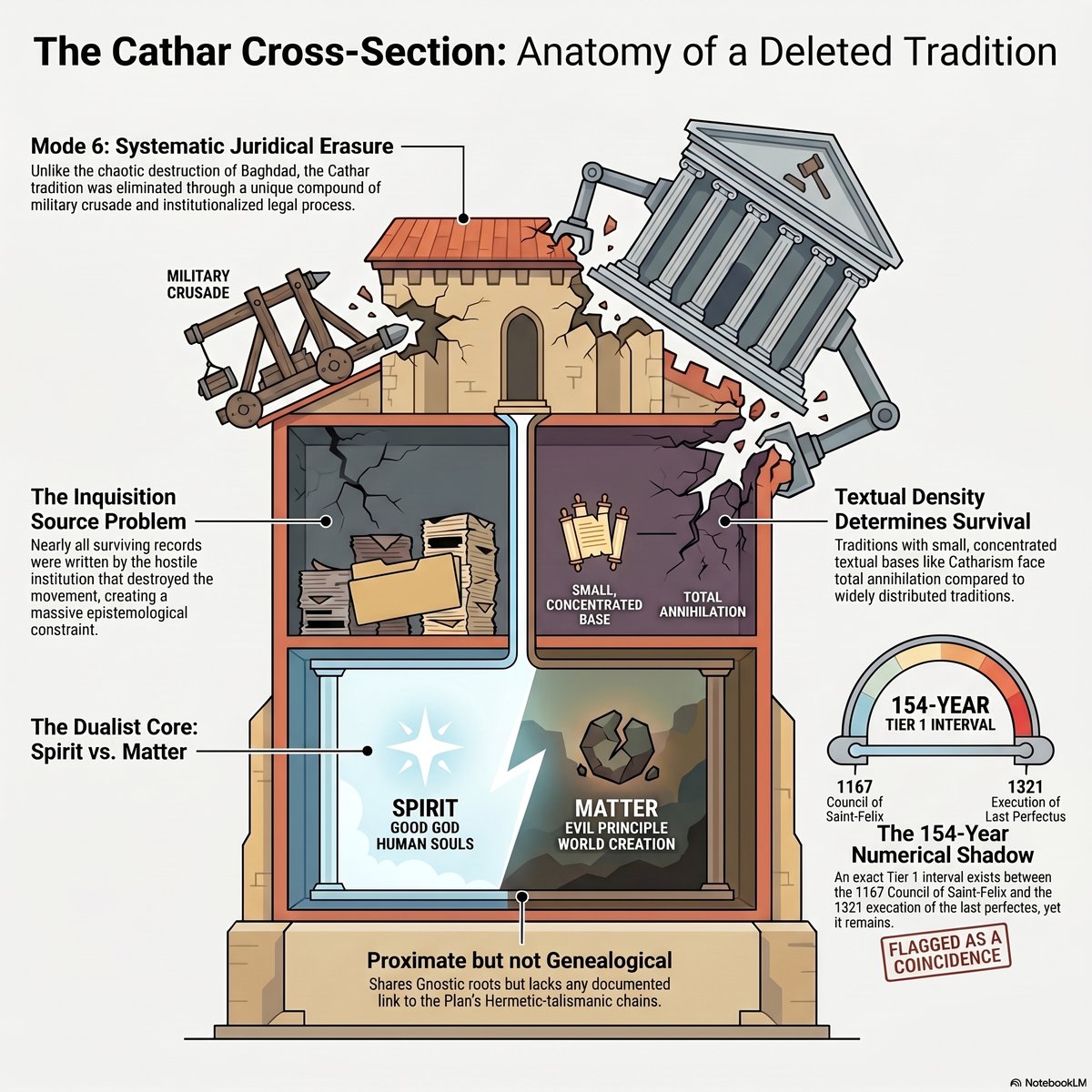
Nearly everything known about the Cathars was written by the institutions that destroyed them. The Albigensian Crusade and the Inquisition that followed didn't just eliminate a religious movement — they dismantled an entire civilization in Occitan France and left behind a documentary record authored almost exclusively by the persecutors. While popular genealogies try to trace Catharism back to ancient Manichaeism, the documented evidence points only to a thin connection with Bogomilism through a single recorded contact event. The Cathars' radical rejection of the material world placed them entirely outside the Hermetic-talismanic transmission chains that define the Western esoteric tradition. This episode classifies the crusade as a Mode 6 event — a violent, near-total annihilation of a tradition's textual record — and examines the juridical machinery of erasure that made it possible.
Show Notes
- The Epistemological Problem — The central difficulty with Cathar history: virtually all surviving documentation was produced by the Catholic Church, the Inquisition, or the crusading forces. The Cathars' own texts were systematically confiscated and burned, leaving researchers dependent on hostile witnesses for reconstruction.
- The Albigensian Crusade (1209-1229) — A twenty-year military campaign authorized by Pope Innocent III against the Cathar communities of Languedoc. The crusade destroyed not only the religious movement but the broader Occitan culture that had sheltered it, including its courts, its literary tradition, and its political autonomy.
- The Inquisition's Juridical Mechanism — Following the military campaign, the Dominican-led Inquisition provided the systematic, bureaucratic apparatus for total erasure. Interrogation records, trial transcripts, and sentencing registers became the primary surviving documentation — all produced by the institution conducting the destruction.
- The Bogomil Connection — Popular accounts link Cathars to a chain stretching back through Bogomilism to ancient Manichaeism. The documented evidence is far thinner: a single recorded contact event connects Cathar dualism to the Bogomil tradition in the Balkans. The legendary genealogy collapses under scrutiny.
- Dualism vs. the Hermetic Tradition — Cathar theology rejected the material world entirely, viewing physical creation as the work of an evil demiurge. This total rejection placed them in direct opposition to the Hermetic-talismanic tradition, which depends on manipulating material correspondences. The Cathars were outside the transmission chains this series tracks.
- Mode 6: Violent Knowledge Loss — The crusade and Inquisition together constitute a Mode 6 event in the series' classification system — a deliberate, institutionally driven destruction that nearly eliminated an entire tradition's textual record. What survives is fragmentary and filtered through the lens of the destroyers.
- The Destruction of Occitan Civilization — The collateral damage extended far beyond theology. The crusade ended the independence of the Languedoc region, suppressed the troubadour literary tradition, and absorbed Occitan political structures into the French crown. The erasure was cultural as much as religious.
Sources & References
- Malcolm Barber — The Cathars: Dualist Heretics in Languedoc in the High Middle Ages (2000)
- Mark Gregory Pegg — A Most Holy War: The Albigensian Crusade and the Battle for Christendom (2008)
- Emmanuel Le Roy Ladurie — Montaillou: The Promised Land of Error (1978)
- Bernard Hamilton — The Albigensian Crusade (Historical Association, 1974)
Maxwell's Pendulum: The Plan
Research Brief
Summary
The Cathar movement in southern France (c. 1140-1321) is the Plan's first dedicated examination of a Latin European religious community destroyed by organized military violence within its own civilization. The Albigensian Crusade (1209-1229) and the subsequent Inquisition constitute a Mode 6 event in Latin Europe, a century before the Plan's core window opens. Diotallevi assigned this round for three converging reasons: it provides the first external application of T3-21 (proximity vs. genealogy) to the claimed Cathar-Bogomil-Gnostic transmission chain; it adds a Latin European Mode 6 case to the T3-20 taxonomy; and it tests the density of pre-window dates against the Plan's tracked numbers. The findings, in summary: the claimed genealogy (Manichaeism to Paulicians to Bogomils to Cathars) is proximate at every link except the Bogomil-Cathar connection, where one documented contact event exists (the Council of Saint-Felix, 1167); no connection to the Plan's Hermetic-talismanic chains can be documented at any point; the Inquisition source problem is the most severe epistemological constraint the Plan has encountered; and the density test produces the ninth consecutive failure.
1. The Inquisition Source Problem
This section comes first because it conditions everything that follows. Nearly every surviving document about Cathar belief was written by people whose institutional purpose was to destroy Catharism. This is not a secondary methodological concern. It is the primary epistemological fact about the tradition.
The principal hostile sources are: Peter of les Vaux-de-Cernay's Historia Albigensis (c. 1213), a Cistercian chronicle of the Albigensian Crusade written by an eyewitness who accompanied the crusading army;1 Rainier Sacconi's Summa de Catharis (c. 1250), written by a former Cathar who converted to Catholicism and became a Dominican inquisitor, estimating approximately 4,000 perfecti across all Cathar communities;2 and Bernard Gui's Practica Inquisitionis Heretice Pravitatis (c. 1324), the most systematic inquisitorial manual, which codified the procedures for identifying, interrogating, and condemning heretics.3 Jacques Fournier (later Pope Benedict XII) conducted a meticulous inquisition at Pamiers from 1318 to 1325, producing 578 interrogations over 370 days, preserved in the Vatican archives.4 Emmanuel Le Roy Ladurie's Montaillou (1975) used the Fournier register to reconstruct village life in a Pyrenean community, demonstrating what the inquisitorial records contain besides theology: agricultural practices, sexual habits, social networks, and the texture of daily life in a community under surveillance.5
The surviving Cathar-authored texts are few. The Liber de Duobus Principiis (Book of the Two Principles), probably composed by the Italian Cathar theologian Giovanni de Lugio in the early thirteenth century, survives in a single manuscript discovered by the Dominican priest Antoine Dondaine in 1939 in a Florence library (Biblioteca Nazionale, Conventi Soppressi, J II 44).6 This is the most extensive original Cathar theological work. The Interrogatio Iohannis (Book of the Secret Supper, also known as the Questions of John), a Bogomil apocryphal text that traveled to the West and became a Cathar scripture, survives in two manuscripts: one from Carcassonne's Inquisition archives, one in Vienna's National Library.7 Two Occitan ritual texts survive: the Lyon Ritual (appended to a New Testament manuscript at the Bibliotheque municipale de Lyon, Ms. Palais des Arts 36), which includes the Aparelhamentum, a monthly confession rite found nowhere else; and the Dublin Ritual (Trinity College Dublin, Ms. 269), discovered by the Belgian philologist Theo Venckeleer in the 1960s.8
The ratio is stark. Against four Cathar-authored texts (one theological treatise, one apocryphal gospel of Bogomil origin, two ritual manuals), the hostile archive contains thousands of inquisitorial interrogations, crusade chronicles, polemical treatises, and papal correspondence. The Plan has encountered source bias before (the Sabians' identity in Round 10 is known partly through al-Nadim's report, and the House of Wisdom's institutional legend was shaped by later Orientalist scholarship), but those cases involved inflation of prestige claims. The Cathar case involves something structurally different: the systematic production of documentation by an institution whose purpose was the tradition's eradication. Every theological claim attributed to the Cathars by inquisitorial sources must be evaluated against the possibility that the claim was shaped, distorted, or fabricated by the interrogator's framework.
This is not a counsel of total skepticism. The Fournier register's detailed, consistent, and internally corroborated testimonies from villagers in Montaillou provide evidence that something coherent was being practiced. The Liber de Duobus Principiis confirms that at least some Cathar theologians held sophisticated dualist positions. But the epistemological asymmetry is real: we know the Cathars primarily through the records of the institution that destroyed them. The Plan must flag this at every point where a theological or organizational claim about Catharism is presented.
2. Cathar Belief: What Can Be Documented
The Dualist Core
Cathar theology, insofar as it can be reconstructed from both hostile and sympathetic sources, was dualist: two opposing principles, one good and one evil, governed existence.9 The material world was the creation of the evil principle (identified with the God of the Old Testament in some formulations, or with a fallen angel in others). The good God was purely spiritual and had no part in material creation. Human souls were sparks of the good God trapped in material bodies by the evil creator. Salvation consisted in the soul's liberation from matter and return to the spiritual realm.9
Two schools of Cathar dualism are documented. Absolute dualism, associated primarily with the Languedocian Cathars, held that the two principles were co-eternal and equally fundamental: neither was derived from the other.10 Mitigated dualism, associated primarily with Italian Cathar communities, held that the evil principle was a fallen angel, subordinate to the good God and derived from him. The Liber de Duobus Principiis argues for absolute dualism in seven chapters, making it the most philosophically developed surviving Cathar text.6
Practice
The central Cathar sacrament was the consolamentum, a laying-on of hands that served simultaneously as baptism, ordination, and (when administered to the dying) last rites.11 Those who received the consolamentum and survived became perfecti (or parfaits), the Cathar elite, bound to strict ascetic discipline: celibacy, vegetarianism (no meat, eggs, or dairy; fish was permitted), and renunciation of oaths and violence.11 The broader community of credentes (believers) lived ordinary lives but sought to receive the consolamentum before death.
The endura, a practice of fasting to death after receiving the consolamentum, is attested in inquisitorial records but its frequency and character are debated.12 Inquisitors presented it as a barbaric suicide practice; modern scholars have questioned whether the records exaggerate a rare practice into a defining feature of Cathar piety. The distinction between what the Cathars practiced and what the Inquisition attributed to them is precisely the source problem described above.
Christ and the Church
Cathar Christology was docetic: Christ appeared to have a material body but did not truly incarnate.9 This followed logically from the dualist premise: if matter is evil, the good God would not subject his son to true incarnation. The Cathars rejected all Catholic sacraments (baptism by water, the Eucharist, marriage, ordination) as material rites administered by a corrupt church that served the evil creator.9 They rejected the sign of the cross on the grounds that it celebrated an instrument of torture. They rejected church buildings as unnecessary: the good God did not require material temples.
These rejections constituted not merely a reform program but a root-and-branch repudiation of the Catholic institutional apparatus. The Cathars did not seek to reform the Church. They held that the Church was an instrument of the evil principle. This is what made the confrontation existential for both sides.
3. Origins: The Claimed Genealogy
The Chain Under Test
The traditional genealogy of Cathar dualism runs: Manichaeism (3rd century CE, Mesopotamia) to Paulicianism (7th-9th century, Armenia/Anatolia) to Bogomilism (10th-14th century, Bulgaria/Byzantium) to Catharism (12th-14th century, southern France and northern Italy).13 Steven Runciman's The Medieval Manichee (1947) codified this chain as the standard scholarly narrative, tracing dualist heresy from its Gnostic antecedents through eastern Christian heterodoxies to their western European expression.14
The T3-21 proximity test (shared textual source, documented transmission lineage, content correspondence) applies to each link in this chain.
Link 1: Manichaeism to Paulicianism
Manichaeism, founded by Mani (c. 216-276 CE) in Mesopotamia, was a universal dualist religion that spread from the Roman Empire to China.15 It declined in the West by the fifth century. The Paulicians emerged in Armenia in the seventh century, flourishing from roughly 650 to 872 in the Byzantine-Arab frontier regions.16
The temporal gap between Manichaeism's western decline (c. 5th century) and Paulicianism's emergence (c. 7th century) is approximately two centuries. No document bridges the gap. Samuel Lieu's comprehensive study of Manichaean survival in the medieval period found no continuous institutional presence in the Byzantine-Armenian frontier zone during the intervening centuries.52 Nina Garsoian's comprehensive study of Greek and Armenian sources argued that Paulicianism should be understood as Adoptionist rather than dualist, challenging the connection at its foundation.17 The scholarly consensus acknowledges that Paulician theology incorporated dualist elements but debates whether these derive from Manichaean transmission or from independent development within the Christian heterodox milieu of the Armenian highlands.16
T3-21 assessment: no shared textual source has been documented. No transmission lineage can be drawn through specific texts or reception events. Content correspondence (dualism) is present but generic: dualist cosmologies have emerged independently in multiple cultural contexts throughout history. Verdict: proximity, not genealogy. The Manichaean-Paulician link is the weakest in the chain.
Link 2: Paulicianism to Bogomilism
The Byzantine Emperor John I Tzimiskes (r. 969-976) transplanted Paulician colonies from eastern Anatolia to Thrace in approximately 970, creating a population of relocated Paulician communities in the Balkans.18 Bogomilism emerged in Bulgaria during the reign of Tsar Peter I (mid-tenth century), founded by a priest named Bogomil. The earliest documentation is Cosmas the Priest's Treatise Against the Bogomils (c. 972), which describes the movement's rejection of ecclesiastical authority and its dualist theology.19
The geographic and chronological proximity between the transplanted Paulician communities in Thrace and the emergence of Bogomilism in Bulgaria in the same decades is suggestive but not conclusive. The Via Egnatia, the principal Roman road connecting Constantinople to the Adriatic, ran through the regions where both transplanted Paulicians and emerging Bogomils were present, providing a plausible transmission corridor.45 Bogomilism subsequently spread back along this route toward Constantinople, where the burning of the Bogomil leader Basil around 1100 attests to the movement's penetration into the imperial capital itself.46 Cosmas does not mention the Paulicians. The Encyclopaedia Iranica notes that "the existence of older dualistic Christian heresies (Paulicianism and Manichaeism) influenced the Bogomil movement," but adds that scholars differ on which was the primary influence.20
T3-21 assessment: no shared textual source is documented. The geographic proximity (transplanted Paulicians in Thrace, emerging Bogomils in neighboring Bulgaria) constitutes institutional proximity rather than documented transmission. Content correspondence is stronger here than at Link 1: both traditions reject the material world, reject the Old Testament God, and practice a simplified Christianity. But content correspondence without documented textual transmission is precisely what T3-21 distinguishes from genealogy. Verdict: proximity with circumstantial support, but not documented genealogy.
Link 3: Bogomilism to Catharism
This is the one link in the chain where a specific documented contact event exists. The Council of Saint-Felix, held at Saint-Felix-de-Caraman in the Lauragais in 1167, was presided over by a figure described in the sources as "papa Nicetas," a Bogomil bishop from Constantinople.21 Nicetas renewed the consolamenta of the assembled Cathar bishops and confirmed episcopal offices for the Cathar churches of Languedoc and Catalonia.21
The documentary basis for this council requires scrutiny. The original charter does not survive. What survives is a text published by Guillaume Besse in the seventeenth century, copied from a now-lost 1223 copy made by Pierre Poulhan, who later became Cathar bishop of Carcassonne.22 Besse forged other documents in his published collection, which casts doubt on the Saint-Felix charter. However, formal analysis by the Institut de recherche et d'histoire des textes (IRHT) concluded that the charter's language and structure are consistent with a medieval original and that it cannot be a modern forgery.22 Most scholars now accept the council as historical, with the qualification that "all doubt is difficult to expel."22
If the Council of Saint-Felix is accepted as historical, it establishes a single documented contact event between Bogomil and Cathar communities: a Bogomil bishop traveled from Constantinople to southern France and participated in the organization of Cathar churches. This is a transmission event of the type the Plan requires: a specific figure, at a documented date, performing a documented function (renewing consolamenta, confirming episcopal structures) that transferred institutional practice from one community to another.
Additional evidence: the Interrogatio Iohannis, a Bogomil text, was translated into Latin and introduced to Italy in the late twelfth century by a Cathar bishop named Nazarials (or Nazario), and subsequently taken to Provence.747 This is a documented textual transmission: a specific text traveled from the Bogomil literary tradition into Cathar communities through a named agent.
T3-21 assessment: one shared textual source (Interrogatio Iohannis, documented as traveling from Bogomil to Cathar communities). One documented transmission event (Council of Saint-Felix, if accepted). Content correspondence is strong: both traditions practice the consolamentum, maintain a perfecti/credentes distinction, hold dualist theology, and reject the Catholic sacramental system. Verdict: the Bogomil-Cathar link passes T3-21 at the minimum threshold. This is the Plan's first application of T3-21 to a tradition other than the one that generated it, and the result is a qualified positive: the connection is real but thin. One documented text, one documented contact event. The Cathar tradition did not emerge from Bogomilism whole; it received specific elements (the consolamentum structure, the Interrogatio Iohannis) through documented channels while developing its own theological and institutional character independently.
The Revisionist Challenge
Mark Pegg's The Corruption of Angels (2001) and A Most Holy War (2008) argue that "Catharism" as a unified, organized counter-church is a modern scholarly construction, and that what medieval sources document is a fragmented, localized set of religious practices that the Inquisition retrospectively unified into a coherent heresy.23 Pegg's core claim is stark: "The Cathars never existed, except as an enduring invention of late nineteenth-century scholars of religion and history."23
R.I. Moore's The Formation of a Persecuting Society (1987/2007) and The War on Heresy (2012) argue from a different direction that the persecution of Cathars was part of a broader pattern in which twelfth- and thirteenth-century European institutions created the categories of persecution (heretic, Jew, leper, sodomite) as instruments of power consolidation.24 Moore contends that "no coherent opposition to Catholicism, outside the Church itself, existed" and that "the true begetters of heresy were the very men committed to its destruction."24
Bernard Hamilton and Peter Biller have contested these revisions, pointing to the Council of Saint-Felix, the surviving Cathar texts, the consistency of inquisitorial testimonies across different regions and decades, and the documented Bogomil connection as evidence that something organizationally real existed.25 The debate is not settled.
The Plan's position: the Pegg/Moore revision sharpens the source problem described in Section 1 but does not resolve it in either direction. The surviving Cathar-authored texts (Liber de Duobus Principiis, the ritual manuals) confirm that some communities held coherent dualist theology and practiced organized rites. The Council of Saint-Felix, if authentic, confirms organizational structure. The Fournier register confirms that villagers in Montaillou in the early fourteenth century practiced identifiable heretical devotions over sustained periods. Whether these constitute a "church" in the sense the Inquisition described is a question about the degree of organizational coherence, not about the existence of the practices themselves. The Plan documents what is documented. What is documented is: dualist theology, the consolamentum, the perfecti/credentes distinction, organized communities, and one contact event with Bogomil missionaries. What is not documented, or documented only through hostile witnesses, is: a unified international counter-church with a hierarchical structure comparable to the Catholic Church.
4. The Albigensian Crusade (1209-1229): Mode 6 in Latin Europe
Precipitating Events
On January 14, 1208, the papal legate Pierre de Castelnau was murdered near Saint-Gilles in Provence.26 Pope Innocent III, who had been calling for action against the Languedocian heresy since 1198, used the assassination (attributed to a squire of Count Raymond VI of Toulouse, though Raymond denied involvement) as the pretext for declaring a crusade.26 The call went out on March 10, 1208, offering crusaders the same indulgences as those who fought in the Holy Land and, critically, offering the lands of heretics and their protectors to those who conquered them.27
The Sack of Beziers (July 22, 1209)
The crusading army, estimated at between 10,000 and 30,000 men, descended the Rhone valley in the summer of 1209 under the nominal command of the papal legate Arnaud Amalric, Abbot of Citeaux.28 Beziers, a prosperous city in the Trencavel viscounty, was the first major target. The city contained both Catholics and Cathars. According to the Cistercian chronicler Caesarius of Heisterbach (writing some years after the event), when the crusaders asked Arnaud Amalric how to distinguish Catholics from heretics, he replied: "Kill them all, God will know his own" (Caedite eos. Novit enim Dominus qui sunt eius).28
Whether Arnaud Amalric actually said this is debated. Caesarius was not an eyewitness; his Dialogus Miraculorum was compiled some years after the event and drew on secondhand reports.53 The papal legate's own report to Innocent III states that approximately 20,000 people were killed regardless of "age, sex, or status."2848 Peter of les Vaux-de-Cernay, who was present, gives a lower figure. Modern estimates range from 7,000 to 20,000 killed.28 The city was burned.
Simon de Montfort's Campaigns (1209-1218)
After the fall of Beziers, the crusade was led increasingly by Simon de Montfort, a minor French nobleman who leveraged the crusade into a territorial conquest of the Languedoc.29 The siege of Carcassonne (August 1-15, 1209) resulted in the surrender of the young Viscount Raymond-Roger Trencavel, who was imprisoned and died in captivity three months later under suspicious circumstances.29 De Montfort systematically besieged and captured Cathar strongholds across the region through the following decade. At the Battle of Muret (September 12, 1213), de Montfort's outnumbered force defeated the combined army of Raymond VI of Toulouse and King Peter II of Aragon, killing Peter on the field, a result that effectively ended Aragonese intervention on behalf of the southern lords.30
De Montfort was killed by a stone launched from a mangonel at the siege of Toulouse on June 25, 1218, an event recorded by William of Puylaurens in his chronicle of the crusade.3154 His son Amaury proved unable to hold the conquered territories, and the crusade's military phase was largely concluded by the Treaty of Paris (April 12, 1229), which imposed French royal authority over the Languedoc, required Count Raymond VII of Toulouse to endow a university (the future University of Toulouse), and established the Inquisition as the permanent mechanism for extirpating heresy.32
The Siege of Montsegur (1243-1244)
Montsegur, a mountain fortress in the Ariege Pyrenees, became the last major Cathar stronghold. The siege began in May 1243, when a royal army of approximately 10,000 under Hugues des Arcis invested the castle.33 The garrison held out for roughly ten months. On March 1, 1244, the defenders surrendered, with a fifteen-day truce during which any perfecti willing to recant would be spared.33
On March 16, 1244, approximately 200 to 225 perfecti who refused to recant were burned on a mass pyre in the field below the castle, known subsequently as the Prat dels Cremats (Field of the Burned).33 This is the single most concentrated act of anti-Cathar violence in the historical record.
The "treasure of the Cathars" legend holds that four perfecti escaped the castle the night before the burning, carrying something of value (variously identified in later legend as the Holy Grail, secret texts, or gold).34 The escape of four individuals from the fortress on the night of March 15 is attested in the inquisitorial records; what they carried, if anything, is not documented.34
The End: Guillaume Belibaste (1321)
The last known Cathar perfectus, Guillaume Belibaste, was betrayed by a spy named Arnaud Sicre (himself the son of a Cathar woman), lured from his refuge in Catalonia, arrested, and burned at Villerouge-Termenes in 1321.35 The Fournier Inquisition at Pamiers (1318-1325) swept up the remnants of the Cathar community in the Ariege. After Belibaste's execution, no documented Cathar perfectus is known to have survived.
5. Mode 6 Classification: The Albigensian Crusade in the T3-20 Taxonomy
The Albigensian Crusade is a Mode 6 event: coerced loss of a knowledge tradition through external violence. The T3-20 taxonomy (established Round 16, extended Round 17) provides three sub-types. The Cathar case falls under Sub-type 2: institutional-to-regional, violent/destructive.
Comparison with the Mongol Sack of Baghdad (1258)
The existing Sub-type 2 instance is the Mongol sack of Baghdad, which destroyed the Abbasid institutional concentration while the Arabic intellectual tradition survived through pre-existing geographic distribution (the Iberian and Sicilian relays). The Cathar case shares the mechanism (military destruction of an institutional center) but differs in three structural respects.
First, the survival outcome. Baghdad's texts survived because they had already been distributed through the relay system before the sack occurred. The Cathar texts did not survive in comparable quantity because the tradition's literary output was small, its texts were not widely distributed through commercial or scholarly networks, and the Inquisition actively sought and destroyed Cathar manuscripts.36 The Liber de Duobus Principiis survives in a single manuscript because that single copy escaped destruction, not because the text had been widely distributed. The survival is accidental, not structural. The Cathar case demonstrates what happens when a Mode 6 event strikes a tradition whose texts have not been pre-distributed: the textual record is nearly annihilated.
Second, the cultural destruction. The Mongol sack destroyed an institution while the broader Arabic intellectual culture continued in Egypt, Spain, and Central Asia. The Albigensian Crusade destroyed not only the Cathar religious community but the broader Occitan civilization of the Languedoc: its political independence, its aristocratic culture, its troubadour tradition, and its linguistic autonomy.37 The Treaty of Paris (1229) imposed French royal authority and French institutional structures. The recatholization and political subjugation of the Languedoc is comparable in cultural scope (though not in population loss) to the Bohemian recatholization after White Mountain (1620), where Frederick V's defeat and the subsequent Habsburg suppression dismantled Bohemian Protestant culture and the Rudolfine intellectual milieu alike.4950 In both cases, a heresy's destruction served as the vehicle for the political absorption of a semi-autonomous region.
Third, the survival mechanism. The personal portability mechanism documented in T3-20 (Round 17 extension) operated for some Cathar communities: perfecti fled to northern Italy, Catalonia, and other regions where persecution was less systematic.38 Belibaste's refuge in Catalonia is a documented instance. But unlike Brahe's departure from Hven (where the practitioner carried the critical data in physical form), or Maier's departure from Prague (where the practitioner carried the intellectual materials to a new publishing context), the Cathar perfecti who fled carried only their practice (the ability to perform the consolamentum) and their oral knowledge. The textual tradition was too small and too targeted for destruction to be carried to safety through personal portability.
Proposed Classification
The Albigensian Crusade is Mode 6, Sub-type 2 (institutional-to-regional, violent/destructive), with a distinctive feature: the destroyed tradition's textual base was too small for the pre-distribution survival mechanism (which saved Baghdad's texts) to operate, and the personal portability mechanism (which saved Brahe's data) was limited by the tradition's oral rather than written character. The Cathar case fills a gap in the T3-20 taxonomy: it is the first Latin European Sub-type 2 instance, and it demonstrates the survival mechanism's dependence on the tradition's textual density. Traditions with large, distributed textual bases (Arabic scholarship) survive Sub-type 2 events through pre-distribution. Traditions with small, concentrated textual bases (Catharism) do not.
6. The T3-21 Test: Catharism and the Plan's Transmission Chains
Diotallevi's primary analytical question for this round: is the Cathar tradition genealogically connected to the Plan's Hermetic-talismanic-Kabbalistic chains, or merely proximate?
The Chains Under Test
The Plan's documented chains run through the Arabic transmission vector (De Imaginibus, Picatrix, De Radiis, Emerald Tablet), the Byzantine vector (Corpus Hermeticum), and the Kabbalistic vector (Mithridates to Pico). All three converge at Florence in the 1480s-1490s.
Criterion 1: Shared Textual Source
No Cathar text references Hermes Trismegistus, the Emerald Tablet, or any text on the De Imaginibus chain. The Liber de Duobus Principiis argues from scriptural and philosophical premises without engaging the Hermetic, alchemical, or talismanic traditions.6 The Interrogatio Iohannis is an apocryphal dialogue between John and Christ, with no Hermetic content.7 The ritual texts describe the consolamentum and the aparelhamentum without referencing any of the Plan's tracked texts. No documented Cathar community engaged with the Toledo translations, the Sicilian translations, or any text transmitted through the Iberian or Sicilian relay.39
Criterion 2: Documented Transmission Lineage
No continuous line of documented transmission can be drawn from any Plan chain node to any Cathar community through specific texts and reception events. The Cathar tradition's documented genealogy runs through Bogomilism (Council of Saint-Felix, the Interrogatio Iohannis), not through the Arabic or Byzantine Hermetic vectors.
Criterion 3: Content Correspondence
The content correspondence is structurally parallel at a high level of abstraction (both the Cathars and the Gnostic texts that influenced the Hermetic tradition share dualist cosmological premises) but diverges completely at the operational level. The Hermetic-talismanic tradition involves the construction of material objects to attract and direct stellar influence. The Cathars rejected material practice entirely: the material world was evil, and the construction of talismans would be an engagement with the evil creator's domain. The Kabbalistic tradition involves the manipulation of divine names and letter combinations. The Cathars had no documented engagement with Hebrew mysticism. The alchemical tradition involves the transformation of matter. The Cathars held matter itself to be irredeemable.
The content divergence is not incidental. It follows from the theological structure. A tradition that holds the material world to be the creation of an evil god will not develop practices that depend on material manipulation for spiritual purposes. The Hermetic-talismanic tradition depends on exactly such practices. The two traditions' theological premises are structurally incompatible at the level of practice, even where they share the abstract premise that the visible world is not the highest reality.
T3-21 Verdict: proximity without genealogy. The Cathar tradition is not connected to the Plan's transmission chains. The connection, such as it is, runs through shared deep-structural features of late-antique Gnostic thought: both the Hermetic tradition and the Cathar tradition draw (at great genealogical distance) on cosmologies that distinguish a higher spiritual reality from a lower material one. But this shared premise produces divergent practical traditions. The Hermetic tradition engages matter in order to transcend it (talismans, alchemy, astral magic). The Cathar tradition rejects matter in order to escape it (asceticism, the consolamentum, docetism). The shared premise does not constitute a shared genealogy. T3-21's first external application produces a negative result, confirming the principle's discriminating power: it does not generate false positives from traditions that share deep-structural features without sharing specific textual or practical inheritance.
7. The Forged Antiquity Test
The forged antiquity test asks whether a prestige claim is attached to a knowledge tradition in excess of what the original participants understood themselves to be doing.
The Cathar case presents the test in an unusual form. The Cathars themselves do not appear to have claimed an ancient pedigree in the manner of the prisca theologia (which credited Hermes Trismegistus and Zoroaster) or the Rosicrucian manifestos (which credited a fourteenth-century founder). What the Cathars claimed was theological truth, not historical antiquity: the good God is the true God; the material world is the evil creator's work; the Catholic Church serves the wrong master.9 The prestige claim, such as it is, is doctrinal rather than genealogical.
The forged antiquity that accrued to the Cathar tradition was applied by others, after the tradition's destruction. Otto Rahn's Kreuzzug gegen den Gral (Crusade Against the Grail, 1933) identified the Cathar "treasure" of Montsegur with the Holy Grail, drawing on Wolfram von Eschenbach's Parzival to construct a narrative of sacred objects concealed by a persecuted spiritual elite.40 Rahn's work attracted the attention of Heinrich Himmler, and Rahn joined the SS before his death in 1939 (ruled a suicide).40 The Rennes-le-Chateau legend, linking an obscure village priest's unexplained wealth to Cathar or Templar treasure, was substantially fabricated by Pierre Plantard and Philippe de Cherisey in the mid-twentieth century.41
The forged antiquity is therefore entirely Type B (observer-generated inflation), applied posthumously by romantic, occultist, and nationalist appropriators. The Cathars did not inflate their own genealogy. Others inflated it for them. The inflation is decorative rather than constitutive: it does not alter the textual genealogy the Plan tracks, because the Cathars are not on the Plan's chains.
This is the fifth application of the forged antiquity mechanism in the Plan's extended material: the Sabians (Type A, constitutive), the prisca theologia's Zoroaster (Type B, constitutive), the Porta Alchemica pilgrim legend (Type B, decorative), the House of Wisdom (Type B, decorative), and now the Cathar treasure legend (Type B, decorative, applied posthumously by external parties). The pattern holds: the mechanism produces positive results where prestige claims operate, and the constitutive/decorative distinction correctly classifies the consequences.
8. The Density Test: Pre-Window Dates
The Cathar material falls entirely before the Plan's core window (1267-1637). The expected result is failure, consistent with the eight prior density-test failures outside the window. This test completes the Latin European pre-window picture.
Key Cathar Dates
| Date | Event |
|---|---|
| c. 1140 | First documented heretical preaching in Languedoc |
| 1167 | Council of Saint-Felix |
| 1198 | Innocent III begins anti-heresy campaign |
| 1208 | Pierre de Castelnau murdered (January 14) |
| 1209 | Sack of Beziers (July 22); Siege of Carcassonne (August) |
| 1213 | Battle of Muret (September 12) |
| 1218 | Simon de Montfort killed at Toulouse (June 25) |
| 1229 | Treaty of Paris (April 12) |
| 1233 | Inquisition established in Toulouse |
| 1243-1244 | Siege of Montsegur |
| 1244 | Burning of 200-225 perfecti at Montsegur (March 16) |
| 1321 | Belibaste burned at Villerouge-Termenes |
Intervals Against Plan Anchors
From 1267 (Opus Majus): - 1267 to 1167 (Saint-Felix) = 100 (backward) - 1267 to 1209 (Beziers) = 58 (backward) - 1267 to 1213 (Muret) = 54 (backward) - 1267 to 1229 (Treaty of Paris) = 38 (backward) - 1267 to 1244 (Montsegur) = 23 (backward) - 1267 to 1321 (Belibaste) = 54 (forward)
None match tracked numbers. 38 is documented in the Plan's inventory (Baresch 1637 to barrel 1599 = 38) but at Tier 4 vocabulary level, not Tier 1. Not new.
From 1421 (Voynich mean carbon date): - 1421 to 1167 = 254 (backward) - 1421 to 1209 = 212 (backward) - 1421 to 1244 = 177 (backward) - 1421 to 1321 = 100 (backward)
212 approaches 216 but does not match. 100 is arithmetically available (10^2) but not a tracked number. None match.
From 1614 (Fama Fraternitatis): - 1614 to 1167 = 447 (backward) - 1614 to 1209 = 405 (backward) - 1614 to 1213 = 401 (backward) - 1614 to 1229 = 385 (backward) - 1614 to 1244 = 370 (backward) - 1614 to 1321 = 293 (backward)
None match.
From 1637 (Baresch letter): - 1637 to 1167 = 470 (backward) - 1637 to 1209 = 428 (backward) - 1637 to 1244 = 393 (backward) - 1637 to 1321 = 316 (backward)
None match.
Intra-Cathar Intervals
- Council of Saint-Felix to Beziers: 1167 to 1209 = 42
- Council of Saint-Felix to Montsegur: 1167 to 1244 = 77
- Council of Saint-Felix to Belibaste: 1167 to 1321 = 154
154. The interval from the Council of Saint-Felix (1167) to the burning of Belibaste (1321) is exactly 154 years.
This requires careful treatment. 154 is a Tier 1 tracked number with three independent appearances in the Plan's core material. The appearance of 154 as an intra-Cathar interval demands the same scrutiny the Plan applies to any potential Tier 1 hit.
Assessment: The dates are real and independently documented. 1167 is the Council of Saint-Felix, attested through the Besse/Poulhan charter (with the authentication caveats noted in Section 3). 1321 is Belibaste's execution, attested in multiple inquisitorial records.35 Neither date was selected by the Plan; both are established in the historical literature. The interval is not constructed from the Plan's own anchor dates; it is an interval between two events within the Cathar tradition itself.
However: 1167 is an approximate date (the council is placed in 1167 by the charter, but the charter's transmission history involves a lost original and a seventeenth-century publication). And 1321 is the date of Belibaste's execution, which marks the end of documented Cathar perfection, not a textual-production event of the type that generates the Plan's existing Tier 1 signatures (which are intervals between document-creation events: the Opus Majus, the Voynich's creation, the Fama, the Baresch letter).
The Plan's Tier 1 signatures are intervals between specific document-creation or publication events within the European Hermetic-talismanic transmission. An interval between a Cathar organizational event and a Cathar execution, in a tradition that is not genealogically connected to the Plan's chains, is a different category of data. The Cathar tradition fails the T3-21 test (Section 6 above). A 154-year interval appearing within a tradition that is not on the Plan's chains raises the question of whether 154 is a property of the Plan's specific chronological architecture (as eight density-test failures suggest) or a more broadly distributed numerical coincidence.
Classification: Flagged for Diotallevi. Not elevated to Tier 1 (the tradition is not on the Plan's chains and the interval is not between document-creation events). Not dismissed (the dates are independently documented and the number is exact). Filed as a Tier 3 observation requiring analytical assessment: the first appearance of a Tier 1 tracked number at exact value in a tradition outside the Plan's genealogical framework.
Other Numbers
- Perfecti burned at Montsegur: 200-225 (range, not exact; no tracked correspondence)
- Duration of Albigensian Crusade: 1209-1229 = 20 years (no correspondence)
- Duration of Montsegur siege: ~10 months (no correspondence)
- Rainier Sacconi's estimate of perfecti: ~4,000 (no correspondence)
- Fournier's interrogations: 578 over 370 days (no correspondence)
Density Test Verdict
The Prague 1599-1601 cluster, the House of Wisdom, and now the Cathar dates produce zero new Tier 1 signatures in the strict sense (intervals between document-creation events on the Plan's chains). The 154-year Saint-Felix-to-Belibaste interval is flagged as a Tier 3 observation but not elevated, for the reasons stated above.
This is the ninth consecutive density-test failure in the sense that no new Tier 1 signature has been generated by dedicated research into a specific tradition. The finding is consistent with the "architectural, not local" formulation established in Round 17: the signatures are properties of the Plan's own chronological framework, not properties that emerge from the examination of individual traditions, however thoroughly investigated.
The 154 anomaly does not break the pattern. It complicates it. Diotallevi will assess whether it constitutes a genuine complication or a coincidence at a value the Plan happens to track.
9. Concealed-Knowledge Modes
The Cathar material engages several of the Plan's nine documented modes:
Mode 1 (Voluntary Concealment): The perfecti operated in secrecy when the Inquisition was active, moving between safe houses, using code names, and relying on networks of credentes for shelter and information.42 This is Mode 1 at the operational level: deliberate concealment of personnel and practice in response to existential threat. The parallel to the Sabian identity gambit (Round 10, Type A forged antiquity) is present but not exact: the Sabians adopted a false public identity to survive under Islamic law; the Cathar perfecti concealed their identity entirely rather than adopting a false one.
Mode 6 (Involuntary Loss): The Albigensian Crusade and the Inquisition constitute Mode 6 at Sub-type 2 scale, as documented in Section 5.
Mode 7 (Juridical): The Inquisition constitutes a formalized juridical mechanism for the destruction of a knowledge tradition. The Plan has not previously encountered Mode 7 at this scale. The Sabian identity gambit (Round 10) involved a community performing a juridical identity to survive. The Inquisition involves an institution creating a juridical apparatus specifically designed to identify, interrogate, and destroy a knowledge tradition. Bernard Gui's Practica is, in functional terms, a manual for the juridical execution of Mode 6: it systemizes the destruction process. The Inquisition is the only documented case in the Plan's material where Mode 7 (juridical) operates as the mechanism of Mode 6 (involuntary loss). Elsewhere in the Plan, Mode 6 operates through military violence (Baghdad, Prague via Swedish looting) or patronage failure (Uraniborg, Prague via political collapse). Here, Mode 6 operates through institutionalized legal process, systematically and over decades.
Mode 3 (Pseudepigraphic): The Interrogatio Iohannis attributes its content to a dialogue between John and Christ. This is Mode 3 in standard form: a text attributed to a prestigious ancient figure to enhance its authority. The attribution is conventional within the Christian apocryphal tradition and does not require special treatment.
No new modes are generated. The Cathar material's distinctive contribution to the concealed-knowledge taxonomy is the Mode 7/Mode 6 compound: juridical process operating as the mechanism of involuntary loss, systematized over decades through an institutional apparatus designed specifically for this function.
10. Cathar Geography and the Troubadour Question
The Cathar heartland was the Languedoc, the region of southern France stretching from the Pyrenees to the Rhone, politically organized around the County of Toulouse and the Trencavel viscounties of Beziers, Carcassonne, Albi, and the Razes.43 This region was culturally distinct from northern France: it spoke the langue d'oc rather than the langue d'oil, it maintained closer ties to Aragon and Catalonia than to Paris, and it was the center of troubadour lyric culture.43 The fortified castles of the Corbieres and Ariege (Queribus, Peyrepertuse, Puivert, and others) provided the physical infrastructure for Cathar resistance, and their ruins remain the most visible material evidence of the tradition's geography.51
The relationship between Catharism and the troubadour tradition has been much discussed and little resolved. The troubadours flourished in the same courts that sheltered Cathar perfecti. Some troubadours (notably Peire Cardenal) wrote lyrics critical of the Catholic clergy. But no troubadour poem contains identifiably Cathar doctrine, and no documented connection links the troubadour aesthetic of courtly love to Cathar theology.44 The proximity is cultural and geographic: both the troubadours and the Cathars flourished in a Languedocian aristocratic culture that valued autonomy from northern French and papal authority. Both were destroyed by the same crusade and its aftermath. But proximity is not genealogy, and the troubadour-Cathar connection, like the Brahe-Hermetic connection, fails the T3-21 test: no shared textual source, no documented transmission, and no content correspondence between the aesthetics of fin'amor and the theology of radical dualism.
11. Flags for Belbo
-
The 154-year Saint-Felix-to-Belibaste interval. This is the most significant finding of the round and requires Diotallevi's formal assessment. The interval (1167-1321) is exact, independently documented, and matches a Tier 1 tracked number. It falls outside the Plan's genealogical framework (the Cathars are not on the chains) and between events of a different type (a council and an execution, not document-creation events). Whether this constitutes a genuine complication of the "architectural, not local" formulation or a coincidence at a tracked value is the analytical question the round generates.
-
T3-21 first external application: qualified negative. The Bogomil-Cathar link passes at minimum threshold (one documented text, one documented contact event). The Manichaeism-Paulicianism and Paulicianism-Bogomilism links fail. The Cathar tradition as a whole fails T3-21 relative to the Plan's chains. The principle discriminates effectively: it does not produce false positives from traditions that share deep-structural features (dualism) without sharing specific textual or practical inheritance (talismanic technique, Hermetic philosophy, Kabbalistic letter manipulation).
-
Mode 7/Mode 6 compound. The Inquisition as the juridical mechanism of involuntary loss is a structural finding about how Mode 6 can be institutionalized. Belbo should consider whether Section 28 or the concealed-knowledge taxonomy needs notation distinguishing Mode 6 events where the destruction is military/chaotic (Baghdad, Beziers) from Mode 6 events where the destruction is juridical/systematic (the Inquisition's decades-long campaign after 1233).
-
Textual density as survival precondition. The Cathar case demonstrates that the pre-distribution survival mechanism (which saved Baghdad's texts) requires a tradition with a large, widely distributed textual base. The Cathars' small literary output meant that the Albigensian Crusade could nearly annihilate their textual record. The Liber de Duobus Principiis survives in a single manuscript. Belbo should note the contrast with Baghdad (where hundreds of Arabic translations had already entered Latin Europe before the sack) and with Prague (where the Rosicrucian manifestos had already been printed before the cascade collapse).
-
The Inquisition source problem as epistemological type. The Plan has not previously encountered a tradition whose documentation is dominated by hostile witnesses at this scale. The Sabians are known partly through hostile sources (al-Nadim) but also through their own scholarly output (Thabit's works). The Cathars are known almost entirely through hostile sources. Belbo should consider whether this constitutes a new epistemological category for the Plan's methodology: traditions where the source archive is adversarial at its foundation.
-
The Pegg/Moore revisionist challenge. If Pegg is right that "Catharism" is a modern historiographical construction imposed on fragmented local practices, then the Bogomil-Cathar genealogy also collapses, because there is no unified Cathar tradition to receive Bogomil influence. The Plan documents the debate without resolving it, but Belbo should note that the T3-21 result holds either way: whether "Catharism" is a real counter-church or a persecutor's construction, neither version connects to the Plan's Hermetic-talismanic chains.
-
Cathar destruction as cultural erasure. The Albigensian Crusade destroyed not only a religious community but a semi-autonomous regional culture (Occitan language, troubadour tradition, Languedocian political autonomy). The parallel to the Bohemian recatholization after White Mountain (1620) is documented: both involve the political absorption of a region under the guise of religious purification. Belbo should note this as a structural parallel within the Plan's Mode 6 inventory.
-
The troubadour connection: proximity only. No genealogical connection between troubadour culture and Cathar theology can be documented. The proximity is geographic and cultural, not intellectual or textual. T3-21 applied and passed: the principle correctly distinguishes cultural co-presence from genealogical connection.
Footnotes
-
Peter of les Vaux-de-Cernay, Historia Albigensis: https://en.wikipedia.org/wiki/Peter_of_les_Vaux-de-Cernay ↩
-
Rainier Sacconi, Summa de Catharis (c. 1250), former Cathar turned Dominican inquisitor: https://en.wikipedia.org/wiki/Rainerius_Sacconi ↩
-
Bernard Gui, Practica Inquisitionis Heretice Pravitatis (c. 1324): https://en.wikipedia.org/wiki/Bernard_Gui ↩
-
Jacques Fournier Inquisition at Pamiers (1318-1325), 578 interrogations: https://en.wikipedia.org/wiki/Pope_Benedict_XII ↩
-
Le Roy Ladurie, Emmanuel. Montaillou (1975): https://en.wikipedia.org/wiki/Montaillou_(book) ↩
-
Liber de Duobus Principiis, single Florence manuscript, discovered Dondaine 1939: https://patrimonioediciones.com/portfolio-item/liber-de-duobus-principiis-codices-cathari-inventi/?lang=en; http://www.gnosis.org/library/cathar-two-principles.htm ↩↩↩
-
Interrogatio Iohannis (Book of the Secret Supper), Bogomil text transmitted to Cathars: https://en.wikipedia.org/wiki/Book_of_the_Secret_Supper; http://www.gnosis.org/library/Interrogatio_Johannis.html ↩↩↩
-
Lyon Ritual and Dublin Ritual: http://gnosis.org/library/Cathar_Ritual-full_text.html; https://www.brepolsonline.net/doi/pdf/10.1484/M.OUTREMER-EB.5.114240 ↩
-
Cathar theology (dualism, docetism, rejection of sacraments): https://en.wikipedia.org/wiki/Catharism; https://www.britannica.com/topic/Cathari ↩↩↩↩↩
-
Absolute vs. mitigated dualism: https://en.wikipedia.org/wiki/Catharism; https://www.wondriumdaily.com/the-roots-of-catharism/ ↩
-
The consolamentum and perfecti/credentes distinction: https://en.wikipedia.org/wiki/Consolamentum; https://www.britannica.com/topic/Cathari ↩↩
-
The endura: https://en.wikipedia.org/wiki/Endura_(Catharism) ↩
-
Traditional genealogy (Manichaeism-Paulicians-Bogomils-Cathars): https://www.iranicaonline.org/articles/cathars-albigensians-and-bogomils/ ↩
-
Runciman, Steven. The Medieval Manichee (1947): https://archive.org/details/medievalmanichee1960runc_h3j6 ↩
-
Manichaeism: https://en.wikipedia.org/wiki/Manichaeism; https://www.britannica.com/topic/Manichaeism ↩
-
Paulicianism: https://en.wikipedia.org/wiki/Paulicianism; https://www.britannica.com/topic/Paulicians ↩↩
-
Nina Garsoian on Paulician Adoptionism: https://www.cambridge.org/core/journals/journal-of-ecclesiastical-history/article/paulician-dualism-revisited/5E5A8DEDBC87597E92714D235D6FE6A3; https://en.wikipedia.org/wiki/Paulicianism ↩
-
John I Tzimiskes and Paulician transplantation to Thrace: https://en.wikipedia.org/wiki/John_I_Tzimiskes ↩
-
Cosmas the Priest, Treatise Against the Bogomils (c. 972): https://en.wikipedia.org/wiki/Treatise_Against_the_Bogomils; https://en.wikipedia.org/wiki/Cosmas_the_Priest ↩
-
Bogomilism and Paulician influence: https://en.wikipedia.org/wiki/Bogomilism; https://www.iranicaonline.org/articles/cathars-albigensians-and-bogomils/ ↩
-
Council of Saint-Felix (1167) and Nicetas: https://en.wikipedia.org/wiki/Council_of_Saint-F%C3%A9lix; https://en.wikipedia.org/wiki/Nicetas_(Bogomil_bishop) ↩↩
-
Saint-Felix charter documentary problems and IRHT analysis: https://en.wikipedia.org/wiki/Council_of_Saint-F%C3%A9lix; https://www.researchgate.net/publication/329177722_La_Charte_de_Niquinta_et_le_rassemblement_de_Saint-Felix_Etat_de_la_question ↩↩↩
-
Pegg, Mark Gregory. The Corruption of Angels (2001) and A Most Holy War (2008): https://press.princeton.edu/books/paperback/9780691123714/the-corruption-of-angels; https://global.oup.com/academic/product/a-most-holy-war-9780195393101; https://en.wikipedia.org/wiki/Mark_Gregory_Pegg ↩↩
-
Moore, R.I. The Formation of a Persecuting Society (1987/2007) and The War on Heresy (2012): https://www.amazon.com/War-Heresy-R-I-Moore/dp/0674416899; https://www.thecollector.com/europe-persecuting-society/ ↩↩
-
Hamilton and Biller contesting Pegg: https://compass.onlinelibrary.wiley.com/doi/10.1111/hic3.12513; https://retrospectjournal.com/2021/05/23/the-epistemic-mystery-of-the-cathars/ ↩
-
Pierre de Castelnau murder (January 14, 1208): https://en.wikipedia.org/wiki/Pierre_de_Castelnau; https://www.britannica.com/event/Albigensian-Crusade ↩↩
-
Innocent III's crusade declaration: https://en.wikipedia.org/wiki/Albigensian_Crusade; https://www.britannica.com/event/Albigensian-Crusade ↩
-
Sack of Beziers (July 22, 1209), "kill them all" attribution to Arnaud Amalric via Caesarius of Heisterbach: https://en.wikipedia.org/wiki/Massacre_at_B%C3%A9ziers; https://en.wikipedia.org/wiki/Arnaud_Amalric ↩↩↩↩
-
Simon de Montfort campaigns and siege of Carcassonne: https://en.wikipedia.org/wiki/Simon_de_Montfort,_5th_Earl_of_Leicester; https://en.wikipedia.org/wiki/Albigensian_Crusade ↩↩
-
Battle of Muret (September 12, 1213): https://en.wikipedia.org/wiki/Battle_of_Muret ↩
-
Simon de Montfort killed at Toulouse (June 25, 1218): https://en.wikipedia.org/wiki/Simon_de_Montfort,_5th_Earl_of_Leicester ↩
-
Treaty of Paris (April 12, 1229): https://en.wikipedia.org/wiki/Treaty_of_Paris_(1229) ↩
-
Siege of Montsegur (1243-1244) and burning of perfecti (March 16, 1244): https://en.wikipedia.org/wiki/Siege_of_Monts%C3%A9gur; https://www.britannica.com/place/Montsegur ↩↩↩
-
Cathar treasure legend and escape of four perfecti: https://en.wikipedia.org/wiki/Siege_of_Monts%C3%A9gur ↩↩
-
Guillaume Belibaste, last known Cathar perfectus, burned 1321: https://en.wikipedia.org/wiki/Guillaume_B%C3%A9libaste ↩↩
-
Inquisition destruction of Cathar manuscripts: https://en.wikipedia.org/wiki/Catharism; https://www.britannica.com/topic/Cathari ↩
-
Destruction of Occitan civilization: https://en.wikipedia.org/wiki/Albigensian_Crusade; https://en.wikipedia.org/wiki/Languedoc ↩
-
Cathar perfecti fleeing to Italy and Catalonia: https://en.wikipedia.org/wiki/Catharism ↩
-
No documented Cathar engagement with Toledo or Sicilian translations: negative finding from systematic search across Cathar-Hermetic intersection literature ↩
-
Otto Rahn, Kreuzzug gegen den Gral (1933), Himmler connection: https://en.wikipedia.org/wiki/Otto_Rahn ↩↩
-
Rennes-le-Chateau fabrication (Plantard and de Cherisey): https://en.wikipedia.org/wiki/Priory_of_Sion; https://en.wikipedia.org/wiki/Rennes-le-Ch%C3%A2teau ↩
-
Cathar perfecti operating in secrecy during Inquisition period: https://en.wikipedia.org/wiki/Catharism; Le Roy Ladurie, Montaillou ↩
-
Languedoc geography and political structure: https://en.wikipedia.org/wiki/Languedoc; https://en.wikipedia.org/wiki/County_of_Toulouse ↩↩
-
Troubadour-Cathar relationship (proximity without documented connection): https://en.wikipedia.org/wiki/Troubadour; https://en.wikipedia.org/wiki/Catharism ↩
-
Bogomilism along the Via Egnatia: https://www.livius.org/articles/religion/bogomilism-along-the-via-egnatia/ ↩
-
Bogomil presence in Constantinople and burning of Basil (c. 1100): https://en.wikipedia.org/wiki/Bogomilism ↩
-
Cathar bishop Nazarials transmitting Interrogatio Iohannis to Italy: http://www.gnosis.org/library/Interrogatio_Johannis.html ↩
-
Beziers casualty estimates (7,000-20,000): https://en.wikipedia.org/wiki/Massacre_at_B%C3%A9ziers ↩
-
Frederick V and Frances Yates's Rosicrucian Enlightenment thesis (for Bohemian comparison): https://en.wikipedia.org/wiki/Frederick_V_of_the_Palatinate ↩
-
Bohemian recatholization after White Mountain for structural comparison: https://en.wikipedia.org/wiki/Bohemian_Revolt ↩
-
Cathar castles (Queribus, Peyrepertuse, Puivert): https://en.wikipedia.org/wiki/Qu%C3%A9ribus; https://en.wikipedia.org/wiki/Peyrepertuse ↩
-
Samuel Lieu on Manichaeism: https://www.amazon.com/Manichaeism-Medieval-Samuel-December/dp/B01B98QCD0 ↩
-
Caesarius of Heisterbach as non-eyewitness source for "kill them all": https://en.wikipedia.org/wiki/Caesarius_of_Heisterbach ↩
-
William of Puylaurens chronicle: https://books.google.com/books/about/The_Chronicle_of_William_of_Puylaurens.html?id=mIQTe2VaZQsC ↩