Rome's Alchemical Door to Nowhere
Listen
Show Notes
# EP015: Rome's Alchemical Door to Nowhere
Summary
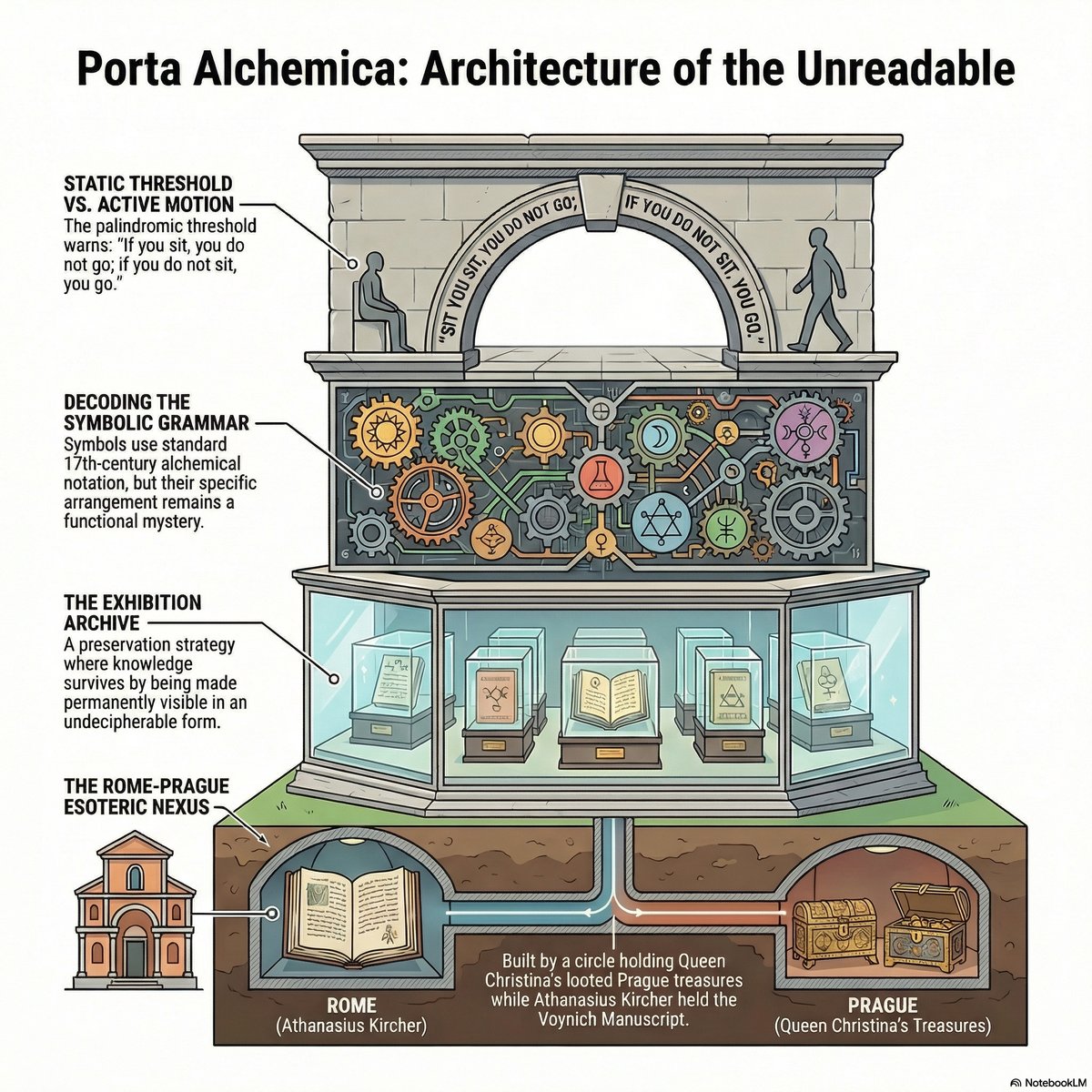
There's a marble doorframe in Rome that opens onto a wall. The Porta Alchemica was built in the 17th century by Massimiliano Palombara, covered in alchemical symbols, Latin riddles, and Hebrew lettering — designed to be seen by anyone walking past but understood by almost no one. The inscriptions come not from ancient sources but from the Aureum Seculum Redivivum, a contemporary Rosicrucian text. The circle that produced it met at the Palazzo Riario: Queen Christina of Sweden, Athanasius Kircher, and a network that held looted treasures from Rudolf II's Prague Kunstkammer — and that also housed the Voynich Manuscript. The gate is an exhibition archive. It preserves esoteric knowledge through permanent public display while withholding the interpretive key. You can stand in front of it right now. You still can't read it.
Show Notes
- The Porta Alchemica — A 17th-century marble doorframe in the Piazza Vittorio Emanuele II in Rome. It's the last surviving gate of five that originally stood in the garden of the Villa Palombara on the Esquiline Hill. It opens onto nothing — the villa was demolished centuries ago.
- Massimiliano Palombara — Marchese di Pietraforte, an aristocratic alchemist who commissioned the gate. His project was not to hide knowledge in a vault but to display it permanently in stone — a fundamentally different preservation strategy than the manuscript or brotherhood models.
- The Inscriptions — Alchemical planetary symbols, Latin riddles referencing the philosopher's stone, and Hebrew lettering arranged in a deliberate program. Research traces the primary inscriptions to the Aureum Seculum Redivivum (1621), a Rosicrucian text by Henricus Madathanus, not to ancient Hermetic sources.
- The Palazzo Riario Circle — Palombara's intellectual network centered on the Palazzo Riario, where Queen Christina of Sweden held court after her abdication and conversion to Catholicism. The circle included Athanasius Kircher, the Jesuit polymath who attempted to decode Egyptian hieroglyphics and collected esoteric manuscripts.
- Queen Christina and the Prague Connection — Christina's collection included objects looted from Rudolf II's Kunstkammer during the Thirty Years' War. Swedish forces sacked Prague Castle in 1648, carrying away the imperial collections. The same network that produced the Porta Alchemica held the physical remnants of Rudolf's occult court.
- The Voynich Connection — The Voynich Manuscript passed through this same Roman intellectual milieu. Athanasius Kircher received the manuscript from Johannes Marcus Marci in 1665-1666, placing it in the Jesuit collections at the Collegio Romano — directly adjacent to Christina's circle.
- The Exhibition Archive — The gate represents a ninth mode of knowledge preservation: public display without explanation. Unlike a hidden manuscript or an encoded cipher, the Porta Alchemica makes its knowledge permanently visible while ensuring that visibility alone is insufficient for comprehension.
Sources & References
- The Porta Alchemica — Piazza Vittorio Emanuele II, Rome (c. 1680)
- Henricus Madathanus — Aureum Seculum Redivivum (1621)
- Athanasius Kircher — Oedipus Aegyptiacus (1652-1654)
- Johannes Marcus Marci — letter to Kircher (1665-1666)
- Anna Maria Partini — La Porta Magica di Roma (1980)
Maxwell's Pendulum: The Plan
Research Brief
Summary
The Porta Alchemica is a stone doorframe standing in the gardens of Piazza Vittorio Emanuele II in Rome, the only surviving gate of five that once belonged to the Villa Palombara on the Esquiline Hill. Built between 1678 and 1680 by Massimiliano Palombara, Marchese di Pietraforte (1614-1685), it is carved with alchemical planetary symbols, Latin inscriptions, and Hebrew lettering. It is described as one of the few surviving alchemical monuments in the Western world.1 Its inscriptions are readable but not decoded: the Latin phrases are legible, the planetary symbols identifiable, the Hebrew letters recognizable, but the system they form has not been credibly reconstructed. The monument is the Plan's most formally paradoxical Mode 8 instance: knowledge carved in stone, facing a public street, designed to be seen and not understood.
The Porta Alchemica sits at a specific intersection in the Plan's genealogy. Palombara's circle included Queen Christina of Sweden, whose armies looted Rudolf II's Kunstkammer in 1648, and Athanasius Kircher, who received the Voynich Manuscript from Marci in 1665/1666. Kircher was simultaneously the leading European authority on Egyptian hieroglyphics (however inaccurate), the Plan's primary Voynich recipient, and a documented member of the circle that designed or influenced the monument's inscriptions. The Porta Alchemica was built roughly twelve years after Kircher received the Voynich. The monument's inscriptions derive primarily from the Aureum Seculum Redivivum (1621/1677) of Henricus Madathanus (Adrian von Mynsicht), a Rosicrucian alchemical allegory. The tradition that built the gate knew the Rosicrucian texts, possessed Rudolf's dispersed collections (through Christina), and held in its hands the one undeciphered manuscript the Plan has been circling for fifteen rounds.
The density test returns the expected result: zero new Tier 1 signatures. The forged antiquity test, applied to the Borri transmutation legend and to the inscriptions' claimed ancient sources, identifies the same mechanism documented in Round 14's Zoroastrian correction: labels doing work the content cannot support.
1. The Monument
Physical Description
The Porta Alchemica (also called Porta Magica, "Magic Door") is a white marble doorframe approximately 2.5 meters high, currently embedded in a section of wall in the northeast corner of the Piazza Vittorio Emanuele II gardens in Rome's Esquiline district.2 Two statues of the Egyptian dwarf-god Bes flank the doorway. The Bes figures were not part of Palombara's original design; they were found separately near the Quirinal Hill, where a temple to Isis and Serapis once stood, and were placed beside the door in 1888 when the monument was relocated.3 The door itself leads nowhere. It is a frame without a room behind it, a threshold that opens onto the garden wall.
The Villa Palombara originally occupied a substantial area of the Esquiline Hill. It had five gates, each bearing inscriptions. The villa was expropriated and demolished by the City of Rome in 1873 to build the new Esquiline district.4 The municipal archaeological commission had the door dismantled at the time of demolition and reconstructed it within the Piazza Vittorio gardens on July 8, 1888.4 This is the only surviving gate. The other four are lost, and no complete record of their inscriptions survives in published scholarship.
The Inscriptions
The inscriptions combine Latin phrases, Hebrew letters, alchemical and planetary symbols, and geometric figures. The principal elements are:
The pediment: A circular design consisting of two overlapping triangles (Star of David / Seal of Solomon) within a circle. The inner inscription reads "CENTRUM IN TRIGONO CENTRI" ("The center is in the triangle of the center"). The outer inscription reads "TRIA SUNT MIRABILIA DEUS ET HOMO MATER ET VIRGO TRINUS ET UNUS" ("There are three marvels: God and man, mother and virgin, triune and one").5 A cross surmounts the upper triangle; an oculus (the alchemical symbol for gold and the sun) occupies the lower point.5 This design recapitulates the title-page emblem of the Aureum Seculum Redivivum (specifically the 1677 posthumous edition, not the 1621 first edition).6
The Hebrew inscription: Above the door, the Hebrew words "Ruach Elohim" ("Spirit of God"), from Genesis 1:2.7
The threshold inscription: Below the door: "SI SEDES NON IS" ("If you sit, you do not go"), which reads backwards as "SI NON SEDES IS" ("If you do not sit, you go"), a palindromic sentence about rest and motion.8
The door jambs: Seven planetary/alchemical symbols are arranged on the jambs, each associated with a Latin verse. The symbols correspond to the seven classical planets and their alchemical metals: Saturn/lead, Jupiter/tin, Mars/iron, Venus/copper, Moon/silver, Mercury/mercury, and Sun/gold.9 Each symbol is accompanied by a Latin inscription that reads as an alchemical riddle. For Saturn: "Quando in tua domo nigri corvi parturient albas columbas, tunc vocaberis sapiens" ("When in your house black crows give birth to white doves, then you will be called wise").10 This imagery is standard alchemical language for the nigredo-to-albedo transformation, the putrefaction of black matter yielding the white stone.
Below the threshold: "EST OPUS OCCULTUM VERI SOPHI APERIRE TERRAM UT GERMINET SALUTEM PRO POPULO" ("It is the hidden work of the true sage to open the earth so that it may bring forth salvation for the people").11
The Hesperius dragon inscription: Near the top: "HORTI MAGICI INGRESSUM HESPERIUS CUSTODIT DRACO ET SINE ALCIDE COLCHICAS DELICIAS NON GUSTASSET IASON" ("The Hesperius dragon guards the entrance of the magic garden, and without Alcides [Hercules], Jason would not have tasted the delights of Colchis").12 This refers to the garden of the Hesperides and the voyage of the Argonauts, standard Hermetic-alchemical allegory for the quest for the Philosopher's Stone.
The Aureum Seculum Redivivum Connection
The design on the pediment has been traced to the title page of the Aureum Seculum Redivivum ("The Golden Age Restored") by Henricus Madathanus, pseudonym of Adrian von Mynsicht (1603-1638).6 Mynsicht was a German physician, alchemist, and Rosicrucian. His Rosicrucian affiliations are evident through the "Fratribus Aureae Crucis" ("Brothers of the Golden Cross") subscription, Trinitarian symbolism, and the work's later inclusion in alchemical-Rosicrucian anthologies including the Musaeum Hermeticum (1625) and the Dyas Chymica Tripartita (1625).13
The first edition appeared in 1621, five years after the third Rosicrucian manifesto (the Chymical Wedding of 1616). The 1677 posthumous edition, which differs from the 1621 original in the design of its title-page emblem, provides the specific geometric design that appears on the Porta Alchemica's pediment.14 This means the inscription was based on a text published one to three years before the monument's construction, not on an ancient or medieval source. The Aureum Seculum Redivivum is a 17th-century Rosicrucian allegory, and the Porta Alchemica reproduces its imagery.
2. Massimiliano Palombara and His Circle
Palombara's Biography
Massimiliano Savelli Palombara was born in 1614 and died in 1685.15 He held the title Marchese di Pietraforte and served as Conservator of Rome between 1651 and 1677, a civic magistracy of the Roman commune.15 He was a poet: his La Bugia ("The Candle"), a collection of verses, was published in 1656.16 He was also a committed practitioner of esoteric arts. In 1656, Palombara openly referred to the "Fraternitas Rosicruciana" (which he called the "Aurea or Rosea Croce"), documenting his self-identification with the Rosicrucian movement at a time when such identification was politically precarious in Counter-Reformation Rome.17
Maria Fiammetta Iovine, a researcher who visited the Ritman Library (Bibliotheca Philosophica Hermetica) in Amsterdam in 2013 to study Palombara, has argued that the Marchese's biography is essential to understanding the Porta Magica and that much published commentary treats the monument in isolation from its builder's documented intellectual life.17 Iovine's research establishes that Palombara's acquaintance with Borri dates from at least 1654.17
Palombara's circle was not an informal social group. It was an organized esoteric network centered on the Palazzo Riario, the Roman residence of Queen Christina of Sweden. The group was known as "The Alchemists of Palazzo Riario."18 Its documented members included Christina, Palombara, Kircher, Borri, and Cardinal Decio Azzolino (Christina's confidant and possible lover).19 The Palazzo Riario contained an alchemical laboratory supervised by Pietro Antonio Bandiera and visited by both Borri and Kircher.18
Queen Christina of Sweden (1626-1689)
Christina abdicated the Swedish throne in 1654, converted to Catholicism, and settled in Rome.20 She took up residence at the Palazzo Riario (now Palazzo Corsini) on the Lungara, where Cardinal Azzolino oversaw renovations beginning in 1659.21 In 1674 she founded the Royal Academy, to which was added an Academy of Physics, Natural History, and Mathematics.21
Christina's relevance to the Plan is structural. When her armies under Hans Christoff von Konigsmarck took Prague Castle in July 1648, the booty included Rudolf II's Kunstkammer. Christina wrote to her cousin Charles X Gustavus: "You know those are the only things I am interested in."22 In 1649, the shipment arrived in Stockholm: 760 paintings, 170 marble and 100 bronze statues, 33,000 coins and medallions, 600 pieces of crystal, 300 scientific instruments, manuscripts, and books.22 Until this shipment arrived, the Swedish royal art collection had been, by European standards, insignificant.23
When Christina abdicated in 1654, she took portions of these collections with her to Rome. The trajectory is direct: Rudolf's Kunstkammer (Prague, 1583-1611) was looted to Stockholm (1648-1649), carried by Christina to Rome (1655 onward), and held at the Palazzo Riario alongside the alchemical laboratory where Palombara, Borri, and Kircher gathered. The woman who owned Rudolf's dispersed collections was a member of the circle that built the Porta Alchemica. This is a documented line of custody for at least some portion of the material culture that had surrounded the Voynich Manuscript in Prague, passing through the same Roman network where Kircher simultaneously held the Voynich itself.
Athanasius Kircher (1602-1680)
Kircher was the most consequential member of Palombara's circle for the Plan's purposes. He held the chair of mathematics at the Collegio Romano (later the Pontifical Gregorian University) and spent his last decades in Rome writing and maintaining his wunderkammer, the Museo Kircheriano.24 His major publications during the period relevant to the Porta Alchemica include:
- Oedipus Aegyptiacus (1652-1654): a three-volume folio on Egyptian hieroglyphics, Chaldean astrology, Hebrew Kabbalah, Greek mythology, Pythagorean mathematics, Arabian alchemy, and "Latin philology."25 Kircher's hieroglyphic translations were, as E.A. Wallis Budge later established, nonsensical, but since Kircher published in learned Latin, he convinced his contemporaries of their accuracy.25
- Mundus Subterraneus (1664): a two-volume atlas of the subterranean world covering fossils, minerals, animals (including dragons), alchemy, and what Kircher called the principles of "panspermia."26 The work includes "a long discussion about alchemy" and addresses the possibility of alchemical transmutation, which Kircher ultimately rejected.26
- Ars Magna Sciendi (1669): Kircher's definitive work on the Llullistic combinatorial method, with applications to theology and "Cabala mysticism."27
Kircher's position vis-a-vis alchemy was complex. In Mundus Subterraneus he attacked the possibility of transmutation, making him an unlikely collaborator in a monument dedicated to alchemical symbolism.28 Yet he was documented as a participant in Christina's alchemical circle. This tension between public skepticism and private participation is itself characteristic of the Roman intellectual milieu: Kircher operated within the Jesuit institutional framework, which required caution about alchemical claims, while simultaneously engaging with a network whose central pursuit was precisely those claims.
Francesco Giuseppe Borri (1627-1695)
Borri is the figure most consistently associated with the Porta Alchemica's origin legend. Born in Milan on May 4, 1627, the son of a physician, he entered a Jesuit seminary in Rome in 1644, where he was taught by Kircher.29 He was expelled around 1649-1650, reportedly over disputes concerning the Immaculate Conception.29 He then established himself as a physician, alchemist, and visionary, taking service with Federico Mirogli as physician and alchemist.30
Borri's trajectory after Milan is a tour of European courts and crises. In Milan, he became the figurehead of a Quietist movement, delivering a public address in the square of Milan Cathedral in 1658.30 The Roman Inquisition tried him in absentia in 1661. The verdict was read publicly and his effigy was brought in procession to the Campo de' Fiori, where Giordano Bruno had been executed sixty years earlier, and was hung and burned together with his writings.31 Borri fled through Augsburg, Strasbourg, Amsterdam, and Copenhagen, performing alchemical demonstrations and attracting both patrons and suspicion. He was eventually arrested in Habsburg territory while en route to Turkey and handed over to papal authorities.32 From 1691, he was under house arrest in Castel Sant'Angelo, where he was permitted to maintain a laboratory and continue his studies, receiving visits from noble friends.33 He died of malaria on August 16, 1695, aged 68.33
3. The Transmutation Legend and the Forged Antiquity Test
The origin story of the Porta Alchemica's inscriptions circulates in multiple versions. The best-documented account comes from the erudite Francesco Cancellieri, who collected the story in 1802.34 According to Cancellieri's account, a pilgrim named "Stibeum" (from Latin stibium, meaning antimony) was hosted at the Villa Palombara for a night. The pilgrim searched the villa's gardens for a mysterious herb capable of producing gold. In the morning, the pilgrim had vanished, leaving behind a quantity of gold and a manuscript covered in enigmatic symbols. Palombara, unable to decode the manuscript, had the symbols carved into the gates of his villa in the hope that someone passing by might decipher them.34
Later traditions identified the pilgrim as Borri, or alternatively as a figure called "Giustiniano Bono."35 Some accounts name Borri directly; others use the Stibeum pseudonym without explicit identification.
Applying the Forged Antiquity Test
The forged antiquity test, formalized in Round 14, asks: does the content of the claim support its stated origin, or is the label doing work the content cannot?
The Stibeum legend: The story requires an unknown stranger to have possessed both the ability to perform transmutation and a system of symbolic notation valuable enough to record in stone. But the inscriptions on the Porta Alchemica are demonstrably drawn from published 17th-century sources, specifically the Aureum Seculum Redivivum (1621/1677). The stranger did not leave behind unknown ancient symbols. He left behind (if he left anything at all) material that Palombara's circle already knew from published Rosicrucian alchemical literature. The legend attributes to a mysterious visitor what the circle possessed from its own library. The label ("mysterious pilgrim with secret knowledge") does the explanatory work; the content (published Rosicrucian imagery) does not require the legend.
Borri as the pilgrim: Borri's documented acquaintance with Palombara dates from at least 1654, twenty-four years before the monument's construction.17 Borri was not a mysterious stranger at the villa; he was a documented associate of two decades' standing. The identification of Borri with the unknown pilgrim collapses a long-established relationship into a single dramatic encounter. The legend transforms a documented collegial relationship into a theatrical origin narrative. This is the pseudepigraphic reproductive strategy identified in Round 6: the tradition generates legends about the origin of concealed knowledge, attributing to dramatic visitations what was actually produced through ordinary scholarly networks.
The herb in the garden: The claim that the pilgrim was searching for a "mysterious herb capable of concocting gold" echoes the Voynich Manuscript's botanical illustrations and the broader Renaissance assumption that botanical knowledge was linked to alchemical transformation. No evidence supports an actual botanical event at the villa. The herb is a narrative element that connects the gate to the broader Hermetic-alchemical tradition, not a documented incident.
Verdict: The transmutation legend is a typical instance of the forged antiquity mechanism: an origin narrative that attributes to a mysterious and ancient source what was actually produced by a documented contemporary circle using published texts. The Porta Alchemica was designed by Palombara and his associates, drawing on the Aureum Seculum Redivivum and the standard alchemical symbolic vocabulary available in their shared library. The pilgrim legend is decorative, not explanatory.
4. Chronological Position: After the Cascade Collapse
The Porta Alchemica (1678-1680) sits two generations after the Prague cascade collapse (1611-1622) and forty years outside the Plan's core chronological window (1267-1637). Its position requires assessment.
The State of Italian Esotericism in the 1670s
The mid-17th century was the peak of alchemical publishing in Europe. Collected editions of alchemical classics were produced by Zetzner (1602, 1622, 1659-1661), Elias Ashmole (Theatrum Chemicum Britannicum, 1652), and later by Manget (Bibliotheca Chemica Curiosa, 1702).36 By the 1670s, the tradition was beginning its transition from active experimental pursuit to antiquarian collection. Palombara's circle was operating at this inflection point: the alchemical laboratory at Palazzo Riario was still active, but the intellectual environment was shifting toward the empiricism that would become the Royal Society's program in England and similar developments on the continent.
In Rome specifically, the Counter-Reformation institutional framework made esoteric activity more precarious than in Protestant territories. Borri's Inquisition trial (1661) and effigy burning at the same site as Bruno's execution (1600) established the stakes. Yet the Alchemists of Palazzo Riario operated under the protection of a former queen and within shouting distance of the Collegio Romano's most famous scholar. The Roman esoteric milieu of the 1670s was not underground; it was aristocratic, protected, and connected to both ecclesiastical and royal power.
Connection to the Prague Dispersal
The documentary chain connecting the Prague collections to the Roman circle is:
- Rudolf's Kunstkammer assembled at Prague Castle (1583-1611)
- Prague looted by Swedish army under Konigsmarck (July 1648)
- Collections shipped to Stockholm (1649): 760 paintings, 33,000 coins, manuscripts, scientific instruments22
- Christina abdicates (1654), converts to Catholicism, settles in Rome with portions of the collections
- Christina establishes court at Palazzo Riario (1659 onward)
- Alchemists of Palazzo Riario form around Christina (1660s-1680s)
- Porta Alchemica built (1678-1680)
This is not a speculative reconstruction. Each step is documented. The woman who held Rudolf's dispersed treasures was a member of the circle that built the monument. Whether any specific manuscript, instrument, or idea from Rudolf's Kunstkammer directly influenced the Porta Alchemica's design is undocumented, but the institutional proximity is a matter of record.
The Mode 5 Hypothesis
Diotallevi flagged the possibility that the Porta Alchemica was a response to the cascade collapse: an attempt to encode in stone what had been dispersed from Prague. The hypothesis has a structural logic. The cascade collapse destroyed the patronage network that had concentrated esoteric knowledge at Prague. The Rosicrucian manifestos (1614-1616) had already translated the court model into a distributed mythological network. The Porta Alchemica, built two generations later, translated the same material into a fixed architectural form.
But the evidence for intentional response is weak. Palombara's 1656 reference to the Fraternitas Rosicruciana documents his awareness of the Rosicrucian tradition.17 The inscriptions' derivation from the Aureum Seculum Redivivum documents contact with Rosicrucian literature. Christina's possession of Rudolfine material documents the physical proximity. None of these individually demonstrates that the monument was built as a response to the Prague dispersal. The structural parallel is present. The documentary evidence for intentionality is absent. The Mode 5 hypothesis (provocative display of concealed knowledge) applies to the monument's form but cannot be verified as its motivation.
5. The Public/Private Paradox
The Porta Alchemica is carved on a gate. Gates face outward. Anyone who passed the Villa Palombara could read the Latin phrases and observe the planetary symbols. The inscriptions were not hidden in a vault, concealed in a manuscript, or encoded in a steganographic text. They were displayed on the threshold of a nobleman's residence, in a city where the Inquisition had burned Borri's effigy sixteen years before the gate was completed.
This is the paradox the director's notes identify. The Voynich Manuscript's Mode 8 is private: the text is locked in a library, accessible only to scholars. The Black Pullet's Mode 8 is accidental: the symbols lost their meaning through commercial diffusion (Mode 9). The Porta Alchemica's Mode 8 is public and intentional: the circle that designed the inscriptions possessed the interpretive framework (Rosicrucian alchemical allegory, Kabbalistic notation, planetary correspondences) and chose to display the symbols without the key.
The palindromic threshold inscription captures the paradox: "SI SEDES NON IS / SI NON SEDES IS" ("If you sit, you do not go / If you do not sit, you go").8 The gate is a threshold that invites passage while withholding the means to pass. The monument's function is not to conceal knowledge (that would be Mode 1 or Mode 2) but to display the fact that knowledge exists without disclosing what the knowledge is. It is an advertisement for a secret.
Does This Require a New Category?
Diotallevi flagged in Round 14 that the Porta Alchemica may represent a spatial/architectural concealment sub-type not fully captured by Mode 8. The question is whether the monument's public placement changes its mode classification.
My assessment: it does not require a new mode. It requires a sub-type within Mode 8. The defining feature of Mode 8 is that knowledge is present and visible but unreadable: the text or symbol exists, but access is denied by encoding. The Porta Alchemica satisfies this definition. What distinguishes it from the Voynich (also Mode 8) is not the mode but the context of display. The Voynich is Mode 8 in a restricted archive. The Porta Alchemica is Mode 8 on a public gate. The encoding is the same structural act; the audience is different. A Mode 8 sub-type designation, "architectural Mode 8" or "public Mode 8," captures the distinction without inflating the taxonomy.
Contemporaneous Commentary
No document from Palombara, Kircher, or any other member of the circle has been identified that articulates the monument's function. Palombara's poetry (La Bugia, 1656) engages with esoteric themes but does not address the gate directly (it predates the gate by over twenty years).16 Kircher's published works from the 1660s and 1670s do not mention the Porta Alchemica. The absence of commentary is itself significant: the circle that built the monument did not explain it in writing. The gate's silence about its own meaning is consistent with its Mode 8 character. An explanation would have defeated the purpose.
6. The Kircher-Voynich Proximity (1665/1666)
Johannes Marcus Marci sent the Voynich Manuscript to Kircher with a cover letter dated August 19, 1665 or 1666 (the dating is disputed by one year).37 Marci, then rector of Charles University in Prague, wrote that the manuscript had been owned by Emperor Rudolf II, who paid 600 gold ducats for it, and that it was believed to be the work of Roger Bacon.37 The manuscript was deposited at the Collegio Romano, where it likely remained in Kircher's collection until the Italian government's confiscation of Church properties after 1870.38
Kircher therefore held the Voynich Manuscript (or had access to it in the Collegio's collection) from approximately 1666 until his death in 1680. The Porta Alchemica was built between 1678 and 1680. For the final twelve to fourteen years of his life, Kircher simultaneously possessed an undeciphered manuscript written in an unknown script (the Voynich) and participated in a circle that carved undeciphered symbols on a public gate (the Porta Alchemica).
No documentary evidence connects these two facts. Kircher's response to the Voynich Manuscript is not documented in any surviving publication or correspondence. There is no record that he attempted to decode it, that he discussed it with Palombara, or that its imagery influenced the Porta Alchemica's design.39 The Voynich and the Porta Alchemica coexisted in the same man's intellectual world without any documented intersection.
This is a proximity, not a connection. The Plan records it as such. The fact that the man who held the Voynich also participated in building the one surviving alchemical monument in Rome is structurally interesting and documentarily empty. It is the kind of coincidence the Plan's methodology requires it to note and not to inflate.
7. Connection to the De Imaginibus Chain
The Plan has traced the De Imaginibus talismanic chain from Thabit ibn Qurra through seven nodes to the Black Pullet. The question is whether the Porta Alchemica belongs on this chain.
Assessment
The Porta Alchemica's inscriptions use planetary/metal correspondences (Saturn/lead, Jupiter/tin, Mars/iron, Venus/copper, Mercury/mercury, Moon/silver, Sun/gold) that are ubiquitous in the Western alchemical tradition.9 These correspondences are present in De Imaginibus, in the Picatrix, in Agrippa, and in every major alchemical compendium from the 12th century onward. Their presence on the monument does not specifically indicate contact with the De Imaginibus chain as opposed to any other branch of the alchemical tradition.
The inscriptions' primary textual source, the Aureum Seculum Redivivum (1621/1677), is a Rosicrucian and Paracelsian text, not a talismanic one. Its symbolism operates through alchemical allegory (the nigredo-to-albedo transformation, the Garden of the Hesperides, the Philosopher's Stone) rather than through the astrological house-based talisman construction that characterizes the De Imaginibus tradition.13 The Porta Alchemica uses planetary symbols as labels for alchemical processes, not as elements of astrological talisman design.
The Kabbalistic elements (Ruach Elohim, the Star of David, the Latin Trinitarian formula) connect the monument to the Christian Kabbalistic tradition that runs through Pico and Reuchlin, not through the Sabian-Islamic astrological tradition of De Imaginibus.7
Verdict: The Porta Alchemica is not a node on the De Imaginibus chain. It draws on a parallel but distinct tradition: Rosicrucian alchemical allegory combined with Christian Kabbalah. The De Imaginibus chain's terminal node remains the Black Pullet (c. 1820). The Porta Alchemica belongs instead to the Rosicrucian/Hermetic tradition that runs from Ficino and Pico through the manifestos (1614-1616) through Mynsicht's Aureum Seculum (1621) to Palombara's Roman circle in the 1670s. The two traditions are adjacent but not identical. The planetary symbolism they share is base-rate alchemical vocabulary, not evidence of a specific transmission link.
8. The Inscriptions: Attribution and the Forged Antiquity Test
Are the Latin Phrases Identifiable Quotations?
The pediment design and its inscriptions derive from the Aureum Seculum Redivivum, published 1621, with the specific geometric design matching the 1677 edition.6 The Saturn inscription ("When in your house black crows give birth to white doves") is standard alchemical vocabulary for the nigredo-to-albedo transformation, found in Paracelsian and Rosicrucian literature from the 16th and 17th centuries.10 The Hesperius dragon/Jason reference is classical mythological allegory applied to alchemical themes, a practice common since the medieval period but codified in Rosicrucian texts.12 The threshold palindrome (SI SEDES NON IS) is a Latin wordplay with no identified specific source; it may be original to Palombara or drawn from an unidentified emblem book.8
Forged antiquity assessment: The inscriptions' Latin phrases are either 17th-century compositions or drawn from 17th-century published texts. They are not quotations from ancient or medieval sources. The alchemical vocabulary they employ (nigredo/albedo, planetary metals, Hesperidean garden) is traditional, but the specific formulations are contemporary with the monument. The inscriptions' apparent antiquity is a function of their register (Latin, alchemical, Kabbalistic) rather than their actual age. The register is ancient. The text is modern.
Do the Hebrew Letters Form Recognizable Words?
"Ruach Elohim" (Spirit of God) is a direct quotation from Genesis 1:2 and is recognizable to anyone with basic Hebrew literacy.7 Its placement above the door aligns the threshold with the creative act: the Spirit moving over the waters at the beginning of creation. The selection is appropriate to both Jewish mystical and Christian Kabbalistic contexts. It does not require specialized Kabbalistic knowledge to identify; it is one of the most famous phrases in the Hebrew Bible.
Whether additional Hebrew letters appear on the monument beyond "Ruach Elohim" is not conclusively documented in the English-language sources consulted. Italian scholarship (Iovine's research through the Ritman Library) may contain more detailed analysis.17
Do the Symbols Correspond to a Specific Tradition?
The planetary symbols are standard alchemical notation, used across all branches of the Western alchemical tradition from the 12th century onward.40 They are not specific to Paracelsian, Rosicrucian, or any other particular school. The hexagram/Seal of Solomon on the pediment is similarly ubiquitous, appearing in Jewish, Christian Kabbalistic, and Hermetic contexts.41 The cross-over-circle and the oculus (sun symbol) are standard alchemical notation.42
The only element that can be attributed to a specific source is the pediment design, which reproduces the title page of the 1677 edition of the Aureum Seculum Redivivum.6 This is the strongest documented attribution. Everything else on the monument is drawn from the general alchemical-Kabbalistic symbolic vocabulary available in any well-stocked 17th-century library.
Forged antiquity assessment of the symbolic vocabulary: The symbols on the Porta Alchemica are not ancient, esoteric, or undecipherable. They are standard 17th-century alchemical notation. The monument's apparent mystery is a function of the modern observer's unfamiliarity with the symbolic vocabulary, not of the symbols' inherent obscurity. To a member of Palombara's circle, the planetary symbols and alchemical verses would have been immediately recognizable as conventional alchemical language. What may have been obscure was the system they formed when combined on a single architectural surface, the particular configuration of conventional symbols into an integrated program. The symbols are vocabulary. The program may be grammar. The vocabulary is decoded; the grammar is not.
9. Density Test
Key Dates
- 1614: Palombara born15
- 1621: Aureum Seculum Redivivum first published13
- 1627: Borri born (May 4)29
- 1626: Christina born (December 18)20
- 1644: Borri enters Jesuit seminary in Rome; taught by Kircher29
- 1648: Swedish army loots Prague Castle; Rudolf's collections taken to Stockholm22
- 1652-1654: Kircher publishes Oedipus Aegyptiacus25
- 1654: Christina abdicates; Palombara and Borri documented as acquainted17
- 1656: Palombara publishes La Bugia; openly references the Fraternitas Rosicruciana17
- 1659: Christina settles at Palazzo Riario21
- 1661: Borri tried by Inquisition in absentia; effigy burned at Campo de' Fiori (January 3)31
- 1664: Kircher publishes Mundus Subterraneus26
- 1665/1666: Marci sends Voynich Manuscript to Kircher37
- 1669: Kircher publishes Ars Magna Sciendi27
- 1677: Aureum Seculum Redivivum republished (posthumous edition with design matching the Porta Alchemica pediment)14
- 1678-1680: Porta Alchemica built1
- 1680: Kircher dies (November 27); Palombara died same year or 168515
- 1689: Christina dies (April 19)20
- 1695: Borri dies in Castel Sant'Angelo (August 16)33
Intervals Against Tier 1 Signatures
Testing key date intervals against 126, 154, 216:
Palombara born (1614) to Porta Alchemica built (1678): 64 years. No hit.
Borri's Inquisition (1661) to Porta Alchemica (1678): 17 years. No hit.
Marci letter (1666) to Porta Alchemica (1678): 12 years. No hit.
Prague looting (1648) to Porta Alchemica (1678): 30 years. No hit.
Christina's abdication (1654) to Porta Alchemica (1678): 24 years. Tier 4 vocabulary (4!). Already tracked; not a new appearance.
Against anchor dates:
Porta Alchemica (1678) minus Plan anchor dates: - 1678 - 1267 = 411. No hit. - 1678 - 1421 = 257. No hit. - 1678 - 1614 = 64. No hit. - 1678 - 1637 = 41. No hit.
Kircher receives Voynich (1666) minus anchor dates: - 1666 - 1267 = 399. No hit. - 1666 - 1421 = 245. No hit. - 1666 - 1614 = 52. No hit (52 = Ben/BaN in Plan vocabulary but already tracked as resonance). - 1666 - 1637 = 29. No hit.
Christina born (1626) to Borri's Inquisition (1661): 35 years. No hit.
Aureum Seculum (1621) to Porta Alchemica (1678): 57 years. No hit.
Kircher's death (1680) minus Fama Fraternitatis (1614): 66 years. No hit.
Borri effigy burning (1661) minus Bruno execution (1600): 61 years. No hit.
Structural Numbers
The monument has seven planetary symbols (Tier 4 vocabulary, base-rate).9 It has one hexagram on the pediment (Tier 4, Star of David / Seal of Solomon). The Villa Palombara had five gates (no tracked significance). The Bes statues number two (no significance; they are not part of the original design).
Density Test Verdict
Zero new Tier 1 signatures. The Porta Alchemica material produces no appearances of 126, 154, or 216 in its structural numbers or date intervals. The one 24/4! interval (Christina's abdication to the monument's construction = 24 years) is not a new appearance; 24 is already tracked at Tier 4 (Vocabulary) after its demotion in Round 8, and this specific interval adds nothing to its evidential weight. This is the sixth consecutive density-test failure (after Alexandria, Harran, Florence, Prague, and Zoroastrianism), extending the pattern established by Round 11. Tier 1 signatures remain confined to the Plan's 1267-1637 core window. The Porta Alchemica, built after the window closed, produces nothing.
10. The Prospective/Memorial Archive Question
Diotallevi formalized the vault/Denkard typological opposition in Round 14: the prospective archive (vault logic: knowledge sealed for future recovery) versus the memorial archive (Denkard logic: catalog of what was lost). Where does the Porta Alchemica fit?
Neither category captures it precisely. The Porta Alchemica is not sealed for future recovery (it is permanently visible). It is not a catalog of lost knowledge (it does not describe what is missing). It is a display of possessed knowledge in a form that prevents unauthorized access. The closest analogy in the Plan's existing framework is the Rosicrucian vault in its mythological function: the vault exists to be found, and the Porta Alchemica exists to be seen. Both signal the presence of hidden knowledge without disclosing it.
But the Rosicrucian vault has a temporal dimension (it is sealed until the appointed time of opening). The Porta Alchemica has no temporal dimension. It is not waiting to be decoded at some future moment. It was carved in its final form and has no mechanism for authorized future decoding (no key is sealed alongside it, no instructions for its recovery are documented). It is a permanently open display of permanently closed knowledge.
I propose a third archival orientation alongside the vault (prospective) and the Denkard (memorial): the exhibition archive, where knowledge is preserved by being made permanently visible in an undecipherable form. The monument preserves by display rather than by concealment. Its survival mechanism is public permanence rather than hidden protection. The knowledge does not degrade because it is carved in stone, but it does not transmit because the stone does not carry the key. The exhibition archive preserves the fact that knowledge exists without preserving the knowledge itself.
11. Flags for Belbo
-
Architectural Mode 8 sub-type: The Porta Alchemica is Mode 8 (encipherment) in a public architectural context. Belbo should articulate this as a sub-type without creating a new mode. The structural distinction from the Voynich (private Mode 8) and the Black Pullet (accidental Mode 8 via Mode 9) is in the context of display, not in the encoding mechanism.
-
Kircher as dual node: Kircher held the Voynich Manuscript and participated in the Porta Alchemica circle simultaneously. No documentary connection exists. Belbo should present this as a proximity that the Plan notes without inflating. The temptation to narrativize the connection is strong; the evidence for it is absent.
-
Chronological positioning: The Porta Alchemica sits 41 years after the Plan's 1637 closing bracket. Belbo should address how the Plan frames material that falls after the window closes. The monument is not evidence within the window; it is a response to the window's contents from outside it.
-
The exhibition archive: If Diotallevi accepts the third archival orientation (exhibition, alongside prospective/vault and memorial/Denkard), Belbo will need to articulate how display-without-key functions as a preservation strategy and where it fits in the Plan's broader account of how knowledge survives.
-
The Prague-to-Rome trajectory: The documented chain from Rudolf's Kunstkammer through Stockholm through Christina's conversion through the Palazzo Riario to the Porta Alchemica is the Plan's most complete post-collapse dispersal pathway after the Maier pivot. Belbo should present it as the material culture's trajectory while the Rosicrucian manifestos represent the intellectual tradition's trajectory. Same collapse, two survival paths: textual (manifestos) and material (collections).
Footnotes
-
Porta Alchemica overview: https://en.wikipedia.org/wiki/Porta_Alchemica See also Atlas Obscura: https://www.atlasobscura.com/places/porta-magica ↩↩
-
Physical description and location: https://www.turismoroma.it/en/places/magic-door See also: https://aroundus.com/p/11675352-porta-alchemica ↩
-
Bes statues as later addition from the Quirinal Hill: https://mysteriouswritings.com/mw-travels-top-ten-interesting-facts-on-the-alchemical-door-porta-alchemica-or-porta-magica-in-rome/ See also: https://en.wikipedia.org/wiki/Porta_Alchemica ↩
-
Villa Palombara demolition (1873) and reconstruction (1888): https://www.indaginiemisteri.it/en/mysteries-of-rome-volume-2-the-alchemical-door-and-the-lost-villa-palombara/ See also: https://en.wikipedia.org/wiki/Porta_Alchemica ↩↩
-
Pediment inscriptions (CENTRUM IN TRIGONO CENTRI; TRIA SUNT MIRABILIA): https://en.wikipedia.org/wiki/Porta_Alchemica See also: https://www.thevintagenews.com/2016/09/13/romes-mysterious-porta-alchemica-numerous-phrases-hermetic-symbols-represents-one-existing-alchemical-monuments-world/ ↩↩
-
Aureum Seculum Redivivum title-page design as source for pediment: https://grokipedia.com/page/Porta_Alchemica See also: https://mysteriouswritings.com/mw-travels-top-ten-interesting-facts-on-the-alchemical-door-porta-alchemica-or-porta-magica-in-rome/ ↩↩↩↩
-
Hebrew inscription "Ruach Elohim" (Genesis 1:2): https://en.wikipedia.org/wiki/Porta_Alchemica See also: https://www.visititaly.eu/places-and-tours/rome-alchemical-door ↩↩↩
-
Palindromic threshold inscription (SI SEDES NON IS): https://cosmicktraveler.wordpress.com/the-alchemical-door-or-porta-alchemica/ See also: https://en.wikipedia.org/wiki/Porta_Alchemica ↩↩↩
-
Seven planetary symbols and metal correspondences: https://en.wikipedia.org/wiki/Porta_Alchemica See also: https://www.rocaille.it/the-alchemical-door/ ↩↩↩
-
Saturn inscription ("black crows give birth to white doves"): https://en.wikipedia.org/wiki/Porta_Alchemica See also on nigredo/albedo in alchemical tradition: https://www.encyclopedia.com/environment/encyclopedias-almanacs-transcripts-and-maps/alchemy-renaissance-alchemy ↩↩
-
"Est opus occultum veri sophi" inscription: https://en.wikipedia.org/wiki/Porta_Alchemica ↩
-
Hesperius dragon and Jason inscription: https://en.wikipedia.org/wiki/Porta_Alchemica See also: https://www.visititaly.eu/places-and-tours/rome-alchemical-door ↩↩
-
Adrian von Mynsicht (Henricus Madathanus): https://en.wikipedia.org/wiki/Adrian_von_Mynsicht See also Rosicrucian affiliations and inclusion in Musaeum Hermeticum: https://via-hygeia.art/a-little-hadrian-von-mynsicht-sampler-part-2-the-1625-german-edition-of-the-aureum-seculum-redivivum-and-its-english-translation/ ↩↩↩
-
1677 posthumous edition as specific source for the pediment design: https://grokipedia.com/page/Porta_Alchemica See also: https://www.thevintagenews.com/2016/10/01/with-numerous-phrases-and-hermetic-symbols-romes-mysterious-porta-alchemica-represents-one-of-the-few-existing-alchemical-monuments-in-the-world/ ↩↩
-
Palombara's biography (1614-1685; some sources give 1680 as death date): https://en.wikipedia.org/wiki/Massimiliano_Palombara See also Geni genealogical record: https://www.geni.com/people/Massimiliano-Savelli-Palombara-marchese-di-Pietraforte/6000000088763114136 ↩↩↩↩
-
La Bugia (1656): https://en.wikipedia.org/wiki/Massimiliano_Palombara See also: https://openlibrary.org/subjects/person:massimiliano_palombara_(1614-1685) ↩↩
-
Ritman Library research on Palombara; Borri acquaintance from 1654; Palombara's 1656 Rosicrucian reference: https://www.ritmanlibrary.com/2013/08/current-research-palombara-and-the-porta-magica-in-rome/ ↩↩↩↩↩↩↩↩
-
"Alchemists of Palazzo Riario" and Christina's laboratory: https://www.atlasobscura.com/places/porta-magica See also: https://www.academia.edu/109016137/Alchemy_in_Christina_of_Swedens_Palazzo_Riario_Rome ↩↩
-
Palombara's circle members (Christina, Azzolino, Borri, Kircher): https://en.wikipedia.org/wiki/Massimiliano_Palombara See also: https://www.alchemywebsite.com/queen_christina.html ↩
-
Queen Christina biography: https://en.wikipedia.org/wiki/Christina,_Queen_of_Sweden ↩↩↩
-
Palazzo Riario and Christina's Royal Academy (1674): https://romasitounesco.it/en/cristina-di-svezia-a-roma/ See also: https://www.vam.ac.uk/blog/creating-new-europe-1600-1800-galleries/born-on-this-day-queen-christina-of-sweden ↩↩↩
-
1648 Prague looting; inventory of collections shipped to Stockholm: https://www.academia.edu/46508634/The_Looting_of_Prague_1648 See also Christina's letter: https://gerson-digital-sweden.rkdstudies.nl/1-dutch-art-and-artists-in-sweden-in-the-early-1650s/14-queen-christina-of-sweden/ ↩↩↩↩
-
Swedish collection insignificant before Prague loot: https://gerson-digital-sweden.rkdstudies.nl/1-dutch-art-and-artists-in-sweden-in-the-early-1650s/14-queen-christina-of-sweden/ ↩
-
Kircher at the Collegio Romano and the Museo Kircheriano: https://en.wikipedia.org/wiki/Athanasius_Kircher See also Vatican Observatory: https://www.vaticanobservatory.org/sacred-space-astronomy/religious-scientists-fr-athanasius-kircher-s-j-1602-1680-jesuit-polymath/ ↩
-
Oedipus Aegyptiacus (1652-1654): https://en.wikipedia.org/wiki/Oedipus_Aegyptiacus See also Public Domain Review: https://publicdomainreview.org/essay/athanasius-kircher-and-the-hieroglyphic-sphinx/ Budge's assessment of Kircher's translations: https://fathom.lib.uchicago.edu/1/777777122590/ ↩↩↩
-
Mundus Subterraneus (1664): https://www.britannica.com/topic/Mundus-subterraneus See also: https://www.academia.edu/45967585/Athanasius_Kirchers_Mundus_subterraneus ↩↩↩
-
Ars Magna Sciendi (1669): https://www.historytools.org/people/athanasius-kircher-and-the-llullistic-method-complete-history See also: https://en.wikipedia.org/wiki/Athanasius_Kircher ↩↩
-
Kircher's rejection of alchemical transmutation in Mundus Subterraneus: https://en.wikipedia.org/wiki/Athanasius_Kircher ↩
-
Borri's biography; Jesuit seminary; Kircher as teacher: https://en.wikipedia.org/wiki/Giuseppe_Francesco_Borri See also: https://alchemywebsite.com/borri_english.htm ↩↩↩↩
-
Borri in Milan; Quietist movement; public address at Milan Cathedral (1658): https://en.wikipedia.org/wiki/Giuseppe_Francesco_Borri ↩↩
-
Borri's Inquisition trial (1661); effigy burned at Campo de' Fiori: https://www.executedtoday.com/2013/01/03/1661-the-effigy-and-books-of-giuseppe-francesco-borri/ See also: https://en.wikipedia.org/wiki/Giuseppe_Francesco_Borri ↩↩
-
Borri's flight through European cities and arrest: https://en.wikipedia.org/wiki/Giuseppe_Francesco_Borri See also: https://alchemywebsite.com/borri_english.htm ↩
-
Borri's imprisonment in Castel Sant'Angelo, laboratory, and death (1695): https://en.wikipedia.org/wiki/Giuseppe_Francesco_Borri ↩↩↩
-
Francesco Cancellieri's 1802 account of the Stibeum/pilgrim legend: https://en.wikipedia.org/wiki/Porta_Alchemica See also: https://www.atlasobscura.com/places/porta-magica ↩↩
-
Identification of pilgrim as Borri or "Giustiniano Bono": https://grokipedia.com/page/Porta_Alchemica See also: https://italian-traditions.com/immortal-secrets-alchemy-gate-rome/ ↩
-
Collected editions of alchemical texts (Zetzner, Ashmole, Manget): https://www.encyclopedia.com/environment/encyclopedias-almanacs-transcripts-and-maps/alchemy-renaissance-alchemy ↩
-
Marci letter (1665/1666) and Voynich provenance: https://www.voynich.nu/letters.html See also Beinecke Library: https://beinecke.library.yale.edu/collections/highlights/voynich-manuscript ↩↩↩
-
Voynich at the Collegio Romano and 1870 confiscation: https://en.wikipedia.org/wiki/Voynich_manuscript See also: https://www.voynich.nu/history.html ↩
-
Absence of documented Kircher response to the Voynich: https://voynich.fandom.com/wiki/Athanasius_Kircher No surviving Kircher publication or letter addresses the manuscript directly. ↩
-
Standard alchemical planetary notation across the Western tradition: https://en.wikipedia.org/wiki/Alchemical_symbol See also: https://www.whats-your-sign.com/alchemy-planet-symbols.html ↩
-
Hexagram/Seal of Solomon in Jewish, Kabbalistic, and Hermetic traditions: https://en.wikipedia.org/wiki/Star_of_David See also: https://en.wikipedia.org/wiki/Seal_of_Solomon ↩
-
Cross-over-circle and oculus as standard alchemical notation for gold/sun: https://www.centreofexcellence.com/7-alchemy-metals-symbolisms/ ↩
-
Borri's Milanese patron Federico Mirogli and early alchemical career: https://alchemywebsite.com/borri_english.htm ↩
-
Kircher's influence on Borri during seminary years: https://en.wikipedia.org/wiki/Giuseppe_Francesco_Borri The teacher-student relationship is the earliest documented intellectual connection between any two members of the Palombara circle. ↩
-
Christina's relationship with Cardinal Decio Azzolino: https://en.wikipedia.org/wiki/Christina,_Queen_of_Sweden See also Rome UNESCO site: https://romasitounesco.it/en/cristina-di-svezia-a-roma/ ↩
-
Kircher published in Latin, convincing contemporaries of accuracy: https://publicdomainreview.org/essay/athanasius-kircher-and-the-hieroglyphic-sphinx/ See also Budge's assessment: https://fathom.lib.uchicago.edu/1/777777122590/ ↩
-
Borri claimed to have transmuted base metal into gold; alleged product displayed in a Danish museum: https://en.wikipedia.org/wiki/Giuseppe_Francesco_Borri ↩
-
Bruno's execution at Campo de' Fiori (1600) and Borri's effigy at the same location (1661): https://www.executedtoday.com/2013/01/03/1661-the-effigy-and-books-of-giuseppe-francesco-borri/ ↩
-
Ritman Library (Bibliotheca Philosophica Hermetica): https://en.wikipedia.org/wiki/Bibliotheca_Philosophica_Hermetica See also: https://embassyofthefreemind.com/en/library/about-the-library ↩
-
Italian-language scholarship on the Porta Alchemica: see Iovine's research via Ritman Library: https://www.ritmanlibrary.com/2013/08/current-research-palombara-and-the-porta-magica-in-rome/ See also Italian-language analysis at: https://www.romaguidetour.it/blog/segreti-roma-porta-magica-piazza-vittorio/ ↩
-
Porta Alchemica at Rivodutri (a second, less well-known alchemical doorway associated with the same tradition): https://www.ancient-origins.net/history-ancient-traditions/rivodutris-alchemical-door-0014388 ↩
-
Borri's gold in Denmark: https://en.wikipedia.org/wiki/Giuseppe_Francesco_Borri The claimed transmutation product is listed as still extant in a Danish museum, though the claim's reliability is not independently verified. ↩
-
Christina's collections transported from Stockholm to Rome: https://blogs.loc.gov/international-collections/2016/12/queen-christina-of-sweden-1626-89/ See also: https://en.wikipedia.org/wiki/Christina,_Queen_of_Sweden ↩
-
Kircher's Museo Kircheriano as precursor to modern museum: https://en.wikipedia.org/wiki/Athanasius_Kircher See also: https://www.mjt.org/exhibits/kircher.html ↩