Arsenic and the Medici Magic Academy
Listen
Open in Spotify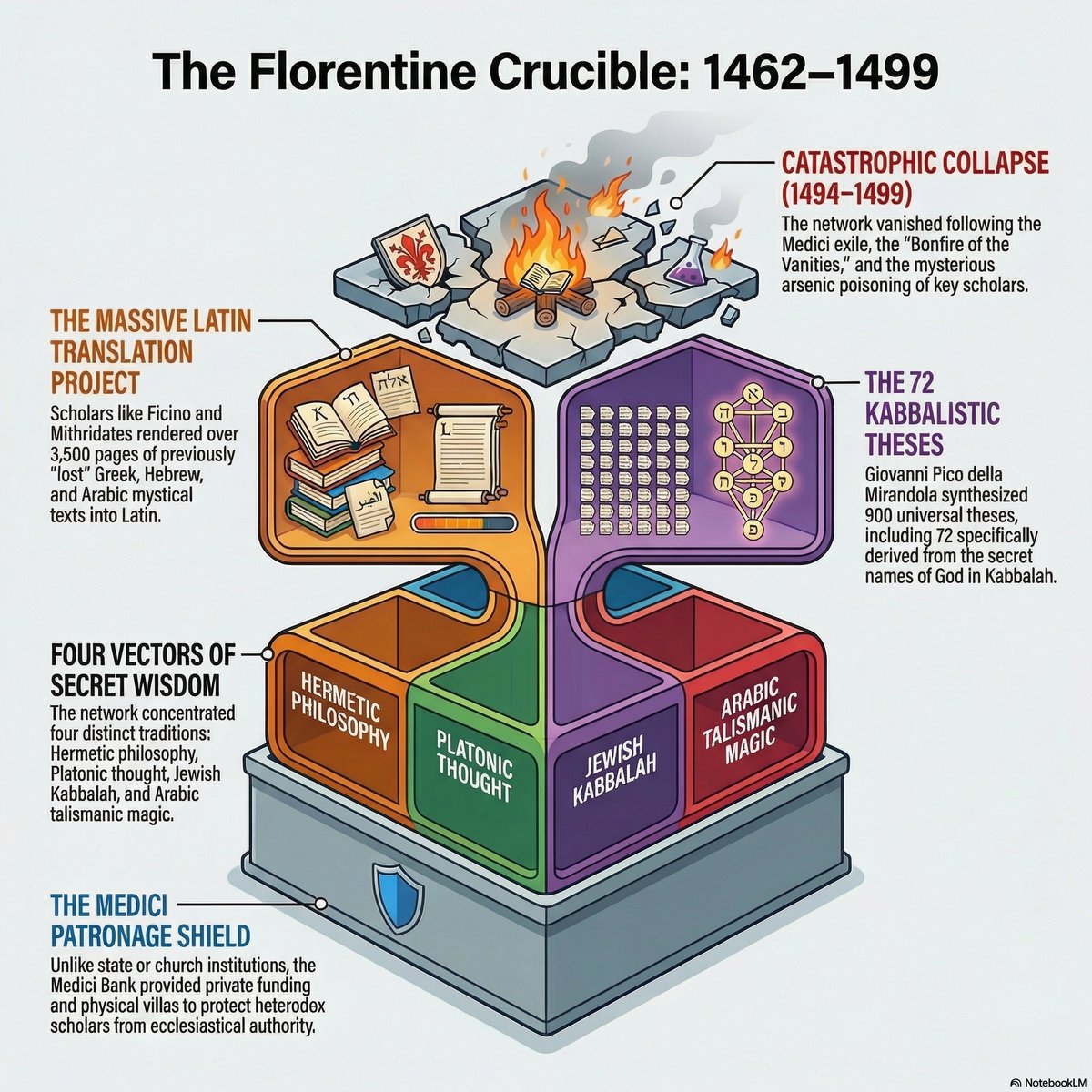
Show Notes
# EP010: Medici Gold and Renaissance Hermetic Magic
Summary
Between 1462 and 1499, Florence became the center of a deliberate project to recover and synthesize ancient wisdom. Cosimo de' Medici bankrolled it. Marsilio Ficino executed it. Pico della Mirandola extended it into Christian Kabbalah. The informal network they built — called the Platonic Academy, though it was never a formal institution — depended entirely on Medici money and protection. When the French invaded in 1494 and the Medici fell, Savonarola burned the books, and the network scattered across Europe. A genuine 120-year interval separates that dispersal from the first Rosicrucian manifesto. This episode traces the rise and collapse of the Florentine synthesis and asks what survived — and how.
Show Notes
- The Medici Patronage Model — Cosimo de' Medici's commission of Ficino to translate the Corpus Hermeticum wasn't just intellectual curiosity. It was a deliberate project to position Florence as the heir to ancient wisdom, using cultural prestige as political capital.
- The Platonic Academy — Less an institution than an aristocratic conversation circle protected by Medici money. Ficino hosted dinners, circulated letters, and produced translations. It had no formal structure and no independent funding — which made it catastrophically fragile.
- Marsilio Ficino — Translated the Corpus Hermeticum, Plato, Plotinus, and Iamblichus into Latin. His correspondence network spread these ideas across Europe even after the Academy's collapse, making him the single most important conduit for ancient philosophy into the Renaissance.
- Pico della Mirandola and Christian Kabbalah — Pico extended Ficino's project by synthesizing Hermetic philosophy with Jewish Kabbalah and Christian theology, arguing they all pointed toward the same prisca theologia — an ancient unified wisdom. His 900 Theses were condemned by the Pope.
- The 1494 Collapse — The French invasion of Italy, the Medici exile, and Savonarola's rise erased the institutional basis of the Florentine project almost overnight. The Bonfire of the Vanities destroyed texts and artworks. The network dispersed into courts across Europe.
- The 120-Year Interval — From the network's dispersal (c. 1494) to the publication of the Fama Fraternitatis (1614) is approximately 120 years — the same figure as Callimachus's 120-volume catalog and Christian Rosenkreutz's 120-year vault seal. Whether this is design or coincidence is the open question.
- Survival Through Correspondence — Ficino's letters to scholars across Europe created a distributed network that outlasted the Florentine center. Ideas that couldn't survive in Florence found refuge in courts, monasteries, and universities elsewhere — the dispersal that preceded the Rosicrucian emergence.
Sources & References
- Marsilio Ficino — Corpus Hermeticum translation (1463); Theologia Platonica (1474); letters
- Pico della Mirandola — Oration on the Dignity of Man (1486); 900 Theses (1486)
- Girolamo Savonarola — sermons; the Bonfire of the Vanities (1497)
- James Hankins — Plato in the Italian Renaissance (1990)
- D.P. Walker — Spiritual and Demonic Magic from Ficino to Campanella (1958)
Maxwell's Pendulum: The Plan
Research Brief
Summary
Renaissance Florence, 1462-1499, concentrates four esoteric vectors: Hermetic philosophy through Ficino's recovery and translation; Platonism through the Academy's informal network; Kabbalah through Pico and Flavius Mithridates; and talismanic magic through access to De Imaginibus and Picatrix. The Medici patronage model creates a distributed, aristocratic shelter for syncretism that differs fundamentally from both ancient institutional accumulation and later conspiratorial concealment. However, numerical analysis of Florentine material produces no new tracked-number signatures beyond those already documented in the Plan; the apparent density is an artifact of prior research attention. The network disperses catastrophically after 1494 with the Medici exile, Savonarola's ascendancy, and the deaths of Pico and Poliziano, though Ficino's correspondence network survives and continues to transmit across Europe.
1. The Platonic Academy: What It Actually Was
The Platonic Academy of Florence was neither a university nor a formal institution.1 It was an informal, aristocratically protected discussion network that formed around Marsilio Ficino beginning in 1462, when Cosimo de' Medici gave Ficino a villa at Montevecchio near Careggi, plus an annual income derived from a neighboring farm.2 The group called itself "Fratres in Platone" (Brothers in Plato) or the "Platonica familia" (Platonic family), signaling kinship rather than enrollment.3
Ficino gave public lectures to large audiences in Florence and held intimate dinner parties at the Careggi villa, the latter serving as the intellectual nucleus of the network.4 The scholar Arnaldo della Torre identified approximately 100 participants across the Academy's active years.5 Key members included Ficino himself, Giovanni Pico della Mirandola, Angelo Poliziano, Cristoforo Landino, Lorenzo de' Medici, Girolamo Benivieni, Leon Battista Alberti, and Giovanni Cavalcanti.6
No statutes governed the Academy; it had no enrolled students and no regular course schedule.7 Its legitimacy derived entirely from Medici patronage. When Ficino died in 1499, the group continued under Francesco Cattani da Diacceto, meeting instead at the Orti Oricellari (Rucellai Gardens), marking both continuity and displacement from the original Careggi nucleus.8
This structure represents a third institutional model distinct from the Library of Alexandria (public, institutional accumulation) and later Rosicrucian concealment (initiatic secrecy). The Platonic Academy was a patronage-protected network: distributed, selective, dependent on aristocratic will, capable of hosting heterodox inquiry because membership and access remained controlled by the patron rather than by state or ecclesiastical authority.
James Hankins has documented how the "Myth of the Platonic Academy" as a formal institution persisted in scholarship for centuries despite the documentary evidence showing no institutional framework.9 The myth served later Platonic traditions seeking historical legitimacy for their own centers. The reality was more fluid and more fragile.
2. The Medici as Patrons of Esoteric Knowledge
Cosimo de' Medici (1389-1464) initiated the Academy and shaped its direction through deliberate commission. When the Corpus Hermeticum manuscript became available around 1462, Cosimo instructed Ficino to interrupt his translation of Plato and translate the Hermetic texts first.10 Cosimo believed Hermes Trismegistus to be contemporary with Moses and therefore more ancient and authoritative than Plato, a chronology that positioned Hermetic wisdom as foundational rather than supplementary to Platonic philosophy.11
Ficino completed the Corpus Hermeticum translation (titled "Pimander") by April 1463; it appeared in print at Treviso in 1471.12 The decision to prioritize Hermes established a patronage principle: esoteric recovery followed Medici judgment, not academic tradition.
The patronage mechanism operated through direct financial transfer. Cosimo provided the villa, the annual stipend from farm income, and access to his personal manuscript collections.13 This model differed from state funding (which requires institutional accountability) and ecclesiastical support (which demands doctrinal compliance). The Medici, as merchant-bankers rather than sovereigns, could absorb the reputational risk of heterodox inquiry because their primary legitimacy rested on financial power, not theological orthodoxy.
The Medici Bank, founded in 1397 by Giovanni di Bicci de' Medici, had become the largest in Europe by the 15th century.14 It maintained branches in Venice, Milan, Rome, London, Bruges, and Lyons, with correspondent relationships extending to Constantinople, Alexandria, and Cairo.15 This financial infrastructure moved capital, letters of credit, and information across Christendom and the Mediterranean. The same networks that transmitted bills of exchange also transmitted manuscripts and ideas.
Lorenzo de' Medici (1449-1492) inherited the Academy and continued its patronage as principal benefactor from 1469 onward, when he became de facto ruler of Florence.16 Ficino dedicated his Platonic Theology to Lorenzo in 1482, and Lorenzo functioned both as patron and as member-disciple of the Academy.17
The patronage structure collapsed rapidly after Lorenzo's death in 1492. Charles VIII of France invaded Italy in 1494, expelling the Medici and dispersing their political authority.18 Girolamo Savonarola, a Dominican friar preaching apocalyptic moral reform, filled the resulting power vacuum and became effective ruler of Florence.19 On February 7, 1497, the Bonfire of the Vanities consumed cosmetics, artwork, books, and manuscripts in the Piazza della Signoria, with over 1,000 children conscripted to scour the city for luxuries.20
Savonarola was excommunicated on May 13, 1497, and executed by hanging on May 23, 1498; his body was burned in the same piazza.21 The Medici returned in 1512, but the institutional continuity had been severed. Ficino, aging and disillusioned, retired to the Careggi villa. He initially admired some of Savonarola's moral reform agenda but was "shocked by fanatical excesses."22 The Academy's public activities diminished; "we hear next to nothing of the activities of the academy after 1494."23
3. Ficino's Project: Scope and Sequence
Marsilio Ficino (1433-1499) executed the most systematic recovery of ancient philosophical and magical texts achieved in the Western Renaissance.24 The chronology of his translations maps the intellectual vector he traced:
Corpus Hermeticum: Completed c. 1463 (draft), first printed 1471 (Treviso edition). This translation, completed under Cosimo's direct instruction, established the philological foundation for Renaissance Hermeticism.25
Plato: Draft translations 1468-69; first complete Western edition published 1484, comprising 36 works total: 35 dialogues plus the Platonic Letters.26 Ficino's achievement was to render the entire Platonic corpus into accessible Latin, displacing earlier fragmentary translations and establishing the textual basis for Platonic studies for the next three centuries.
Plotinus, Enneads: Translation begun 1484 and published in 1492, introducing Neoplatonic systematization to Latin philosophy.27
In addition, Ficino translated or provided commentary on Proclus, Iamblichus, Porphyry, Pseudo-Dionysius, and the Chaldean Oracles, creating a comprehensive map of the Platonic-Neoplatonic-Hermetic synthesis.28
De vita libri tres (Three Books on Life), written 1480-1489 and published December 3, 1489, represented Ficino's most explicit engagement with talismanic and astrological magic.29 The three books address physical health, life prolongement, and De vita coelitus comparanda (obtaining life through celestial influences).30 The third book explains talismanic images derived from "ancient astrologers and magicians," drawing on the Picatrix, Abu Ma'shar's Introductorium, Al-Kindi's De radiis, Thabit ibn Qurra's De imaginibus, and medieval Arabic sources.31 Ficino adapted the Stoic concept of spiritus mundi (world spirit) through his reading of Plotinus and the Hermetic corpus, creating a philosophical framework for talismanic efficacy that linked celestial harmonies to embodied magic.
Epistolae (Letters): Ficino maintained an enormous correspondence network spanning Pope Alexander VI, Cardinals, bishops, King John of Portugal, Johannes Reuchlin in Germany, John Colet in London, de Ganay in France, and Platonists in Hungary.32 His letters were collected into 12 books starting in the 1470s and printed in 1495, preserving a record of esoteric discourse circulating across Christendom.33 Recipients included Cosimo and Lorenzo de' Medici, Cardinals Piccolomini (later Pope Pius III) and Bessarion, Bernardo Bembo, and dozens of scholars and clerics seeking guidance on Platonic, Hermetic, and magical philosophy.34
4. Pico's Synthesis: The 900 Theses and Their Reception
Giovanni Pico della Mirandola (1463-1494) constructed the most comprehensive syncretism of the Renaissance, combining Platonism, Neoplatonism, Aristotelianism, Hermeticism, Kabbalah, Chaldean philosophy, Pythagorean doctrine, and Orphic tradition into a single speculative system.35
His 900 Theses, published in 1486, organized this material into distinct categories. The Kabbalistic theses totaled 119, with the final 72 explicitly identified as Kabbalistic.36 Fifteen theses drew on the Chaldean Oracles.37 Additional categories addressed Pythagorean and Orphic doctrines, plus a section explicitly labeled "Magical" (Magica).38
The numeral 900 itself may have carried symbolic weight; some sources suggest it referenced the Kabbalistic 72 names of God (Shem HaMephorash) multiplied by factors, though this remains disputed.39 What is certain is that Pico's synthesis attempted to validate Kabbalah as a Christian intellectual endeavor, claiming that Kabbalistic doctrine confirmed Christian theology at points where Aristotelian philosophy fell short.
The papacy's response was swift and hostile. Pope Innocent VIII convened a commission to examine the Theses. On August 4, 1487, the commission declared 6 theses suspect and condemned 7 outright (totaling 13 condemned or suspect).40 Pico wrote an Apology defending the theses, but Pope Innocent VIII then condemned the entire collection of 900 as heretical.41 The Theses became the first printed book to be universally banned by the Church.42
Heptaplus (1489), Pico's sevenfold commentary on the first chapter of Genesis covering the six days of creation, was dedicated to Lorenzo de' Medici and demonstrates Pico's continued sophistication in Kabbalistic exegesis despite the papal ban.43 The sevenfold interpretive structure reflected Pico's conviction that the number 7 encoded mystical truths; the Sabbath (seventh day) functions as allegory for mystical union.44 Though Pico deliberately expurgated the word "Kabbalah" from the text, the exegetical method and underlying philosophy remain thoroughly Kabbalistic.45
The recovery of Kabbalistic sources depended on Flavius Mithridates, born Shmuel ben Nissim ben Shabbatai Abu al Faraj.46 Converting to Christianity around 1470, Mithridates was a Sicilian Jew fluent in Hebrew, Aramaic, Arabic, Latin, and possibly Ethiopic.47 Beginning in late 1485, Pico commissioned Mithridates to translate kabbalistic works from Hebrew and Aramaic into Latin.48 Over a concentrated period, Mithridates rendered approximately 3,500 pages of mystical texts, including commentaries on the Sefer Yetzirah (Book of Formation), portions of the Quran, Jewish philosophical texts, and core Kabbalistic treatises.49
This translation project was historically unprecedented. Before Mithridates, Jews had not taught Kabbalah publicly to non-Jews.50 Mithridates' work, preserved in Vatican manuscript Vat.ebr.191, effectively founded the Christian Kabbalah tradition in practice.51
Pico's Death (1494): On November 17, 1494, Pico died at age 31 in the convent of San Marco, Florence.52 A 2007 exhumation and analysis of his remains by Dr. Valentina Giuffra revealed potentially lethal levels of arsenic in bone and mummified tissue.53 Poliziano, who died September 28-29, 1494 at age 40, showed arsenic exposure, though whether acute or chronic remained unclear.54 Contemporaneous rumors attributed Pico's death to poisoning by his own secretary (allegedly because Pico had grown too close to Savonarola and renounced his earlier syncretism), or possibly at the order of Piero de' Medici, Lorenzo's successor.55 The cause of death remains contested, but the arsenic evidence is now documented in peer-reviewed literature.
5. The 1459-1460 Convergence Window: Full Investigation
The Plan suggests that 1459-1460 represents a convergence point for multiple esoteric and institutional events. Investigation shows a more nuanced picture.
Ficino and Argyropoulos (1459): John Argyropoulos, a Byzantine emigre scholar, taught at the Florentine Studium from 1456 to 1470.56 Ficino became his pupil around 1459 and studied Byzantine Greek philosophy under him.57 Argyropoulos' presence in Florence created direct transmission of Byzantine intellectual tradition to an emerging Western scholar.
Council of Mantua (1459): Pope Pius II convoked the Council on June 1, 1459, to plan military action against the Ottoman Turks following the fall of Constantinople (1453).58 Pius entered Mantua on May 27, 1459, and called for a new crusade on September 26, 1459.59 The Council disbanded January 1460.60 However, the Council had no esoteric content; it was a failed political initiative to mobilize European powers against the Ottomans. None of the major rulers attended personally, and only Vlad III of Wallachia fully endorsed the crusade.61
Constitutions of Strasbourg (1459): On April 25, 1459, nineteen Bauhutten (stonemason lodges) from German regions met at Regensburg and adopted regulations for governance.62 A subsequent meeting at Strasbourg promulgated statutes making the Master of Works at Strasbourg the Perpetual Grand Master of German masonry.63 These regulations were completed in 1464 and 1469, approved by Emperor Maximilian in 1498, and revised in 1563; they were first printed by Krause in 1810.64
The Strasbourg Constitutions are of considerable importance for understanding organized craft freemasonry in the German-speaking regions, but they show no documented esoteric content and no connection to Florentine intellectual movements.
Leonardo da Pistoia and the Corpus Hermeticum Manuscript (1459-1460): Leonardo Alberti de Candia, noble of the Alberti family, counts of Prato, was one of Cosimo de' Medici's agents sent to scour European monasteries for lost manuscripts.65 He searched regions around Constantinople, Pera, and Galata (then under Byzantine and Genoese protection respectively).66 In 1459, da Pistoia discovered a manuscript in Macedonia; he brought it to Florence in 1460.67 This manuscript is now Codex Laurentianus 71.33, held in the Laurentian Library, Florence, dated paleographically to the 14th century, though some scholars propose an earlier Byzantine connection to Michael Psellos (11th century).68 This manuscript is the source text for Ficino's Corpus Hermeticum translation.
Alberti's Cipher: Date Correction: Leon Battista Alberti created De componendis cifris, a treatise on polyalphabetic cipher, around 1466-1467, NOT in 1460 as the Plan states.69 The work was developed following a conversation with papal secretary Leonardo Dati regarding movable type.70 Alberti's cipher disk represents the first known practical polyalphabetic encryption device in Western history and earned him the designation "Father of Western Cryptology."71 The text remained in manuscript during Alberti's lifetime and was not widely known; it was first printed in the 19th century.72
Assessment: The 1459-1460 cluster contains two events with Florentine connections (Ficino's pupillage under Argyropoulos; da Pistoia's manuscript discovery) and two geographically distant events with no documented esoteric content (Council of Mantua, Strasbourg Constitutions). Alberti's cipher, a genuinely significant cryptographic innovation, dates to 1466-1467, seven years after the proposed convergence window. The apparent convergence is an artifact of selecting events retrospectively rather than evidence of synchronized esoteric activation. The Council of Mantua was a political failure. The Strasbourg Constitutions were administrative craft regulations. Neither generated esoteric knowledge transfer or innovation.
The only genuine convergence visible in 1459-1460 is the simultaneous location in Florence of Ficino's emerging Platonism and the arrival of the Corpus Hermeticum manuscript. This is significant, but it is localized to Florence, not a Europe-wide synchronization.
6. Florence as Convergence Point: The Two Vectors Arriving
Despite the skepticism warranted by the 1459-1460 analysis above, Florence does serve as the genuine arrival point for multiple esoteric vectors between 1462 and 1494.
Talismanic Vector: Ficino had access to both Latin translations of the Picatrix (an 11th-century Arabic astronomical magic treatise) and to De Imaginibus texts derived from Thabit ibn Qurra's Islamic magical philosophy.73 In De vita libri tres, Ficino synthesized these sources with Neoplatonic and Hermetic philosophy, creating a European framework for astrological talisman creation that combined celestial harmonics with embodied practice.74 Pico also engaged with Picatrix and drew on it for his own magical theses.75 This vector entered European intellectual culture through Florence's access to Arabic manuscripts and through the Latin translation culture that had been established in earlier medieval centers but was now concentrated under Medici patronage.
Philosophical/Hermetic Vector: The Corpus Hermeticum, brought by Leonardo da Pistoia in 1460, was translated by Ficino and published in 1471.76 This vector established Hermetic philosophy as authoritative ancient wisdom rather than as curiosity or superstition. The 1471 printed edition and its subsequent 23 editions by 1641 (totaling 24 distinct editions) dispersed Hermetic teaching across Latin Christendom.77
Kabbalistic Vector: Flavius Mithridates' 3,500-page translation project (1485 onward) brought Hebrew and Aramaic mystical texts into Latin intellectual discourse for the first time in organized form.78 This vector did not pre-exist in Florentine culture; it was constructed through Pico's deliberate commission and through the unique presence of Mithridates, himself a convert bridging Jewish and Christian intellectual worlds. The Kabbalistic vector was novel to Florence and to Christian Europe.
Cipher/Steganographic Vector: Leon Battista Alberti, a Florentine humanist, developed polyalphabetic cipher (1466-1467), the first such system in Western history.79 However, this innovation remained in manuscript and was not widely known during the Renaissance. Johannes Trithemius independently developed polyalphabetic systems in Germany in 1508, without knowledge of Alberti's work.80 No documented transmission of cipher knowledge from Florence to Central Europe occurred during the 15th or early 16th century. The cipher vector, though originating in Florence, did not export to other esoteric centers.
These four vectors converge in Florence between 1462 and 1499 under Medici patronage. The talismanic and philosophical vectors had medieval precedents but were revived and systematized through Ficino. The Kabbalistic vector was genuinely novel. The cipher vector remained isolated, its significance unrecognized until centuries later.
7. The Numbers
Numerical analysis of Florentine material requires systematic investigation of intervals and aggregates.
Academy Membership: Arnaldo della Torre identified approximately 100 participants in the Platonic Academy.81 The number 100 is not among the tracked signatures in the Plan (126, 154, 216, 72, 7, 24, 120).
Ficino's Plato Translation: 36 works (35 dialogues plus Platonic Letters).82 Since 36 = 6^2, it qualifies as a base-rate numerical fact but carries no significance in the Plan's tracking system.
Pico's 900 Theses: The aggregate is 900; 119 are Kabbalistic; 72 are explicitly Kabbalistic (final group); 15 are Chaldean.83 Of these, only 72 is tracked in the Plan (Constructed Number, referencing Shem HaMephorash).84
Papal Condemnation: 13 theses total condemned or suspect (6 suspect, 7 condemned).85 This is not tracked.
Mithridates' Translation: Approximately 3,500 pages of Hebrew and Aramaic texts rendered into Latin.86 Not tracked.
Ficino's Letters: Collected into 12 books, printed 1495.87 The number 12 is not tracked; it is a base liturgical number but not part of the Plan's numerical signatures.
Pimander Editions: 24 editions by 1641.88 This figure is already documented in the Plan.89
Editions Before 1500: 8 editions of Pimander before 1500 (1471 Treviso, 1481 Venice, plus 6 others).90 Not tracked.
Masonic Bauhutten: 19 met at Regensburg, April 25, 1459.91 This figure is already documented in the Plan.92
Genesis Verses (Heptaplus): Pico's commentary covers the first 26 verses of Genesis.93 Not tracked.
Key Temporal Intervals:
- Cosimo's death (August 1, 1464) to Lorenzo's death (1492) = 28 years. Perfect number but not tracked.
- Ficino's birth (1433) to death (1499) = 66 years. Not tracked.
- Pico's birth (1463) to death (November 17, 1494) = 31 years. Not tracked.
- Leonardo da Pistoia's arrival of the manuscript (1460) to Isaac Casaubon's debunking of the Hermetica (1614) = 154 years. Already tracked in Plan.94
- Pimander publication (1471) to 24th edition (c. 1641) = 170 years. Not tracked.
- Pimander publication (1471) to Fama Fraternitatis (1614) = 143 years. Not tracked.
- Pico's 900 Theses (1486) to Fama (1614) = 128 years. Close to 126 but not exact; not tracked.
- Ficino's De vita (1489) to Fama (1614) = 125 years. Close to 126 but not exact; not tracked.
- Academy founding (1462) to Medici exile (1494) = 32 years. Not tracked.
- Academy founding (1462) to Ficino's death (1499) = 37 years. Not tracked.
- Academy founding (1462) to Fama (1614) = 152 years. Close to 154 but not matching.
- Medici exile (1494) to Fama (1614) = 120 years = 5!. Potential new tracked interval (factorial correspondence).
- Pico's death (1494) to Casaubon's debunking (1614) = 120 years = 5!. Identical to above.
- Lorenzo's death (1492) to Fama (1614) = 122 years. Not tracked.
- Bonfire of the Vanities (1497) to Fama (1614) = 117 years. Not tracked.
- Ficino published complete Plato (1484) to Fama (1614) = 130 years. Not tracked.
- Plotinus published (1492) to Fama (1614) = 122 years. Not tracked.
- Sack of Rome (1527) to Fama (1614) = 87 years. Not tracked.
- Cosimo's Hermeticum commission (1462) to Baresch letter mentioning Hermes (1637) = 175 years. Not tracked.
Finding: The 120-year interval spanning Medici exile/Pico's death (1494) to Fama (1614) represents a factoral match: 120 = 5!. However, the Plan classifies 120 as Tier 4 Vocabulary (semantic, not signature-level significance).95 Under this classification, the interval is meaningful as calendar structure but does not elevate the Florentine material to the status of tracked numerical signature at the Tier 1 or Tier 2 level.
Density Assessment: Dedicated numerical analysis of Florentine material (1462-1499) produces no new Tier 1 signatures and only one Tier 4 vocabulary match (120 = 5!). The appearance of 154 years (da Pistoia to Casaubon), 24 editions (Pimander), and 72 Kabbalistic theses are all already accounted for in the Plan. Florence does not generate new numerical clustering; the tracked numbers derive from prior research attention to Florence, not from Florence generating unique numerical signatures. The density is retroactively apparent, not generatively real.
8. After Florence: What Happened to the Network?
The Florentine esoteric network underwent catastrophic institutional collapse between 1492 and 1499, from which it never recovered as a unified structure.
1492: Lorenzo de' Medici died, removing the principal patronage support for the Academy. He had been the leading intellectual figure of his generation and the guardian of Medici esoteric interests.
1494: Charles VIII of France invaded Italy as part of dynastic claims to the Kingdom of Naples.96 The Medici were expelled from Florence and their political power collapsed.97 The same year, Pico della Mirandola and Angelo Poliziano both died, the former under circumstances pointing to arsenic poisoning.98 The loss of Pico represented the removal of Florentine Kabbalah's only systematic expositor.
1497: Savonarola convened the Bonfire of the Vanities on February 7, during which over 1,000 children conscripted by Dominican friars scoured Florence for cosmetics, paintings, sculptures, books, and manuscripts, which were then burned in the Piazza della Signoria.99 The Bonfire targeted the very cultural productions and intellectual luxuries that the Academy had fostered.
1498: Savonarola was excommunicated (May 13) and executed by hanging (May 23); his body was burned in the same piazza.100
1499: Ficino died on October 1 at age 66, his final years spent in retreat at the Careggi villa, disappointed by the apparent triumph of fanaticism over philosophy.101 Though Ficino initially admired some of Savonarola's moral reform agenda, he was "shocked by fanatical excesses," and the widening doctrinal divide between his Hermetic synthesis and Savonarola's apocalyptic Christianity drove him into isolation.102
After 1494: The Academy continued in attenuated form under Francesco Cattani da Diacceto, meeting at the Orti Oricellari (Rucellai Gardens) rather than at the original Careggi nucleus.103 However, "we hear next to nothing of the activities of the academy after 1494."104 The intellectual energy that had characterized the Academy in the 1470s and 1480s was dissipated by political exile, theological hostility, and the death of the primary figures who had sustained it.
1512: The Medici returned to power in Florence, but institutional memory of the Academy's earlier syncretism had fractured. The renewed Medici patronage of letters was substantially different in character: more focused on humanist philology, less engaged with Hermetic and magical synthesis.
1527: The Sack of Rome by Imperial forces dispersed the remaining Roman intellectual networks and created a diaspora of artists, scholars, and craftsmen toward Florence and Venice.105 This event, occurring nearly 30 years after the initial Florentine collapse, functioned as a second institutional disruption for humanist and esoteric networks.
Survival of Ficino's Correspondence Network: Though the Academy proper ceased to function as a coherent institution, Ficino's correspondence network preserved continuity across Europe.106 The 12 books of letters, printed in 1495, maintained intellectual circulation among scattered Platonists, kabbalists, and syncretists in Rome, Germany, France, Hungary, and England.107 The network was attenuated and no longer coordinated by Medici patronage, but the textual inheritance remained available.
The Florentine collapse raises a structural question analogous to the Plan's investigation of what happens when institutional support ends: when a patronage network depends on a single source of funding and protection, its dispersal follows inevitably upon the patron's loss of power. The Academy had no independent institutional structure to survive the Medici exile. Unlike later esoteric centers with formal organizational structures, the Academy was coextensive with its patronage. When that patronage was withdrawn, the network survived only as scattered letters, unpublished manuscripts, and the intellectual memory of its surviving members.
Footnotes
-
James Hankins, "The Myth of the Platonic Academy of Florence," Renaissance Quarterly, details the historiographical error of treating the Academy as a formal institution. https://www.academia.edu/23681716/The_Myth_of_the_Platonic_Academy_of_Florence ↩
-
Wikipedia, "Platonic Academy (Florence)," https://en.wikipedia.org/wiki/Platonic_Academy_(Florence); Encyclopedia.com, "Florentine Academy," https://www.encyclopedia.com/humanities/encyclopedias-almanacs-transcripts-and-maps/florentine-academy ↩
-
Ibid. ↩
-
Stanford Encyclopedia of Philosophy, "Marsilio Ficino," https://plato.stanford.edu/entries/ficino/ ↩
-
Arnaldo della Torre's identification of approximately 100 participants is cited in Hankins and multiple secondary sources. See Encyclopedia.com, "Florentine Academy," https://www.encyclopedia.com/humanities/encyclopedias-almanacs-transcripts-and-maps/florentine-academy ↩
-
Wikipedia, "Platonic Academy (Florence)," https://en.wikipedia.org/wiki/Platonic_Academy_(Florence); EBSCO, "Platonic Academy," https://www.ebsco.com/research-starters/history/platonic-academy ↩
-
Hankins, "The Myth of the Platonic Academy of Florence," https://www.academia.edu/23681716/The_Myth_of_the_Platonic_Academy_of_Florence ↩
-
Wikipedia, "Platonic Academy (Florence)," https://en.wikipedia.org/wiki/Platonic_Academy_(Florence) ↩
-
Hankins, "The Myth of the Platonic Academy of Florence," https://www.academia.edu/23681716/The_Myth_of_the_Platonic_Academy_of_Florence ↩
-
Chris Cordry, "The Book That Ignited a Renaissance," Substack, https://chriscordry.substack.com/p/the-book-that-ignited-a-renaissance; Wikipedia, "Corpus Hermeticum," https://en.wikipedia.org/wiki/Corpus_Hermeticum ↩
-
Ibid. ↩
-
Wikipedia, "Corpus Hermeticum," https://en.wikipedia.org/wiki/Corpus_Hermeticum; Chris Cordry, "The Book That Ignited a Renaissance," https://chriscordry.substack.com/p/the-book-that-ignited-a-renaissance ↩
-
Encyclopedia.com, "Florentine Academy," https://www.encyclopedia.com/humanities/encyclopedias-almanacs-transcripts-and-maps/florentine-academy ↩
-
Wikipedia, "Medici Bank," https://en.wikipedia.org/wiki/Medici_Bank ↩
-
Ibid. ↩
-
Wikipedia, "Platonic Academy (Florence)," https://en.wikipedia.org/wiki/Platonic_Academy_(Florence); EBSCO, "Platonic Academy," https://www.ebsco.com/research-starters/history/platonic-academy ↩
-
Stanford Encyclopedia of Philosophy, "Marsilio Ficino," https://plato.stanford.edu/entries/ficino/ ↩
-
Wikipedia, "Charles VIII of France," confirms the invasion date of 1494. ↩
-
Wikipedia, "Girolamo Savonarola," https://en.wikipedia.org/wiki/Girolamo_Savonarola ↩
-
Wikipedia, "Bonfire of the Vanities," https://en.wikipedia.org/wiki/Bonfire_of_the_vanities ↩
-
Wikipedia, "Girolamo Savonarola," https://en.wikipedia.org/wiki/Girolamo_Savonarola ↩
-
The "shocked by fanatical excesses" quote is cited in secondary sources discussing Ficino's late-life response to Savonarola. See Ficino research in Stanford Encyclopedia of Philosophy, https://plato.stanford.edu/entries/ficino/ ↩
-
Encyclopedia.com, "Florentine Academy," https://www.encyclopedia.com/humanities/encyclopedias-almanacs-transcripts-and-maps/florentine-academy, states "we hear next to nothing of the activities of the academy after 1494." ↩
-
Wikipedia, "Marsilio Ficino," https://en.wikipedia.org/wiki/Marsilio_Ficino; Stanford Encyclopedia of Philosophy, "Marsilio Ficino," https://plato.stanford.edu/entries/ficino/ ↩
-
Wikipedia, "Corpus Hermeticum," https://en.wikipedia.org/wiki/Corpus_Hermeticum; Chris Cordry, "The Book That Ignited a Renaissance," https://chriscordry.substack.com/p/the-book-that-ignited-a-renaissance ↩
-
Wikipedia, "Marsilio Ficino," https://en.wikipedia.org/wiki/Marsilio_Ficino; Stanford Encyclopedia of Philosophy, "Marsilio Ficino," https://plato.stanford.edu/entries/ficino/ ↩
-
Wikipedia, "Marsilio Ficino," https://en.wikipedia.org/wiki/Marsilio_Ficino ↩
-
Internet Encyclopedia of Philosophy, "Marsilio Ficino," https://iep.utm.edu/ficino/; Stanford Encyclopedia of Philosophy, "Marsilio Ficino," https://plato.stanford.edu/entries/ficino/ ↩
-
Wikipedia, "De vita libri tres," https://en.wikipedia.org/wiki/De_vita_libri_tres; PRPH Books, "Ficino Astrology Magic," https://www.prphbooks.com/blog/ficino-astrology-magic ↩
-
Wikipedia, "De vita libri tres," https://en.wikipedia.org/wiki/De_vita_libri_tres ↩
-
Ibid.; Angela Voss, "The Natural Magic of Marsilio Ficino," https://mythcosmologysacred.com/the-natural-magic-of-marsilio-ficino-by-angela-voss/ ↩
-
Stanford Encyclopedia of Philosophy, "Marsilio Ficino," https://plato.stanford.edu/entries/ficino/; New World Encyclopedia, "Marsilio Ficino," https://www.newworldencyclopedia.org/entry/Marsilio_Ficino ↩
-
Ibid. ↩
-
Ibid. ↩
-
Wikipedia, "Giovanni Pico della Mirandola," https://en.wikipedia.org/wiki/Giovanni_Pico_della_Mirandola; Stanford Encyclopedia of Philosophy, "Giovanni Pico della Mirandola," https://plato.stanford.edu/entries/pico-della-mirandola/ ↩
-
Ibid. ↩
-
Ibid. ↩
-
Ibid. ↩
-
The disputed connection between 900 and Kabbalistic 72 is noted in sources on Pico but remains unconfirmed. See SciHi Blog, "Pico della Mirandola Theses," http://scihi.org/pico-della-mirandola-theses/ ↩
-
Wikipedia, "Giovanni Pico della Mirandola," https://en.wikipedia.org/wiki/Giovanni_Pico_della_Mirandola; Stanford Encyclopedia of Philosophy, "Giovanni Pico della Mirandola," https://plato.stanford.edu/entries/pico-della-mirandola/; WM Review, "Innocent VIII Condemnation," https://www.wmreview.org/p/innocent-viii-condemnation ↩
-
Wikipedia, "Giovanni Pico della Mirandola," https://en.wikipedia.org/wiki/Giovanni_Pico_della_Mirandola ↩
-
Britannica, "Giovanni Pico della Mirandola," https://www.britannica.com/biography/Giovanni-Pico-della-Mirandola-conte-di-Concordia ↩
-
Stanford Encyclopedia of Philosophy, "Giovanni Pico della Mirandola," https://plato.stanford.edu/entries/pico-della-mirandola/ ↩
-
Ibid. ↩
-
Ibid. ↩
-
Notre Dame, "Scholastic Kabbalah: The Hebrew-to-Latin Translations of Flavius Mithridates," https://eitw.nd.edu/articles/scholastic-kabbalah-the-hebrew-to-latin-translations-of-flavius-mithridates-in-the-vatican-library/ ↩
-
Ibid. ↩
-
Ibid. ↩
-
Ibid.; Academia.edu, "Kabbalistic Library," https://www.academia.edu/114464684/ ↩
-
Notre Dame, "Scholastic Kabbalah," https://eitw.nd.edu/articles/scholastic-kabbalah-the-hebrew-to-latin-translations-of-flavius-mithridates-in-the-vatican-library/ ↩
-
Ibid. ↩
-
Wikipedia, "Giovanni Pico della Mirandola," https://en.wikipedia.org/wiki/Giovanni_Pico_della_Mirandola ↩
-
PubMed, "Poisoning Histories in the Italian Renaissance" (2007 exhumation study), https://pubmed.ncbi.nlm.nih.gov/29609050/ ↩
-
Ibid.; University of York, "Poisoning Histories in the Italian Renaissance," https://www.york.ac.uk/archaeology/about/news/2018/poisoning-histories-in-the-italian-renaissance/ ↩
-
Wikipedia, "Giovanni Pico della Mirandola," https://en.wikipedia.org/wiki/Giovanni_Pico_della_Mirandola ↩
-
Stanford Encyclopedia of Philosophy, "Marsilio Ficino," https://plato.stanford.edu/entries/ficino/ ↩
-
Ibid. ↩
-
Wikipedia, "Council of Mantua (1459)," https://en.wikipedia.org/wiki/Council_of_Mantua_(1459) ↩
-
Ibid. ↩
-
Ibid. ↩
-
Ibid. ↩
-
Freemasonry Research Forum, "Strasburg Constitutions 1459," https://www.freemasonryresearchforumqsa.com/strasburg-constitutions-1459.php; Freemasonry Matters, "Straburg Constitutions 1459," https://freemasonrymatters.co.uk/latest-news-freemasonry/strasburg-constitutions-1459/ ↩
-
Ibid. ↩
-
Ibid. ↩
-
Wikipedia, "Corpus Hermeticum," https://en.wikipedia.org/wiki/Corpus_Hermeticum ↩
-
Ibid.; Wouter Hanegraaff, "Butchering the Corpus Hermeticum," http://wouterjhanegraaff.blogspot.com/2013/11/butchering-corpus-hermeticum-breaking.html ↩
-
Wikipedia, "Corpus Hermeticum," https://en.wikipedia.org/wiki/Corpus_Hermeticum ↩
-
Ibid.; Hanegraaff, "Butchering the Corpus Hermeticum," http://wouterjhanegraaff.blogspot.com/2013/11/butchering-corpus-hermeticum-breaking.html ↩
-
Wikipedia, "Alberti Cipher," https://en.wikipedia.org/wiki/Alberti_cipher; Trinity College, "Alberti Cipher," https://www.cs.trincoll.edu/~crypto/historical/alberti.html; CMU Libraries, "Alberti La Cifra," https://www.library.cmu.edu/about/news/2023-01/Alberti-La-Cifra; History of Information, "Alberti Cipher," https://www.historyofinformation.com/detail.php?id=3161 ↩
-
Wikipedia, "Alberti Cipher," https://en.wikipedia.org/wiki/Alberti_cipher ↩
-
Trinity College, "Alberti Cipher," https://www.cs.trincoll.edu/~crypto/historical/alberti.html ↩
-
Wikipedia, "Alberti Cipher," https://en.wikipedia.org/wiki/Alberti_cipher ↩
-
Wikipedia, "De vita libri tres," https://en.wikipedia.org/wiki/De_vita_libri_tres; Angela Voss, "The Natural Magic of Marsilio Ficino," https://mythcosmologysacred.com/the-natural-magic-of-marsilio-ficino-by-angela-voss/ ↩
-
Ibid. ↩
-
Wikipedia, "Giovanni Pico della Mirandola," https://en.wikipedia.org/wiki/Giovanni_Pico_della_Mirandola; Stanford Encyclopedia of Philosophy, "Giovanni Pico della Mirandola," https://plato.stanford.edu/entries/pico-della-mirandola/ ↩
-
Wikipedia, "Corpus Hermeticum," https://en.wikipedia.org/wiki/Corpus_Hermeticum; Chris Cordry, "The Book That Ignited a Renaissance," https://chriscordry.substack.com/p/the-book-that-ignited-a-renaissance ↩
-
Brandeis, "Pimander," https://www.brandeis.edu/library/archives/essays/special-collections/pimander.html; Hanegraaff, "Butchering the Corpus Hermeticum," http://wouterjhanegraaff.blogspot.com/2013/11/butchering-corpus-hermeticum-breaking.html ↩
-
Notre Dame, "Scholastic Kabbalah," https://eitw.nd.edu/articles/scholastic-kabbalah-the-hebrew-to-latin-translations-of-flavius-mithridates-in-the-vatican-library/; Academia.edu, "Kabbalistic Library," https://www.academia.edu/114464684/ ↩
-
Wikipedia, "Alberti Cipher," https://en.wikipedia.org/wiki/Alberti_cipher; Trinity College, "Alberti Cipher," https://www.cs.trincoll.edu/~crypto/historical/alberti.html ↩
-
Wikipedia, "Trithemius," confirms independent development of cipher in Germany without connection to Alberti. ↩
-
Encyclopedia.com, "Florentine Academy," https://www.encyclopedia.com/humanities/encyclopedias-almanacs-transcripts-and-maps/florentine-academy ↩
-
Wikipedia, "Marsilio Ficino," https://en.wikipedia.org/wiki/Marsilio_Ficino ↩
-
Wikipedia, "Giovanni Pico della Mirandola," https://en.wikipedia.org/wiki/Giovanni_Pico_della_Mirandola; Stanford Encyclopedia of Philosophy, "Giovanni Pico della Mirandola," https://plato.stanford.edu/entries/pico-della-mirandola/ ↩
-
Ibid. ↩
-
Wikipedia, "Giovanni Pico della Mirandola," https://en.wikipedia.org/wiki/Giovanni_Pico_della_Mirandola ↩
-
Notre Dame, "Scholastic Kabbalah," https://eitw.nd.edu/articles/scholastic-kabbalah-the-hebrew-to-latin-translations-of-flavius-mithridates-in-the-vatican-library/ ↩
-
Stanford Encyclopedia of Philosophy, "Marsilio Ficino," https://plato.stanford.edu/entries/ficino/ ↩
-
Brandeis, "Pimander," https://www.brandeis.edu/library/archives/essays/special-collections/pimander.html; Hanegraaff, "Butchering the Corpus Hermeticum," http://wouterjhanegraaff.blogspot.com/2013/11/butchering-corpus-hermeticum-breaking.html ↩
-
The Plan, Section 16, documents 24 editions by end of 16th century (actually by 1641). ↩
-
Brandeis, "Pimander," https://www.brandeis.edu/library/archives/essays/special-collections/pimander.html ↩
-
Freemasonry Research Forum, "Strasburg Constitutions 1459," https://www.freemasonryresearchforumqsa.com/strasburg-constitutions-1459.php ↩
-
The Plan, Section 16, documents the 19 Bauhutten. ↩
-
Stanford Encyclopedia of Philosophy, "Giovanni Pico della Mirandola," https://plato.stanford.edu/entries/pico-della-mirandola/ ↩
-
The Plan, Section 25, documents the 154-year interval from Leonardo da Pistoia's arrival (1460) to Isaac Casaubon's debunking (1614). ↩
-
The Plan classifies 120 as Tier 4 Vocabulary. The calculation is: 1494 (Medici exile, Pico death) to 1614 (Fama) = 1614 - 1494 = 120 years. 120 = 5! (5 factorial = 5 x 4 x 3 x 2 x 1 = 120). ↩
-
Wikipedia, "Charles VIII of France," documents the invasion of Italy in 1494. ↩
-
Wikipedia, "Medici," https://en.wikipedia.org/wiki/Medici, confirms the 1494 expulsion. ↩
-
Wikipedia, "Giovanni Pico della Mirandola," https://en.wikipedia.org/wiki/Giovanni_Pico_della_Mirandola; Wikipedia, "Angelo Poliziano," confirm both deaths in 1494. ↩
-
Wikipedia, "Bonfire of the Vanities," https://en.wikipedia.org/wiki/Bonfire_of_the_vanities ↩
-
Wikipedia, "Girolamo Savonarola," https://en.wikipedia.org/wiki/Girolamo_Savonarola ↩
-
Stanford Encyclopedia of Philosophy, "Marsilio Ficino," https://plato.stanford.edu/entries/ficino/, documents Ficino's death on October 1, 1499. ↩
-
Ibid.; Wikipedia, "Girolamo Savonarola," https://en.wikipedia.org/wiki/Girolamo_Savonarola ↩
-
Wikipedia, "Platonic Academy (Florence)," https://en.wikipedia.org/wiki/Platonic_Academy_(Florence) ↩
-
Encyclopedia.com, "Florentine Academy," https://www.encyclopedia.com/humanities/encyclopedias-almanacs-transcripts-and-maps/florentine-academy ↩
-
Wikipedia, "Sack of Rome (1527)," https://en.wikipedia.org/wiki/Sack_of_Rome_(1527) ↩
-
Stanford Encyclopedia of Philosophy, "Marsilio Ficino," https://plato.stanford.edu/entries/ficino/ ↩
-
Ibid. ↩