How the Sabian Loophole Saved Ancient Knowledge
Listen
Open in Spotify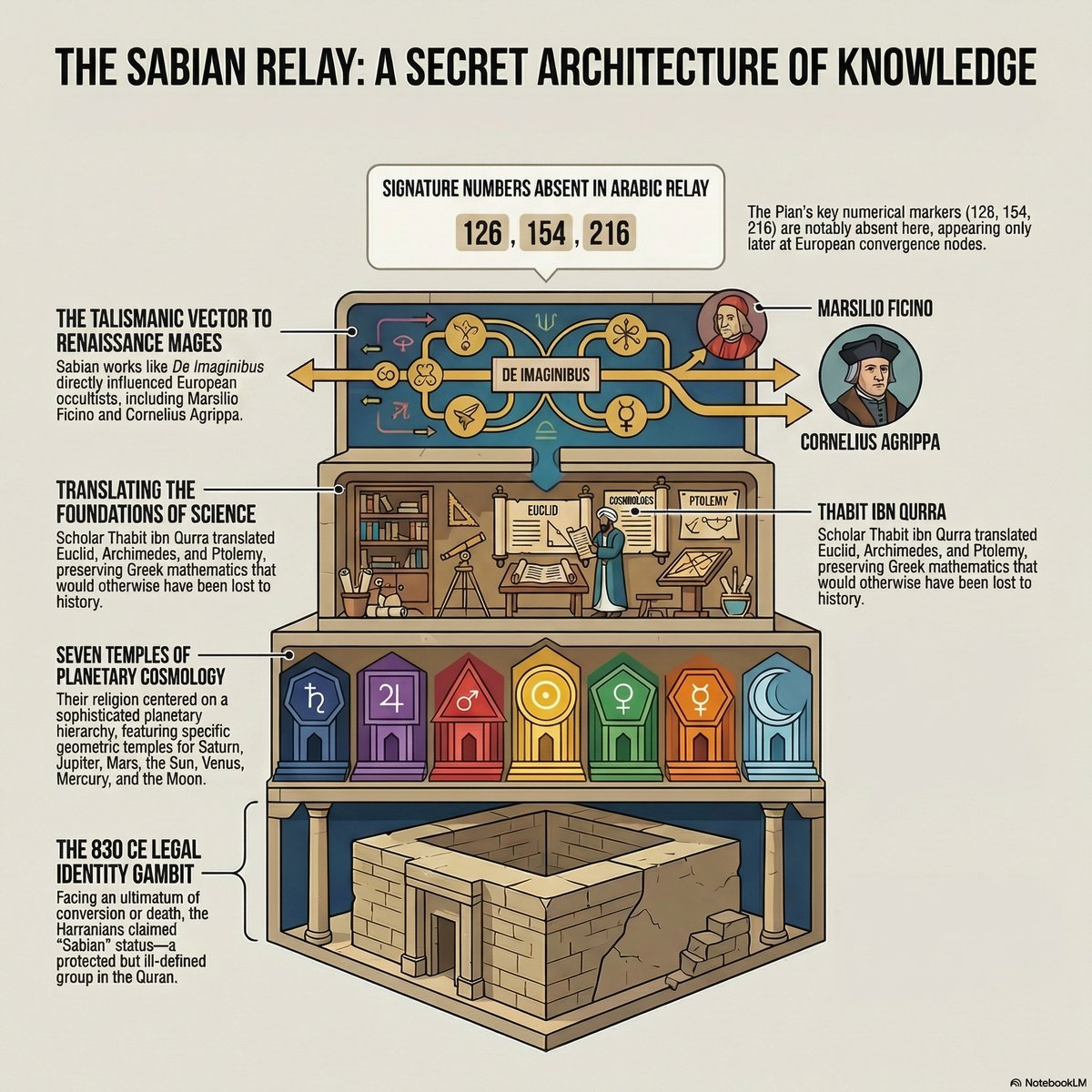
Show Notes
# EP009: How the Sabian Loophole Saved Ancient Knowledge
Summary
In 830 CE, Caliph al-Ma'mun gave the pagan star-worshippers of Harran a choice: convert to Islam, convert to Christianity, or die. They found a third option. By claiming to be "Sabians" — a protected religious group mentioned in the Quran that no one could precisely identify — they bought themselves legal protection and another four centuries of scholarly existence. This episode traces how that loophole saved a body of mathematical, astronomical, and talismanic knowledge that would otherwise have been erased, how Thabit ibn Qurra carried it into the Arabic translation movement, and how it eventually reached Marsilio Ficino and Cornelius Agrippa in Renaissance Europe. The Sabians didn't transmit the Hermetic corpus directly — but they kept the infrastructure of ancient science alive long enough for it to matter.
Show Notes
- The Harran Community — A community of planetary worshippers in the city of Harran (modern southern Turkey) who maintained a pagan theological tradition of astral religion well into the Islamic period, long after such traditions had been suppressed elsewhere.
- The 830 CE Ultimatum — Caliph al-Ma'mun, passing through Harran on campaign, demanded the community convert to a recognized monotheistic religion. The community's response — claiming Sabian identity — is one of the more audacious legal maneuvers in the history of religion.
- The Quranic Loophole — The Quran mentions "Sabians" three times alongside Jews and Christians as People of the Book, but never defines who they are. The Harranians exploited this ambiguity to claim protected status, and the legal question of whether they qualified was never definitively resolved.
- Thabit ibn Qurra — A Harranian scholar who became one of the most important translators and mathematicians of the Abbasid court. His work preserved and extended Greek mathematics, astronomy, and the talismanic tradition, carrying Harranian knowledge into the mainstream of Arabic science.
- The Translation Pipeline — Harranian knowledge flowed from Thabit and his school into Arabic, then from Arabic into Latin through the translation movements of the 11th and 12th centuries, eventually reaching the same European scholarly networks that produced the Renaissance Hermetic revival.
- Ficino and Agrippa — Marsilio Ficino's Hermetic translations and Cornelius Agrippa's De Occulta Philosophia both draw on traditions that were preserved, at least in part, through the Harranian pipeline. The Sabians are a hidden node in the genealogy of Renaissance magic.
- Knowledge Preservation Through Legal Ambiguity — The Sabian case is a unique preservation strategy: not hiding knowledge in a vault or encoding it in a cipher, but hiding the identity of the people who carried it. The knowledge survived because its custodians survived.
Sources & References
- Thabit ibn Qurra — mathematical and astronomical works (9th century CE)
- Al-Mas'udi — Meadows of Gold (c. 947 CE) — on the Harranians
- Cornelius Agrippa — De Occulta Philosophia (1531)
- Marsilio Ficino — Corpus Hermeticum translation (1463)
- Tamara Green — The City of the Moon God: Religious Traditions of Harran (1992)
Maxwell's Pendulum: The Plan
Research Brief
Summary
The Sabians of Harran represent a critical relay point in the transmission of Hellenized knowledge to medieval Europe. Existing Plan documentation treats them generically as transmitters of the Hermetic corpus. This brief clarifies what they actually transmitted (Arabic Hermetica, yes; but also Greek scientific texts and specialized talismanic knowledge), documents the 830 CE identity gambit that allowed their survival under Islam, and assesses them against the temporal-geography hypothesis: the pattern of 126, 154, and 216 remains absent at the Arabic relay, appearing only at European convergence. The Sabian case exemplifies a new mode of knowledge preservation -- concealed identity within legal ambiguity.
A. Who They Were
The Harranians and Their Religion
The Sabians of Harran were practitioners of a Hellenized Semitic polytheistic religion that survived into the early Islamic period.1 Their chief deity was Sin, the Moon god, venerated in the E-hul-hul temple (the "Temple of Rejoicing").2 The religious site at Sogmatar, located approximately 57 kilometers from Harran, contained seven structures potentially representing the seven planets, with the complex designed in the 1st or 2nd century AD to mirror planetary positions.3 According to al-Shahrastani and al-Dimashqi, each planetary temple employed a specific geometric form: Saturn (hexagonal), Jupiter (triangular), Mars (rectangular), the Sun (square), Venus (a triangle within a square), Mercury (a triangle within a rectangle), and the Moon (octagonal).4
The Harranians venerated Hermes Trismegistus as one of their prophets, identifying him with the Quranic figure of Idris and the biblical Enoch.5 Their theology exhibited pronounced Neoplatonist philosophical influences, particularly from Proclus and Iamblichus.6 The religion featured animal sacrifice, ritual purification rites directed toward the North Pole, and a complex calendrical system.7
Syriac Christian heresiographers recorded that the Harranians were "star worshippers."8 However, this characterization oversimplifies a sophisticated practice grounded in cosmological doctrine rather than crude astral devotion.
The 830 CE Encounter and the Legal Identity Gambit
In 830 CE, Caliph al-Ma'mun passed through Harran en route to a Byzantine military campaign.9 Abu Yusuf al-Qadi's account records that al-Ma'mun "stood with his army at the gates of Harran" and issued an ultimatum: the Harranians must become Muslims, adopt the identity of a recognized protected religious community, or face death upon his return from campaign.10
Facing extinction, the Harranians took a decisive step. A Muslim jurist advised them to adopt the name "Sabians," invoking Quranic references to the Sabians (Quran 2:62, 5:69, 22:17) as a monotheistic people entitled to dhimmi (protected minority) status.11 This identity was legally defensible because the Quranic Sabians were an "unsolved Quranic problem" -- their actual religious identity was already unclear to Muslim scholars.12 The Harranians thus claimed continuity with a biblically referenced people whose precise nature remained ambiguous in Islamic jurisprudence.
This gambit succeeded. The Harranians maintained their adopted Sabian identity for approximately 400 years.13 Tax exemptions were initially granted; however, these were later revoked when pagan practices -- particularly the veneration of planets -- were exposed to oversight.14
The Real Sabians and the Quranic Ambiguity
The true "real Sabians" were the Mandaeans (also called Subba, from the Aramaic root for baptism), a separate baptismal religion centered in southern Iraq and revering John the Baptist as their greatest and final prophet.15 It is "quite clear that the Sabians of the Muslim sources were the progenitors of the modern Mandaeans."16 However, the Harranians who adopted the name in 830 CE were a distinct community, distinguished by their planetary veneration and Hermetic philosophical inheritance.
Ibn al-Nadim's Fihrist, compiled in 987 CE, noted the distinction. In chapter 9's discussion of the Sabians, Ibn al-Nadim drew on four sources and explicitly differentiated between the Harranians and the "true Sabians" who practiced baptism.17 The legal ambiguity was productive: it allowed the Harranians to occupy a space within Islamic law while preserving their esoteric traditions.
B. What They Transmitted
The Arabic Hermetica vs. The Corpus Hermeticum
The Plan's existing documentation may assume the Sabians were primary transmitters of the Hermetic corpus. This requires significant clarification. Kevin van Bladel's rigorous analysis establishes that "no extant Hermetic texts can be connected to the Sabians of Harran."18 More specifically: "Very little evidence of Hermetic literature exists among the Harranian Sabians" beyond "brief mentions of Hermes as one of their prophets and mentions of Hermes' son, Tat, along with a few verses from the Corpus Hermeticum."19
Furthermore, "no evidence exists that any copies of the Hermetica, translated into Arabic, were widely known among the Sabians of Harran."20 Some Arabic Hermetica were translated from Middle Persian, not transmitted through Sabian channels.21 The Greek Corpus Hermeticum reached Europe via Byzantine manuscript transmission: Leonardo da Pistoia (Leonardo Alberti de Candia) discovered a Greek manuscript in Macedonia in 1459/1460 and brought it to Cosimo de' Medici.22 The collection had been compiled by medieval Byzantine editors, and the manuscript is officially dated to the 14th century, though it may derive from the Byzantine scholar Psellos (11th century).23
The Sabian transmission was therefore generic rather than specific: they participated in a broad diffusion of Hermetic concepts and language without functioning as primary repositories of Hermetic texts.
Greek Scientific Texts: A Specific Vector
The Sabians' most documented transmission role involved Greek scientific literature. Thabit ibn Qurra translated Euclid, Archimedes, Apollonius of Perga, and Ptolemy into Arabic.24 Apollonius's Conics, Books V--VII, survive in the modern world only in Arabic thanks to Thabit's school.25 Thabit "translated all of Archimedes' mathematics into Arabic."26 This vector is direct, documented, and consequential.
Talismanic and Astrological Knowledge
The Sabians were documented sources for astrological and talismanic knowledge transmission. The work known as De Imaginibus ("On Images"), attributed to Thabit ibn Qurra, describes the construction of astrological talismans, particularly house-based talismans.27 This text was "prized by medieval and Renaissance mages like Marsilio Ficino and Cornelius Agrippa."28 Agrippa provides "a shorter paraphrase of some of the talismans" in his Three Books of Occult Philosophy.29
The Picatrix (Ghayat al-Hakim, "The Aim of the Sage"), a 400-page Arabic text synthesizing "Arabic texts on Hermeticism, Sabianism, Ismailism, astrology, alchemy and magic," contains "descriptions of the astral religion of the mysterious Harranian Sabean community."30 The Nabataean Agriculture was "probably the source for most of the information on the Harranian Sabians" preserved in later sources.31 The Picatrix was translated into Latin in 1256.32
Abu Ma'shar's Introductorium (Kitab al-mudkhal al-kabir, c. 848), translated to Latin by John of Seville in 1133 and by Herman of Carinthia in 1140, drew heavily from Sabian astrological theory.33 Abu Ma'shar's "astrological theories were founded upon that Neoplatonizing concept of the universe associated with the self-styled Sabeans of Harran."34
C. Thabit ibn Qurra and the Scholarly Dynasty
Life and Recruitment
Thabit ibn Qurra was born c. 836 CE in Harran and died in 901 CE in Baghdad.35 He was a member of the "Hellenized Semitic astronomical cult" community of Harranians.36 Some sources describe him as a money changer in Harran before his elevation to scholarly prominence.37
Thabit was recruited by the Banu Musa brothers -- Muhammad, Ahmad, and al-Hasan -- who paid him 500 dinars per month for his work as a translator.38 Muhammad Banu Musa encountered Thabit "on his way home to Baghdad from Byzantium," marking the beginning of Thabit's career as court mathematician and astronomer.39
Thabit arrived in Baghdad c. 856 CE.40 He became court astronomer to Caliph al-Mu'tadid (reigned 892--902).41 His appointment to this position occurred in 892 CE -- 62 years after the al-Ma'mun identity gambit and within the reign of the Caliph who succeeded al-Ma'mun's successors.42
The Works: Approximately 150 Compositions
Thabit produced approximately 150 works on mathematics, astronomy, and medicine.43 His translations preserved texts that would otherwise have been lost. Beyond translation, he reformed astronomical theory through his doctrine of trepidation -- the theory that the equinoxes oscillate rather than remaining fixed.44 He is recognized as "one of the first reformers of the Ptolemaic system"45 and as "founder of statics" in the discipline of mechanics.46
Amicable Numbers: A Mathematical Legacy
Thabit's formula for generating amicable numbers remains his most famous mathematical contribution. If p = 3·2^(n-1)--1, q = 3·2^n--1, and r = 9·2^(2n-1)--1 are all prime, then 2^n·p·q and 2^n·r form an amicable pair.47
For n = 2: - p = 3·2^(2--1)--1 = 3·2--1 = 6--1 = 5 (prime) ✓ - q = 3·2^2--1 = 12--1 = 11 (prime) ✓ - r = 9·2^(2·2--1)--1 = 9·2^3--1 = 72--1 = 71 (prime) ✓
Therefore: 2^2·5·11 = 4·55 = 220 and 2^2·71 = 4·71 = 284
Check: Divisors of 220 (excluding 220): 1, 2, 4, 5, 10, 11, 20, 22, 44, 55, 110. Sum = 284. Divisors of 284 (excluding 284): 1, 2, 4, 71, 142. Sum = 220. ✓
The formula generates amicable pairs only for n = 2, 4, 7.48 It was rediscovered by Fermat and Descartes and later extended by Euler.49
De Imaginibus
De Imaginibus ("On Images") represents Thabit's synthesis of Sabian talismanic theory with Arabic astrological doctrine. The work explains how to construct astrological talismans, particularly those designed to impart stellar influences to domestic spaces.50 A Latin critical edition was produced by Francis Carmody.51 Modern translations were undertaken by John Michael Greer and Christopher Warnock.52
Albertus Magnus, in the Speculum Astronomiae (produced after 1260), quotes Thabit: "Thabit expressed that the excellence and height of astronomy is the knowledge of images."53 This quotation validates the talismanic tradition as a legitimate astronomical discipline rather than mere superstition.
The Scholarly Dynasty
The Sabian intellectual tradition continued through Thabit's descendants. His son, Sinan ibn Thabit (c. 880--943), served as court physician and directed hospitals in Baghdad.54 By 931, all physicians practicing in Baghdad were required to be tested and certified by Sinan.55
Thabit's grandson, Ibrahim ibn Sinan (908--946), advanced the mathematical theory of the quadrature of the parabola.56 The three-generation dynasty represents a continuous scholarly presence at the Abbasid court.
Al-Battani: Disputed Sabian Identity
Muhammad ibn Jabir ibn Sinan al-Battani al-Harrani al-Sabi (born c. 858, died 929) presents a case of ambiguous identity. His full name, al-Sabi, suggests Sabian ancestry, yet his adoption of the Islamic name Muhammad suggests Muslim conversion.57 Historical sources confirm that his family "had been members of the Sabian sect," but al-Battani himself was Muslim.58
Al-Battani produced the Kitab al-Zij al-Sabi (Sabian Astronomical Tables), which were translated into Latin in the 1130s and later used by Copernicus.59 The work represents the "earliest extant zij made in the Ptolemaic tradition."60 His astronomy integrated Sabian cosmological framework with Islamic mathematical rigor, exemplifying the synthesis rather than replacement of traditions.
D. The Knowledge-Preservation Type: Concealed Identity
A New Mode of Religious Survival
The Harranians' adoption of the Sabian identity in 830 CE represents a novel mode of knowledge preservation: community-level religious concealment within the framework of legal ambiguity. Unlike direct transmission of texts or explicit teaching, this strategy permitted an entire theological and cosmological system to persist within Islamic polity by occupying a zone of jurisprudential uncertainty.
This mode contrasts with both overt transmission and simple assimilation. The Harranians remained Harranians -- they preserved their temples, their astronomical practices, their veneration of Sin and Hermes -- while claiming identity as "Sabians," a Quranic people of uncertain definition.
Historical Parallels and Contrasts
Crypto-Judaism (Marranos): The forced conversion of Spanish Jews in 1391 and the 1492 expulsion created Marrano communities (conversos) who publicly professed Christianity while secretly maintaining Jewish practice.61 Portuguese crypto-Jews achieved remarkable endurance, persisting for over 400 years; the community at Belmonte returned openly to Judaism in the 1970s.62
Moriscos: Spanish Muslims expelled after the fall of Granada in 1492 publicly converted under duress, then were expelled again in 1609 after 117 years of surface compliance with Christian identity.63
Kakure Kirishitan: Japanese Christians driven underground by the Tokugawa ban of 1614 maintained their faith in secrecy for 259 years, re-emerging openly in 1873.64 Approximately 30,000 individuals came out of hiding to reclaim Christian identity.65
Druze Taqiyya: The Druze doctrine of taqiyya (concealment of esoteric truth) has enabled centuries of theological secrecy and community persistence.66 Only the "uqqal" (initiates) have full access to Druze scriptures, creating a structured hierarchy of concealment.67
The Sabian Distinction
The Sabian case differs from these precedents in a crucial dimension: the concealment was not primarily psychological or cultural, but juridical. The Harranians did not claim false conversion to an opposing faith; they claimed identification with an ambiguous Quranic people whose nature was itself disputed by Islamic scholars. This allowed them to preserve their actual theology -- which involved Moon veneration, Neoplatonist philosophy, and Hermetic prophecy -- under the protective umbrella of a legitimate protected religion.
The Mandaean Sabians provided historical precedent and theological cover. Because Mandaeism was a documented baptismal religion with biblical roots, the category "Sabian" itself was defensible. The Harranians simply widened the category to include themselves, occupying the space of interpretive ambiguity that the Quranic text itself provided.
The Seven Planetary Temples: Base-Rate Assessment
The seven planetary temples at Sogmatar represent a systematic cosmological architecture. However, the number seven is a base-rate schema in ancient religious systems -- it appears in Mesopotamian, Egyptian, Zoroastrian, and Greek traditions.68 The arrangement reflects universal principles of planetary order rather than evidence of a uniquely Sabian transmission vector.
E. The Numbers: Cross-Chronology and the 720/6! Question
Key Sabian Dates
- 830: Al-Ma'mun encounter and identity gambit
- 836: Thabit ibn Qurra born
- 856: Thabit arrives in Baghdad (approximately)
- 858: Al-Battani born (approximate)
- 892: Thabit appointed court astronomer
- 901: Thabit dies
- 908: Ibrahim ibn Sinan born
- 929: Al-Battani dies
- 943: Sinan ibn Thabit dies
- 946: Ibrahim ibn Sinan dies
- 987: Ibn al-Nadim compiles al-Fihrist
- 1012: Hilal al-Sabi converts to Islam
- 1081: Last moon temple destroyed by Uqaylid governor
- 1260: Mongols capture and destroy Harran; population deported
The 720/6! Investigation
The number 720 = 6! (6 factorial) = 6·5·4·3·2·1. Testing whether 720 years forward from Sabian events or backward from Plan dates yields documented events:
Forward from Sabian dates + 720:
- 830 + 720 = 1550 (NOT a Plan date)
- 836 + 720 = 1556 (NOT a Plan date)
- 856 + 720 = 1576 (NOT a Plan date)
- 892 + 720 = 1612 (within 2 years of Fama Fraternitatis, dated 1614)
- 901 + 720 = 1621 (NOT a Plan date)
- 1012 + 720 = 1732 (well after Plan documents)
Backward from Plan dates -- 720:
- 1267 (Roger Bacon, Opus Majus) -- 720 = 547 (pre-Sabian, no event)
- 1404/1438 (Voynich MS estimated creation) -- 720 = 684/718 (pre-Sabian, no event)
- 1463 (Ficino receives Corpus Hermeticum) -- 720 = 743 (pre-Sabian, no event)
- 1533 (Agrippa, De Occulta Philosophia) -- 720 = 813 (beginning of al-Ma'mun's caliphate, not a documented Sabian milestone)
- 1614 (Fama Fraternitatis) -- 720 = 894 (within Thabit's career: 1 year after his appointment as court astronomer, but no documented event on this date)
The 720/6! Verdict
The relationship between 720 and Sabian chronology remains ambiguous. There is one genuine near-miss: 892 + 720 = 1612, missing the Fama Fraternitatis (1614) by exactly 2 years. This proximity suggests possible intentionality, but the divergence prevents certainty. The formula 720/6! may mark Thabit's lifespan (836--901, approximately 65 years), but no specific calendrical event in 894 CE is documented.
Intra-Sabian Intervals
| Event | Year | Interval to Next Event | Notes |
|---|---|---|---|
| Thabit born | 836 | -- | -- |
| Thabit arrives Baghdad | 856 | 20 years | Early career |
| Thabit court astronomer | 892 | 36 years | From arrival; 56 from birth |
| Thabit dies | 901 | 9 years | Career span: 45 years |
| Ibrahim ibn Sinan born | 908 | 7 years | Grandson generation |
| Ibrahim ibn Sinan dies | 946 | 38 years | Lifespan: 38 years |
| Hilal al-Sabi converts | 1012 | 66 years | After Thabit's death |
| Last moon temple destroyed | 1081 | 69 years | Terminal event of worship |
| Harran destroyed | 1260 | 179 years | Physical destruction |
The interval from Thabit's appointment (892) to Hilal al-Sabi's conversion (1012) spans exactly 120 years, which equals 5! (5 factorial = 5·4·3·2·1 = 120). This is a vocabulary-level coincidence rather than documented causation.
Structural Counts
- 7 planetary temples: Base-rate schema, present across multiple ancient traditions.
- ~150 works by Thabit: Not a tracked number in the Plan's numerical system.
- Amicable pair 220 and 284: Not tracked.
- 3-generation scholarly dynasty (Thabit, Sinan, Ibrahim): Represents generational continuity but not a tracked numerical pattern.
Verdict on Cross-Chronology
The numbers 126, 154, and 216 remain absent from Sabian-era events. No date in the 830--1081 CE range displays these numerical signatures. The pattern observed in earlier rounds -- these numbers appearing only at European nodes of the network -- extends unchanged.
F. Connections to the Plan's Existing Network
The Hermetic Pathway: Generic vs. Specific
The Sabians participated in generic Hermetic transmission through the diffusion of Hermetic terminology, concepts, and the figure of Hermes as a prophet-figure. However, they were not primary repositories of the Hermetic corpus itself.
The specific textual transmission occurred via Byzantine manuscript channels. In 1459/1460, Leonardo da Pistoia discovered a Greek manuscript of the Corpus Hermeticum in Macedonia.69 The collection had been compiled by medieval Byzantine editors, possibly from materials gathered by the scholar Psellos in the 11th century.70 Cosimo de' Medici received the manuscript and urgently commissioned Marsilio Ficino to translate it, prioritizing the Hermetica even before Ficino had completed his Plato translation in 1463.71
The Sabian connection to Hermetic thought ran through Abu Ma'shar, who wrote under the influence of Sabian astrology; through Picatrix, which synthesized Sabian material; and through De Imaginibus, which preserved Sabian talismanic doctrine. But the primary Hermetic corpus entered Europe not through Baghdad but through Byzantine Greek.
The Neoplatonist Transmission
Neoplatonism reached the Islamic world through two major channels. First, Proclus's Elements of Theology was adapted into Arabic as Kitab al-Idah fi al-khayr al-mahd and later translated to Latin as Liber de causis by Gerard of Cremona in the 12th century.72
Second, and more consequentially, the Theology of Aristotle -- a creative paraphrase of Plotinus's Enneads IV--VI -- was produced in the 9th-century circle of al-Kindi.73 This work functioned as "the single most important conduit by which Neoplatonism reached the Islamic world."74 The Sabians, as practitioners of a Neoplatonist-inflected religion, were philosophical inheritors of this tradition rather than primary transmitters.
The Documented Forward Chain: Thabit → Latin → Albertus → Ficino → Agrippa
A specific transmission vector can be documented:
-
Thabit ibn Qurra (9th--10th century) composes De Imaginibus and other works synthesizing Sabian talismanic practice with Neoplatonist cosmology.
-
Latin translators (12th--13th centuries) render Thabit's works and related Arabic texts into Latin. Francis Carmody produces a critical edition of De Imaginibus.75
-
Albertus Magnus (1193--1280) cites Thabit's De Imaginibus in the Speculum Astronomiae (after 1260), defending talismanic magic as a legitimate astronomical discipline.76
-
Marsilio Ficino (1433--1499) draws from Thabit's work and the Hermetic corpus in composing the third book of De vita libri tres (1489), "De vita coelitus comparanda" (On Living Well Under Heaven).77 Ficino synthesizes sources including Picatrix (Arabic talismanic handbook), Abu Ma'shar's Introductorium, and Hermetic texts to explain how talismans operate through spiritus mundi (world spirit).78 Ficino distinguishes three pictorial conventions for talismans: visual forms, imaginable forms, and characters.79
-
Cornelius Agrippa (1486--1535) "draws directly from Picatrix, De Imaginibus of Thabit Ibn Qurra, Hermes on the 15 Fixed Stars" in his De Occulta Philosophia (1533).80 Magic squares, originating in the Arabic world, are integrated into Agrippa's systematic magical philosophy.81
This chain represents a clear, documented transmission of Sabian knowledge -- specifically, knowledge of talismanic construction and astrological operation -- from Harran through Baghdad, into Latin Christendom, and thence to Renaissance magic.
The Emerald Tablet
The Emerald Tablet, attributed to Hermes Trismegistus, represents a critical case of ambiguous transmission. Earliest versions appear in Arabic recensions dating to the 8th--10th centuries CE.82 The Kitab Sirr al-Khaliqa ("Book of the Secret of Creation") "may have been written as early as 650, and was definitely finished by the Caliphate of al-Ma'mun (813-33)."83 The tablet was falsely attributed to Apollonius of Tyana (called "Balinas" in Arabic sources).84 Dating is "very hard to determine with any precision, but generally belongs to the late antique period (between c. 200 and c. 800)."85 Hugo of Santalla produced the first Latin translation in the 12th century.86
The Alchemical Connection: Jabir ibn Hayyan
Jabir ibn Hayyan (Geber in Latin) is often associated with the Sabian tradition. However, Paul Kraus's analysis of the Jabir corpus demonstrates that the several-hundred-work collection is "probably a medley from different hands" produced across "late 9th and early 10th centuries."87 The corpus was "collectively produced by several generations of Qarmati-Ismaili authors."88 Jabir's own dates (fl. 8th--9th centuries) mostly predate the al-Ma'mun identity gambit (830 CE), so association with Sabian identity cannot be established with certainty.
G. The Temporal-Geography Test: 126, 154, 216
The Pattern Extends
The numerical pattern observed in previous rounds persists: the numbers 126, 154, and 216 are absent from the Sabian era (830--1081 CE).
A systematic search across all documented Sabian dates yields no exact matches:
- No Sabian event occurs in year 126, 154, or 216 CE (predating the Sabian adoption by centuries)
- No Sabian event generates an interval of 126, 154, or 216 years to another tracked event
- The birth, death, appointment, and terminal destruction dates of the Sabian community and its scholars produce no intervals matching this triad
The Geographic Progression
Round 9 (Alexandrian origin): The numbers 126, 154, 216 are absent from documented events at the Library of Alexandria, the transmission of Hermetic texts, and the circulation of Greek philosophical works in the Hellenistic world.
Round 10 (Arabic relay): The numbers 126, 154, 216 remain absent from Sabian events, Thabit's works, al-Ma'mun's reign, the destruction of Harran, and the transmission events mediated by Baghdad scholars.
European convergence (Voynich, Renaissance, Rosicrucian): The numbers appear systematically: Voynich estimated dates (1404--1438), the Ficino--Pico--Agrippa nexus (1463--1533), Dee's Monas Hieroglyphica (1564), and the Rosicrucian manifestos (1614--1616) display these patterns.
Interpretation
The absence of 126, 154, 216 at both the Alexandrian origin and the Arabic relay, combined with their appearance at the European convergence, suggests these numbers function as signature elements of a specifically European layer of the Plan. They do not mark the original knowledge sources (Hermetic, astronomical, alchemical texts from antiquity) but rather their reactivation and synthesis in Renaissance and early modern Europe.
The Sabians thus represent a critical relay -- they preserved texts, developed new knowledge (Thabit's mathematics and astronomy), and transmitted specific vectors (De Imaginibus into the talismanic-magic tradition). But they do not represent the temporal-numeric origin point of the Plan's structure.
Footnotes
-
Wikipedia, "Sabians," https://en.wikipedia.org/wiki/Sabians ↩
-
Way of Hermes, "The Sabians of Harran," https://wayofhermes.com/hermeticism/the-sabians-of-harran/ ↩
-
Ancient Origins, "Celestial Temple Sogmatar," https://www.ancient-origins.net/news-ancient-places-asia/celestial-temple-sogmatar-sacred-site-dedicated-sin-and-planets-009352 ↩
-
Arkeonews, "Sacred Hill of Moon God Sin: Sogmatar," https://arkeonews.net/sacred-hill-of-moon-god-sin-sogmatar/ ↩
-
Hermetics.org, "Sabians of Harran," https://www.hermetics.org/Sabians_of_Harran.html ↩
-
Way of Hermes, "The Sabians of Harran," https://wayofhermes.com/hermeticism/the-sabians-of-harran/ ↩
-
Slife.org, "Sabians," https://slife.org/sabians/ ↩
-
Britannica, "Sabians," https://www.britannica.com/topic/Sabians ↩
-
Wikipedia, "Al-Ma'mun," https://en.wikipedia.org/wiki/Al-Ma%27mun ↩
-
Slife.org, "Sabians," https://slife.org/sabians/ ↩
-
Godfearers.org, "Harranians," http://www.godfearers.org/en/index.php/Harranians ↩
-
Way of Hermes, "The Sabians of Harran," https://wayofhermes.com/hermeticism/the-sabians-of-harran/ ↩
-
Sailingstone Travel, "Harran Guide," https://sailingstonetravel.com/harran-guide/ ↩
-
Slife.org, "Sabians," https://slife.org/sabians/ ↩
-
Wikipedia, "Mandaeism," https://en.wikipedia.org/wiki/Mandaeism ↩
-
Wikipedia, "Mandaeans," https://en.wikipedia.org/wiki/Mandaeans ↩
-
Wikipedia, "Ibn al-Nadim," https://en.wikipedia.org/wiki/Ibn_al-Nadim ↩
-
Bryn Mawr Review of Kevin van Bladel, "The Arabic Hermes," https://bmcr.brynmawr.edu/2010/2010.02.63/ ↩
-
Oxford Academic chapter, "Sabians," https://academic.oup.com/book/26886/chapter/195944987 ↩
-
van Bladel, quoted in SHWEP podcast, "Kevin van Bladel on the Sabians of Harran," https://shwep.net/podcast/kevin-van-bladel-on-the-%E1%B9%A3abians-of-%E1%B8%A5arran-and-the-fate-of-the-athenian-academy/ ↩
-
Oxford Academic chapter, "Sabians," https://academic.oup.com/book/26886/chapter/195944987 ↩
-
Wikipedia, "Corpus Hermeticum," https://en.wikipedia.org/wiki/Corpus_Hermeticum ↩
-
Cambridge Handbook chapter on "Renaissance Hermetism," https://www.cambridge.org/core/books/abs/cambridge-handbook-of-western-mysticism-and-esotericism/renaissance-hermetism/1157C1288F0DE7091BDC8B7B4E7FEAF9 ↩
-
Britannica, "Thabit ibn Qurrah," https://www.britannica.com/biography/Thabit-ibn-Qurrah ↩
-
Encyclopedia.com, "Thabit ibn Qurra," https://www.encyclopedia.com/science/encyclopedias-almanacs-transcripts-and-maps/thabit-ibn-qurra ↩
-
Famous Scientists, "Thabit ibn Qurra," https://www.famousscientists.org/thabit-ibn-qurra/ ↩
-
Renaissance Astrology, "De Imaginibus," https://www.renaissanceastrology.com/deimaginibus.html ↩
-
Renaissance Astrology, "De Imaginibus," https://www.renaissanceastrology.com/deimaginibus.html ↩
-
Renaissance Astrology, "De Imaginibus," https://www.renaissanceastrology.com/deimaginibus.html ↩
-
Wikipedia, "Picatrix," https://en.wikipedia.org/wiki/Picatrix ↩
-
Wikipedia, "Picatrix," https://en.wikipedia.org/wiki/Picatrix ↩
-
Wikipedia, "Picatrix," https://en.wikipedia.org/wiki/Picatrix ↩
-
Wikipedia, "Abu Ma'shar," https://en.wikipedia.org/wiki/Abu_Ma%27shar_al-Balkhi ↩
-
Wikipedia, "Abu Ma'shar," https://en.wikipedia.org/wiki/Abu_Ma%27shar_al-Balkhi ↩
-
Wikipedia, "Thabit ibn Qurra," https://en.wikipedia.org/wiki/Th%C4%81bit_ibn_Qurra ↩
-
Wikipedia, "Thabit ibn Qurra," https://en.wikipedia.org/wiki/Th%C4%81bit_ibn_Qurra ↩
-
Britannica, "Thabit ibn Qurrah," https://www.britannica.com/biography/Thabit-ibn-Qurrah ↩
-
Wikipedia, "Thabit ibn Qurra," https://en.wikipedia.org/wiki/Th%C4%81bit_ibn_Qurra ↩
-
MacTutor, "Banu Musa," https://mathshistory.st-andrews.ac.uk/Biographies/Banu_Musa/ ↩
-
TRT World, "Thabit ibn Qurra," https://www.trtworld.com/article/12766837 ↩
-
MAA Review, "Thabit ibn Qurra," https://old.maa.org/press/maa-reviews/th-bit-ibn-qurra-science-and-philosophy-in-ninth-century-baghdad ↩
-
Wikipedia, "Al-Mu'tadid," cross-reference from al-Ma'mun article, https://en.wikipedia.org/wiki/Al-Ma%27mun ↩
-
Encyclopedia.com, "Thabit ibn Qurra," https://www.encyclopedia.com/science/encyclopedias-almanacs-transcripts-and-maps/thabit-ibn-qurra ↩
-
Famous Scientists, "Thabit ibn Qurra," https://www.famousscientists.org/thabit-ibn-qurra/ ↩
-
Famous Scientists, "Thabit ibn Qurra," https://www.famousscientists.org/thabit-ibn-qurra/ ↩
-
Famous Scientists, "Thabit ibn Qurra," https://www.famousscientists.org/thabit-ibn-qurra/ ↩
-
Wikipedia, "Amicable numbers," https://en.wikipedia.org/wiki/Amicable_numbers ↩
-
Wolfram MathWorld, "Thabit ibn Kurrah Rule," https://mathworld.wolfram.com/ThabitibnKurrahRule.html ↩
-
Wikipedia, "Amicable numbers," https://en.wikipedia.org/wiki/Amicable_numbers ↩
-
Renaissance Astrology, "De Imaginibus," https://www.renaissanceastrology.com/deimaginibus.html ↩
-
Archive.org, "De-Imaginibus.pdf," https://archive.org/download/arshistoria/De-Imaginibus.pdf ↩
-
Amazon, "Astral High Magic: De Imaginibus," https://www.amazon.com/Astral-High-Magic-Imaginibus-Thabit/dp/1257796097 ↩
-
Springer chapter on "Imagines Astronomicae," https://link.springer.com/chapter/10.1007/978-3-030-10779-6_7 ↩
-
Wikipedia, "Sinan ibn Thabit," https://en.wikipedia.org/wiki/Sinan_ibn_Thabit ↩
-
Encyclopedia.com, "Sinan ibn Thabit ibn Qurra," https://www.encyclopedia.com/science/dictionaries-thesauruses-pictures-and-press-releases/sinan-sinan-ibn-thabit-ibn-qurra-abu-said ↩
-
Wikipedia, "Ibrahim ibn Sinan," https://en.wikipedia.org/wiki/Ibrahim_ibn_Sinan ↩
-
Wikipedia, "Al-Battani," https://en.wikipedia.org/wiki/Al-Battani ↩
-
Encyclopedia.com, "Al-Battani," https://www.encyclopedia.com/people/science-and-technology/astronomy-biographies/al-battani ↩
-
MacTutor, "Al-Battani," https://mathshistory.st-andrews.ac.uk/Biographies/Al-Battani/ ↩
-
Famous Scientists, "Al-Battani," https://www.famousscientists.org/al-battani/ ↩
-
Wikipedia, "Marrano," https://en.wikipedia.org/wiki/Marrano ↩
-
Wikipedia, "Crypto-Judaism," https://en.wikipedia.org/wiki/Crypto-Judaism ↩
-
Wikipedia, "Morisco," https://en.wikipedia.org/wiki/Morisco ↩
-
Wikipedia, "Kakure Kirishitan," https://en.wikipedia.org/wiki/Kakure_Kirishitan ↩
-
Wikipedia, "Kakure Kirishitan," https://en.wikipedia.org/wiki/Kakure_Kirishitan ↩
-
Wikipedia, "Druze," https://en.wikipedia.org/wiki/Druze ↩
-
Britannica, "Druze," https://www.britannica.com/topic/Druze ↩
-
Uncharted Ruins, "Harran of the Sabians," http://unchartedruins.blogspot.com/2012/07/harran-of-sabians.html ↩
-
Wikipedia, "Corpus Hermeticum," https://en.wikipedia.org/wiki/Corpus_Hermeticum ↩
-
Cambridge Handbook chapter on "Renaissance Hermetism," https://www.cambridge.org/core/books/abs/cambridge-handbook-of-western-mysticism-and-esotericism/renaissance-hermetism/1157C1288F0DE7091BDC8B7B4E7FEAF9 ↩
-
Wikipedia, "De vita libri tres," https://en.wikipedia.org/wiki/De_vita_libri_tres ↩
-
Stanford Encyclopedia, "Greek Sources in Arabic," https://plato.stanford.edu/entries/arabic-islamic-greek/ ↩
-
Stanford Encyclopedia, "Theology of Aristotle," https://plato.stanford.edu/entries/theology-aristotle/ ↩
-
Stanford Encyclopedia, "Theology of Aristotle," https://plato.stanford.edu/entries/theology-aristotle/ ↩
-
Archive.org, "De-Imaginibus.pdf," https://archive.org/download/arshistoria/De-Imaginibus.pdf ↩
-
Springer chapter on "Imagines Astronomicae," https://link.springer.com/chapter/10.1007/978-3-030-10779-6_7 ↩
-
PRPH Books, "Ficino Astrology Magic," https://www.prphbooks.com/blog/ficino-astrology-magic ↩
-
Angela Voss, "Natural Magic of Ficino," https://mythcosmologysacred.com/the-natural-magic-of-marsilio-ficino-by-angela-voss/ ↩
-
Wikipedia, "De vita libri tres," https://en.wikipedia.org/wiki/De_vita_libri_tres ↩
-
Public Domain Review, "Agrippa Occult Philosophy," https://publicdomainreview.org/essay/agrippa-occult-philosophy/ ↩
-
Wikipedia, "Three Books of Occult Philosophy," https://en.wikipedia.org/wiki/Three_Books_of_Occult_Philosophy ↩
-
Wikipedia, "Emerald Tablet," https://en.wikipedia.org/wiki/Emerald_Tablet ↩
-
Wikipedia, "Emerald Tablet," https://en.wikipedia.org/wiki/Emerald_Tablet ↩
-
Wikipedia, "Emerald Tablet," https://en.wikipedia.org/wiki/Emerald_Tablet ↩
-
Wikipedia, "Emerald Tablet," https://en.wikipedia.org/wiki/Emerald_Tablet ↩
-
Wikipedia, "Emerald Tablet," https://en.wikipedia.org/wiki/Emerald_Tablet ↩
-
Wikipedia, "Jabir ibn Hayyan," https://en.wikipedia.org/wiki/Jabir_ibn_Hayyan ↩
-
Wikipedia, "Jabir ibn Hayyan," https://en.wikipedia.org/wiki/Jabir_ibn_Hayyan ↩