How Neglect Killed the Library of Alexandria
Listen
Open in Spotify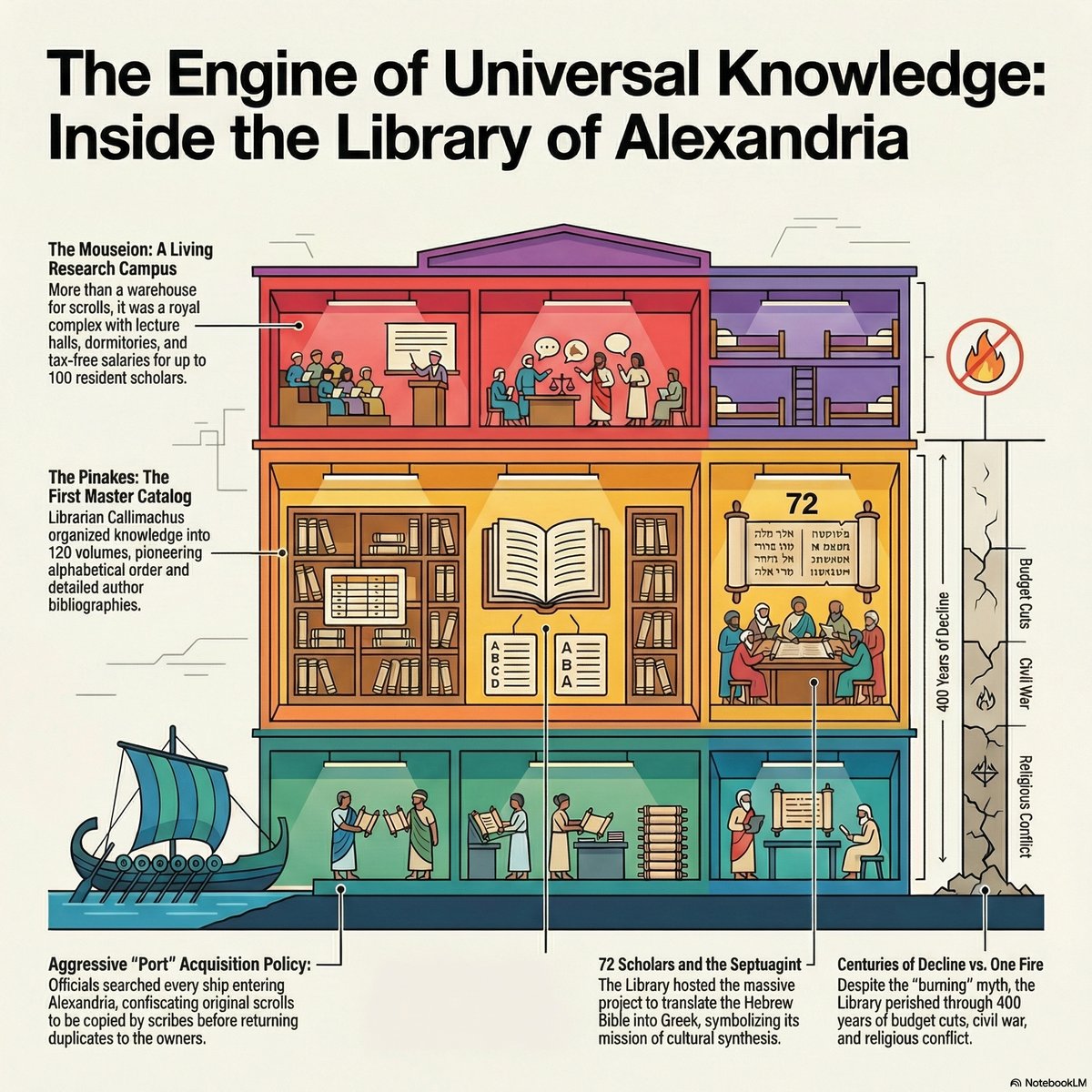
Show Notes
# EP008: How Neglect Killed the Library of Alexandria
Summary
The Library of Alexandria wasn't destroyed in a single fire. It died slowly — through political neglect, religious conflict, and centuries of underfunding. This episode traces the full arc of the greatest knowledge institution of the ancient world, from the Ptolemaic dynasty's ambition to collect every book ever written, through Callimachus's 120-volume catalog, through the 72 scholars who produced the Septuagint, to the protracted decline that eventually erased it. More importantly, it traces what survived: the Hermetic, alchemical, and Kabbalistic traditions that passed through Alexandria, then into Arabic scholarship, then into Byzantine preservation, and finally into the Renaissance minds that are the subject of this entire investigation.
Show Notes
- The Ptolemaic Project — The Library was founded by the Ptolemaic dynasty as a deliberate attempt to aggregate all world knowledge into a single Greek-language collection. Ships docking at Alexandria were required to surrender any scrolls for copying. The ambition was total.
- The Mouseion and the Serapeum — The complex had two main components: the Mouseion, a residential scholarly community funded by the state, and the Serapeum, a secondary public annex that held overflow collections and survived longer than the main library.
- Callimachus and the 120-Volume Catalog — Callimachus produced the Pinakes, a 120-volume bibliographic catalog of Greek literature — the first systematic attempt to organize human knowledge. It is itself lost, known only through references in other texts.
- The Septuagint and the Number 72 — The Greek translation of the Hebrew scriptures was produced at Alexandria by 72 scholars (6 from each of the 12 tribes), working for 72 days. The number 72 appears here as it does in the Ars Goetia and the Kabbalistic tradition.
- The Myth of the Single Fire — Popular history attributes the library's destruction to Julius Caesar, or Theophilus, or the Arab conquest. Modern scholarship shows a protracted decline across several centuries — each episode of political instability removed another layer of funding and attention.
- What Survived and How — The Hermetic, alchemical, and Neoplatonic texts that shaped Renaissance occultism passed through Alexandria before their destruction. Arabic scholars preserved Aristotle, Euclid, and the medical tradition; Byzantine scribes kept the literary corpus. Neither preserved everything.
- Alexandria as Archetype — The library functions in this investigation the way the Voynich Manuscript does: as a symbol of knowledge that was deliberately assembled, deliberately hidden, and only partially recovered — the same pattern, at a much larger scale.
Sources & References
- Callimachus — Pinakes (c. 245 BCE, fragmentary)
- Letter of Aristeas (c. 2nd century BCE) — on the Septuagint
- Plutarch — Life of Caesar on the Alexandrian fire
- Edward Parsons — The Alexandrian Library (1952)
- Luciano Canfora — The Vanished Library (1987)
Maxwell's Pendulum: The Plan
Research Brief
A. The Institution
Founding
The Library of Alexandria was founded during the early Ptolemaic dynasty, though the precise date and attribution remain debated. Ptolemy I Soter (r. 323-283 BCE) initiated the project, possibly on the advice of Demetrius of Phalerum, an Athenian statesman and student of Aristotle who had taken refuge at the Ptolemaic court after his exile from Athens around 297 BCE.12 However, the Library became a functioning institution under Ptolemy II Philadelphus (r. 283-246 BCE), who substantially developed it and oversaw its first major acquisitions. The scholarly consensus places the founding in the range of c. 295-283 BCE, with the caveat that "founding" describes a process rather than an event: Ptolemy I laid the groundwork, Demetrius may have proposed the concept (modeled on Aristotle's Lyceum), and Ptolemy II built the institution into the dominant scholarly center of the Hellenistic world.34
Demetrius's actual role is disputed. He fell from favor when Ptolemy II succeeded his father, and some scholars doubt he had any significant role in the Library's organization. Others credit him with collecting the earliest texts, including works of Aristotle and Theophrastus, that formed the nucleus of the collection.5
The Mouseion
The Library was part of a larger institution called the Mouseion (Museum), a research community housed in a complex of buildings and gardens near the royal palace in the Bruchion quarter.6 Strabo, who visited around 20 BCE, described it as having colonnaded walkways, lecture and banquet halls, and dormitory-style quarters for resident scholars.7 The institution was organized with a president-priest at its head, followed by salaried scholars in various disciplines. Scholars received free room and board, salaries from the Egyptian state, and paid no taxes.8
The number of resident scholars at any given time is estimated at approximately 30 to 100, depending on the period, with some accounts suggesting over 1,000 scholars and students engaged with the institution daily at its peak, though the distinction between permanent residents and visiting scholars is unclear.9 Disciplines represented included mathematics, astronomy, medicine, rhetoric, law, literary criticism, history, geography, and the natural sciences.
The Daughter Library at the Serapeum
A satellite library was established at the Serapeum, a temple dedicated to the Greco-Egyptian god Serapis, during the reign of Ptolemy III Euergetes (246-222 BCE), when the main Library ran out of space.10 According to the Byzantine scholar Johannes Tzetzes (12th century), who claimed to cite Ptolemaic sources, the Serapeum held approximately 42,800 scrolls.11 The Serapeum library functioned as a public-access annex, contrasting with the more restricted main collection. By the late 4th century CE, it was probably the largest surviving book collection in Alexandria, as the main Library's collection had long since been dispersed or destroyed.12 The Serapeum and its library were destroyed in 391 CE under Bishop Theophilus (see Section B).
The Pinakes
Callimachus of Cyrene (c. 310/305-240 BCE) compiled the Pinakes, a bibliographic catalog of the Library's holdings that ran to 120 volumes -- approximately five times the length of Homer's Iliad.1314 It is widely regarded as the first library catalog in the Western tradition. Callimachus divided the catalog by genre, separating poetry from prose and then subdividing further. The main categories included: epic poetry, lyric poetry, tragedy, comedy, rhetoric, law, history, medicine, mathematics, natural science, and miscellanies.1516
Each entry recorded the author's name, birthplace, father's name, educational background, a complete list of known works, the first line (incipit) of each work, a content summary, the manuscript's origin, and any scholarly doubts about attribution.17 Callimachus also introduced alphabetical ordering within each category. The Pinakes is lost; it survives only in references by later authors. Despite his foundational contribution, Callimachus never served as head librarian.18
Critical structural number: The Pinakes comprised 120 volumes. 120 = 5!, the fifth factorial, which is a Tier 1 value in the Plan's factorial sequence. This is the first appearance of a tracked factorial value in a structural count within Alexandrian material. Whether this is significant or coincidental is assessed in Section D.
The Acquisition Policy
The Ptolemies pursued an exceptionally aggressive collection strategy. The goal was universal: every Greek text in existence, plus significant works from other cultures, translated into Greek.19
Three acquisition methods are particularly documented. First, purchasing agents were dispatched throughout the Mediterranean to buy manuscripts.20 Second, ships entering Alexandria's port had their books confiscated; scribes copied the texts and returned copies to the owners while keeping the originals. This practice is reported by Galen (2nd century CE).21 Third, and most notoriously: Ptolemy III Euergetes borrowed the official Athenian state copies of the tragedies of Aeschylus, Sophocles, and Euripides (compiled under Lycurgus's law to ensure accurate theatrical performances), posted an enormous deposit as guarantee of return, then kept the originals and returned copies, forfeiting the deposit.2223
The Library also pursued major translation projects. Works from Persian, Babylonian, Egyptian, and Jewish sources were translated into Greek, reflecting the cosmopolitan ambitions of the Ptolemaic state.24
The Septuagint and the Number 72
The most consequential translation project attributed to the Library is the Septuagint: the Greek translation of the Hebrew Bible. The primary source for the tradition is the Letter of Aristeas, which claims that Ptolemy II Philadelphus commissioned the project and that the high priest Eleazar in Jerusalem sent 72 translators -- six from each of the twelve tribes of Israel -- to Alexandria to perform the work, probably in the early to mid-3rd century BCE.2526
The number fluctuates in the tradition. The Letter of Aristeas consistently says 72. Josephus (1st century CE) and many Church Fathers say 70, and the translation came to be called the "Septuagint" (from Latin septuaginta, seventy).27 Some traditions add that the translation was completed in 72 days. A later elaboration, recorded by Irenaeus, claims the 72 translators were placed in separate rooms and produced identical translations independently -- a miracle story absent from the original Letter of Aristeas.28
Scholarly assessment of the 72 number: The Letter of Aristeas is widely regarded as pseudepigraphical, composed in Alexandria probably between 170 and 130 BCE, well after the translation event.29 Benjamin Wright, a leading Septuagint scholar, concluded that the Letter "tells scholars nothing about the historical origins of the translation."30 The 72 figure (6 x 12) is a schematic construction reflecting the tribal organization of Israel, not a historical headcount. The actual translation was almost certainly a gradual, organic process undertaken by Hellenized Jews in Alexandria who no longer read Hebrew fluently, not a coordinated royal commission with a specific number of personnel.31
The 72 in the Plan's framework: 72 is the number of names in the Shem HaMephorash, derived from Exodus 14:19-21. Each verse contains 72 Hebrew letters; read boustrophedon, they produce 72 three-letter divine names, totaling 216 letters (72 x 3 = 216).32 The Goetia's 72 demons were editorially constructed to match this number (Round 5). Pico's 72 Kabbalistic theses explicitly invoke the Shem HaMephorash (Round 4). The Septuagint tradition places 72 translators at the Library of Alexandria, in the same city where the Corpus Hermeticum would be composed four to five centuries later. Whether the Septuagint's 72 reflects the same sexagesimal arithmetic (72 = 6 x 12, a natural product of base-60 counting) or the tribal schema (6 per tribe x 12 tribes) or both is an open question. The number is assessed in Section D.
Scroll and Volume Counts
Ancient sources disagree wildly on the Library's size:
| Source | Date | Claimed Number | Notes |
|---|---|---|---|
| Demetrius of Phalerum (reported) | c. 295 BCE | 200,000; goal of 500,000 | Initial assessment |
| Seneca (citing Livy) | c. 49 CE | 40,000 burned in Caesar's fire | May refer only to warehouse portion |
| Aulus Gellius | c. 170 CE | 700,000 | Likely inflated |
| Ammianus Marcellinus | 4th c. CE | 700,000 | Probably repeats Gellius |
| Orosius | c. 416 CE | 400,000 | General estimate |
| Isidore of Seville | c. 630 CE | 70,000 | Lower estimate |
| Johannes Tzetzes | 12th c. CE | 490,000 + 42,800 at Serapeum | Most detailed enumeration |
Modern scholars are skeptical of the higher figures. Roger Bagnall calculated that if every known Greek author of the 3rd century BCE had produced 50 scrolls each, the total would reach only approximately 31,250 volumes, making claims of 400,000-700,000 mathematically implausible given known Greek literary production.36 Scribal error hypotheses suggest that medieval copyists confused similar Latin numerals: quadraginta (40) for quadringenta (400), septuaginta (70) for septingenta (700).37 Current scholarly estimates range from 40,000 to perhaps 400,000 at absolute maximum, with many cautious historians settling on approximately 40,000-100,000 as more plausible.38
B. The Destruction(s)
The scholarly consensus is unambiguous: the Library of Alexandria did not perish in a single catastrophic fire. It declined over centuries through a combination of political instability, loss of patronage, religious conflict, and natural disaster.3940
Caesar's Fire (48 BCE)
During the Alexandrian War, Caesar's soldiers set fire to Egyptian ships in the harbor. The fire spread to nearby warehouses. Seneca, citing Livy, reports 40,000 scrolls destroyed.41 Cassius Dio's Greek wording refers to "storehouses" rather than the Library proper.42 Plutarch is the only ancient source to explicitly attribute library destruction to Caesar, and many Caesar-hostile sources are silent on the alleged catastrophe.43
Modern assessment: The fire destroyed scrolls in port warehouses, not the main Library. Strabo visited the Mouseion around 20 BCE, decades after the fire, and described it as functioning.44 Didymus Chalcenterus produced composite commentaries in the late 1st century BCE/early 1st century CE, indicating the scholarly community survived.45
Aurelian's Attack (272 CE)
Emperor Aurelian recaptured Alexandria from Palmyrene occupation, destroying the Bruchion quarter where the Library and Mouseion were located.46 However, the Library had already undergone severe decline. Library membership appears to have ceased by the 260s CE.47 The sole known head librarian from the entire Roman period is Tiberius Claudius Balbillus (1st century CE).48 By 272, Aurelian likely destroyed buildings that were already largely empty.
Theophilus and the Serapeum (391 CE)
In 391 CE, Emperor Theodosius I authorized the demolition of pagan temples. Bishop Theophilus of Alexandria led an attack on the Serapeum, destroying the temple and any remaining book collection.49 Three near-contemporary sources document the event: Rufinus (c. 345-410 CE), who had personally visited the Serapeum before its destruction and is the earliest and best-informed witness; Socrates Scholasticus (c. 380-440 CE); and Eunapius (c. 345-420 CE), who offers the pagan perspective.5051
Whether the Serapeum still housed a significant collection by 391 is debated. The primary sources describe a religious destruction, not a deliberate targeting of a library. Whatever books remained were collateral damage in a campaign against pagan institutions.
The Arab Conquest Legend (642 CE)
The story that Caliph Omar ordered the Library burned -- "if the books agree with the Quran, they are unnecessary; if they disagree, they are dangerous" -- first appears in the 13th century, in the writings of Ibn al-Qifti (c. 1172-1248) and Bar-Hebraeus (1226-1286).52 This is 600 years after the alleged event. No contemporary or near-contemporary source mentions it. Bernard Lewis called the story "completely unfounded." Hugh Kennedy characterized it as "a myth long ago consigned to the garbage can by serious historians."53
The legend's origin may be political: it first appears shortly after Saladin broke up the Fatimid libraries in Cairo (c. 1193 CE), suggesting it was fabricated to provide historical precedent for that act.54 By 642, there was no functioning library to destroy.
The Broader Narrative
The Library's effective end came not through any single event but through the cumulative effect of: Ptolemy VIII's expulsion of foreign scholars (145 BCE); declining Roman patronage after 30 BCE; Aurelian's destruction of the Bruchion (272 CE); the earthquake and tsunami of 365 CE, which devastated Alexandria's coastline and submerged portions of the royal quarter; and the Christianization of the empire, which replaced pagan scholarly institutions with ecclesiastical ones.5556
The popular myth of "the burning of the Library of Alexandria" functions in Western culture as the archetypal narrative of knowledge loss -- a symbol of civilization's fragility, the cost of intolerance, and the irreversibility of destruction.57 The myth is powerful precisely because it is simple. The reality -- centuries of gradual institutional decay -- is more accurate and less dramatic.
Hypatia (415 CE)
Hypatia of Alexandria (c. 355-415 CE), mathematician, astronomer, and philosopher, was murdered by a Christian mob in March 415 CE during a political conflict between the Roman prefect Orestes and Bishop Cyril.58 She was the last prominent scholar associated with the Alexandrian tradition. Her death is often cited as marking the end of the classical intellectual tradition in Alexandria, though this is an oversimplification: pagan philosophical schools persisted for decades after her death.59
C. The Scholars and the Knowledge
Head Librarians (in order)
- Zenodotus of Ephesus (served c. 284-? BCE): First recorded head librarian. Established alphabetical organization and canonical texts for Homer.60
- Apollonius of Rhodes (served prior to c. 246 BCE): Author of the Argonautica. Published critical work on Homer.61
- Eratosthenes of Cyrene (served c. 235-194 BCE): Calculated the Earth's circumference. "Father of geography." Third librarian.62
- Aristophanes of Byzantium (served from c. 180 BCE): Invented the system of Greek diacritical marks. First to divide poems into separate lines on the page.63
- Aristarchus of Samothrace (served 153-145 BCE): Most influential ancient Homeric scholar. Fled to Cyprus in 145 BCE during the Ptolemaic succession crisis.64
A late 2nd-century CE papyrus (Oxyrhynchus Papyrus 1241) confirms this succession.65
Number of head librarians: Five documented head librarians over approximately 140 years. 5 is the base of 5! = 120, which is the number of volumes in the Pinakes. This is noted without elevation.
Key Scholars
Euclid (active c. 300 BCE): Taught at the Mouseion under Ptolemy I. His Elements, comprising 13 books, established the foundations of geometry and remained the primary text until the 19th century.66
Archimedes (287-212 BCE): Born in Syracuse; studied in Alexandria with followers of Euclid. Maintained correspondence with Alexandrian scholars throughout his career. His surviving works were addressed to mathematicians in Alexandria.67
Aristarchus of Samos (c. 310-230 BCE): Proposed the first known heliocentric model, placing the Sun at the center with Earth revolving around it. The theory was rejected in favor of geocentric models for nearly two millennia.68
Hipparchus (c. 190-120 BCE): Completed the first known star catalog in 129 BCE, cataloging approximately 850 stars. Parts of this lost catalog were rediscovered in 2022 in the Codex Climaci Rescriptus, a palimpsest from Saint Catherine's Monastery on Sinai.6970
Claudius Ptolemy (c. 100-170 CE): Worked in Alexandria. Authored the Almagest (the authoritative astronomy text for over a millennium) and the Tetrabiblos, an astrological treatise connecting to the technical Hermetica tradition.71 The Tetrabiblos is significant for the Plan: it represents the continuation of the technical Hermetic tradition (astrology, practical application of celestial knowledge) within the Alexandrian intellectual milieu, centuries after the Library's founding.
Hero of Alexandria (c. 10-70 CE): Engineer and mathematician. His Pneumatica described over 100 mechanical devices, including the aeolipyle (the first documented steam-powered engine), a coin-operated vending machine, and theatrical automation.72
Hypatia of Alexandria (c. 355-415 CE): Last major scholar of the Alexandrian tradition. See Section B.
Knowledge Preserved and Lost
The Library's copying program preserved Greek literature through multiple transmission channels: through Byzantine manuscript tradition (centered on the Imperial Library of Constantinople, established c. 357 CE), through the Arabic translation movement (8th-10th centuries, centered on the House of Wisdom in Baghdad), and through monastic preservation in the Latin West.73
The survival rates for Greek drama illustrate the scale of loss. Sophocles wrote approximately 120 plays; 7 survive.74 Euripides wrote approximately 90; 18 or 19 survive (he fared better because he became a cornerstone of Hellenistic education).75 Aeschylus: similar severe losses. The vast majority of ancient Greek literary production is lost, and the Library's copying was the principal mechanism by which what survives reached us.
Sophocles' 120 plays: A coincidence worth documenting: the number of plays attributed to Sophocles approximately matches 120 = 5!, the same factorial that appears in the Pinakes' volume count. This is assessed in Section D as a coincidence.
D. Numbers Table
Tracked Numbers: Systematic Search
| Number | Status | Context | Source | Base-Rate Assessment |
|---|---|---|---|---|
| 126 | ABSENT | Systematic search of all scroll counts, structural counts, dates, intervals, architectural measurements, and administrative numbers. No appearance of 126 in any Alexandrian source material. | All sources surveyed | Expected absence confirms nothing new; Alexandria is within the Plan's documentary network, so 126's absence is a data point, not a test. |
| 154 | ABSENT | Same systematic search. No 154 in Alexandrian material. | All sources surveyed | Same assessment as 126. |
| 216 | ABSENT as direct count. Present only as arithmetic product of the Septuagint's 72 (72 x 3 = 216 = Shem HaMephorash letters). | 72 translators x 3 letters per divine name = 216 32 | The 72-to-216 relationship exists as a mathematical fact within the Kabbalistic framework. It is not a number that appears independently in Alexandrian material. No scroll count, date, interval, or structural measurement produces 216. | |
| 72 | PRESENT | Septuagint: 72 translators per Letter of Aristeas (6 per tribe x 12 tribes). Some traditions: 72 days for completion. 36 Egyptian nomes (72/2) in some reckonings. | 252627 | See detailed assessment below. |
| 120 = 5! | PRESENT | Callimachus's Pinakes: 120 volumes. Sophocles: approximately 120 plays (coincidental). Inter-Alexandria intervals: Aristarchus fled (-145) to Philo born (-25) = 120 years; Philo died (50) to Ptolemy died (170) = 120 years; Valentinus in Alexandria (130) to Cleopatra the Alchemist (250) = 120 years. | 131474 | See detailed assessment below. |
| 24 = 4! | PRESENT as interval | Serapeum destruction (391 CE) to Hypatia's death (415 CE) = 24 years. | 4958 | 24 has been demoted to Tier 4 (Vocabulary) as of Round 8. This interval is within Alexandria's own history -- not a cross-Plan interval. Noted as vocabulary appearance. |
| 6 = 3! | PRESENT | 6 translators per tribe in Septuagint schema (6 x 12 = 72). Also: 6 is base-rate. | 25 | Base-rate. |
| 720 = 6! | ABSENT | No scroll count, date, interval, or structural number produces 720 in Alexandrian material. | All sources surveyed | Confirmed absent. |
| 1, 2 | PRESENT (trivially) | As inter-date intervals between various near-contemporaneous events. | Various | Base-rate; trivially present. |
Key Dates and Intervals
Intervals between Alexandrian dates and Plan dates:
A systematic calculation of all intervals between Alexandrian dates (Library founding, Septuagint, Caesar's fire, Serapeum, Hypatia, Arab conquest, Philo, Ptolemy, etc.) and all Plan dates (Voynich mean 1421, Baresch 1637, Widemann 1599, Fama 1614, Ficino 1463, Leonardo da Pistoia 1460, Pico 1486, Opus Majus 1267, Dee 1584, Pepin 1347, Weyer 1563) produces no exact matches for 126, 154, 216, 120, or 720.
The time scales are too large: Alexandrian dates range from the 3rd century BCE to the 7th century CE, and Plan dates range from the 13th to 17th century CE. The resulting intervals (typically 800-1,900 years) are far outside the range where the Plan's tracked numbers have appeared. The factorial sequence operates within the Plan's 15th-17th century European chronology; it was never expected to span millennia.
Intervals within Alexandria's own history:
| From | To | Interval | Match? |
|---|---|---|---|
| Serapeum destruction (391) | Hypatia death (415) | 24 | 24 = 4! (Tier 4 vocabulary) |
| Eratosthenes born (-276) | Septuagint tradition (-270) | 6 | 6 = 3! (trivial) |
| Aristarchus Samothrace fled (-145) | Philo born (-25) | 120 | 120 = 5! |
| Philo died (50) | Claudius Ptolemy died (170) | 120 | 120 = 5! |
| Valentinus in Alexandria (130) | Cleopatra the Alchemist (250) | 120 | 120 = 5! |
The three 120-year intervals deserve scrutiny. They span different pairs of figures across Alexandria's intellectual history, but the dates used are approximate: "c. 25 BCE" for Philo's birth, "c. 50 CE" for his death, "c. 170 CE" for Ptolemy's death, "c. 250 CE" for Cleopatra the Alchemist's activity. The intervals are calculated from approximate dates, and a shift of 5-10 years in any direction would destroy the match. These are artifacts of the uncertainty in ancient biographical dating, not precision findings. They are noted and not pressed.
The 72 Question: Detailed Assessment
The Septuagint tradition places 72 translators at the Library of Alexandria. The Plan tracks 72 as a "constructed number" (Goetia's 72 demons, editorially designed to match the Shem HaMephorash) and as the key to 216 (72 x 3 = 216 letters). Pico's 72 Kabbalistic theses invoke the Shem HaMephorash explicitly.
The question is: does the Septuagint's 72 constitute an independent appearance of the number in the Plan's documentary network?
Arguments for significance:
-
The Septuagint tradition originates in Alexandria, the same city where the Corpus Hermeticum was composed 400-500 years later. The Plan already traces the Hermetic chain through Alexandria (Section 16). The 72 translators are at the headwaters of the same transmission network.
-
The 72 is schematic (6 x 12 = tribal organization) but the schema itself derives from the twelve-tribe structure, which is a religious-cosmological framework. The number 72 in Jewish tradition is associated with the Shem HaMephorash, the names of God, and the languages of humanity (70 or 72 nations in Genesis 10, with Israel and Aramaic sometimes added). Whether the Septuagint's 72 was chosen to echo this existing significance or whether the significance developed later from the Septuagint tradition is an open question.
-
Philo of Alexandria (c. 25 BCE - c. 50 CE), who developed the allegorical interpretation method that influenced later Kabbalistic hermeneutics, used the Septuagint as his primary text.76 The 72-translator tradition and the allegorical hermeneutic tradition both originate in Alexandria's Jewish community. The path from Alexandrian Jewish allegory to Kabbalistic interpretation runs through Philo.
Arguments against significance:
-
The Letter of Aristeas is pseudepigraphical and was composed 100-150 years after the translation event.29 The 72 is a literary construction, not a historical count. It was designed to evoke completeness (all twelve tribes represented) rather than to match the Shem HaMephorash, which developed its 72-name form through a separate exegetical tradition on Exodus 14:19-21.
-
72 is a sexagesimal product (72 = 6 x 12 = 60 + 12). The sexagesimal substrate (Round 8) predicts that 72 will appear wherever base-60 counting operates. The Septuagint's 72 may be an independent instance of the same arithmetic availability.
-
72 is already classified in the Plan's framework as a "constructed number" (Tier: Constructed). The Septuagint's 72 is another construction: a pseudepigraphical author chose the number to fit a theological schema. Both the Goetia compiler and the Letter of Aristeas author selected 72 from a repertoire of cosmologically available numbers. The structural act is the same.
Assessment: The Septuagint's 72 is a constructed number at Alexandria. It originates in the same city and the same Jewish intellectual community that produced Philo's allegorical hermeneutics, which fed into the Kabbalistic interpretive tradition. The documentary connection to the Plan's Hermetic network is real: Alexandria is explicitly on the Plan's Hermetic transmission chain (Section 16). But the 72 itself is a literary-theological construction, not an independent emergence. It belongs in the Plan's "Constructed Numbers" category alongside the Goetia's 72, with the additional note that both constructions draw on the same sexagesimal availability of 72 within the broad ancient Mediterranean numerical ecology.
The 72-to-216 relationship (72 x 3 = 216 = Shem HaMephorash letters) is a mathematical fact within the Kabbalistic framework. It is not generated by the Alexandrian material; it is generated by the later exegetical tradition that operates on the same Exodus verses. The Septuagint's 72 does not independently produce 216 in any Alexandrian context.
The 120/Pinakes Question: Detailed Assessment
The Pinakes comprised 120 volumes. 120 = 5!, the fifth term in the Plan's factorial sequence. The factorial sequence (1!, 2!, 3!, 4!, 5!) remains Tier 1 as ordered intervals in the Voynich-Rosicrucian chronology. The question: does the Pinakes' 120 volumes constitute an appearance of the factorial value in the Plan's documentary network?
Arguments for significance:
-
Alexandria is on the Plan's Hermetic transmission chain. The Pinakes' 120 volumes predate the Plan's European chronology by 1,700 years, but the institutional infrastructure of knowledge organization at Alexandria is the ancestor of the traditions the Plan traces.
-
120 = 5! appears in the Fama Fraternitatis (the 120-year vault cycle: vault sealed 120 years before discovery). The Pinakes' 120 volumes and the Fama's 120-year cycle are both structural uses of 120 in knowledge-preservation contexts. Different domains, same number, same type of activity (organizing and preserving knowledge).
Arguments against significance:
-
120 is a highly composite number (divisors: 1, 2, 3, 4, 5, 6, 8, 10, 12, 15, 20, 24, 30, 40, 60, 120). It is the product of 1 x 2 x 3 x 4 x 5, which makes it the natural unit for systems built on the first five integers. It is also a sexagesimal product (120 = 2 x 60). The number is cosmologically and arithmetically available to any tradition that organizes in fives, tens, or sixties.
-
The Plan's factorial sequence is defined as ordered intervals between specific 15th-17th century European events. The Pinakes' 120 volumes are a structural count in a 3rd-century-BCE catalog. These are different kinds of numerical presence. The factorial sequence is contingent (specific events fell at factorial intervals); the Pinakes' 120 may be contingent (Callimachus happened to fill 120 scrolls) or round-number convention.
-
The three approximate 120-year intervals within Alexandria's history (Aristarchus to Philo, Philo to Ptolemy, Valentinus to Cleopatra) are artifacts of imprecise ancient dates, not precision matches. They do not support elevating 120 as an Alexandrian signature.
Assessment: The Pinakes' 120 volumes is noted as a vocabulary-level appearance of 5! within the Plan's broader documentary network. It does not constitute a new independent appearance of the factorial sequence (which is defined by ordered intervals, not isolated values). The coincidence with the Fama's 120-year cycle is recorded but not elevated: both are round-number uses of a highly composite number in knowledge-preservation contexts, and 120's arithmetic availability (sexagesimal, factorial) makes such coincidences expected.
E. Connections to the Plan's Existing Network
Unlike Rama's Bridge (Round 8), the Library of Alexandria sits directly on the Plan's documentary network. The connections are real.
The Hermetic Connection
The Corpus Hermeticum was composed in Alexandria in the 2nd-3rd century CE by multiple anonymous authors writing under the name Hermes Trismegistus.77 The technical Hermetica -- practical texts on astrology, alchemy, and pharmacology -- circulated in the same milieu, some dating to the 2nd-3rd century BCE.78 The Library was the institutional center of Alexandrian intellectual life during the period when the Hermetic tradition took shape.
Whether Hermetic texts were physically housed in the Library's collection is uncertain but probable. The Library collected Greek texts systematically; the Hermetic philosophical and technical texts were composed in Greek in Alexandria; the Library was active during the period of earliest Hermetic composition. The inference is strong, though no catalog entry survives to confirm it.
The Plan traces the Hermetic transmission chain through Alexandria (Section 16): late antique Alexandria to the Sabians of Harran to the Arabic translation movement to Byzantine preservation to Leonardo da Pistoia (1460) to Ficino (1462-63). The Library is the institutional infrastructure at the origin of this chain. The chain was already in the Plan; the Library as institution was not.
The Kabbalistic Connection
The Septuagint was produced in Alexandria (see Section A). Philo of Alexandria (c. 25 BCE - c. 50 CE) developed the allegorical interpretation method that treated biblical characters and events as symbolic representations of philosophical and spiritual truths: Adam as mind, Eve as sensation, Noah as relative righteousness.7980 Philo compared the literal sense of scripture to a body's shadow, finding authentic truth in the spiritual/symbolic meaning.
Philo's allegorical hermeneutics influenced later Jewish interpretive traditions, particularly the remez (hint/allegory) dimension of interpretation that became foundational to Kabbalistic reading of scripture.81 His doctrines concerning the divine Word, the throne-chariot and cherubim (Merkavah), the divine splendor (Shekhinah), and the names of God and angels fed into the streams that would become medieval Kabbalah.82
The connection is genealogical, not numerical. The Plan's Kabbalistic architecture (the Shem HaMephorash, gematria of Gevurah, the Yetziratic framework) descends from a tradition that passed through Alexandria's Jewish community. Philo is an intermediate node: not a Kabbalist, but a developer of hermeneutic methods that Kabbalah later adopted and transformed.
The Gnostic Connection
Alexandria was the center of early Christian Gnosticism. Basilides (fl. 2nd century CE) founded his school there, claiming a secret tradition from Glaucias, an interpreter of the Apostle Peter.83 Valentinus (c. 100-180 CE) was educated in Alexandria before moving to Rome around 136-140 CE; his system taught that spiritual knowledge (gnosis) was hidden from the uninitiated and accessible only to the spiritually elect.84
The Nag Hammadi library, discovered in 1945, contains 52 mostly Gnostic treatises composed in the Alexandrian intellectual milieu, including three texts from the Corpus Hermeticum and a partial translation of Plato's Republic.85 The texts were sealed in a jar and buried around 367 CE to survive Bishop Athanasius's condemnation of heretical books -- a literal instance of the vault/preservation trope that the Plan tracks across multiple traditions.86
The Gnostic tradition shares the concealed-knowledge structure with the Plan's other traditions: knowledge as simultaneously gift and transgression, accessible only through initiation, preserved through restricted transmission. This is thematically connected but structurally base-rate: concealed-knowledge structures are common across esoteric traditions (Round 7 extended the archetype to the Book of Watchers, 3rd century BCE).
The Alchemical Connection
Alexandrian alchemy is the direct ancestor of both Arabic and European alchemy. The word "alchemy" derives from Arabic al-kimiya, itself probably from either Egyptian keme (black earth, i.e., Egypt) or Greek khemeia (the art of alloying metals).87 The key figures are:
Maria the Jewess (c. 1st century CE): Invented the bain-marie (double boiler), a fundamental alchemical apparatus. Her original works are lost; she survives through citations in Zosimos.88
Zosimos of Panopolis (c. 4th century CE): The greatest Graeco-Egyptian alchemist. His work, imbued with Gnosticism and Hermeticism, raised alchemy to its most sophisticated ancient level. He extensively cited both Maria the Jewess and Hermetic sources.89
Cleopatra the Alchemist (c. 3rd century CE): Invented an early alembic (alchemical still). Authored works on transmutation and the Philosopher's Stone.90
The Alexandrian alchemical tradition passed into Arabic alchemy (Jabir ibn Hayyan and successors, 8th-13th centuries) and thence into European alchemy, which is one of the strands the Plan traces through its Hermetic chain.91 The connection is genealogical and documented: the technical Hermetica circulated in Alexandria, and alchemical practice continued there from the 1st century CE through Zosimos in the 4th century, providing the textual and practical corpus that Arabic translators later preserved.
The Concealed-Knowledge Type
Does the concealed-knowledge type apply to the Library of Alexandria? The answer is more nuanced than in previous rounds.
The Library itself was not a concealed-knowledge institution. It was an open (within its class) scholarly institution funded by the state. Knowledge was accumulated, organized, and made available to resident scholars. The acquisition policy was aggressive but not secretive. The Library does not fit the Plan's concealed-knowledge type in its institutional phase.
However, the Library's aftermath produces three relevant patterns:
-
Knowledge loss as the inverse of concealment. The Library's destruction is the Western world's most famous narrative of knowledge rendered inaccessible. But the knowledge was destroyed, not concealed. Destruction and concealment are structurally opposite: concealment preserves knowledge in hidden form, destruction eliminates it. The Library is the antitype of the Plan's vault trope.
-
Hypatia as concealed-knowledge figure. Hypatia was a knowledge-bearer killed by an organized mob. Her death functions in the tradition as the murder of learning by intolerance. She does not fit the Plan's type (which requires voluntary or institutional concealment, plus legend-generation), but she approaches it from the involuntary direction, like Roger Bacon. Bacon was silenced by his order; Hypatia was silenced by a mob. Neither chose concealment.
-
The Nag Hammadi texts. Sealed in jars and buried to survive persecution. This is the vault trope in its most literal form. But the Nag Hammadi library is already counted in the Plan's vault-trope base-rate list (Round 5). It does not add a new instance; it confirms that the vault trope is present in Alexandrian material.
Assessment: The concealed-knowledge type does not apply to the Library of Alexandria as an institution. The Library is the archetype of lost knowledge, not concealed knowledge. Hypatia's murder is involuntary concealment (Roger Bacon's category), not the voluntary or institutional variety that characterizes the Plan's type. The Nag Hammadi texts are already counted. The Library adds no new instance of the type, but it deepens the type's genealogy: the institution that produced the Hermetic texts, the Gnostic texts, and the alchemical tradition also produced the conditions (institutional decline, religious persecution) that forced those traditions underground.
F. Base-Rate Assessment
How Common Are Ancient Libraries?
| Library | Location | Period | Collection Size | Notes |
|---|---|---|---|---|
| Library of Ashurbanipal | Nineveh | 7th c. BCE | ~30,943 tablets/fragments (~10,000 distinct works) | Systematic collection by royal decree |
| Library of Pergamum | Pergamon | c. 200 BCE | ~200,000 scrolls (Plutarch, unverified) | Second-largest ancient collection; rival to Alexandria |
| Villa of the Papyri | Herculaneum | 1st c. BCE | ~1,800 scrolls | Private collection, preserved by Vesuvius eruption (79 CE) |
| Bibliotheca Ulpia | Rome | 114 CE | ~40,000 scrolls (20,000 Greek + 20,000 Latin) | Greatest Roman imperial library |
| House of Wisdom | Baghdad | 9th c. CE | 400,000+ manuscripts (accumulated over time) | Largest pre-modern library; explicitly inspired by Alexandria |
Ancient libraries are common but not universal. Institutional collection and preservation of texts is a feature of centralized states with sufficient surplus to fund scholarship. The Library of Alexandria is the most famous but not unique in kind. Ashurbanipal's library predates it by centuries. Pergamum was a deliberate rival. The imperial Roman libraries served a similar function on a smaller scale. The House of Wisdom in Baghdad modeled itself explicitly on the Alexandrian precedent.
How Common Are "Lost Library" Narratives?
The Library of Alexandria is the paradigm case, but "lost library" narratives are a recurring motif: the destruction of Ashurbanipal's library in the fall of Nineveh (612 BCE), the burning of the Imperial Library of Constantinople (multiple fires, most notably during the Fourth Crusade in 1204), the destruction of Maya codices by Spanish conquistadors and missionaries (16th century), the burning of the Library of Congress by British forces (1814).97 The pattern is base-rate for civilizations that invest in centralized knowledge institutions: the institution accumulates, the institution is destroyed (by war, by fire, by neglect, by ideology), the destruction becomes a symbol of what was lost.
The Library of Alexandria is exceptional in the density of its cultural symbolism, not in its structural type. Its destruction (or rather, its gradual decline repackaged as destruction) functions as the founding myth of the Western relationship to lost knowledge. This symbolic function is itself relevant to the Plan: the Library is the archetype from which later lost-knowledge narratives (the Rosicrucian vault, the Voynich's silent centuries, the brazen head legends) derive their emotional power, even when there is no genealogical connection.
Source List
-
Wikipedia: Library of Alexandria. https://en.wikipedia.org/wiki/Library_of_Alexandria ↩
-
Harvard Classical Continuum: About Demetrius of Phaleron. https://continuum.fas.harvard.edu/about-demetrius-of-phaleron/ ↩
-
Britannica: Library of Alexandria. https://www.britannica.com/topic/Library-of-Alexandria ↩
-
World History Encyclopedia: Library of Alexandria. https://www.worldhistory.org/Library_of_Alexandria/ ↩
-
History of Information: Demetrius of Phalerum. https://www.historyofinformation.com/detail.php?id=152 ↩
-
Britannica: Alexandrian Museum. https://www.britannica.com/topic/Alexandrian-Museum ↩
-
Biblical Archaeology Society: The Ancient Library of Alexandria. https://www.biblicalarchaeology.org/daily/biblical-sites-places/biblical-archaeology-places/the-ancient-library-of-alexandria/ ↩
-
Brewminate: The Library of Alexandria. https://brewminate.com/the-library-of-alexandria-ancient-egyptian-ptolemaic-legacy/ ↩
-
Wikipedia: Mouseion. https://en.wikipedia.org/wiki/Mouseion ↩
-
Encyclopaedia Romana: Library in the Serapeum. https://penelope.uchicago.edu/encyclopaedia_romana/greece/paganism/daughter.html ↩
-
Tzetzes scroll count: cited in Wikipedia: Library of Alexandria. https://en.wikipedia.org/wiki/Library_of_Alexandria ↩
-
History: What Destroyed the Library of Alexandria? https://www.history.com/articles/library-of-alexandria-destroyed ↩
-
Wikipedia: Pinakes. https://en.wikipedia.org/wiki/Pinakes ↩↩
-
Britannica: Pinakes. https://www.britannica.com/topic/Pinakes ↩↩
-
Brewminate: Pinakes and Callimachus. https://brewminate.com/pinakes-callimachus-of-cyrene-and-his-work-at-the-ancient-library-of-alexandria/ ↩
-
History of Information: Callimachus Produces the Pinakes. https://www.historyofinformation.com/detail.php?id=136 ↩
-
TIME: The Story of the First Card Catalog. https://time.com/4730810/first-card-catalog/ ↩
-
Bellevue Public Library: Callimachus and the Pinakes. https://library.bellevue.edu/articles/callimachus-and-the-pinakes-library-beginnings/ ↩
-
Historical Eve: Origins and Acquisition. https://historicaleve.com/origins-and-acquisition-of-the-books-in-the-library-of-alexandria/ ↩
-
UCL Digital Egypt: Alexandria Library. https://www.ucl.ac.uk/museums-static/digitalegypt/writing/library/alexandria.html ↩
-
Antiquitatem: Library of Alexandria acquisition. http://www.antiquitatem.com/en/library-of-alexandria-books-copy/ ↩
-
Galen on ship confiscation and Athenian plays: cited in World History Encyclopedia. https://www.worldhistory.org/Library_of_Alexandria/ ↩
-
Greece.org: The Library of Alexandria. https://www.greece.org/alexandria/library.html ↩
-
Translation projects: cited in World History Encyclopedia. https://www.worldhistory.org/Library_of_Alexandria/ ↩
-
Wikipedia: Septuagint. https://en.wikipedia.org/wiki/Septuagint ↩↩↩
-
Britannica: Septuagint. https://www.britannica.com/topic/Septuagint ↩↩
-
Encyclopedia.com: Septuagint. https://www.encyclopedia.com/philosophy-and-religion/bible/bible-general/septuagint ↩↩
-
TheTorah.com: Letter of Aristeas. https://www.thetorah.com/article/letter-of-aristeas-the-lxx-translation-universalized-the-torahs-wisdom ↩
-
Wikipedia: Letter of Aristeas. https://en.wikipedia.org/wiki/Letter_of_Aristeas ↩↩
-
Wright on Aristeas: cited in Biblical Archaeology. https://biblearchaeology.org/research/new-testament-era/4022-a-brief-history-of-the-septuagint ↩
-
Center for Online Judaic Studies: Septuagint and Library. https://cojs.org/250-b-c-e-septuagint-library-alexandria/ ↩
-
Shem HaMephorash: Wikipedia. https://en.wikipedia.org/wiki/Shem_HaMephorash; Chabad.org: Creation and the Name of 72. https://www.chabad.org/kabbalah/article_cdo/aid/380598/jewish/Creation-and-the-Name-of-72.htm ↩↩
-
Encyclopaedia Romana: Great Library. https://penelope.uchicago.edu/encyclopaedia_romana/greece/paganism/library.html ↩
-
Open University: Library of Alexandria. https://www.open.edu/openlearn/history-the-arts/library-alexandria/content-section-2.1 ↩
-
TheCollector: Great Library. https://www.thecollector.com/library-of-alexandria/ ↩
-
Bagnall calculation: cited in National Geographic. https://www.nationalgeographic.com/history/article/who-burned-library-of-alexandria-egypt ↩
-
Scribal error hypothesis: Encyclopaedia Romana. https://penelope.uchicago.edu/encyclopaedia_romana/greece/paganism/library.html ↩
-
McKenzie estimate (~128,000): cited in scholarly discussions of Library size. ↩
-
National Geographic: What really happened. https://www.nationalgeographic.com/history/article/who-burned-library-of-alexandria-egypt ↩
-
TIME: Library of Alexandria Is Mostly a Legend. https://time.com/5912689/library-of-alexandria-burning/ ↩
-
Seneca on Caesar's fire: Encyclopaedia Romana. https://penelope.uchicago.edu/encyclopaedia_romana/greece/paganism/library.html ↩
-
Cassius Dio "storehouses": Bad Ancient. https://www.badancient.com/claims/julius-caesar-burn-library-of-alexandria/ ↩
-
Plutarch as sole source: Bad Ancient. https://www.badancient.com/claims/julius-caesar-burn-library-of-alexandria/ ↩
-
Strabo at Mouseion: Wikipedia: Library of Alexandria. https://en.wikipedia.org/wiki/Library_of_Alexandria ↩
-
OSU eHistory: Burning of Library. https://ehistory.osu.edu/articles/burning-library-alexandria ↩
-
Aurelian and Bruchion: World History Encyclopedia. https://www.worldhistory.org/Library_of_Alexandria/ ↩
-
Library membership ceased 260s: National Geographic. https://www.nationalgeographic.com/history/article/who-burned-library-of-alexandria-egypt ↩
-
Balbillus as sole Roman librarian: National Geographic. https://www.nationalgeographic.com/history/article/who-burned-library-of-alexandria-egypt ↩
-
Theophilus and Serapeum: Wikipedia: Library of Alexandria. https://en.wikipedia.org/wiki/Library_of_Alexandria ↩↩
-
Rufinus: Encyclopaedia Romana: Serapeum. https://penelope.uchicago.edu/encyclopaedia_romana/greece/paganism/serapeum.html ↩
-
Socrates Scholasticus: New Advent. https://www.newadvent.org/fathers/26015.htm ↩
-
Ibn al-Qifti and Bar-Hebraeus: Discover the Truth. https://discover-the-truth.com/2017/08/04/the-myth-of-umar-ibn-al-khattab-burning-the-library-of-alexandria/ ↩
-
Lewis and Kennedy quoted: National Geographic. https://www.nationalgeographic.com/history/article/who-burned-library-of-alexandria-egypt ↩
-
Saladin connection: History of Information. https://www.historyofinformation.com/detail.php?id=5023 ↩
-
El-Abbadi: JSTOR Daily. https://daily.jstor.org/horses-mouth-mustafa-el-abbadi/ ↩
-
Earthquake of 365 CE: National Geographic. https://www.nationalgeographic.com/history/article/who-burned-library-of-alexandria-egypt ↩
-
Myth in Western culture: National Geographic. https://www.nationalgeographic.com/history/article/who-burned-library-of-alexandria-egypt ↩
-
Hypatia: Britannica. https://www.britannica.com/biography/Hypatia; Wikipedia. https://en.wikipedia.org/wiki/Hypatia ↩↩
-
World History Encyclopedia: Hypatia. https://www.worldhistory.org/Hypatia_of_Alexandria/ ↩
-
Zenodotus: World History Encyclopedia. https://www.worldhistory.org/Library_of_Alexandria/ ↩
-
Apollonius: Wikipedia. https://en.wikipedia.org/wiki/Apollonius_of_Rhodes; Britannica. https://www.britannica.com/biography/Apollonius-of-Rhodes ↩
-
Eratosthenes: Britannica. https://www.britannica.com/biography/Eratosthenes; Wikipedia. https://en.wikipedia.org/wiki/Eratosthenes ↩
-
Aristophanes of Byzantium: Wikipedia. https://en.wikipedia.org/wiki/Aristophanes_of_Byzantium ↩
-
Aristarchus of Samothrace: Wikipedia. https://en.wikipedia.org/wiki/Aristarchus_of_Samothrace; Britannica. https://www.britannica.com/biography/Aristarchus-of-Samothrace ↩
-
Oxyrhynchus Papyrus 1241: Wikipedia: Library of Alexandria. https://en.wikipedia.org/wiki/Library_of_Alexandria ↩
-
Euclid: Wikipedia. https://en.wikipedia.org/wiki/Euclid; MacTutor. https://mathshistory.st-andrews.ac.uk/Biographies/Euclid/ ↩
-
Archimedes: Wikipedia. https://en.wikipedia.org/wiki/Archimedes; Britannica. https://www.britannica.com/biography/Archimedes ↩
-
Aristarchus of Samos: Wikipedia. https://en.wikipedia.org/wiki/Aristarchus_of_Samos ↩
-
Hipparchus star catalog: Wikipedia. https://en.wikipedia.org/wiki/Hipparchus_star_catalog ↩
-
Codex Climaci Rescriptus: Sky & Telescope. https://skyandtelescope.org/astronomy-news/lost-star-catalog-of-ancient-times-comes-light/ ↩
-
Claudius Ptolemy: Wikipedia. https://en.wikipedia.org/wiki/Ptolemy; Tetrabiblos: https://en.wikipedia.org/wiki/Tetrabiblos ↩
-
Hero of Alexandria: Wikipedia. https://en.wikipedia.org/wiki/Hero_of_Alexandria; Pneumatica: Britannica. https://www.britannica.com/topic/Pneumatica ↩
-
Transmission of the Greek Classics: Wikipedia. https://en.wikipedia.org/wiki/Transmission_of_the_Greek_Classics ↩
-
Sophocles: approximately 120 plays, 7 surviving. https://www.potentialdifference.org.uk/posts/what-are-the-lost-greek-tragedies ↩↩
-
Euripides: Wikipedia. https://en.wikipedia.org/wiki/Euripides ↩
-
Philo: Wikipedia. https://en.wikipedia.org/wiki/Philo; Internet Encyclopedia of Philosophy. https://iep.utm.edu/philo/ ↩
-
Corpus Hermeticum: Wikipedia. https://en.wikipedia.org/wiki/Corpus_Hermeticum ↩
-
Hermetica: Wikipedia. https://en.wikipedia.org/wiki/Hermetica ↩
-
Philo's allegorical method: The Lehrhaus. https://thelehrhaus.com/jewish-thought-history/philo-of-alexandria-and-the-soul-of-torah/ ↩
-
Philo allegory: History of Biblical Interpretation. https://www.bibleandtheology.net/highlights-from-the-history-of-biblical-interpretation-introduction-to-allegorical-interpretation-with-philo/ ↩
-
Hellenistic influence: Fabrizio Musacchio. https://www.fabriziomusacchio.com/weekend_stories/told/2025/2025-01-08-septagint_and_philo_of_alexandria/ ↩
-
Philo's influence on later mysticism: Internet Encyclopedia of Philosophy. https://iep.utm.edu/philo/ ↩
-
Basilides: Wikipedia. https://en.wikipedia.org/wiki/Basilides; Britannica. https://www.britannica.com/biography/Basilides ↩
-
Valentinus: Wikipedia. https://en.wikipedia.org/wiki/Valentinus_(Gnostic) ↩
-
Nag Hammadi: Wikipedia. https://en.wikipedia.org/wiki/Nag_Hammadi_library ↩
-
Nag Hammadi burial: Biblical Archaeology Society. https://www.biblicalarchaeology.org/daily/biblical-artifacts/the-nag-hammadi-codices/ ↩
-
Etymology of alchemy: Wikipedia. https://en.wikipedia.org/wiki/Etymology_of_chemistry; https://en.wikipedia.org/wiki/Alchemy ↩
-
Maria the Jewess: Substack. https://naturalperfumeacademy.substack.com/p/zosimos-of-panopolis-and-mary-the ↩
-
Zosimos: Wikipedia. https://en.wikipedia.org/wiki/Zosimos_of_Panopolis ↩
-
Cleopatra the Alchemist: Wikipedia. https://en.wikipedia.org/wiki/Cleopatra_the_Alchemist ↩
-
Al-Kimiya: Science History Institute. https://www.sciencehistory.org/stories/magazine/al-kimiya-notes-on-arabic-alchemy/ ↩
-
Library of Ashurbanipal: Wikipedia. https://en.wikipedia.org/wiki/Library_of_Ashurbanipal ↩
-
Library of Pergamum: World History Encyclopedia. https://www.worldhistory.org/Library_of_Pergamon/ ↩
-
Villa of the Papyri: Wikipedia. https://en.wikipedia.org/wiki/Villa_of_the_Papyri ↩
-
Bibliotheca Ulpia: Britannica. https://www.britannica.com/place/Bibliotheca-Ulpia ↩
-
House of Wisdom: Britannica. https://www.britannica.com/place/Bayt-al-Hikmah; Wikipedia. https://en.wikipedia.org/wiki/House_of_Wisdom ↩
-
Lost library narratives: various sources; Library of Congress burning: https://en.wikipedia.org/wiki/Burning_of_Washington; Maya codex destruction: https://en.wikipedia.org/wiki/Maya_codices ↩