
The Hunt for the Lost Enochian Code
Listen
Open in Spotify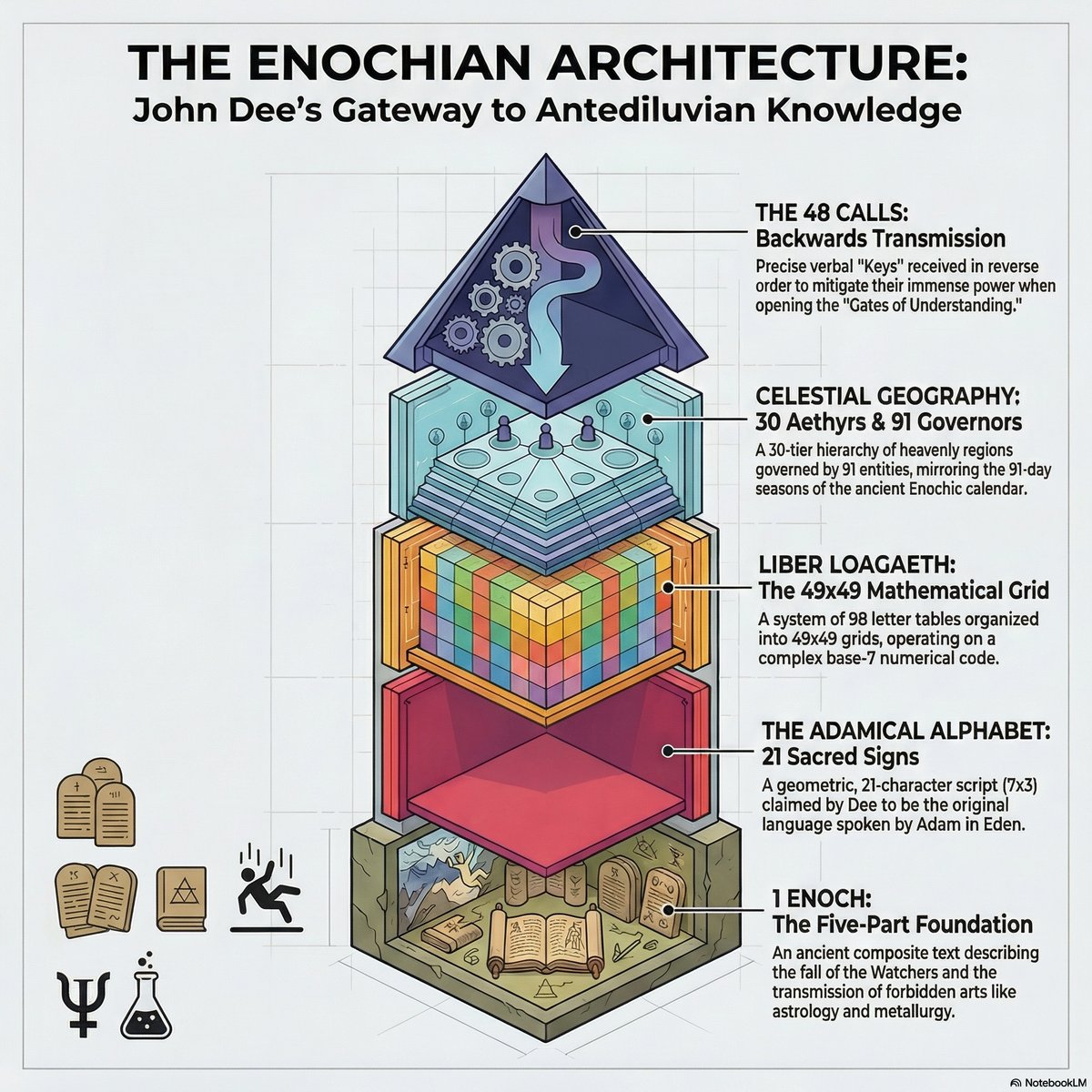
Show Notes
# EP007: The Hunt for the Lost Enochian Code
Summary
The Book of Enoch vanished from Western knowledge for over a thousand years. John Dee claimed to have received the original language of Adam from angels. This episode connects both traditions through the figure of Dee himself — the man who linked medieval alchemy, Renaissance magic, and the court of Rudolf II in Prague. We examine the Ethiopic Book of Enoch's long disappearance and recovery, then trace how Dee and Edward Kelley's "angelic conversations" produced a 21-letter alphabet and a linguistic system with structural numbers — 24 Seniors, 91 Governors — that either offer independent proof of a hidden design or reflect shared cosmological templates. The question is which.
Show Notes
- The Book of Enoch — An ancient Jewish text describing antediluvian knowledge passed from angels to humanity. Lost to Western scholars after the early Church excluded it from the canon, it survived only in Ethiopic translation until James Bruce recovered copies in the 1770s.
- John Dee and Edward Kelley — Between 1582 and 1587, Dee and Kelley conducted a series of "angelic conversations" using scrying sessions. The result was the Enochian system: a claimed angelic language with its own alphabet, grammar, and cosmological structure.
- The 21-Letter Enochian Alphabet — A unique script Dee and Kelley recorded from their sessions, distinct from any known language. Whether it's a constructed language, a cipher, or something else remains debated.
- 24 Seniors and 91 Governors — Structural numbers in the Enochian system that organize its cosmology. The question is whether these numbers provide independent numerical evidence for a larger pattern or simply recycle common cosmological templates (24 elders from Revelation, etc.).
- Concealed Antediluvian Knowledge — Both the Book of Enoch and Dee's system share a core premise: that a body of knowledge from before the Flood was hidden, lost, and periodically rediscovered. The tradition connects ancient Jewish apocalypticism to Renaissance occultism.
- Dee as the Central Node — Dee connects nearly every thread in this investigation: Roger Bacon's secret writing, the Voynich Manuscript's provenance in Prague, Rudolf II's court, the Rosicrucian tradition, and the Elizabethan intelligence networks. He is the figure through whom these lines converge.
- Rudolf II's Prague — The imperial court where Dee and Kelley performed their workings, where the Voynich Manuscript likely resided, and where alchemy and occult scholarship had direct political patronage.
Sources & References
- 1 Enoch (Ethiopic Book of Enoch) — R.H. Charles translation (1917)
- John Dee — spiritual diaries (Sloane MSS 3188, 3189, British Library)
- Meric Casaubon — A True & Faithful Relation (1659)
- James Bruce — Ethiopian travels (1768-1773)
- Deborah Harkness — John Dee's Conversations with Angels (1999)
Maxwell's Pendulum: The Plan
Research Brief
Round: 7 Date: April 2026
A. The Book(s) of Enoch
1 Enoch (Ethiopian Enoch)
1 Enoch is a composite text, assembled from five originally independent works composed over roughly two centuries. The current scholarly dating for each section:
Book of Watchers (chapters 1-36): c. 300-200 BCE. One of the two oldest sections. The Qumran fragments (4Q201) are paleographically dated to 200-150 BCE, but the composition itself is earlier. The section describes the fall of the Watchers (angels who descended to mate with human women) and Enoch's heavenly visions. 1
Astronomical Book (chapters 72-82): c. 300-200 BCE, contemporary with or possibly predating the Book of Watchers. Contains a detailed 364-day solar calendar and celestial mechanics received by Enoch from the angel Uriel. The calendar divides the year into four seasons of exactly 91 days each (months of 30, 30, and 31 days), totaling 364 days. 364 is divisible by 7, yielding exactly 52 weeks, so every date falls on the same day of the week each year. 2 3
Book of Parables / Similitudes (chapters 37-71): c. 100 BCE to 1st century CE. The latest and most contested section. Critically: no fragments of the Parables were found at Qumran. This is the only major section absent from the Dead Sea Scrolls. J.T. Milik proposed a dating as late as the 2nd century CE based on this absence; most current scholars place it in the 1st century BCE. 4
Book of Dream Visions (chapters 83-90): c. 165-160 BCE. Dated by internal historical references to the Maccabean period. Contains the Animal Apocalypse and the Vision of the Seventy Shepherds. 5
Epistle of Enoch (chapters 91-108): Early 2nd century BCE, Maccabean period. Contains the Apocalypse of Weeks. 6
Total chapter count: 108 chapters across all five sections. 7
Manuscript History
Original language: Aramaic. Translated into Greek around the turn of the first millennium, then from Greek into Ge'ez (Ethiopic) between the 4th and 7th centuries CE.
Dead Sea Scrolls fragments: 11 Aramaic manuscripts found in Cave 4 at Qumran, designated 4Q201 through 4Q212. These cover approximately one-fifth of the Ethiopic text. The fragments represent the Book of Watchers, the Astronomical Book, the Dream Visions, and the Epistle. The Parables/Similitudes are completely absent. 8 9
Ethiopian Ge'ez manuscripts: The earliest surviving Ethiopian manuscripts date to the 15th century CE, though the translation was made centuries earlier (4th-7th century). At least three definitely 15th-century manuscripts are known. 10
The gap in Western knowledge: 1 Enoch was effectively lost to Western Christendom from the 4th century CE to the 18th century, a gap of approximately 1,400 years. The last significant citations in the Western tradition are from Church Fathers (Tertullian, Clement of Alexandria, Origen) in the 2nd-3rd centuries. By the 4th-5th century, figures including Jerome, Augustine, and Hilary had rejected it. The Council of Laodicea (c. 363-364 CE) formally excluded it from the canon. A late 9th-century allusion by the Byzantine chronicler George Syncellus is the last known Western reference before its rediscovery. 11 12
James Bruce's recovery (1773): The Scottish traveler James Bruce (1730-1794) recovered three complete Ge'ez copies of 1 Enoch during his expedition to Ethiopia. He presented one to King Louis XV for the French National Library in Paris (1773), deposited a second at the Bodleian Library, Oxford (1774), and retained a third (later added to the Bodleian after his death in 1794). A fourth copy was donated to Cardinal Antonelli's library and later acquired by the Vatican around 1825. 13 14 15
Richard Laurence's translation (1821): The first English translation, made from the Bodleian Ge'ez manuscript by Richard Laurence (1760-1838), Regius Professor of Hebrew at Oxford. 16 17
R.H. Charles critical edition (1906): Using 23 Ge'ez manuscripts and all available sources. Second edition 1912. 1
The Antediluvian Knowledge Motif
What the text says Enoch received and recorded:
Forbidden arts taught by the Watchers (1 Enoch chapters 6-8): Two hundred Watchers descended to Mount Hermon under twenty named leaders, led by Shemihazah (also spelled Semyaza). They took human wives and taught humanity specific forbidden arts:
- Azazel: metallurgy (swords, knives, shields, breastplates), cosmetics (antimony for eyelids), ornamental jewelry
- Semjaza: spells, cutting of roots (herbalism/pharmacology)
- Armaros: breaking of spells (counter-magic)
- Baraqijal: astrology
- Kokabiel: constellations
- Ezeqeel: cloud-reading (weather divination)
- Araqiel: signs of the earth (geomancy)
- Shamsiel: signs of the sun
- Sariel: course of the moon 18 19
Number of named Watcher leaders in 1 Enoch 6:7: 20 chiefs, each commanding 10 Watchers, for a total of 200 Watchers. 20
Enoch's celestial education (1 Enoch 72-82): The angel Uriel gives Enoch detailed knowledge of celestial mechanics: the movements of the sun, moon, and stars, the 364-day calendar, and the seasonal cycles. 1 Enoch 81:6: Uriel advises Enoch to write down the knowledge for his children. 1 Enoch 82:1: Enoch assures his son Methuselah that he has written a book containing this celestial knowledge. 21
The Seventy Shepherds (1 Enoch 83-90): The Dream Visions depict 70 shepherds appointed by God to govern the nations after Israel's punishment. They are divided into three periods: 35 + 23 + 12 = 70. The shepherds are judged and condemned at the end of the vision. 5
2 Enoch (Slavonic Enoch / Book of the Secrets of Enoch)
Composition date: 1st century CE, likely before the destruction of the Jerusalem Temple in 70 CE (references to pilgrimage and temple rituals suggest pre-70 authorship). Survives in Old Church Slavonic manuscripts from the 8th century onward, based on an earlier Greek or Semitic original. Exists in longer and shorter recensions. 22
Seven heavens cosmology: Enoch ascends through seven tiers of heaven (some witnesses of the longer recension report ten). The seventh heaven is the dwelling place of God. 23
The 365/366 books: 2 Enoch states that after 30 days and nights of instruction, the angel Vereviel dictated to Enoch 360 books (Recension A) or 366 books (other recensions) containing "all that is knowable." Enoch was returned to earth for 30 days to give his family these books before the Flood. 24
Enoch's age: Genesis 5:23 states Enoch lived 365 years before God "took him." 365 = the number of days in the solar year. The 364-day Enochic calendar and the 365-year lifespan create a near-identity between the man and the calendar he received. 25
3 Enoch (Sefer Hekhalot)
Composition date: Core visionary material from the 3rd-4th centuries CE; final redaction in the 5th-6th centuries CE in Babylonian Jewish communities. Written in Hebrew, pseudepigraphically attributed to Rabbi Ishmael ben Elisha (2nd century CE). 26
Metatron identification: Enoch is transformed into the angel Metatron, "Prince of the Divine Presence," a vice-regent figure enthroned near God's Throne of Glory. Metatron serves as mediator, celestial scribe, and protector. 27
Merkabah mysticism connection: 3 Enoch belongs to the Hekhalot literature ("palaces"), which overlaps with Merkabah ("Chariot") mysticism. The text describes a guided tour of the celestial palaces. 28
Canon Status
Ethiopian Orthodox: Canonical. The Ethiopian Orthodox Tewahedo Church and the Eritrean Orthodox Tewahedo Church are the only major Christian traditions that include 1 Enoch in their biblical canon. 1
Early Christian citations: Jude 1:14-15 directly quotes 1 Enoch: "Enoch, the seventh from Adam, prophesied, saying, 'Behold, the Lord comes with ten thousands of His holy ones.'" Tertullian (c. 160-225 CE) considered it divinely inspired. Clement of Alexandria and Irenaeus also referenced it. 29
Western exclusion: By the 4th century, Jerome, Augustine, and Hilary had dismissed it as apocryphal. Council of Laodicea (c. 363-364) formally excluded it. Reasons: divergence from orthodox doctrines on the origin of sin (Watchers vs. human responsibility), complex cosmology conflicting with accepted teachings, and pseudepigraphical status violating canonicity criteria. 29 30
B. Dee's Enochian System
Chronology of the Angelic Conversations
1581: Dee began magical pursuits, seeking communication with angels through crystal gazing. 31
March 1582: Edward Kelley (born August 1, 1555) arrived at Dee's home in Mortlake and became Dee's scryer. 32
March 26, 1583: Formal start of recorded angelic transmissions. Kelley reported visions in the crystal of a 21-lettered alphabet. Shortly after, Kelley began receiving the Liber Loagaeth ("Book of Speech from God"), comprising the 49x49 letter tables. 33
September 1583: Dee, Kelley, and families departed England for the Continent with the Polish nobleman Olbracht Laski. 34
March 1584: Arrival in Cracow, Poland.
April 10-13, 1584: The angel Nalvage gave Dee and Kelley their first tablet. The 48 Enochian Calls (Keys) began transmission around April 13. 35
July 13, 1584: Final Calls received. The Calls were transmitted backwards due to their supposed immense power. 36
August 1584: Dee traveled to Prague and had an audience with Emperor Rudolf II. Exact date not documented in available sources. Dee presented his work but Rudolf withheld patronage. 37 38
1585-1587: Dee lived at Trebon castle in Bohemia; angelic conversations continued.
1587: The Tabula Recensa (Reformed Great Table) was created with the guidance of archangel Raphael. 39
1589: Dee and Kelley separated. Dee returned to England. Kelley remained in Bohemia.
1589/1590: Rudolf II made Kelley "Knight of Imany." Kelley acquired estates and property in Prague. 34
May 1591: Kelley arrested and imprisoned at Krivoklat Castle for killing Jiri Hunkler in a duel.
November 1, 1597: Kelley died at Hnevin Castle in Most, aged approximately 42, from injuries sustained attempting escape. 40 41
December 1608 or March 1609: John Dee died, aged 81. 31
The Enochian Alphabet
21 characters. Confirmed by multiple sources. Each character has its own name, pronunciation, and symbolic meaning. The script is angular and geometric, resembling no known human alphabet. Written right-to-left. 33 42
Dee mapped the Enochian letters onto 22 English letters, treating U and V as positional variants and omitting J, K, and W. He called it the "Adamical alphabet" and "First Language of God-Christ."
21 = 7 x 3. The seven-based structure is pervasive throughout the system (see Numbers Table below).
The 49x49 Letter Tables (Liber Loagaeth)
The Liber Loagaeth ("Book of Speech from God") comprises 98 great letter tables on the recto and verso of 49 leaves. Each table is a 49x49 grid of letters. The tables are alchemical in nature. 49 = 7 x 7 = 7^2. The system uses a base-7 code. 43
Contained in Sloane MS 3189, British Library.
The 30 Aethyrs (Ayres)
30 concentric heavenly regions, ranging from TEX (30th, lowest, closest to the material world) to LIL (1st, highest). Each Aethyr is ruled by 3 Governors, except TEX which has 4, totaling 91 Governors across the system. 44 45
The Aethyrs incorporate the Four Elements, Seven Planets, and Twelve Signs of the Zodiac. They map roughly onto Kabbalistic cosmology: LIL corresponds to Kether in Atziluth, TEX to Malkuth in Yetzirah.
The Enochian Calls (Keys)
There are 19 unique Calls (Keys). The first 18 correspond to divisions of the four Watchtowers (elements). The 19th Call is used for all 30 Aethyrs, with the specific Aethyr name inserted. When each use of the 19th Call is counted separately, the total is 48 Calls (18 + 30). 46 36 47
The angels told Dee there were "49 voices, or callings: which are the Natural Keys to open those, not 49 but 48 (for one is not to be opened) Gates of Understanding." One gate is deliberately forbidden.
The Calls were received in Cracow between April 13 and July 13, 1584, and were transmitted backwards (last to first) because of their power.
The 24 Seniors
The Watchtower system contains 24 Seniors (also called Elders): 6 Seniors per Watchtower x 4 Watchtowers = 24 total. They follow the King in the hierarchy and function as conduits for planetary forces. The 24 Seniors are associated with the Zodiac (2 Seniors per Sign), with 3 Signs per Triplicity yielding 6 per Element. 48 49
This directly corresponds to the 24 Elders of Revelation 4:4. The correspondence is explicitly acknowledged by Dee, who cited Revelation 4 in Theorem 24 of his earlier work, the Monas Hieroglyphica. 50
The Adamic Language Claim
Dee never used the term "Enochian." He called the language "Angelical," "Celestial Speech," "First Language of God-Christ," and "Adamical." He asserted it was the language used by Adam in the Garden of Eden to name all of God's creatures. The angels told Dee and Kelley that the biblical patriarch Enoch had been the last human before them to know this language. 51 52 53
Dee framed the entire angelic enterprise as recovery of antediluvian knowledge: "an anterior Ur-language that was spoken by Adam before the fall." The naming "Enochian" derives from the assertion that Enoch, the seventh from Adam, was the last human to possess the language before Dee and Kelley received it.
Dee's Relationship to the Enoch Tradition
Scholarly work exists on "the Book of Enoch, the Angelic Alphabet and the 'Real Cabbala' in the Angelic Conferences of John Dee" (University of Leicester), but available sources do not explicitly confirm that Dee owned or directly cited 1 Enoch. The naming connection is through Genesis, not through the Enochic apocrypha. Dee claimed to recover the language Enoch used, but there is no documented evidence that Dee read the Ethiopian text (which was not available in Europe until 1773, over 160 years after his death). 54
Dee and Trithemius
Dee's interest in angelic communication began after reading Trithemius's Steganographia around 1553. In 1564 at Antwerp, Dee borrowed and copied a manuscript of the Steganographia. The work provided models of angelic systems and steganographic techniques. Robert Hooke proposed in the 17th century that Dee's angel diaries may have been "secret intelligence reports encrypted with Trithemian steganography for dispatch to Queen Elizabeth I." 55 56
The Cracow/Prague Period and the Plan
Dee's Continental period (1583-1589) overlaps with the Plan's Prague chronology. Key points:
- 1584: Dee received the Enochian Calls in Cracow, then traveled to Prague to present his work to Rudolf II. This is the same year already in the Plan (Section 2: Dee arrived at Rudolf's court).
- 1585-1587: Dee lived at Trebon castle, within Rudolf's sphere. The Tabula Recensa was reformed in 1587.
- 1589: Dee departed; Kelley remained and was knighted by Rudolf.
- The angelic conversations continued throughout Dee's time in Bohemia. The Enochian system was actively being constructed in the same environment where the Voynich would later surface.
Dee and the Voynich
The provenance claim (Voynich proposed Dee sold the manuscript to Rudolf) has been thoroughly debunked. Dee's meticulously kept diaries do not mention the sale. Rafal Prinke critically examined the circumstantial evidence and showed none of it can be substantiated. The 2023 Guzy identification of Carl Widemann as the seller has replaced the Dee-Bacon legend. 57 58
C. Numbers Table
Structural Numbers in the Enochian System
| Number | Context | Base-rate concern? | Source |
|---|---|---|---|
| 21 | Characters in the Enochian alphabet (= 7 x 3) | Seven-based; 7 is base-rate per Round 4 | https://en.wikipedia.org/wiki/Enochian |
| 49 | Side length of Loagaeth tables (= 7^2); also 49 leaves | Seven-based | https://enochian.org/categories/articles/enochian-magick-article-list/49x49-loagaeth-tables-enochian-magick.html |
| 98 | Total letter tables (49 leaves x 2 sides) = 2 x 49 | Derivative of 49 | https://enochian.org/categories/articles/enochian-magick-article-list/49x49-loagaeth-tables-enochian-magick.html |
| 30 | Aethyrs | No tracked-number match | https://en.wikipedia.org/wiki/Enochian_magic |
| 19 | Unique Calls (Keys) | 19/Chavah is tracked in the Plan (confirmed Round 3) but classified as small number after base-rate reckoning | https://www.kondor.de/enoch/calls.html |
| 48 | Total Calls including Aethyr variants (= 18 + 30 = 2 x 24) | Derivative of 24 | https://hermetic.com/enochia/calls |
| 91 | Governors across 30 Aethyrs (= 7 x 13) | Seven-based | https://en.wikipedia.org/wiki/Enochian_magic |
| 24 | Seniors in the Watchtower system (6 per Watchtower x 4) | BASE-RATE CONCERN (see below) | https://hermetic.com/jones/the-system-of-enochian-magick/the-hierarchy-of-the-watchtowers |
| 4 | Watchtowers (elements) | Trivially common | https://en.wikipedia.org/wiki/Enochian_magic |
Structural Numbers in the Enoch Texts
| Number | Context | Base-rate concern? | Source |
|---|---|---|---|
| 108 | Chapters in 1 Enoch | No tracked-number match. 108 is sacred in Buddhism (prayer beads) but not in the Plan | https://en.wikipedia.org/wiki/Book_of_Enoch |
| 200 | Watchers who descended (1 Enoch 6:6) | No tracked-number match | https://en.wikipedia.org/wiki/Watcher_(angel) |
| 20 | Named Watcher leaders (1 Enoch 6:7) | No tracked-number match | https://en.wikipedia.org/wiki/Watcher_(angel) |
| 70 | Shepherds in the Dream Visions (1 Enoch 83-90) | NOT 72. 70 is common in Jewish tradition (70 nations, 70 elders, Sanhedrin) | https://www.encyclopedia.com/religion/encyclopedias-almanacs-transcripts-and-maps/seventy-shepherds-vision |
| 364 | Days in the Enochic calendar (= 52 x 7) | Seven-based | https://en.wikipedia.org/wiki/Enoch_calendar |
| 91 | Days per season in the Enochic calendar (= 7 x 13) | Seven-based; same number as Enochian Governors | https://en.wikipedia.org/wiki/Enoch_calendar |
| 365 | Enoch's age in Genesis 5:23 | Solar year; no tracked-number match | https://biblehub.com/genesis/5-23.htm |
| 366/360 | Books Enoch recorded (2 Enoch, varies by recension) | No tracked-number match | https://www.iranicaonline.org/articles/enoch-books-of/ |
| 7 | Heavens in 2 Enoch (some recensions: 10) | Base-rate per Round 4 | https://www.marquette.edu/maqom/2enoch.html |
| 5 | Major sections of 1 Enoch | Trivially common | https://en.wikipedia.org/wiki/Book_of_Enoch |
Tracked Plan Numbers: Presence or Absence
126: ABSENT. No appearance as a structural count, interval, chapter number, angel count, or any other element in either the Enoch texts or Dee's Enochian system. Searched systematically; confirmed absent.
154: ABSENT. No appearance in any context. Searched systematically; confirmed absent.
216: NOT INDEPENDENTLY PRESENT. 216 is the number of letters in the Shem HaMephorash (72 names x 3 letters each). The Shem HaMephorash exists in the same broad angelic-mystical territory as the Enochian tradition, and the Golden Dawn later correlated the two systems. However: Dee's original Enochian system does not use 72 or 216. The Enochian system has 91 Governors, not 72 angels. The Shem HaMephorash is Kabbalistic, not Enochian. There is no documented evidence that Dee referenced the Shem HaMephorash in constructing his system. The 216 is present in the surrounding Kabbalistic tradition but absent from the Enochian material specifically. Same mechanism as Round 5: the Goetia's 72 was adjacent to 216 through the Shem HaMephorash, but the connection is through shared tradition, not independent appearance. 59
24: PRESENT, with base-rate concern. 24 Seniors appear in Dee's Watchtower system (6 per Watchtower x 4 = 24). However, this is explicitly derived from Revelation 4:4's 24 Elders. Dee cited Revelation 4 in Theorem 24 of the Monas Hieroglyphica. The 24 is not independently discovered in the Enochian material; it is inherited from a biblical source that was already structured around 24. Furthermore, 24 appears widely in angelic and cosmological systems: 24 hours in the day, 24 Elders in Revelation, the Ars Paulina's 24 angels of the hours (already counted as the Plan's fourth appearance of 24/4!). The Enochian 24 is structural, but it is base-rate for Judaeo-Christian cosmological architecture.
Assessment: The Plan currently has four independent appearances of 24/4! (court recruitment span, Monas theorems, Pimander editions, Ars Paulina hours). The Enochian 24 would be a fifth. But "independent" is the operative word. The Monas Hieroglyphica's Theorem 24 and the Enochian 24 Seniors both originate from Dee, who was explicitly working from Revelation 4:4. The Ars Paulina's 24 angels of the hours also maps onto the temporal division of the day. These are not independent discoveries; they are parallel applications of the same cosmological template (the 24-hour/24-elder structure) across different systems. The base-rate test would need to check: does 24 appear as a structural count in cosmological systems generally? Yes, it does. Extensively.
72: ABSENT from Dee's original Enochian system. The Shem HaMephorash's 72 names are Kabbalistic. Dee's system uses 91 Governors. The Golden Dawn (1890s) later correlated both systems but kept them separate. The Golden Dawn did NOT collapse the 91-Governor structure onto the 72-angel framework. No 72 in the Enochian material proper. 45 59
Factorial values in intervals:
Key dates: Dee's birth 1527, conversations start 1583, Calls received 1584, Prague audience 1584, Dee's death 1608/1609.
| Interval | Years | Factorial? |
|---|---|---|
| Voynich mean (1421) to Dee birth (1527) | 106 | No |
| Voynich mean (1421) to conversations (1583) | 162 | No |
| Voynich mean (1421) to Calls/Prague (1584) | 163 | No |
| Voynich mean (1421) to Dee death (1608) | 187 | No |
| Opus Majus (1267) to Dee birth (1527) | 260 | No |
| Opus Majus (1267) to conversations (1583) | 316 | No |
| Opus Majus (1267) to Prague (1584) | 317 | No |
| Dee birth (1527) to Baresch (1637) | 110 | No |
| Dee birth (1527) to Fama (1614) | 87 | No |
| Conversations (1583) to Fama (1614) | 31 | No |
| Conversations (1583) to Baresch (1637) | 54 | No |
| Dee death (1608) to Fama (1614) | 6 | = 3! (but 6 is base-rate per Round 4) |
| Dee death (1608) to Baresch (1637) | 29 | No |
| Prague (1584) to Fama (1614) | 30 | No (matches Aethyr count) |
| Prague (1584) to Baresch (1637) | 53 | No |
| Leonardo da Pistoia (1460) to conversations (1583) | 123 | No |
| Weyer (1563) to conversations (1583) | 20 | No |
| Weyer (1563) to Prague/Calls (1584) | 21 | No (matches alphabet count) |
| Pepin (1347) to Dee birth (1527) | 180 | No |
| Monas Hieroglyphica (1564) to Prague (1584) | 20 | No |
Result: One factorial interval: Dee's death (1608) to the Fama (1614) = 6 = 3!. However, 6 was classified as base-rate noise in Round 4 (appears in both control chronologies as an interval). The existing factorial sequence tracks 1!, 2!, 3!, 4!, 5! as documented intervals between specific events. Adding a second 3! does not extend the sequence; it duplicates a term already present.
No intervals of 126, 154, 216, 120, or 720.
Additional Notable Numbers
-
91 appears twice: as the number of Enochian Governors AND as the number of days per season in the Enochic calendar. Two independent systems (Dee's 16th-century construction and the Astronomical Book's 3rd-century BCE calendar) produce the same number. 91 = 7 x 13. Both are seven-based, which is base-rate. But the coincidence is worth noting for the record.
-
19 Calls: The Plan tracks 19/Chavah as a confirmed structural principle (third appearance in Round 3: factor in two intervals plus 19 Bauhutten). The Enochian system has 19 unique Calls. This would be a fourth appearance. However: 19 is a small number. The base-rate test in Round 4 was designed to address small numbers. 19's status in the tiered framework is ambiguous (confirmed in Round 3 but not included in the post-Round-4 Tier 1 or Tier 2 listings). I report the coincidence and do not press it.
-
48 = 2 x 24. The 48 Calls decompose as 18 + 30. The relationship to 24 is arithmetic (48 = 2 x 24) but the 48 itself is not structurally organized around 24 within Dee's system. The internal structure is 18 elemental Calls + 1 Aethyr Call used 30 times. The 24 is in the Seniors, not the Calls.
-
The 70 Shepherds (1 Enoch) vs. 72 (Shem HaMephorash): NOT the same. The Dream Visions use 70, not 72. 70 is a standard number in Jewish tradition (70 nations of Genesis 10, 70 elders of Numbers 11:16, the Sanhedrin). 72 is specific to the Shem HaMephorash. The difference is significant: the Enochic tradition and the Kabbalistic tradition use different numbers for their angelic/divine governance structures.
D. Connections to the Plan's Existing Network
Dee at Rudolf's Court: What the Enochian Angle Adds
The Plan already covers Dee at Rudolf's court (Section 2), Dee's Bacon's Epistola editing (Round 6 findings), and Dee's Sworn Book ownership (Round 5). The Enochian angle adds:
-
The specific nature of Dee's work in Prague. Dee was not merely a polymath visitor. He was actively constructing the most ambitious artificial language project in European history, receiving the Enochian Calls in Cracow just months before traveling to Prague. When he presented his work to Rudolf, he was presenting a system that claimed to recover the original Adamic language. The Plan already notes that Rudolf's court would have found an unreadable manuscript "interesting" rather than strange. The Enochian context makes this observation more specific: Dee's project was a live demonstration that constructing encoded linguistic systems was a prestigious, active, and funded activity in exactly this environment.
-
The scrying methodology. Dee's angel conversations required a scryer (Kelley) and a recorder (Dee). The knowledge was mediated: it could not be accessed directly but required a specialized intermediary. This parallels the Voynich's resistance to direct reading: the manuscript's content is accessible only through a decoding mechanism that no one has identified. The structural parallel is between two systems that both require a key to access their content. I note this as a thematic parallel, not as evidence of a connection.
-
Kelley's fate at Rudolf's court. Kelley remained after Dee left in 1589, was knighted by Rudolf, acquired property, and then was imprisoned and died in 1597. This is the trajectory of a court practitioner whose patron's favor was unstable. It is relevant to the Plan because Kelley's imprisonment and death precede by two years the arrival of Widemann's barrel (1599), establishing that the court's relationship to esoteric practitioners was volatile and that the network was already experiencing instability before Rudolf's political collapse.
The Ethiopian Preservation as Concealment-and-Recovery Narrative
1 Enoch survived in Ethiopia while lost to the Western world for approximately 1,400 years (4th century to 1773). This is the longest documented case of a text surviving in a single tradition while being completely unknown to the rest of the literate world.
The structural parallel to the Plan's vault trope: a text is sealed away (by canon exclusion rather than physical interment), preserved in a geographically isolated tradition (Ethiopian Christianity rather than a seven-sided vault), and recovered after centuries by an outsider (James Bruce rather than a Rosicrucian brother). The discovery-and-return narrative matches the Fama's vault-opening story in structure.
However: the Ethiopian preservation is base-rate. Texts survive in isolated traditions and are recovered all the time. The Nag Hammadi library (discovered 1945), the Dead Sea Scrolls (discovered 1947-1956), the Cairo Geniza (discovered 1896) all follow the same pattern. The vault trope was already identified as base-rate in Round 5 (six independent traditions). Adding the Ethiopian preservation extends the list to seven. The container is common; the contents differ.
What distinguishes the Ethiopian case is the duration: 1,400 years is longer than any of the other recovery narratives in the Plan's material. The Rosicrucian vault was sealed for 120 years. The Voynich's silent period is at most 200 years (1430s to 1630s). The Hermetic texts survived continuously in the West through the Asclepius. The Ethiopian preservation is an order of magnitude longer than anything else in the Plan.
The Antediluvian Knowledge Motif as Origin Point
The director's notes ask whether the Enochian tradition is the origin point of the concealed-knowledge type in Western esotericism.
Answer: not the absolute origin, but the primary transmission point.
The Mesopotamian apkallu tradition (Seven Sages who taught humanity before the Flood) is older, attested in Neo-Assyrian texts. The Enochic Watchers tradition appears to draw on the apkallu model: both describe celestial beings who transmit forbidden/advanced knowledge to humanity before a catastrophic flood. The seventh apkallu, Utuabzu, ascended to heaven, paralleling Enoch's ascension. 60
But the apkallu tradition did not enter Western esotericism directly. It entered through the Enochic filter. The Book of Watchers (3rd century BCE) is the text that brought the antediluvian-knowledge motif into the Jewish, Christian, and Islamic traditions that fed Western esotericism. The Enochic version introduced: (1) named individual knowledge-bearers with specific arts assigned to each, (2) the knowledge as forbidden rather than merely ancient, (3) a moral framework in which the transmission of knowledge is itself the transgression, (4) the survival of the knowledge despite the Flood.
The Plan's concealed-knowledge type (Harriot, Roger Bacon, the Voynich author, the grimoire compilers) operates in the shadow of this motif. These figures accumulate knowledge and conceal it, or have it concealed by institutions, or encode it in unreadable forms. The Enochic narrative provides the archetype: knowledge from a higher source, transmitted to a restricted audience, persisting despite attempts to destroy or suppress it.
Whether the Enochic tradition is the origin of this type or merely its oldest documented expression in the Western tradition is a question the evidence cannot fully resolve. The apkallu are older but less directly connected to the esoteric lineage. The Enochic texts are the texts that the tradition actually read, cited, and built upon.
Dee as Connective Figure
Dee now connects to the Plan through five channels:
- Rudolf's court (1584-1589): Presented the Enochian system, which is the most ambitious constructed language project in the Plan's timeline.
- Roger Bacon's Epistola: Edited and contributed to the 1618 publication. Custodian of the medieval concealment text.
- Sworn Book of Honorius (Sloane MS 313): Owned a copy of the grimoire whose trial reference (1347) anchors one end of the verified 216-year interval.
- The English axis: Globe Theatre consultation, Monas Hieroglyphica (1564), connection to Fludd and the Rosicrucian network.
- The Enochian/antediluvian channel (new): Claimed to recover the language Adam spoke in Eden. Framed his work as antediluvian knowledge recovery. The Enochian system is a live demonstration that the concealed-knowledge type was not merely historical but active and productive in the Plan's own timeframe.
Dee is the figure through whom the medieval (Bacon), the antediluvian (Enochian), the Solomonic (Sworn Book), the English (Globe/Fludd/Bacon), and the Rudolfine (Prague court) threads all pass. No other figure in the Plan connects this many threads.
E. Base-Rate Assessment
Antediluvian Knowledge Motif
Base-rate. The idea that there was a body of knowledge before the Flood appears across at least five independent traditions:
-
Mesopotamian: The apkallu (Seven Sages) taught humanity before the Flood. Knowledge tablets were buried for post-Flood recovery. 60
-
Jewish/Christian: The Enochic tradition (Watchers, antediluvian libraries). The Pillars of Seth (Josephus, Antiquities 1.2.3): two pillars erected to preserve astronomical knowledge before the Flood. 21
-
Islamic: Idris (identified with Enoch) credited with originating arithmetic, astronomy, alchemy, building, tailoring, and writing. Taken bodily to paradise. 61
-
Greek: Atlantis (Plato's Timaeus/Critias): advanced civilization destroyed by flood, knowledge preserved through Egyptian records. 62
-
Hindu: Matsya (Fish Avatar) rescues Manu and the Seven Sages from the deluge, preserving sacred knowledge for the next cycle. 63
The motif is not specific to the Enoch lineage. It is base-rate for any tradition with a flood narrative and an interest in the origins of knowledge.
Angelic Language Claims
Base-rate. Claims of divine or angelic languages predate Dee by centuries:
-
Hildegard von Bingen's Lingua Ignota (12th century): 1,011 nouns arranged in cosmic hierarchy, with a 23-character alphabet (Litterae Ignotae). 64 65
-
Glossolalia: Attested since at least the 2nd century (Montanus). The Testament of Job (46-48) describes speaking "in the languages of the angels." 66
-
Language of the Birds (Islamic mysticism): Farid ud-Din Attar's 12th-century Conference of the Birds; Qur'an 27:16 (Solomon taught "the speech of birds"). 67
-
Hebrew as divine language (Kabbalah): God created the universe through Hebrew letters. Abraham Abulafia (1240 CE) systematized letter-mysticism. Each letter derives from a Sefirah. 68
Dee's Enochian is typical, not exceptional, in the history of constructed sacred languages. His innovation was the systematization (complete alphabet, grammar, vocabulary, and cosmological framework), not the claim itself.
Second Temple Pseudepigraphy
Base-rate. Pseudepigraphic attribution is the dominant literary mode of the Second Temple period. Major pseudepigraphic texts attributed to:
- Enoch: 1 Enoch, 2 Enoch, 3 Enoch
- Moses: Testament of Moses, Jubilees
- Solomon: Testament of Solomon, Wisdom of Solomon
- Abraham: Apocalypse of Abraham, Testament of Abraham
- Others: Testament of Job, Testament of Levi, 4 Ezra
Enochian pseudepigraphy is typical: Enoch's heavenly translation (Genesis 5:24) makes him an ideal subject for apocalyptic revelation, just as Solomon's wisdom makes him an ideal subject for magical texts. 69 70
The Voynich-Enochian Parallel (Unreadable Scripts)
Both the Voynich manuscript and the Enochian language are writing systems that resist decipherment by outsiders. Is this a meaningful parallel or a surface similarity?
Assessment: Surface similarity. The Voynich resists decipherment because its encoding method is unknown. Enochian is perfectly readable to anyone who learns its 21-character alphabet and studies Dee's recorded grammar and vocabulary. The Voynich is a closed system. Enochian is an open system that was always intended to be teachable (Dee recorded it meticulously). The parallel is that both are "scripts outsiders cannot read," but the mechanism and purpose of the opacity are fundamentally different. One is encoded; the other is merely unfamiliar. The comparison is thematic, not structural.
Summary of Findings
What was found:
- 24 Seniors in the Enochian Watchtower system (fifth instance of 24 in the Plan's material, but with significant base-rate concern: derived from Revelation 4:4, ubiquitous in Judaeo-Christian cosmology)
- Dee death (1608) to Fama (1614) = 6 = 3! (factorial, but 6 is base-rate per Round 4)
- The Enochian system is saturated with sevens: 21 = 7x3, 49 = 7^2, 91 = 7x13, 364 = 52x7. All base-rate per Round 4
- 19 unique Calls (Chavah is a tracked number, but 19 is small and its tier status is ambiguous post-Round-4)
- 91 appears in both Dee's Governors and the Enochic calendar (independent seven-based systems converging on the same number)
- The Ethiopian preservation as a 1,400-year concealment-and-recovery narrative (base-rate vault trope, but longest duration in the Plan)
- The antediluvian knowledge motif as the archetype of the concealed-knowledge type (base-rate across five traditions, but the Enochic version is the transmission point into Western esotericism)
- Dee as five-channel connective figure (Rudolf's court, Bacon's Epistola, Sworn Book, English axis, Enochian/antediluvian)
- The pseudepigraphic pattern (Enochic attribution is typical of Second Temple pseudepigraphy; adds to the pattern documented in Rounds 5-6)
- Angelic language as base-rate (Hildegard, glossolalia, Language of the Birds, Hebrew)
- The Voynich-Enochian script parallel is thematic, not structural
What was NOT found:
- 126: Absent
- 154: Absent
- 216: Not independently present (only via Shem HaMephorash, same tradition, not Enochian)
- 72: Absent from Dee's original Enochian system (Kabbalistic, not Enochian)
- No intervals of 126, 154, 216, 120, or 720 between Enochian dates and Plan dates
- No factorial extension (the only factorial hit, 1608-1614 = 6, is base-rate)
- No Dee-Voynich ownership evidence (debunked)
- No Dee reference to 1 Enoch text (text unavailable in Europe until 1773)
The 24 Seniors are the item that requires your assessment. The question is whether this fifth appearance of 24 is independent or derived. My assessment: derived. Dee built his Watchtower system on Revelation 4:4, not on an independent discovery. The 24 is the biblical number, applied to a new cosmological architecture. This is the same structural act as the Goetia compiler adjusting demon counts to match the Shem HaMephorash: the framework determined the number, not the data. If the Plan's methodology distinguishes constructed from discovered numbers (Round 5), the Enochian 24 is constructed. Dee chose 24 because Revelation said 24. The Plan's other 24s may be equally derived from a common cosmological template. This is the base-rate question the director's notes told me not to flinch from.
The headline is not a number. The headline is Dee. The Enochian angle does not add a new number to the Plan's architecture. It adds a new dimension to a figure who was already the Plan's most connected node. Dee is now: the man who tried to recover the language Adam spoke in Eden, who did so using a scryer as intermediary (paralleling the Voynich's need for a decoding key), who performed this work in the same environment where the Voynich surfaced, who edited Roger Bacon's text about concealing secrets, who owned the grimoire whose trial anchors a 216-year interval, and who connects the English theatrical world to the Prague esoteric world. Every track passes through him. The Enochian angle makes this convergence more extreme without adding a new numerical claim. Whether that is reassuring or alarming is an editorial question.
Footnotes
-
https://bibleinterp.arizona.edu/articles/2018/05/esl428016 ↩
-
https://readingacts.com/2016/06/07/dating-the-similitudes-1-enoch-37-71/ ↩
-
https://www.encyclopedia.com/religion/encyclopedias-almanacs-transcripts-and-maps/seventy-shepherds-vision ↩↩
-
https://en.wikisource.org/wiki/The_Book_of_Enoch_(Charles)/Chapter_108 ↩
-
https://www.deadseascrolls.org.il/explore-the-archive/manuscript/4Q201-1?locale=en_US ↩
-
https://scholarworks.uni.edu/cgi/viewcontent.cgi?article=6532&context=facpub ↩
-
https://larryhurtado.wordpress.com/2019/10/06/1-enoch-an-update-on-manuscripts-and-cautionary-notes-on-usage/ ↩
-
https://en.wikipedia.org/wiki/Reception_of_the_Book_of_Enoch_in_premodernity ↩
-
https://journals.sagepub.com/doi/abs/10.1177/0951820718786199 ↩
-
https://www.globalgreyebooks.com/book-of-enoch-the-prophet-ebook.html ↩
-
https://readingacts.com/2016/05/31/the-fallen-angels-1-enoch-6-8/ ↩
-
https://intertextual.bible/text/1-enoch-8.1/legends-of-the-jews-3 ↩
-
https://jewishrootsofchristianmysticism.com/roles-and-titles-of-enoch-metatron-in-sefer-hekhalot-and-other-materials/ ↩
-
https://www.genesismarksthespot.com/blog/why-1-enoch-is-not-in-the-canon-of-scripture/ ↩↩
-
https://www.presentingthegospel.com/post/why-was-the-book-of-enoch-excluded-from-the-protestant-canon-exploring-its-history-influence-and ↩
-
https://www.curiousarchive.com/john-dees-conversations-with-angels/ ↩
-
https://magicbohemia.com/edward-kelleys-bohemian-adventures/ ↩↩
-
https://aaronleitch.wordpress.com/2017/04/16/the-48-enochian-keys-angelic-calling-1/ ↩
-
https://dhayton.haverford.edu/blog/2012/08/05/john-dee-in-rudolfine-prague/ ↩
-
https://www.lrb.co.uk/the-paper/v23/n08/charles-nicholl/the-last-years-of-edward-kelley-alchemist-to-the-emperor ↩
-
https://enochian.org/categories/articles/enochian-magick-article-list/49x49-loagaeth-tables-enochian-magick.html ↩
-
http://andrewloganmontgomery.blogspot.com/2017/04/enochian-magic-scrying-aethyrs.html ↩
-
https://enochiantoday.wordpress.com/2021/05/06/watchtower-calls-and-servient-aethyr-angels-the-numerical-connection/ ↩
-
https://hermetic.com/jones/the-system-of-enochian-magick/the-hierarchy-of-the-watchtowers ↩
-
http://paganmurmur.blogspot.com/2014/09/enochian-journal-5-24-seniors.html ↩
-
https://www.theosophical.org/publications/quest-magazine/the-tongue-of-angels ↩
-
https://www.ancient-origins.net/artifacts-ancient-writings/enochian-mysterious-lost-language-angels-003100 ↩
-
https://www.rcp.ac.uk/news-and-media/news-and-opinion/code-making-and-code-breaking-john-dee-and-the-art-of-cryptography/ ↩
-
https://proto57.wordpress.com/2015/07/22/the-origins-of-the-dee-myth/ ↩
-
https://www.worldhistory.org/article/2738/hildegard-of-bingens-unknown-language-and-unknown/ ↩
-
https://www.chabad.org/library/article_cdo/aid/3354288/jewish/Why-Is-Hebrew-Called-the-Holy-Tongue-Lashon-Hakodesh.htm ↩
-
https://textandcanon.org/the-pseudepigrapha-of-second-temple-judaism/ ↩