How Roger Bacon Became a Wizard
Listen
Open in Spotify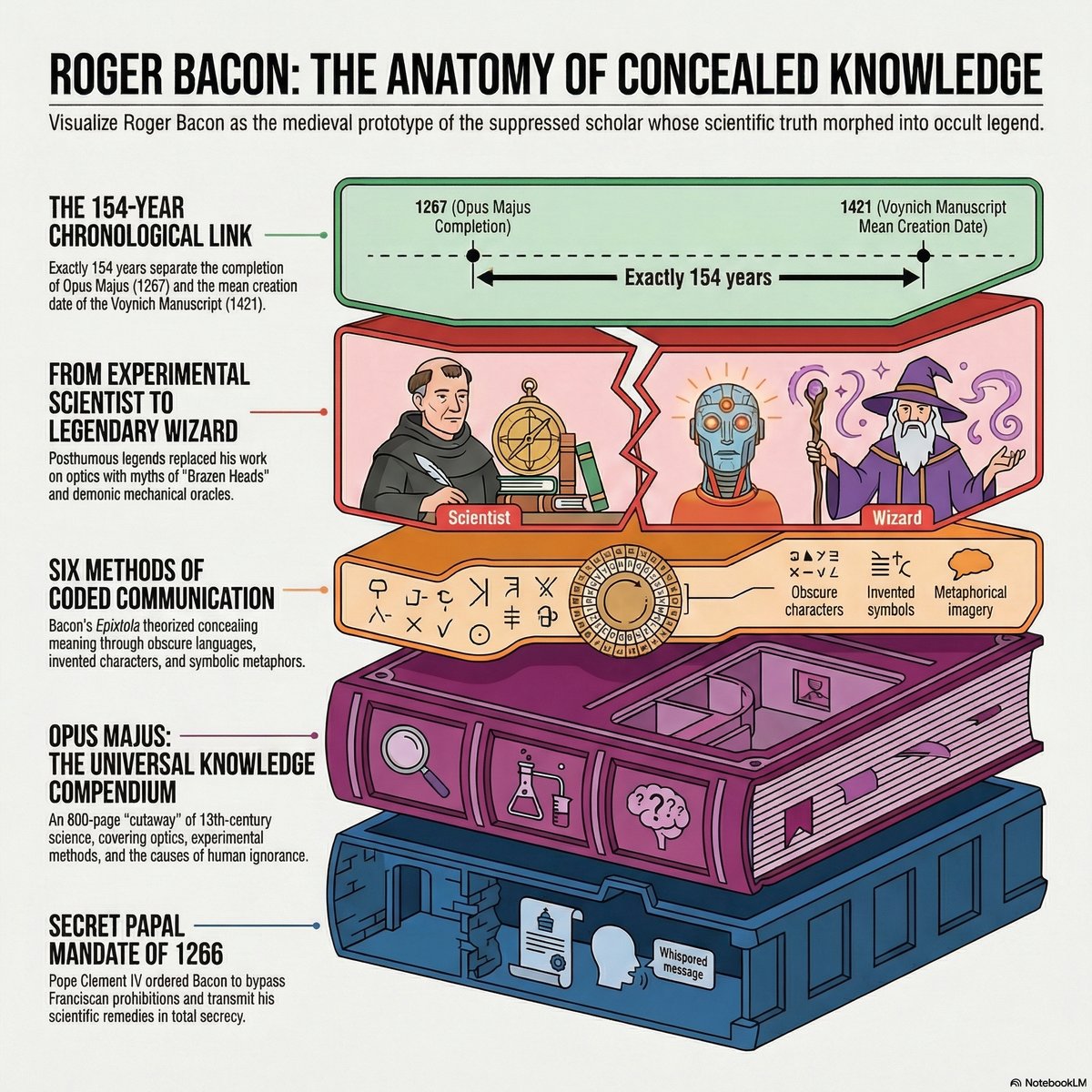
Show Notes
# EP006: How Roger Bacon Became a Wizard
Summary
Roger Bacon was a 13th-century Franciscan friar who studied optics, languages, and experimental science — and the Church made him stop. Restricted by his order, he wrote the Opus Majus in secret for the Pope. Within a few generations, he had been transformed from a natural philosopher into a legendary sorcerer who built a talking brazen head and practiced forbidden arts. This episode traces how Bacon's real work became myth, why modern scholarship rules him out as the Voynich Manuscript's author despite a recurring 154-year interval linking his timeline to the manuscript's creation, and how John Dee inherited Bacon's theories on secret writing centuries later. Bacon is the prototype: extraordinary intellect that generates enduring legends of forbidden knowledge.
Show Notes
- Roger Bacon and the Franciscan Restrictions — A medieval scholar working in natural philosophy and early experimental science, Bacon was censored by his own Franciscan Order. His major works, including the Opus Majus, were composed in secret and sent directly to Pope Clement IV.
- The 154-Year Interval — Carbon dating rules out Bacon as the Voynich Manuscript's author, but a recurring 154-year gap connects his period of activity to the manuscript's creation window — the same interval that appears elsewhere in this research.
- From Scientist to Sorcerer — Bacon's posthumous reputation underwent a complete transformation. Within centuries, he was no longer remembered as a scholar but as a mythical magician associated with talking brazen heads, necromancy, and forbidden arts.
- The Brazen Head Legend — A persistent myth that Bacon constructed a mechanical bronze head capable of speech. The legend appears in Robert Greene's 1594 play Friar Bacon and Friar Bungay and became one of the defining images of medieval "wizardry."
- Early Cryptography — Bacon wrote explicitly about methods for concealing knowledge through coded writing. His work on secret communication places him at the origin of a tradition that runs through the Voynich Manuscript and into the Elizabethan intelligence networks.
- John Dee as Custodian — Dee, writing two centuries later, collected and studied Bacon's work on secret writing and optics. The intellectual lineage from Bacon to Dee to the broader occult network is direct and documented.
- The Concealed-Knowledge Prototype — Bacon exemplifies a recurring pattern: a genuine intellect whose real contributions are obscured by legends of forbidden knowledge, creating a mythological template that later figures inherit.
Sources & References
- Roger Bacon — Opus Majus (c. 1267)
- Robert Greene — Friar Bacon and Friar Bungay (1594)
- Voynich Manuscript carbon dating — University of Arizona (2009), dated to 1404-1438
- John Dee — personal library and annotations on Bacon's works
- Brian Clegg — The First Scientist: A Life of Roger Bacon (2003)
Maxwell's Pendulum: The Plan
Research Brief
Round: 6 Topic: Roger Bacon (c. 1220 - c. 1292), the Doctor Mirabilis, and the medieval concealed-knowledge type
1. The Man Himself
1.1 Biography
Roger Bacon was born c. 1219/1220 (current scholarship favors this over the older c. 1214 estimate, based on Bacon's own claim that 40 years had passed since he registered at Oxford at age 13). He studied at Oxford (c. 1228-1236), becoming a Master of Arts, then moved to Paris (c. 1237-1247/1248) where he lectured on Latin grammar, Aristotelian logic, arithmetic, geometry, and the mathematical aspects of astronomy and music.1
He joined the Franciscan Order in 1256 or 1257, likely at Oxford. After 1260, a Franciscan statute prohibited friars from publishing books without prior approval. This restriction governed the rest of Bacon's career.1
1.2 The Papal Commission
On June 22, 1266, Pope Clement IV issued a papal mandate requesting Bacon's "writings and remedies for current conditions," explicitly ordering him to disregard Franciscan prohibitions and work in utmost secrecy. Bacon composed the Opus Majus in Paris during 1266-1267 and sent it to Clement in late 1267 or early 1268. Clement IV died November 29, 1268. It is uncertain whether Clement ever read the work he had commissioned.5
1.3 The Imprisonment Question
Traditional narrative: Bacon was imprisoned c. 1277-1292 (approximately 15 years) by the Franciscan order for "suspected novelties" in his teaching.
Current scholarship: Heavily debated. The first reference to Bacon's imprisonment dates from approximately 80 years after his death. The Chronica XXIV Generalium states that Jerome of Ascoli (later Pope Nicholas IV), as Minister General of the Franciscans (1274-1279), "condemned and rejected the doctrine of the English brother Roger Bacon, Doctor of Divinity, which contains many suspect innovations, by reason of which Roger was imprisoned." But this source is late.1
The 1277 Condemnation of Paris (Bishop Stephen Tempier condemning 219 propositions on March 7, 1277) did not target Bacon specifically. It was directed at the Arts Faculty broadly. Bacon's own condemnation came separately, between 1277-1279.9
Modern scholars are split on whether the imprisonment actually occurred. Some argue that if it did, the real reasons were less about his scientific work and more about his "combative personality," attacks on theologians, and millenarianism. Bacon was last documented as alive c. 1292 (the date of his Compendium Studii Theologiae). Some sources suggest he died c. 1294.10
1.4 Major Works
Opus Majus (c. 1266-1267): Seven parts. (1) Four General Causes of Human Ignorance; (2) The Affinity of Philosophy with Theology; (3) On the Usefulness of Grammar; (4) The Usefulness of Mathematics in Physics; (5) On the Science of Perspective (optics); (6) On Experimental Knowledge; (7) A Philosophy of Morality. Approximately 840-878 pages in modern editions.5
Opus Minus (c. 1267): A shorter summary/abstract intended to accompany the Opus Majus in case the longer work was lost.
Opus Tertium (c. 1267): An introductory summary to the other two works. Modern scholars believe it was probably never sent to the Pope.8
Epistola de Secretis Operibus Artis et Naturae et de Nullitate Magiae (c. 1270s): "The Letter on the Hidden Powers of Art and Nature and on the Invalidity of Magic." 11 chapters. Contains the enumeration of methods for concealing secrets. Critically, the cipher passages first appear in a Paris 1542 edition from a poor manuscript and may result from editorial reconstruction by Orontius Fine. The gunpowder recipe passages are also considered late additions with no early manuscript authority.12
Other surviving works: Communia Naturalium, Communia Mathematica, Compendium Studii Philosophiae (c. 1271), Compendium Studii Theologiae (c. 1292), fragmentary Greek and Hebrew grammars. Approximately 101 titles attributed across all categories.14
2. The Concealed-Knowledge Type
2.1 How Bacon Fits the Type
The Plan has been tracking figures who accumulate knowledge but do not or cannot disseminate it freely: Harriot (published almost nothing), the Voynich author (wrote in an unreadable script), Dee (developed Enochian for restricted audiences), the grimoire compilers (hid content behind pseudepigraphy). Bacon fits this pattern through forced institutional restriction rather than voluntary encryption.
From 1257 to 1267, the Franciscan Order prohibited Bacon from publishing. His major works were composed in secret, for a single papal patron, under explicit orders to bypass the Franciscan prohibition. When Clement IV died in 1268, Bacon lost his protector and the works remained largely uncirculated. His later imprisonment (if it occurred) extended the suppression.
What makes Bacon different from the Renaissance figures: 1. Period: Medieval, not Renaissance. The institutional context was fundamentally different. 2. Patron: The Pope himself, the highest ecclesiastical authority. Bacon wrote for the institution that was suppressing him. 3. Content: Legitimate natural philosophy (optics, mathematics, experimental method), not esoteric or occult knowledge. The Church would eventually come to accept these subjects. 4. Mechanism: Institutional prohibition, not personal choice. Harriot chose not to publish. Bacon was forbidden to.15
2.2 The Doctor Mirabilis Legend
Bacon's transformation from scientist to legendary wizard occurred within approximately a century of his death. The irony is precise: "Within a century of his death the only reputation he gained was as a magician, and this endured until the seventeenth century." A physician named Peter of Trou claimed Bacon could conjure bridges, use magic mirrors, and create a brazen head with a demonic voice.16
The English tradition viewed Bacon as "the epitome of a wise and subtle possessor of forbidden knowledge, a Faust-like magician who had tricked the devil and so was able to go to heaven." His title "Doctor Mirabilis" (Wonderful Teacher) was a posthumous scholastic accolade, not a self-designation.
Assessment for the Plan: The Doctor Mirabilis legend is itself a concealed-knowledge phenomenon. A man who wrote about optics and experimental method became, in folk memory, a magician. The tradition of attributing mysterious powers to advanced thinkers is the same tradition that later attributed the Voynich Manuscript to Roger Bacon. The concealed-knowledge type does not merely produce hidden knowledge; it generates legends about hidden knowledge. The legend is part of the type.
3. Secret Writing and Ciphers
3.1 Bacon's Enumeration
The Epistola de Secretis Operibus describes six methods of concealing meaning in writing: 1. Use of an unfamiliar language 2. Invented or obscure words 3. Altered letters or secret alphabets 4. Transposition of letters 5. Use of symbols, pictures, metaphors 6. A combination of all the above
Some sources expand this to seven methods, adding consonant-only writing (used by Hebrews, Chaldeans, and Arabians) or entirely invented letter systems.18
Critical caveat: The cipher passages in the Epistola first appear in a 1542 Paris edition and may be editorial interpolations. The original manuscript tradition is uncertain. If the cipher content is a 16th-century addition, Bacon's role in the cipher tradition is considerably diminished.19
3.2 Relationship to the Later Cipher Tradition
Finding: Bacon's medieval cipher work is largely disconnected from the Renaissance cryptographic tradition. There is no documented chain of influence from Roger Bacon to Alberti (c. 1467, polyalphabetic cipher), Trithemius (c. 1499, tabula recta), or Francis Bacon (1605, bilateral cipher). The Renaissance cryptologists developed their systems independently within a different mathematical framework.21
The Trithemius parallel: Bacon's Epistola explicitly rejects magic in its title ("de Nullitate Magiae") while discussing secret methods. Trithemius's Steganographia (c. 1499) hides a cipher treatise inside the appearance of a grimoire. Both texts use the appearance of one thing to conceal another. But the parallel is thematic, not genealogical. No documented influence connects them.
Assessment for the Plan: Bacon does not connect the cipher tradition to Trithemius through a documented chain. He is a parallel development, not a link. The Plan's English axis (Dee-Fludd-Bacon-theater) remains the primary cipher lineage. Roger Bacon is a medieval prototype of the cipher thinker, but the tradition had to be re-invented in the Renaissance.
3.3 John Dee and the Epistola
The Epistola was edited by John Dee. This is a documented connection: Dee handled Roger Bacon's text about concealing secrets. Dee, who developed the Enochian language and presented his "Book of Mysteries" to Rudolf II, and who owned the Sworn Book of Honorius, was also a custodian of Roger Bacon's cipher theory.18
4. The Encyclopedic Impulse
4.1 The Opus Majus as Universal Knowledge
The Opus Majus covers the causes of error, the relationship of philosophy to theology, languages, mathematics, optics, experimental science, and moral philosophy. It was written for the Pope as an argument that the Church should embrace experimental science. Its scope is universal: it attempts to compile all knowledge worth knowing.
4.2 Comparative Context
The encyclopedic impulse appears across many periods: - Isidore of Seville, Etymologiae (c. 636): 20 books. Second only to the Bible in medieval copying frequency. - Vincent of Beauvais, Speculum Majus (13th century): Three parts covering nature, doctrine, and history. - Roger Bacon, Opus Majus (1267): Seven parts. Written for the Pope. - Francis Bacon, New Atlantis (1627) / Salomon's House: Institutional model for organized knowledge. - Fama Fraternitatis (c. 1610): Describes Rosenkreutz assembling universal knowledge from the East. - The Voynich Manuscript: Apparent compendium of botanical, astronomical, and pharmacological knowledge.
Assessment: The encyclopedic impulse is base-rate for ambitious scholars in any period. It is not specific to the tradition the Plan is tracking. Isidore of Seville was not part of any esoteric tradition; he was a Church Father. Vincent of Beauvais was a Dominican encyclopedist. The desire to compile all knowledge is a recurring feature of intellectual ambition generally. The Plan should note the parallel between Roger Bacon's Opus Majus and Salomon's House without claiming it as evidence of a specific tradition.23
5. Roger Bacon and Francis Bacon
5.1 Genealogical Connection
No documented direct genealogical connection. Both families appear in the Bacon lineage of Suffolk, but the connection is distant at best. Roger Bacon's line extends to a "John alias Roger 'Friar Bacon'" (ends c. 1546). Francis Bacon was the son of Sir Nicholas Bacon, Lord Keeper of the Great Seal, who descended from Robert Bacon of Drinkstone, Suffolk.26
5.2 Intellectual Lineage
No documented direct intellectual influence. Francis Bacon characterized Roger Bacon as exceptional among medieval scholastics, noting that Roger "had set aside the scholastic disputations of his age and engaged in the mechanical understanding of the secrets of nature." But Francis developed his empirical program independently.1
5.3 The 360-Year Gap
Opus Majus (1267) to New Atlantis (1627) = 360 years. This is not discussed in scholarly literature as significant. 360 is the number of degrees in a circle but also a common round interval. No scholarly discussion of this correspondence was found.
Assessment: Decorative. The "two Bacons" are interesting as bookends of the concealed-knowledge tradition (one medieval, one early modern), but the bookend relationship is thematic, not genealogical or documentary.
6. Roger Bacon and the Voynich Manuscript
6.1 The Attribution History
Wilfrid Voynich (1912): Proposed the Roger Bacon attribution after purchasing the manuscript, based partly on the Marci letter.
The Marci letter (1665/1666): Marci wrote to Athanasius Kircher that Rudolf II purchased the manuscript for 600 ducats and that Raphael Mnishovsky speculated (but did not definitively claim) that the author was Roger Bacon. Marci himself suspended judgment. Some scholars have questioned whether the letter itself is authentic, though this remains an open question.29
William Romaine Newbold (1920s): Claimed to have deciphered the manuscript. His theory: the visible text is meaningless; each letter contains microscopic shorthand markings visible only under magnification. He claimed folio 68r showed Roger Bacon's drawing of the Andromeda Nebula viewed through a telescope, implying Bacon invented both telescope and microscope.
John Matthews Manly (1931): Debunked Newbold in Speculum VI, pp. 345-391. The apparent microscopic markings are pareidolia: artifacts of ink cracking on rough vellum. "In my opinion, the Newbold claims are entirely baseless and should be definitely and absolutely rejected."31
Carbon dating (2009): 1404-1438 CE (95% confidence interval). Definitively eliminates Roger Bacon (d. c. 1292) as the author.31
6.2 The False Attribution as Pattern
The debunked Bacon-Voynich attribution is relevant to the Plan not as evidence but as evidence of a pattern. The tradition of attributing mysterious texts to famous secret-keepers is the same pattern seen in: - Grimoire pseudepigraphy (Key of Solomon attributed to Solomon) - Hermetic pseudepigraphy (Corpus Hermeticum attributed to Hermes) - Rosicrucian pseudepigraphy (Fama attributed to Christian Rosenkreuz)
The Voynich-Bacon attribution follows the same logic: an unreadable manuscript must have been written by a famous secret-keeper. Wilfrid Voynich and Newbold performed the same operation as the Goetia compiler and the grimoire pseudepigraphers: they looked at an unattributed text and attached it to the most prestigious concealed-knowledge figure available. Roger Bacon was the medieval equivalent of Solomon or Hermes: a name that made a mystery legible.
6.3 Genuine Parallels (Despite Debunked Attribution)
Despite the carbon dating elimination, genuine thematic parallels exist between Bacon's work and the Voynich: - Optics: Bacon's Part V (Perspectiva) covers light, vision, refraction, lenses. The Voynich contains optical-seeming circular diagrams. - Botany/pharmacology: The Voynich contains 126 botanical illustrations and pharmaceutical material. Bacon's Part VI emphasizes empirical observation of natural phenomena. - Secret writing: The Voynich's entire construction embodies the concealment principles Bacon theorized. - Encyclopedic scope: Both are compendia spanning multiple knowledge domains.
These parallels do not connect Bacon to the Voynich causally. They connect Bacon to the Voynich typologically: both are products of the same intellectual culture of compiling, concealing, and preserving knowledge.
7. Numbers
7.1 THE 154 FINDING
Opus Majus (1267) to Voynich mean creation date (1421) = 154 years.
This is the third independent appearance of 154.
The three appearances: 1. Total sonnet count: 154 sonnets 2. Hermetic lifespan: Leonardo da Pistoia (1460) to Isaac Casaubon's debunking (1614) = 154 years 3. Roger Bacon's Opus Majus (1267) to the Voynich Manuscript mean creation date (1421) = 154 years
Qualification: The Opus Majus date (1267) is precise: it was composed in 1266-1267 at the request of Clement IV, who died November 29, 1268. The Voynich mean creation date (1421) is the midpoint of the radiocarbon range (1404-1438). A midpoint is not a precise date. If the Voynich was created in 1404, the interval is 137 years. If 1438, the interval is 171 years. The 154 appears only at the midpoint of a 34-year range.
However: The base-rate test uses the same mean creation date (1421) for the 216 interval (1421 to 1637 = 216). The Plan has already accepted 1421 as the operative date for the Voynich's creation. Using the same date consistently, the interval from the Opus Majus to the Voynich is 154 years.
Assessment: This is the finding that crosses the threshold. Three independent appearances. Three different domains: literary count (sonnets), historical interval (Hermetic lifespan), and now a second historical interval (Opus Majus to Voynich). Zero appearances in either control chronology. If the framework promotes numbers at three appearances, 154 moves from Tier 2 to Tier 1.
7.2 THE 216 VERIFICATION
the framework's flagged interval: Trial of Etienne Pepin (1347) to Weyer's Pseudomonarchia Daemonum (1563) = 216 years.
Verification result: The 1347 date appears to be PRECISE.
The trial of Etienne Pepin (also recorded as Olivier Pepin) was a necromancy and magic prosecution in Mende, Gevaudan, France. Pepin, a defrocked Franciscan friar, was accused of bewitching Albert Lordet, Bishop of Mende, using magical rituals from the Liber Juratus (Sworn Book of Honorius). The trial was embedded in broader political conflicts between local barons and the bishops of Mende, involving Guerin de Chateauneuf, nephew of Pope Clement VI.34
Multiple sources cite 1347 without qualifiers like "circa" or "approximately." The French scholarly article specifically references "(1347)" in its title with precision. The trial is documented in medieval court/inquisition records from Mende, representing primary source evidence. Active scholarly study continues (Julien Veronese, Richard Kieckhefer, Robert Mathiesen, Sophie Page).35
Assessment: The 1347 date is precise enough for the Plan's purposes. 1347 to 1563 = 216 years. This is the second independent appearance of 216 as a historical interval. The first is the Voynich mean creation date (1421) to Baresch's letter (1637) = 216 years. The two intervals are independent: different starting events (grimoire trial / manuscript creation), different ending events (demon catalogue / alchemist's letter), overlapping but distinct time periods.
The 216 interval from Pepin to Weyer is confirmed. 216 now has two independent appearances as a historical interval. Zero appearances in control chronologies. This strengthens its Tier 1 standing.
7.3 Other Tracked Numbers
126: Not found in Roger Bacon's biography, works, or legacy.
24/4!: The Opus Majus has 7 parts, not 24. No structural count of 24 found in Bacon's works. Clement IV's papacy lasted 3 years, 9 months, 24 days, but the 24 here is in days, not an independent structural count.
Factorial numbers: 7 parts of the Opus Majus is not a factorial (7 is not in the factorial sequence). 6 methods of concealing secrets is a factorial (6 = 3!), but this is a small number and base-rate. No larger factorial counts found.
Roger Bacon's lifespan: Approximately 72 years (c. 1220 to c. 1292). 72 is a constructed number in the Plan's framework (the Goetia's adjusted demon count). It is also the number of names in the Shem HaMephorash. Bacon's lifespan equaling 72 is coincidental: medieval lifespans were variable and Bacon's birth year is approximate. This is base-rate.
7.4 Other Intervals
| From | To | Interval | Notes |
|---|---|---|---|
| Opus Majus (1267) | Voynich START (1404) | 137 | Not tracked |
| Opus Majus (1267) | Voynich MEAN (1421) | 154 | THIRD APPEARANCE |
| Opus Majus (1267) | Voynich END (1438) | 171 | Not tracked |
| Bacon death (c. 1292) | Voynich MEAN (1421) | 129 | Not tracked |
| Opus Majus (1267) | New Atlantis (1627) | 360 | Not tracked; decorative |
| Opus Majus (1267) | Steganographia (c. 1499) | 232 | Not tracked |
| Opus Majus (1267) | Fama (1614) | 347 | Not tracked |
| Opus Majus (1267) | Isaac Casaubon (1614) | 347 | Not tracked |
| Bacon birth (c. 1220) | Dee at Prague (1584) | 364 | Not tracked |
| Bacon death (c. 1292) | Voynich START (1404) | 112 | Not tracked |
Only one tracked number appears: 154 (Opus Majus to Voynich mean).
8. The Brazen Head Tradition
8.1 The Legend
The brazen head is a legendary mechanical oracle made of brass that could answer any question or predict the future. It has been attributed to at least five major scholarly figures:
- Pope Sylvester II (Gerbert of Aurillac, c. 946-1003): Earliest figure. William of Malmesbury (12th century) claimed Gerbert constructed an oracular head.
- Albertus Magnus (1206-1280): Legend claims Albert built an automaton with a human voice "bestowed by a cacodemon." Thomas Aquinas reportedly destroyed it.
- Robert Grosseteste (c. 1170-1253): Attributed with constructing a brazen head using "astral science."
- Roger Bacon (c. 1220-c. 1292): The most prominent figure in the English tradition. In collaboration with Friar Bungay, allegedly created a talking brass head that could surround England with a wall of brass. The head uttered "Time is," "Time was," and "Time is past" before self-destructing.
- Virgil (in medieval legend): The classical poet reimagined as a sorcerer.
Additional attributions: Boethius, Arnaldus de Villa Nova, Stephen of Tours, Enrique de Villena.36
8.2 The Bacon-Specific Legend
The earliest documented attachment of the brazen head to Roger Bacon appears in The Famous Historie of Fryer Bacon, an anonymous prose romance dated to c. 1555 (earliest surviving printed edition 1627). Robert Greene dramatized the legend in Friar Bacon and Friar Bungay (c. 1589-1592), one of the most successful Elizabethan comedies.38
Greene's play: Bacon and Friar Bungay create the head to protect England. The head is animated by demonic influence. It utters three statements ("Time is," "Time was," "Time is past") and shatters. The play was performed on the Elizabethan stage in the same period as Shakespeare's early works.40
8.3 Base-Rate Assessment
The brazen head legend is base-rate for medieval scholars. It attaches to at least five independent figures across four centuries (Sylvester II in the 10th century through Bacon in the 13th century). It is a recurring motif: extraordinary knowledge or advanced technical skill was frequently mythologized through the brazen head narrative. The legend says more about how medieval culture processed exceptional intellect than about any individual figure.
Comparison to the vault trope: In Round 5, the vault-corpse-hidden-text narrative was confirmed as base-rate across six traditions. The brazen head is base-rate across at least five figures. Both are common narrative containers that different traditions fill with their own content. The brazen head is the "once upon a time" of medieval genius legends, as the vault is the "once upon a time" of esoteric founding myths.
8.4 The Brazen Head as Medieval AI
Modern scholarship has explicitly analyzed the brazen head as a concept of artificial intelligence. Sources describe it as "a precursor to contemporary ideas of humanoid robots, and even AI technologies." The brazen head represents "a site where medieval and early modern thinkers confronted the limits of human inquiry and the imagined potential of artificial intelligence long before such concepts acquired technological form."36
Assessment for the Plan: The brazen head is a curiosity, not a connection. It does not link Roger Bacon to the Plan's existing architecture in a way that strengthens any existing thread. It is interesting as evidence that the concealed-knowledge type generates legends about artificial knowledge creation, but it does not carry tracked numbers, does not connect to documented transmission chains, and is base-rate. Record it and do not press it.
9. Roger Bacon and Robert Grosseteste
Bacon almost certainly did NOT study directly under Grosseteste (who was leaving Oxford by Bacon's arrival). However, Bacon was heavily influenced by Grosseteste's work on optics, experimental method, and calendar reform. Both were interested in the same intellectual program: mathematics as the foundation of natural philosophy, direct observation and experiment as the path to knowledge, and the importance of languages (Greek, Hebrew, Arabic) for accessing the full range of philosophical texts.42
The Grosseteste-Bacon lineage represents a proto-scientific tradition at Oxford that preceded the Renaissance by two centuries. Grosseteste is sometimes called "the father of Western experimental science."43
10. Summary Assessment
What is signal: - 154: THIRD APPEARANCE. Opus Majus (1267) to Voynich mean creation date (1421) = 154 years. This crosses the threshold. - 216: SECOND APPEARANCE VERIFIED. Pepin trial (1347) to Weyer (1563) = 216 years. The 1347 date is precise. the framework's flagged interval is confirmed. - Bacon as the medieval concealed-knowledge type fits the Plan's pattern genuinely. Forced restriction, papal patronage, posthumous legend-building. - The false Voynich attribution illustrates the pseudepigraphic impulse: attributing mysterious texts to prestigious concealed-knowledge figures. - Dee edited Bacon's Epistola on secret writing. Direct documentary connection.
What is noise: - The brazen head legend is base-rate (5+ figures). - The encyclopedic impulse is base-rate (Isidore, Vincent, Bacon, Francis Bacon, etc.). - The "two Bacons" have no documented genealogical or intellectual connection. - The 360-year gap (Opus Majus to New Atlantis) is decorative. - Roger Bacon's cipher work does not connect to the later cipher tradition (Alberti, Trithemius, Francis Bacon) through any documented chain. - Bacon's lifespan of approximately 72 years is coincidental.
What is ambiguous: - The authenticity of the Epistola's cipher content (may be 16th-century interpolation). - The imprisonment (may be legendary, possibly politically motivated rather than intellectual). - Whether the concealed-knowledge type extends meaningfully from the medieval period to the Renaissance, or whether medieval institutional suppression and Renaissance voluntary concealment are fundamentally different phenomena.
Footnotes
-
https://en.wikipedia.org/wiki/Condemnations_of_1210%E2%80%931277 ↩
-
https://www.ancient-origins.net/history-famous-people/roger-bacon-0018320 ↩
-
https://en.wikipedia.org/wiki/The_Letter_Of_Roger_Bacon_Concerning_The_Marvelous_Power_Of_Art_And_Nature_And_The_Nullity_Of_Magic; ↩
-
https://www.historytoday.com/archive/roger-bacon-doctor-mirabilis; ↩
-
https://www.cambridge.org/core/services/aop-cambridge-core/content/view/2956344B98469DA86DEBC37E9389CD4F/S0362152900006619a.pdf/roger-bacon-as-magician-.pdf ↩
-
https://en.wikipedia.org/wiki/The_Letter_Of_Roger_Bacon_Concerning_The_Marvelous_Power_Of_Art_And_Nature_And_The_Nullity_Of_Magic ↩↩
-
http://profs.sci.univr.it/~giaco/download/Watermarking-Obfuscation/Early%20Cryptology.pdf; ↩
-
https://voynichrevisionist.com/2018/12/23/wheat-from-chaff-3/ ↩
-
https://www.gauldingorigins.com/the-bacon-family-of-suffolk; ↩
-
https://proto57.wordpress.com/2015/09/11/the-1665-marci-letter-a-forgery/ ↩
-
https://www.sciencedaily.com/releases/2011/02/110210153016.html ↩
-
https://brewminate.com/secrets-in-bronze-the-brazen-head-and-the-medieval-dream-of-artificial-speech/; ↩↩
-
https://filsonarthistory.wordpress.com/2019/03/28/special-topics-lecture-18-the-brazen-head-and-the-scholastic-philosophers/ ↩
-
https://en.wikipedia.org/wiki/Friar_Bacon_and_Friar_Bungay; ↩
-
http://elizabethandrama.org/the-playwrights/robert-greene/friar-bacon-friar-bungay/ ↩
-
https://mathshistory.st-andrews.ac.uk/Biographies/Grosseteste/; ↩
-
https://mpo.im/insights/laying-the-foundations-of-modern-optics-robert-grosseteste-and-the-scientific-method/ ↩