Mathematical Architecture of the Solomonic Grimoires
Listen
Open in Spotify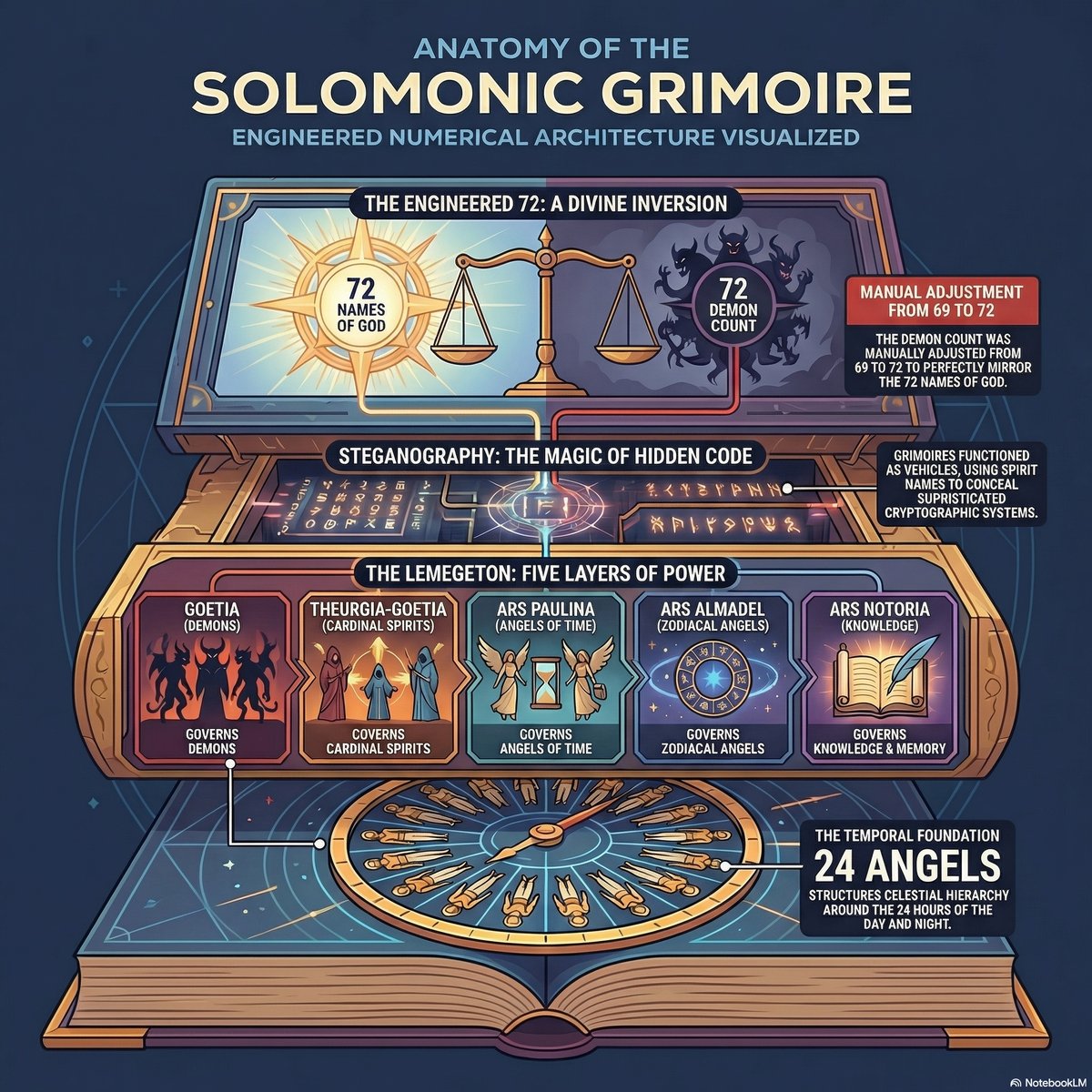
Show Notes
# EP005: Mathematical Architecture of the Solomonic Grimoires
Summary
The Greater and Lesser Keys of Solomon weren't just spell books — they were engineered systems. Built across centuries by compilers working at the intersection of Jewish mysticism, Islamic legend, and Christian Kabbalah, the grimoires encode deliberate numerical structures. The 72 demons of the Ars Goetia mirror the 72 Names of God. Francis Bacon's Salomon's House echoes the same mathematical patterns. This episode traces how forbidden knowledge was hidden in plain sight through pseudepigraphy and steganography — and asks which of the numbers are intentional and which are noise.
Show Notes
- The Solomonic Tradition — A centuries-long lineage of magical texts attributed to King Solomon, compiled from Jewish, Islamic, and Christian sources. The pseudepigraphic attribution gave the texts authority while shielding their real authors from persecution.
- The 72 Demons and the 72 Names of God — The Ars Goetia's demon catalog wasn't arbitrary. The number 72 was engineered to mirror the 72-fold Name of God from Kabbalistic tradition — a deliberate structural alignment finalized over several centuries of compilation.
- The Greater and Lesser Keys — Two distinct grimoire collections with different histories. The Greater Key focuses on ritual preparation and angelic invocation; the Lesser Key (which contains the Ars Goetia) catalogs demons and their seals. Both use overlapping numerical frameworks.
- Jewish Mysticism Meets Islamic Legend — Solomon appears in both the Torah and the Quran. The grimoire tradition drew from the Talmudic portrayal of Solomon as master of demons and the Islamic accounts of djinn bound to his service, fusing them into a unified magical system.
- Francis Bacon's Salomon's House — New Atlantis (1627) describes an institution called Salomon's House with structural features that echo the mathematical patterns found in the grimoires, particularly the recurring number 24.
- Pseudepigraphy and Steganography — The grimoires used false attribution (pseudepigraphy) and hidden encoding (steganography) as dual strategies to preserve forbidden knowledge against institutional suppression by the Church.
- Signal vs. Noise — The research identifies which numerical convergences appear to be intentional design and which are likely coincidental or archetypal features recurring throughout Western occultism.
Sources & References
- The Lesser Key of Solomon (Lemegeton) — Ars Goetia
- The Greater Key of Solomon (Clavicula Salomonis)
- Francis Bacon — New Atlantis (1627)
- The 72-fold Name of God — Kabbalistic tradition (Shemhamphorasch)
- Joseph Peterson — The Lesser Key of Solomon (critical edition)
Maxwell's Pendulum: The Plan
Research Brief
Round: 5 Topic: The Solomonic grimoire tradition, with particular attention to the Ars Goetia, the 72 inversion, and the grimoire transmission chain
1. The Texts Themselves
1.1 The Key of Solomon (Clavicula Salomonis)
The Key of Solomon is a pseudepigraphal grimoire attributed to King Solomon but composed in the 14th or 15th century, almost certainly in Italy. The oldest known partial manuscript, recently identified by Matteo Cova, dates to 1380-1410 (two leaves, Trente MS 86½). A complete Italian manuscript (BNF Ital. 1524) is dated to 1446. A 15th-century Greek manuscript survives as British Library Harley MS 5596. The earliest scholarly reference to the text appears in Peter of Abano's Lucidator dubitabilium astronomiae (1303-1310), which places knowledge of a "Clavicula Salomonis" at the very start of the 14th century.1
The text survives in Latin, Italian, French, English, Greek, and Hebrew manuscripts, with the Hebrew versions dating to the 16th-18th centuries (dating disputed). Major collections are held at the British Library (Harley MS 5596, Sloane MS 3847), the Bodleian Library (Michael MS 276), the University of Pennsylvania (Ms. Codex 1673), and the Bibliothèque de l'Arsenal in Paris.3
Content: The Clavicula contains 44 pentacles (talismanic seals) in the standard Mathers edition (1889), organized by planetary rulership: Saturn (7), Jupiter (7), Mars (7), Sun (7), Venus (5), Mercury (5), Moon (6). However, manuscript variation is significant. Sloane MS 1307 contains only 13 pentacles. A Hebrew manuscript has 9 pentacles titled "Concerning the sanctity of the nine Kandariri." The 44-pentacle count is a late standardization, not an original structural feature.4
Attribution: The Solomon attribution is strategic pseudepigraphy. Solomon was considered the wisest man who lived, and the Hebrew Bible does not describe him as a magician; that tradition developed from Jewish midrash, Talmudic sources, and Islamic tradition. Attributing a grimoire to Solomon gave it biblical authority and a degree of protection against ecclesiastical condemnation.
1.2 The Lesser Key of Solomon (Lemegeton)
The Lemegeton Clavicula Salomonis (the name "Lesser Key of Solomon" was coined by A.E. Waite in 1898) was compiled in the mid-17th century from materials dating back two centuries or more. It draws on Johann Weyer's Pseudomonarchia Daemonum (1577), Heinrich Cornelius Agrippa's De Occulta Philosophia, the Heptameron of pseudo-Pietro d'Abano, and the Magical Calendar.6
The Five Books:
- Ars Goetia -- catalogue of 72 demons with their seals, ranks, and abilities
- Ars Theurgia-Goetia -- spirits of the cardinal directions
- Ars Paulina -- angels of the hours (24) and zodiacal degrees
- Ars Almadel -- angels of the four altitudes (seasons)
- Ars Notoria -- prayers and orations for intellectual enhancement; the oldest component, with Latin manuscripts from the 13th century or possibly earlier8
Earliest datable manuscripts: British Library Sloane 2731 (1687) and Sloane 3648. The Ars Goetia could not have been compiled before 1570 based on textual analysis (the omission of the demon Pruflas, which matches a specific edition of the Pseudomonarchia Daemonum cited in Reginald Scot's 1584 Discovery of Witchcraft). The Livre des Esperitz, a 15th-16th century French text, is clearly related to Lemegeton source materials.
1.3 The Ars Goetia and Its 72 Demons
The Ars Goetia catalogues exactly 72 demons. The hierarchy consists of seven ranks:
- 9 Kings (corresponding to the Sun)
- 23 Dukes (Venus)
- 15 Marquises (Moon)
- 14 Earls/Counts (Mars)
- 7 Princes (Jupiter)
- 3 Presidents (Mercury)
- 1 Knight (Saturn)
Each demon is assigned a sigil (seal) used in conjuration.10
Where does the number 72 come from?
This is the critical question for the Plan. The answer is: the number was deliberately engineered, but the engineering is visible in the textual history.
Johann Weyer's Pseudomonarchia Daemonum (appendix to De praestigiis daemonum, 1563/1577) lists 69 demons, not 72. Weyer, a medical doctor and opponent of witch persecution, compiled his demon catalogue partly as satire, meant to undermine witch trials by presenting demons as bureaucratically catalogued entities rather than genuine threats.11
The Ars Goetia's compiler(s) modified Weyer's list: removed Pruflas (-1), added four new demons (Vassago, Seere, Dantalion, Andromalius) (+4), reaching 72. The arithmetic is transparent: 69 - 1 + 4 = 72. The count was adjusted to match 72, which strongly suggests the compiler(s) intended alignment with the 72 Names of God (Shem HaMephorash). The alignment is deliberate but implicit. No surviving manuscript of the Ars Goetia explicitly states that the 72 demons correspond to the 72 divine names. The connection was made explicit only later.
1.4 The Testament of Solomon
The Testament of Solomon is a pseudepigraphal Greek text describing how Solomon was empowered to command demons through a magical ring granted by the archangel Michael, using them to build the Temple in Jerusalem. Composition dates range from the late 1st century CE to the High Middle Ages; McCown argued for an early 3rd-century CE date incorporating 1st-century Jewish material.13
The Testament is foundational to the later grimoire tradition of Solomon as demon-commander. However, the tradition has deeper roots: the Babylonian Talmud (bGittin 68b-69a) contains the story of Solomon and the demon-king Ashmedai (Asmodeus), involving a magic ring and the shamir (a legendary worm that cuts stone). This Talmudic layer predates the Testament.14
2. The 72 Inversion
2.1 The Shem HaMephorash
The 72 Names of God derive from Exodus 14:19-21, three consecutive verses each containing exactly 72 Hebrew letters. The derivation method: verse 19 written left-to-right, verse 20 right-to-left, verse 21 left-to-right; reading vertically produces 72 three-letter combinations. 72 names x 3 letters = 216 letters total.15
This derivation was documented by Rashi (11th century, b. Sukkah 45a) and in the Sefer HaBahir (c. 1150-1200). The 72-fold name is central to the Sefer Raziel HaMalakh. Johann Reuchlin (1455-1522) made the names pronounceable by adding suffixes like "El" or "Yah," treating them as names of 72 angels, documented in his De Arte Cabalistica (1517). The 72 angels are grouped into eight choirs of nine.17
2.2 The Angel-Demon Correspondence: When Was It Made?
This is the key finding for the Plan's architecture.
The explicit pairing of the 72 Goetia demons with the 72 Shem HaMephorash angels is not found in the original Ars Goetia text. It is a later overlay, applied in two documented stages:
-
Thomas Rudd (1583-1656): In his manuscript Liber Malorum Spirituum seu Goetia, Rudd paired the seals and demons with the 72 angels of the Shem HaMephorash. This is the earliest documented explicit pairing.
-
S.L. MacGregor Mathers (1904): The Golden Dawn founder translated the Ars Goetia from manuscript and added material from Golden Dawn Kabbalistic work, presenting the angel-demon pairing system as if it were original to the text.19
Assessment for the Plan: The 72 inversion is real but constructed in stages. The Ars Goetia's compiler(s) adjusted the demon count to 72, almost certainly with awareness of the Shem HaMephorash. The explicit angel-demon pairing was formalized by Rudd in the early-to-mid 17th century. The Kabbalistic theology that frames demons as "shadows" or "shells" (klippot) of angels was applied to the Goetia by the Golden Dawn in the late 19th century. The inversion is therefore historical and deliberate, but it is a synthesis constructed over approximately 300 years (1570s to 1890s), not a single-source design.
2.3 The Klippot Framework
The concept of klippot (shells, husks, peels) in Kabbalistic thought provides the theological framework for treating demons as inversions of divine emanations. The klippot are described in the Zohar as "nutshells" for holiness. In Lurianic Kabbalah, when divine light shattered the vessels of the Sephiroth (shevirah), shards fell into the abyss forming the klippot.20
The traditional Kabbalistic system describes 12 qlippothic orders of demons, 3 powers before Satan, and 22 demons corresponding to the Hebrew alphabet letters. The mapping of 72 Goetic demons onto 72 klippothic counterparts of the Shem HaMephorash angels was formalized by the Golden Dawn (1896-1905) and explored systematically by Thomas Karlsson in Qabalah, Qliphoth and Goetic Magic.22
2.4 Pico's 72 Kabbalistic Theses
Giovanni Pico della Mirandola published 900 theses in December 1486. Of these, 72 were specifically Kabbalistic (part of a larger 119-thesis Kabbalistic section). The use of exactly 72 Kabbalistic theses was almost certainly a deliberate reference to the 72 Names of God.23
Pico is considered the founder of Christian Kabbalah. His 900 Theses was the first printed book to be universally banned by the Church. The three 72s:
- Shem HaMephorash: 72 divine names (medieval Kabbalah, documented by Rashi and Sefer HaBahir)
- Pico's theses: 72 Kabbalistic conclusions (1486)
- Ars Goetia: 72 demons (mid-17th century compilation from 1570s+ materials)
Assessment: These form a deliberate system only in retrospect. Pico inherited the 72-name tradition. The Goetia compiler(s) independently adjusted their count to match the same number. The three 72s share a common source (the Shem HaMephorash) but were produced independently over two centuries. The system is convergent, not designed as a triad.
3. Solomon and the Transmission Chain
3.1 Solomonic Attribution: Historical Basis
The tradition of Solomon as keeper of occult knowledge develops through several layers:
- Hebrew Bible: Solomon is wise but not explicitly a magician
- Talmud (bGittin 68b-69a): Solomon commands the demon Ashmedai using a magical ring; uses the shamir to build the Temple without iron tools
- Testament of Solomon (1st-4th century CE): Full narrative of Solomon commanding demons through a ring from the archangel Michael
- Quran (Sulayman): Solomon controls jinn, speaks to animals, commands wind; a fount of molten brass flows for him25
The grimoire attribution exploits this layered tradition: by claiming Solomonic authorship, a medieval text can draw on Jewish, Christian, and Islamic authority simultaneously.
3.2 Solomon in Islamic Tradition (Sulayman)
In the Quran, Sulayman is a prophet and king who was granted dominion over the jinn. Medieval Arabic writers developed the legend extensively:
- Solomon's Seal: A ring made of brass and iron, used to seal written commands to good and evil spirits
- The sealed vessels: Solomon locked rebellious jinn inside jars, bottles (Qamaqim as-Suleimaniyya), lamps, and coffers of brass, cast into the sea or deep pits
- The City of Brass: A major Arabic narrative bringing together themes of brass, Solomon, and jinn-binding26
Connection to Plan's existing nodes: The Sabians of Harran, already in the Plan at the 720 mark, maintained astral and magical practices for centuries after the Muslim conquest. They are described as "prime candidates for the transmission of Hermetic materials." However, a critical caveat: Kevin van Bladel's research argues that presently known evidence for Hermetic literature among the Harranians is "exceedingly small," and "evidence for a Harranian 'Hermeticism,' in any meaningful sense of the word, is not to be found." The Sabians' role appears stronger for astrological than for Solomonic magical transmission specifically.28
3.3 Arabic-to-Latin Translation Movement
The transmission pathway for magical texts:
-
Picatrix (Ghayat al-Hakim): Arabic astrological-magical text (likely 11th century), translated to Spanish and Latin 1256-1258 under Alfonso X of Castile. A comprehensive handbook of talismanic magic. The Picatrix does not reference Solomon explicitly in the sources I found, but it draws on Nabataean, Sabian, Chaldean, and Assyrian magical lore.31
-
Shams al-Ma'arif ("Sun of Knowledge"): The most prominent Islamic grimoire, attributed (disputedly) to 13th-century North African Sufi scholar Ahmad al-Buni. Features magic squares and numerology-alphabet combinations for communicating with jinn, angels, and spirits. Status in Islamic circles comparable to the Key of Solomon in Western tradition.33
-
Translation centers (Toledo, Sicily, southern Italy): The Arabic-to-Latin translation movement is well documented for scientific and philosophical texts at these centers. However, I found no specific documentation establishing that grimoire manuscripts were translated at these centers. The Key of Solomon shows clear marks of medieval Islamic, Christian, and Jewish mystical traditions blending together, suggesting Arabic magical tradition entered the Latin West, but the specific translation route is not as well documented as it is for philosophical texts.34
3.4 The Renaissance Magical Synthesis
Agrippa, Trithemius, and Reuchlin represent the convergence of Hermetic, Kabbalistic, and Solomonic traditions:
-
Agrippa, De Occulta Philosophia (written 1509-1510, circulated in manuscript, published 1533): The most comprehensive exposition of Renaissance magic, systematically mapping the network of forces from angels and demons through stars and planets to the material world. Three books addressing Elemental, Celestial, and Intellectual magic, drawing from Hebrew, Greek, and Chaldean contexts.35
-
Trithemius, Steganographia (written c. 1499, published Frankfurt 1606, placed on Index 1609): Appears to describe magical spirit invocation with angel names and conjuration formulas. Since the 1606 publication of a decryption key, understood as a cryptography treatise disguised as a grimoire. The spirit names and conjuration words encode cipher methods. This is significant: a text received historically as a grimoire featuring angelic and spirit names turns out to be a steganographic system. A concealment vehicle that is itself concealed.37
-
Reuchlin, De Verbo Mirifico (1494) and De Arte Cabalistica (1517): Foundational works of Christian Kabbalah. Reuchlin made the 72 Shem HaMephorash names pronounceable by adding "El" and "Yah" suffixes. No explicit references to Solomonic magical tradition found in the search results, but Reuchlin was influential on Agrippa, Paracelsus, and Robert Fludd, all of whom engaged with Solomonic materials.39
4. Salomon's House
4.1 Bacon's Spelling and References
Francis Bacon used the Latin Vulgate spelling "Salomon" in New Atlantis (published posthumously 1627), following standard scholarly Bible conventions of his era. The choice is not a coded variant; it is simply the Latinate form.41
Bacon explicitly references the Solomonic wisdom tradition. The institution is described as founded "for the finding out of the true nature of all things, whereby God might have the more glory in the workmanship of them." Bacon alludes to "Solomon's Natural History," connecting to Jewish esoteric traditions in which Solomon possessed deep understanding of Creation's mysteries.42
4.2 The 36 Officials
Salomon's House comprises 36 principal fellows organized into 9 functional categories:
- Merchants of Light (12) -- travel abroad under assumed identities to procure books and experimental patterns
- Depredators (3) -- collect experiments from existing books
- Mystery-men (3) -- gather insights from mechanical arts and liberal sciences
- Pioneers/Miners (3) -- devise and test novel experiments
- Compilers (3) -- organize experiments into titles and tables
- Dowry-men/Benefactors (3) -- derive practical applications
- Lamps (3) -- design subsequent experiments
- Inoculators (3) -- carry out directed trials
- Interpreters of Nature (3) -- final synthesis43
Note on structure: The count is 12 + (8 x 3) = 12 + 24 = 36. The first category (Merchants of Light) has four times as many members as each of the other eight. The overall structure is 36 = 12 + 24 = 12 + 4!. This is a new observation for the Plan's architecture.
4.3 The 36/36 Correspondence
The First Folio (1623) contains 36 plays. Salomon's House (1627) has 36 officials. Both are posthumous preservation projects (Shakespeare died 1616, Bacon died 1626). Both organize their contents into categorical divisions. No scholarly literature connecting these two 36s was found in my searches.45
4.4 The Number 36 in Related Traditions
-
36 decans: Ancient Egyptian divisions of the zodiac, each spanning 10 degrees (36 x 10 = 360). Dating to approximately 2100 BCE. The Ars Paulina uses zodiacal degrees, implying decanal awareness, but no explicit "decanal magic" system documented in the grimoire tradition.47
-
Lamed Vav Tzadikim: 36 righteous people in Jewish mysticism (Lamed=30, Vav=6). Talmudic and Kabbalistic sources. No direct Solomonic connection documented.48
-
36 in grimoire texts: No explicit use of 36 as a primary structural count found in the Solomonic grimoire tradition.
5. The Grimoire Tradition and Concealment
5.1 Grimoires as Transmission Vehicle
Grimoires were handwritten, copied through restricted networks, and attributed to ancient authorities. The practitioners were often scholars, scientists, or scribes with access to paper and bound books, who naturally recorded their traditions into manuscripts called textbooks or "grammars" (French: grimoire).50
The transmission parallels the Hermetic chain: texts attributed to ancient authorities (Hermes, Solomon), copied and circulated among initiates, surviving persecution through secrecy and pseudepigraphy. The grimoire tradition is a parallel transmission track to the Hermetic tradition, sharing the same preservation strategy (pseudepigraphal attribution, restricted circulation, claim of antique authority) but operating with different content (practical magic vs. philosophical theology).
5.2 Inquisition and Survival
In 1599, the Index of Prohibited Books listed many grimoires as forbidden, including the Key of Solomon. The Tridentine Rules (1564) established excommunication as punishment for possession of grimoires and magical texts. The Inquisition's pursuit of magical texts extended from clergy libraries to folk healers' recipe books.51
Grimoires survived through the same mechanisms documented for other suppressed texts: copying by sympathetic scribes, concealment in private libraries, transmission under pseudepigraphal cover, and the sheer difficulty of destroying all copies of a hand-copied tradition. The British Library's Sloane Collection alone preserves multiple grimoire manuscripts acquired by Sir Hans Sloane (1660-1753).
5.3 The Sworn Book of Honorius (Liber Juratus Honorii)
The Sworn Book is the earliest major European grimoire with documented manuscript evidence. Composition date uncertain but possibly referenced as Liber Sacer in the 13th century. The first certain historical record is the 1347 trial record of Etienne Pepin from Mende, France.54
Oldest surviving manuscripts: - Sloane MS 3854 (fol. 117-144), 14th century - Sloane MS 313, late 14th or early 15th century (this manuscript was in the possession of John Dee)
The text claims to preserve knowledge threatened by papal persecution. It is attributed to Honorius of Thebes, presented as receiving knowledge from Solomon. Its preservation narrative parallels the Fama Fraternitatis's narrative of hidden knowledge surviving institutional suppression. Both texts position themselves as transmitting esoteric wisdom across time despite active persecution. The key difference: the Sworn Book claims to preserve despite ongoing threat; the Fama claims to reveal knowledge that was successfully hidden for 120 years.
6. Numbers
6.1 The Number 72
Status: Confirmed structural count in the Ars Goetia. 72 demons exactly. The count was engineered from Weyer's 69 by the addition/removal of demons to reach the target. Variant counts exist only in the source material (Weyer's 69); the Goetia itself is stable at 72 across manuscripts.
6.2 The Number 154
Status: NOT FOUND in the Solomonic tradition. I searched for 154 as an interval between manuscript dates, as a count of any element, as a chapter number, and in any other structural capacity. No appearance. The Solomonic grimoire tradition does not contribute a third appearance of 154.
This is data. the threshold requires three independent appearances. Two remain (sonnets, Hermetic lifespan). The Solomonic material does not provide the third.
6.3 The Number 126
Status: NOT FOUND in the Solomonic tradition. No structural element, interval, or count of 126 found in any Solomonic grimoire text.
6.4 The Number 216
Status: Present only through arithmetic (72 x 3 = 216). No independent appearance of 216 as a structural element in the Solomonic material. The connection to the Plan's existing 216 (Voynich-to-Baresch interval) runs through the Shem HaMephorash: the Goetia's 72 is one-third of 216. But this is arithmetic, not an independent occurrence.
6.5 The Number 36
Status: Not explicitly found as a primary count in Solomonic grimoire texts. 36 appears in adjacent traditions (decans, Lamed Vav Tzadikim, Salomon's House) but not within the grimoire corpus itself.
6.6 The Number 24
Status: CONFIRMED structural element. The Ars Paulina (third book of the Lemegeton) structures its first part around 24 angels corresponding to the 24 hours of the day (12 day, 12 night). This is the fourth independent appearance of 24 as a structural count in the Plan's material, alongside: court recruitment span (24 years), Monas Hieroglyphica theorems (24), Pimander editions by 1600 (24).56
Assessment for the framework: 24 = 4! now has four independent appearances across four domains: chronological interval, textual structure, publication count, and grimoire architecture. This crosses the threshold of three and should be elevated from Tier 2 to Tier 1 alongside 126, 216, and the factorial sequence.
6.7 Factorial Numbers
- 1! = 1: Not structurally significant in grimoire texts
- 2! = 2: Not structurally significant
- 3! = 6: Not found as a primary count
- 4! = 24: Found in Ars Paulina (see above)
- 5! = 120: Not found
- 6! = 720: Not found
The Ars Paulina's 24-hour angel structure is the only factorial count in the Lemegeton.
6.8 Salomon's House Internal Structure
New observation: Salomon's House = 12 Merchants of Light + (8 categories x 3 each) = 12 + 24 = 36. The number 24 appears again, embedded within the 36 as its dominant component. The structure is: one category of 12 (scouts/gatherers) plus 24 internal processors. This means Salomon's House contains both 36 (total) and 24 (internal operations) as structural counts.
7. The Emerald Tablet Vault Question
7.1 The Trope Documented
The vault-corpse-hidden-text discovery narrative is a widespread founding-myth trope, not specific to the Hermetic tradition. Documented instances:
-
Emerald Tablet (8th-century Arabic narrative): Balinus (Apollonius of Tyana) discovers a sealed vault beneath a statue of Hermes in Tyana. Inside: the mummified body of Hermes seated on a golden throne, clutching the Emerald Tablet in one hand and an explanatory book in the other.57
-
Rosicrucian Vault (Fama Fraternitatis, c. 1610): A hidden vault of seven sides containing the perfectly preserved body of Christian Rosenkreuz, the manuscript Liber M in gold letters, and various devices (mirrors, bells, lamps, artificial songs).58
-
Solomon's sealed vessels (Islamic tradition): Solomon locks rebellious jinn inside brass jars, bottles, lamps, and coffers, sealed with his ring and cast into the sea or pits. An inversion: the vessel contains not texts but beings/knowledge in animate form.59
-
Nag Hammadi codices (buried c. 367 CE, discovered 1945): 12-13 leather-bound papyrus codices buried in a sealed jar. Burial likely prompted by Bishop Athanasius's 367 CE Easter letter condemning heretical books. Hidden to preserve them from institutional destruction.60
-
Dead Sea Scrolls (hidden c. 1st century CE, discovered 1946-1947): Housed in cylindrical pottery jars in caves around Qumran. Linked to the Jewish custom of genizah (storing worn-out sacred manuscripts in earthenware vessels buried in caves).61
-
Book of Enoch (written 3rd-1st century BCE, preserved in Ethiopian Church, rediscovered 1773 by James Bruce, verified 1947 by Dead Sea Scrolls Aramaic fragments): Hidden knowledge preserved in an isolated community, rediscovered centuries later.62
7.2 Assessment for the Plan
The vault-corpse-hidden-text narrative is base-rate for esoteric founding myths. It appears across at least six independent traditions spanning from the 1st century BCE to the 17th century CE. The Emerald Tablet / Rosicrucian vault parallel (already in the Plan, Section 17) is real, but it is one instance of a common pattern, not evidence of direct transmission.
The pattern serves consistent functions across traditions: authenticating texts through claims of antiquity and hidden preservation, explaining why knowledge was "lost" to mainstream culture, justifying restricted transmission, and providing narrative cover for texts attributed to ancient authorities.
However: The Fama's authors were demonstrably literate in the Hermetic tradition (Besold's Christian Cabala, the broader Tubingen circle's engagement with prisca theologia). They may have consciously adopted the Emerald Tablet's discovery narrative as a template. The trope is base-rate for founding myths, but the Fama's specific use of it may be a deliberate literary borrowing from the Hermetic tradition they knew. Base-rate does not exclude direct influence; it means direct influence is not the only explanation.
8. The 1614 Question
8.1 Timeline
- Isaac Casaubon's De rebus sacris: Published in London in 1614.
- Fama Fraternitatis: First printed in Kassel, Germany, in 1614. However, the Fama circulated in manuscript form from approximately 1610. A manuscript was seen in Tyrol by 1610.63
8.2 Assessment
The Fama's authors almost certainly did not know Isaac Casaubon's debunking before their own publication. Multiple factors:
- The Fama existed in manuscript by c. 1610, potentially 4 years before Casaubon's publication.
- Geographic separation: London (Casaubon) vs. Kassel (Fama).
- Different intellectual networks: Casaubon moved in Anglican/classical scholarship circles; the Tubingen circle operated within German Protestant university culture.
- Isaac Casaubon died in 1614, the same year of publication; his work was the culmination of years of scholarship and its distribution would have been gradual.
The 1614 convergence is therefore coincidental, not responsive. The Fama did not launch the new vehicle because the old vehicle was being debunked. The timing is genuine convergence, not causation. This makes the convergence more, not less, interesting for the Plan: two independent events in the same year, one destroying the Hermetic origin story and one launching a new transmission vehicle, without coordination.
9. the framework Research Directions
9.1 Third Appearance of 154
Not found. The Solomonic material does not provide a third appearance. Two appearances remain (sonnets: 154 total; Hermetic lifespan: Leonardo da Pistoia 1460 to Isaac Casaubon 1614 = 154 years). The number remains in Tier 2, developing.
9.2 Emerald Tablet Vault as Narrative Base-Rate
Addressed in Section 7 above. Confirmed as base-rate trope. The vault-corpse-text narrative appears across at least six independent traditions. The Fama's use of it may be deliberate borrowing from the Hermetic tradition, but it is not evidence of unique transmission. This partially weakens the Plan's Section 17 argument but does not eliminate it: the argument now rests on documented Hermetic literacy among the Fama's authors (which would explain why they chose this specific trope), not on the uniqueness of the trope itself.
9.3 1614 Causation
Addressed in Section 8 above. No causal connection documented. The Fama preceded Casaubon's publication in manuscript form. The 1614 convergence is coincidental.
9.4 Three Mothers Predictive Test
The Solomonic tradition does not fit naturally into the existing three-mothers mapping (Voynich = Mem/Water, Rosicrucians = Aleph/Air, Shakespeare = Shin/Fire). The Solomonic grimoire tradition emphasizes Names, Seals, Angels, and Spirits, operating within a framework of command and binding rather than elemental correspondences. It does not correspond to any of the three mothers in an obvious way.
Assessment: The mapping was already flagged as ambiguous. Adding the Solomonic material as a fourth topic that does not fit the three-element scheme reinforces the ambiguity. The three-mothers mapping should remain in the inventory as a noted resonance but should not be pressed further. It may have been premature to attempt a topic-to-element mapping at all; the three mothers describe cosmological principles, not research topics.
10. New Connections to Plan Architecture
10.1 The Steganographic Grimoire
Trithemius's Steganographia (written c. 1499, published 1606) is a cryptography treatise disguised as a grimoire. This is directly relevant to the Plan's binary/steganographic principle: a text about concealment that is itself concealed. It connects to: - Bacon's bilateral cipher (1605): steganographic A/B encoding - The Currier A/B populations: two systems within one text - The Sefer Yetzirah double letters: hard/soft articulations of the same letter
Trithemius was Agrippa's teacher. Agrippa was the primary source for Weyer's demon catalogue. Weyer's catalogue became the Ars Goetia. The chain: Trithemius (concealed cryptography as grimoire) -> Agrippa (Renaissance magical synthesis) -> Weyer (demon catalogue as anti-witch-persecution argument) -> Ars Goetia (demon count adjusted to 72).
10.2 The 24 Elevation
The Ars Paulina's 24-hour angel structure is the fourth independent appearance of 24/4! in the Plan's material. If the framework confirms this crosses his threshold, 24 moves from Tier 2 to Tier 1. The four appearances span: chronological interval (court recruitment), textual structure (Monas theorems), publication count (Pimander editions), and grimoire architecture (Ars Paulina angels). Four domains, four instances, one factorial.
10.3 Salomon's House Internal Arithmetic
The 36 officials decompose as 12 + 24 = 36. This embeds 24 within 36, connecting two of the Plan's tracked numbers. It also means Salomon's House encodes 4! inside 6^2: the factorial and the power of six overlap in the same institutional structure.
10.4 The Weyer Pivot: 69 to 72
Johann Weyer published 69 demons in 1563. The Ars Goetia adjusted this to 72. This adjustment is the single most important piece of evidence for whether the 72/216 architecture is deliberate or coincidental in the grimoire tradition. Someone, sometime between 1570 and the mid-17th century, made a conscious editorial decision to add three demons and remove one, bringing the count to 72. This person knew the Shem HaMephorash. The 72 inversion was designed, not discovered.
10.5 Grimoire Tradition as Parallel Preservation Track
The grimoire tradition used the same preservation strategies the Plan has documented for the Hermetic and Rosicrucian traditions: pseudepigraphal attribution (Solomon, Honorius), restricted circulation through initiated networks, survival through copying despite persecution, and the use of antique authority claims to protect contemporary knowledge. This is not a new finding but a confirmation: the preservation behavior the Plan traces is not unique to any single tradition but is the standard operating procedure for persecuted knowledge systems in medieval and early modern Europe.
11. Key Dates for the Grimoire Tradition
| Date | Event |
|---|---|
| 1st-3rd century CE | Testament of Solomon composed |
| 1100-1350 | Sworn Book of Honorius composed (range) |
| 13th century | Ars Notoria manuscripts (oldest Lemegeton component) |
| 1303-1310 | Peter of Abano references Key of Solomon |
| 1347 | Trial of Etienne Pepin (first certain reference to Sworn Book) |
| 1380-1410 | Oldest known Key of Solomon manuscript (partial) |
| 1446 | BNF Ital. 1524 (Key of Solomon) |
| 1486 | Pico's 900 theses (72 Kabbalistic) |
| c. 1499 | Trithemius writes Steganographia |
| 1517 | Reuchlin's De Arte Cabalistica |
| 1533 | Agrippa's De Occulta Philosophia published |
| 1563 | Weyer's Pseudomonarchia Daemonum (69 demons) |
| 1599 | Index of Prohibited Books lists grimoires |
| 1606 | Steganographia published |
| c. 1570-1650 | Ars Goetia compiled (72 demons) |
| 1904 | Mathers publishes Goetia with Shem HaMephorash pairings |
12. Summary Assessment
What is signal: - The 72 count in the Ars Goetia was engineered to match the Shem HaMephorash. This is not coincidence; it is editorial design, visible in the Weyer-to-Goetia textual history. - 24 appears as a structural count in the Ars Paulina (fourth independent appearance of 4!). - The grimoire tradition operates as a parallel preservation track using identical strategies to those documented in the Hermetic and Rosicrucian chains. - Trithemius's Steganographia is a steganographic text about steganography, connecting to the Plan's binary/concealment principle. - The vault-corpse-text narrative is a base-rate trope for esoteric founding myths.
What is noise: - 154 does not appear. The Solomonic tradition does not contribute to the 154 threshold. - 126 does not appear. The Solomonic tradition does not reinforce this signature. - 216's only connection to the Solomonic material is arithmetic (72 x 3), not an independent occurrence. - 36 is present in adjacent traditions (Salomon's House, Lamed Vav Tzadikim, decans) but not in grimoire texts themselves. - Three-mothers mapping does not extend to the Solomonic tradition.
What is ambiguous: - The 1614 convergence: coincidental rather than causal, but no less striking for that. - The vault trope: base-rate across traditions, but the Fama's authors knew the Hermetic tradition and may have consciously borrowed the template. - The 72 inversion as a "system": real but constructed over 300 years, not designed as a unified architecture.
Footnotes
-
https://openn.library.upenn.edu/Data/0002/html/mscodex1673.html ↩
-
https://setnakh.com/blogs/news/the-44-seals-of-king-solomon-origins-symbolism-and-modern-esoteric-practice; ↩
-
https://www.renaissanceastrology.com/solomonpentacles.html ↩
-
https://en.wikipedia.org/wiki/List_of_demons_in_the_Ars_Goetia ↩
-
https://intertextual.bible/text/testament-of-solomon-1/gittin-68a ↩
-
https://www.chabad.org/kabbalah/article_cdo/aid/1388270/jewish/72-Names-of-G-d.htm ↩
-
https://www.encyclopedia.com/science/encyclopedias-almanacs-transcripts-and-maps/shemhamphorash ↩
-
https://setnakh.com/blogs/news/the-72-goetia-demons-and-the-72-shemhamephorash-angels-shadow-light-and-the-alchemy-of-the-soul; ↩
-
https://archive.org/stream/ThomasKarlssonQabalahQliphothAndGoeticMagick/Thomas-Karlsson-Qabalah-Qliphoth-and-Goetic-Magick_djvu.txt ↩
-
https://en.wikipedia.org/wiki/Giovanni_Pico_della_Mirandola; ↩
-
https://glitchbottle.substack.com/p/the-city-of-brass-jinn-and-solomons; ↩
-
https://wayofhermes.com/hermeticism/the-sabians-of-harran/; ↩
-
https://plato.stanford.edu/entries/arabic-islamic-influence/ ↩
-
https://en.wikipedia.org/wiki/Three_Books_of_Occult_Philosophy; ↩
-
https://thewisdomtradition.substack.com/p/my-notes-for-manly-p-halls-lecture ↩
-
https://en.wikisource.org/wiki/Popular_Science_Monthly/Volume_62/December_1902/Solomon's_House ↩
-
https://en.wikipedia.org/wiki/Baconian_theory_of_Shakespeare_authorship ↩
-
https://www.chabad.org/library/article_cdo/aid/837699/jewish/Who-Are-the-36-Hidden-Tzadikim.htm ↩
-
https://en.wikipedia.org/wiki/Index_Librorum_Prohibitorum; ↩
-
https://www.worldhistory.org/article/2018/index-of-prohibited-books/; ↩
-
https://en.wikipedia.org/wiki/List_of_angels_in_Ars_Paulina ↩
-
https://glitchbottle.substack.com/p/the-city-of-brass-jinn-and-solomons ↩