How a Fictional Ghost Built the Renaissance
Listen
Open in Spotify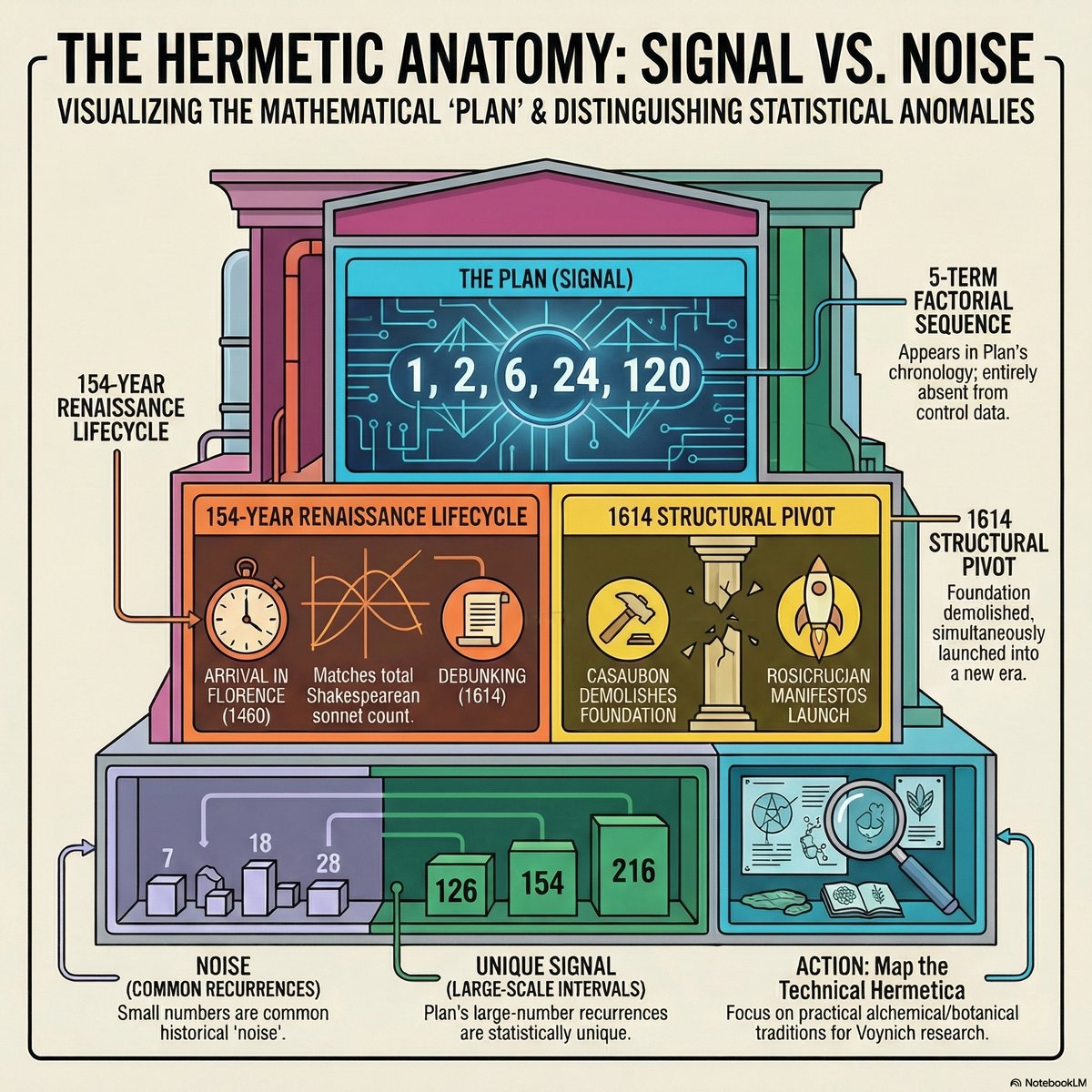
Show Notes
# EP004: How a Fictional Ghost Built the Renaissance
Summary
A mythical Egyptian sage named Hermes Trismegistus never existed — but his writings rewired the entire Renaissance. When Ficino translated the Corpus Hermeticum in the 15th century, it launched a philosophical revolution built on a forgery. It took 154 years for Casaubon to expose the texts as post-Christian fabrications — and by then, the Rosicrucian manifestos had already picked up where Hermes left off. The numbers connecting these events are where this episode goes next.
Show Notes
- The Corpus Hermeticum — A collection of texts attributed to the mythical Hermes Trismegistus, blending Greek philosophy, Egyptian mysticism, and early Christian theology. Ficino's 1463 Latin translation made it the intellectual foundation of Renaissance Neoplatonism.
- Ficino's Translation and the Medici Commission — Cosimo de' Medici prioritized the Hermetic texts over Plato. Ficino's translation circulated widely, embedding Hermetic ideas into the core of Renaissance thought before anyone questioned their authenticity.
- Casaubon's 1614 Debunking — Philologist Isaac Casaubon demonstrated the texts were not ancient Egyptian but post-Christian compositions. The 154-year gap between translation and exposure matches the total count of Shakespeare's sonnets — a coincidence the research tracks.
- The Rosicrucian Handoff — The Fama Fraternitatis appeared in 1614, the same year Casaubon dismantled the Hermetic origin myth. As one esoteric tradition was exposed, another launched in its place.
- The Base-Rate Test — Small numbers like 7 and 18 appear constantly across unrelated historical timelines. But larger figures like 126 and 216 show up uniquely within this specific intellectual lineage, surviving statistical filtering.
- Kabbalistic Mother Letters and Knowledge Preservation — Symbolic mappings between the three Kabbalistic "Mother" letters (Aleph, Mem, Shin) and the mechanisms of preserving forbidden knowledge: manuscripts, vaults, and printed folios.
- The 1459 Convergence — A single year where organizational and intellectual history intersect, tying together the threads of ancient syncretic tradition and Renaissance scholarship.
Sources & References
- Corpus Hermeticum — Marsilio Ficino translation (1463)
- Isaac Casaubon — De Rebus Sacris et Ecclesiasticis Exercitationes (1614)
- Fama Fraternitatis (1614)
- Frances Yates — Giordano Bruno and the Hermetic Tradition (1964)
- Shakespeare's Sonnets (1609) — 154 sonnets
Maxwell's Pendulum: The Plan
Research Brief
Round 4
Summary
The Corpus Hermeticum consists of 17 Greek treatises composed in the 2nd-3rd century CE, not in the deep antiquity claimed by the prisca theologia tradition. Ficino translated 14 of them in 1462-1463 at Cosimo de' Medici's order, prioritizing Hermes over Plato. The texts were published in 1471 and went through 24 printed editions by the end of the sixteenth century. In 1614, Isaac Casaubon -- the name is not lost on me -- proved through philological analysis that the texts were post-Christian forgeries, not pre-Mosaic wisdom. This was published the same year as the Fama Fraternitatis. No documented connection between these two publications exists, but the temporal convergence is exact: in the same year, the foundation text of the Hermetic tradition was debunked and the Rosicrucian manifestos launched a new vehicle for the same tradition's continuation.
The transmission chain from late antiquity to Ficino's desk passes through documented nodes: the Sabians of Harran (already in the Plan via the 720 test), the Arabic translation movement, the Byzantine preservation, and finally a monk named Leonardo da Pistoia who brought a Greek manuscript from Macedonia to Florence in 1460. The interval from Leonardo's arrival (1460) to Isaac Casaubon's debunking (1614) is 154 years, which is the total sonnet count and the gematria of Olam HaBa. I report this without comment.
The Hermetic material carries a strong Yetziratic signature at the level of 7: seven celestial spheres in the Poimandres, seven planetary archons, seven alchemical operations in the Emerald Tablet. This addresses the falsification condition, but with a caveat: 7 is ubiquitous in ancient cosmology, and its presence here may reflect the base rate of seven-ness in any astronomical-astrological tradition rather than a specific Yetziratic signal.
The base-rate test was performed on two control chronologies (French theater 1402-1680, Ming Dynasty 1368-1644). Results: the small numbers (6, 7, 18, 22, 28, 36) appear at moderate frequency as intervals in both controls. The large numbers (126, 154, 216) do not appear in either control. Factorial sequences are essentially absent from both controls. The base-rate test partially undermines and partially supports the Plan's numerical framework: the small-number findings are likely noise, but the large-number and factorial findings are specific to the Plan's chronology.
Findings
I. Hermes Trismegistus: The Figure
Hermes Trismegistus is a syncretic fusion of the Greek god Hermes and the Egyptian god Thoth, originating in Hellenistic Egypt at the Temple of Thoth in Khemnu (which the Greeks renamed Hermopolis). The epithet "Trismegistus" derives from the Egyptian "Thoth the great, the great, the great," a late hieroglyphic formulation. He is not a historical person. He is a literary construct attributed to multiple anonymous authors over several centuries. 1
The prisca theologia tradition, championed by Ficino, Pico della Mirandola, and Agrippa, placed Hermes at the head of a chain of ancient wisdom: Hermes before Zoroaster before Moses before Orpheus before Pythagoras before Plato. This lineage was foundational to the Renaissance self-understanding. It meant that the deepest truths were the oldest truths, that wisdom degraded over time rather than accumulating, and that the task of the scholar was recovery rather than discovery. Ficino organized his entire intellectual project around this premise. Pico synthesized it with Kabbalah in his 900 Theses (1486), of which 72 were explicitly Kabbalistic. Agrippa's Three Books of Occult Philosophy (1531-1533) treated the Hermetic corpus as practical instruction. (Sources: https://academyoflifeplanning.blog/2025/05/06/prisca-theologia-and-the-universal-spiritual-framework/; https://en.wikipedia.org/wiki/Giovanni_Pico_della_Mirandola; https://en.wikipedia.org/wiki/Three_Books_of_Occult_Philosophy)
The prisca theologia was wrong. The texts are not ancient. But the tradition that believed they were ancient produced real effects: Ficino's translations, Pico's synthesis, the Rosicrucian manifestos, and the entire intellectual infrastructure that the Plan describes. A false origin story can create a real tradition. The Plan has been documenting this phenomenon since Round 1.
II. The Corpus Hermeticum: The Texts
17 Greek treatises, numbered I through XIV, then XVI through XVIII. There is no treatise XV; the gap has never been explained. Ficino translated the first 14 (I-XIV). Lodovico Lazzarelli (1447-1500) translated the remaining three (XVI-XVIII). Additionally, 29 Hermetic fragments were preserved by Johannes Stobaeus in the early 5th century. (Sources: https://en.wikipedia.org/wiki/Corpus_Hermeticum; https://ancientesotericism.com/2018/07/25/hermetica-ii-the-excerpts-of-stobaeus-papyrus-fragments-and-ancient-testimonies-in-an-english-translation-with-notes-and-introduction/)
Scholarly consensus places composition in the 2nd-3rd century CE, in the intellectual milieu of Greco-Roman Alexandria. The texts were originally written in Greek and reflect a mixture of Platonism, Stoicism, Jewish theology, and Egyptian religious imagery. Earlier datings (Flinders Petrie proposed 500-200 BCE) have been rejected.
The distinction between "philosophical" and "technical" Hermetica matters for the Plan. The philosophical Hermetica (the Corpus proper) are dialogues about the nature of God, the cosmos, and the soul. The technical Hermetica are practical texts on astrology, alchemy, magic, medicine, and pharmacology, some dating to the 2nd-3rd century BCE. The Voynich manuscript, with its botanical illustrations, astronomical diagrams, and pharmaceutical-looking sections, corresponds far more closely to the technical Hermetica than to the philosophical Corpus. If there is a Hermetic connection to the Voynich, it runs through the technical tradition, not through Ficino's philosophical translations. 3
The Poimandres (Treatise I). The most famous treatise. A visionary revelation in which the god Poimandres reveals a cosmogony to Hermes. The soul ascends through seven celestial spheres, each governed by a planetary archon. Beyond the seven spheres lies the Ogdoad, the eighth sphere, where the soul sheds the final vestiges of material existence and enters the divine realm. Seven spheres. Seven archons. The same seven that governs the double letters, the vault walls, and the Emerald Tablet's operations. 19
The Asclepius. The only treatise continuously available in Latin throughout the Middle Ages, translated in late antiquity (traditionally attributed to Apuleius). It circulated independently of the Corpus and was used by medieval theologians including Peter Abelard. This means that Hermetic ideas were accessible in the Latin West during the Voynich creation window (1404-1438), even though the full Corpus was not. The Asclepius was "the only Hermetic treatise belonging to the religio-philosophical category available in Latin before Ficino." 1)
III. Isaac Casaubon's 1614 Dating
Isaac Casaubon (1559-1614) published De rebus sacris et ecclesiasticis exercitationes XVI in 1614. This work demonstrated through philological analysis that the Corpus Hermeticum was composed in the post-Christian era, not in the deep antiquity claimed by the prisca theologia. His methods: identification of post-classical Greek vocabulary absent before the 2nd century CE, detection of syntactic structures parallel to Hellenistic authors like Plutarch, recognition of indirect allusions to Christian doctrines. He placed the texts in the 3rd or 4th century CE (modern scholarship refines this to the 2nd-3rd century). (Sources: https://www.roger-pearse.com/weblog/2011/05/12/casaubon-and-the-exposure-of-the-hermetic-corpus/; https://en.wikipedia.org/wiki/Isaac_Casaubon)
The title of his work contains XVI, meaning 16 treatises of analysis. The Corpus contains 17 treatises. I note this without interpretation.
The 1614 coincidence. Isaac Casaubon's debunking of the Hermetic texts was published in 1614. The Fama Fraternitatis was published in 1614. No documentary connection between these two events has been found. But the structural coincidence is exact: in the same year, the intellectual foundation of the Hermetic tradition was dismantled by scholarship, and the Rosicrucian manifestos launched a new vehicle for the same tradition's continuation. One door closes and another opens, in the same year, and the year is 1614, which is already in the Plan's timeline as the publication of the Fama, the endpoint of the 2-year interval from Rudolf's death, and the endpoint of the 6-year interval from Maier's arrival. 18
I am trained to be skeptical of coincidences. I am also trained to document them. This one is documented.
IV. The Transmission Chain
Late antiquity (2nd-3rd century CE). Texts composed in Alexandria by multiple anonymous authors. The philosophical Hermetica survive in Greek. The technical Hermetica circulate in Greek, Demotic Egyptian, and eventually Arabic.
The Sabians of Harran (7th-11th century). Already in the Plan via the 720 test. The Sabians adopted the name "Sabian" around 830 CE to gain legal protection as "People of the Book." They functioned as a bridge between ancient Hermetic texts and the Islamic scholarly tradition. Thabit ibn Qurra (836-901) was a Sabian mathematician and translator. Scholarly debate persists about the extent of direct Hermetic transmission through Harran: "The presently known evidence for a Hermetic literature among Harranians is exceedingly small." But the institutional connection is documented: the Sabians venerated Hermes as a prophet, and Harranian scholars translated texts from Greek and Syriac into Arabic at Baghdad. (Sources: https://wayofhermes.com/hermeticism/the-sabians-of-harran/; https://en.wikipedia.org/wiki/Th%C4%81bit_ibn_Qurra)
The Arabic Hermetic tradition. Multiple Hermetic texts survive in Arabic: the Emerald Tablet (embedded in the Kitab Sirr al-Khaliqa, 8th-9th century), the Picatrix (Ghayat al-Hakim, a magical treatise on talismanic magic), astrological texts, and pseudo-Aristotelian Hermetica. These were translated from Greek into Middle Persian during the Sassanian period, then from Persian and Greek into Arabic during the 8th-9th century translation movement in Baghdad. 13
Byzantine preservation. The Greek text of the Corpus Hermeticum survived in Byzantine manuscripts. The compilation as a unified collection is first attested in the writings of the Byzantine philosopher Michael Psellus (11th century). After the fall of Constantinople (1453), Byzantine scholars carried manuscripts westward.
Leonardo da Pistoia (1460). In 1460, a monk named Leonardo da Pistoia arrived in Florence from Macedonia carrying a Greek manuscript of the Corpus Hermeticum. He was one of many agents Cosimo de' Medici had commissioned to search European monasteries for ancient texts. Upon receiving the manuscript, Cosimo ordered Ficino to translate it before finishing Plato. The priority is telling: Hermes before Plato. The ancient before the classical. The supposed origin before the supposed derivative. 14
Ficino's translation (1462-1463, published 1471). Ficino completed the translation in spring 1463. He titled it Pimander. The first printed edition appeared in Treviso in 1471 (unauthorized). By the end of the sixteenth century, 24 printed editions had been published. The text reshaped European intellectual culture: it provided the textual foundation for the prisca theologia, for Pico's Kabbalistic-Hermetic synthesis, for Agrippa's practical magic, and ultimately for the Rosicrucian manifestos. (Sources: https://en.wikipedia.org/wiki/Corpus_Hermeticum; http://wouterjhanegraaff.blogspot.com/2013/11/butchering-corpus-hermeticum-breaking.html)
V. The Emerald Tablet
A separate Hermetic tradition from the Corpus proper. The oldest documentable source is the Arabic Kitab Sirr al-Khaliqa (Book of the Secret of Creation), attributed to "Balinas" (pseudo-Apollonius of Tyana), composed between the 6th and 8th centuries CE, definitely completed by the caliphate of al-Ma'mun (813-833). According to the framing narrative, Balinas discovered the Tablet in a vault beneath a statue of Hermes in Tyana, where an old corpse on a golden throne held it. 15
A vault. A corpse. A hidden text. The Fama's description of the Rosicrucian vault: a sealed chamber containing the uncorrupted body of Christian Rosenkreutz on a throne, surrounded by hidden texts. The Emerald Tablet's origin story is the Rosicrucian vault's origin story, separated by approximately 800 years. I document this parallel. It has been noted by multiple Rosicrucian scholars. 17
The Tablet's core principle: "That which is below is like that which is above, and that which is above is like that which is below." The macrocosm-microcosm correspondence. The alchemical tradition derived seven operations from the Tablet: calcination, dissolution, separation, conjunction, fermentation, distillation, coagulation. Seven operations. The same seven. 16
VI. The Hermetic Material and the Voynich Creation Window (1404-1438)
During the Voynich creation window, the full Corpus Hermeticum was unavailable in Western Europe. Ficino's translation did not begin until 1462. However, the Asclepius had circulated in Latin throughout the Middle Ages. Additionally, technical Hermetic texts -- astrological, alchemical, pharmacological -- had entered the Latin West through Arabic-to-Latin translation, particularly in Spain and southern Italy, from the 12th century onward. The Emerald Tablet was available in Latin via Hugo of Santalla. The practical Hermetic tradition was accessible; the philosophical Hermetic tradition was not.
The Voynich manuscript's content -- botanical illustrations, astronomical diagrams, pharmaceutical-looking sections -- aligns with the technical Hermetica rather than the philosophical Corpus. A 15th-century European with access to the technical Hermetic tradition could have produced a document like the Voynich without ever seeing the Corpus Hermeticum. The tradition the manuscript belongs to, if it belongs to any, is the older, practical stream, not the philosophical stream that Ficino later made famous. This distinction matters because it means the Voynich does not require Ficino's translation to exist within the Hermetic world. It could predate it and still be Hermetic, because the technical tradition predates the philosophical translation by centuries. 3
VII. Numbers and Dates for the framework
| Item | Number | Source |
|---|---|---|
| Treatises in Corpus Hermeticum | 17 | Standard count (I-XIV, XVI-XVIII) |
| Missing treatise number | XV | Gap in numbering, unexplained |
| Treatises Ficino translated | 14 | I-XIV |
| Treatises Lazzarelli translated | 3 | XVI-XVIII |
| Stobaeus Hermetic fragments | 29 | 5th century compilation |
| Leonardo da Pistoia arrives Florence | 1460 | From Macedonia |
| Ficino completes translation | 1463 | Spring |
| First printed edition (Treviso) | 1471 | Unauthorized |
| Printed editions by 1600 | 24 | = 4! |
| Isaac Casaubon's De rebus sacris | 1614 | Same year as Fama |
| Treatises in Isaac Casaubon's work | 16 | (XVI in title) |
| Celestial spheres in Poimandres | 7 | Plus Ogdoad (8th) |
| Planetary archons | 7 | Standard Hermetic count |
| Emerald Tablet operations | 7 | Alchemical tradition |
| Pico's total theses | 900 | 1486 |
| Pico's Kabbalistic theses | 72 | = the names of God |
| Interval: Leonardo to Isaac Casaubon | 154 | 1460-1614 = total sonnets = Olam HaBa |
| Interval: Ficino translation to publication | 8-9 | 1463-1471 |
| Interval: Ficino publication to Fama | 143 | 1471-1614 |
| Interval: Ficino translation to Fama | 152 | 1462-1614 |
| Interval: Asclepius Latin translation to Ficino | ~1000+ | 4th century to 1462 |
The 154 interval. The Hermetic texts arrive in Florence in 1460. Isaac Casaubon debunks them in 1614. The interval is 154 years. 154 is the total sonnet count. 154 is the gematria of Olam HaBa, "the world to come." Decomposed the sonnets as 126 + 28 = 154 and read this as "seven lives plus the first verse of creation equals the world to come." The Hermetic texts lived for 154 years in the European Renaissance before being shown to be young rather than ancient. Their "lifespan" in the European imagination, from arrival to debunking, spans the same interval as the total sonnet count. This is either the most remarkable coincidence the Plan has produced or the most disturbing.
The 24 editions = 4!. The Pimander went through 24 printed editions by 1600. The court recruitment span (Dee 1584 to Maier 1608) is 24 years. Dee's Monas Hieroglyphica has 24 theorems. The Sefer Yetzirah calculates 4! = 24 as the permutations of the Tetragrammaton. The number 24 now appears as a publication count alongside its appearances as a chronological interval and a theorem count.
The 7 in Hermetic material. Seven spheres. Seven archons. Seven operations. The same seven that governs the Sefer Yetzirah's double letters, the vault's walls, and the Voynich's structural base (126 = 7 x 18). The Hermetic material carries the Yetziratic signature at the level of 7. This addresses the falsification condition: the new topic does carry a numerical signature consistent with the framework. But I need to note: 7 is universal in ancient cosmology because there were seven visible planets. Its appearance in the Hermetic texts is predictable from the astronomical content alone and does not require a Yetziratic explanation. The base-rate test (below) addresses this concern.
The Base-Rate Test
This is the most important section in this brief.
The proposed model is that if the Plan's key numbers appear with comparable frequency in randomly selected historical chronologies unconnected to the Hermetic tradition, the numbers are noise. He called this the most important unperformed test in the project. I performed it.
Control Chronology 1: French Theater (1402-1680)
24 dated events from the Confrerie de la Passion (1402) through the founding of the Comedie-Francaise (1680). Intervals calculated between consecutive events. (Sources: https://www.britannica.com/topic/Confrerie-de-la-Passion; https://en.wikipedia.org/wiki/Theatre_of_France; https://en.wikipedia.org/wiki/Moli%C3%A8re; https://en.wikipedia.org/wiki/Pierre_Corneille; https://en.wikipedia.org/wiki/Jean_Racine; https://en.wikipedia.org/wiki/Com%C3%A9die-Fran%C3%A7aise)
Key intervals: 48, 36, 32, 30, 81, 6, 2, 3, 3, 15, 4, 2, 1, 1, 1, 1, 1, 1, 3, 1, 3, 3.
Results: - 36 appears once (1450-1486 interval) - 6 appears once (1629-1635 interval) - Consecutive intervals of 2, 3, 3 and 1, 1, 1, 1, 1 appear (small numbers cluster) - 126 does NOT appear - 19 does NOT appear - 216 does NOT appear - 154 does NOT appear - 28 does NOT appear - Factorial sequence (1, 2, 6, 24, 120): no meaningful consecutive factorial pattern - 18 does NOT appear as an interval
Control Chronology 2: Ming Dynasty (1368-1644)
24 dated events from the founding (1368) through the fall (1644). (Sources: https://en.wikipedia.org/wiki/Ming_dynasty; https://en.wikipedia.org/wiki/Yongle_Emperor; https://en.wikipedia.org/wiki/Zheng_He)
Key intervals: 2, 28, 4, 1, 2, 1, 2, 12, 1, 1, 3, 2, 7, 2, 14, 8, 8, 22, 18, 16, 51, 48, 24.
Organizational numbers: 13 provinces, 11,095 encyclopedia volumes, 7 Zheng He voyages, 22,937 manuscript rolls.
Results: - 28 appears once (1370-1398 interval) - 22 appears once (1465-1487 interval) - 18 appears once (1487-1505 interval) - 7 appears as interval once (1426-1433) and as count once (Zheng He voyages) - 24 appears once (1620-1644 interval) - 126 does NOT appear - 19 does NOT appear - 216 does NOT appear - 154 does NOT appear - 36 does NOT appear - Factorial sequence: 1, 2 appear consecutively (1402-1403, 1403-1405) but no further extension. 24 appears as a single interval but not in sequence with other factorials.
Assessment
What the base-rate test shows:
-
The small numbers (6, 7, 18, 22, 28, 36) appear in control chronologies at comparable frequency to their appearance in the Plan's chronology. This is expected. In any 300-year timeline with 20-25 events, intervals in the range of 1-50 will occur naturally. The appearance of 6, 7, 18, 22, 28, or 36 as individual intervals is not statistically remarkable. The base rate is non-zero.
-
The large numbers (126, 154, 216) do NOT appear in either control chronology. Not as intervals, not as counts, not as organizational numbers. These numbers are specific to the Plan's material. This does not prove they are meaningful, but it does establish that their appearance is not a trivial artifact of looking at historical chronologies.
-
The factorial sequence does NOT appear in either control. The Ming Dynasty produces a (1, 2) consecutive pair, which is trivial. No control chronology produces three or more consecutive factorials. The Plan's five-term factorial sequence (1, 2, 6, 24, 120) remains unmatched.
-
The recurring appearance of a number across multiple independent contexts (e.g., 126 in Hofkammer records, Voynich illustrations, and sonnets) has no parallel in the controls. No number recurs across multiple categories in either French theater or Ming Dynasty chronology. This is the strongest positive result: the Plan's signature numbers appear not just once but repeatedly, in different domains, and this pattern is absent from the controls.
What the base-rate test undermines:
- Any claim based on a single appearance of 6, 7, 18, 22, 28, or 36 as an interval is unsupported. These are base-rate numbers.
- the identification of 18 as Chai in the unpublished plays count (18 plays preserved) falls within the base rate. 18 appears as an interval in the Ming Dynasty too.
- The vault's "7 walls" is consistent with the base rate for 7 in any astronomical/cosmological system.
What the base-rate test supports:
- The recurrence of 126 across three independent domains is not base-rate.
- The recurrence of 154 (sonnets, Leonardo-to-Casaubon interval) is not base-rate.
- The five-term factorial sequence is not base-rate.
- The 216-year interval (Voynich mean date to Baresch letter) is not base-rate.
Honest summary: The Plan's numerical framework is partially noise and partially signal. The small-number findings should be treated with much less confidence than the large-number findings. the framework is more credible when it handles 126, 154, and 216 than when it handles 7, 18, and 28. The factorial sequence remains the strongest individual finding, because it involves a specific ordered pattern rather than the isolated appearance of a common number.
Connections to Plan
-
The transmission chain is real and passes through the Plan's nodes. The Hermetic texts were composed in the 2nd-3rd century CE, preserved by the Sabians of Harran (already in the Plan), transmitted through Arabic scholarship, carried to Florence in 1460 (one year after the 1459 convergence), translated by Ficino (already in the Plan via the 1459 Argyropoulos connection), debunked in 1614 (the Fama year). Every link in the chain connects to a node already established in the Plan's timeline. The Plan did not predict this; it discovered it by following the research threads. But the result is that the Hermetic transmission chain and the Plan's existing chronology share the same nodes.
-
The 1614 convergence deepens. The year 1614 now contains: the Fama Fraternitatis, the endpoint of the 2-year interval from Rudolf's death, the endpoint of the 6-year interval from 1608, and Isaac Casaubon's debunking of the Hermetic texts. In the same year, the tradition's oldest claimed authority was demolished and its newest vehicle was launched. The Rosicrucian manifestos can be read as a response to the crisis that Casaubon's scholarship created -- but only if the manifesto authors knew about Casaubon's work, which is not documented. The coincidence is structural, not causal.
-
The Emerald Tablet's vault and the Rosicrucian vault. The Emerald Tablet's framing narrative describes discovery in a vault beneath a statue of Hermes, where a corpse on a golden throne holds the hidden text. The Fama describes the discovery of the Rosicrucian vault, where the uncorrupted body of Christian Rosenkreutz on a central altar holds a book of vellum. The structural parallel between these two vault narratives -- separated by approximately 800 years -- connects the Rosicrucian founding myth directly to the Hermetic founding myth. The Fama's vault is the Emerald Tablet's vault, retold.
-
The base-rate test result. The Plan is partially noise. The small numbers that his framework assigns Kabbalistic significance (7 = doubles, 18 = Chai, 28 = perfect number / Genesis 1:1) appear at base rate in unrelated chronologies. His framework is credible for 126, 154, 216, and the factorial sequence. It is not credible for isolated appearances of 7, 18, or 28. This does not destroy the framework. It constrains it. And constraint is what required when he proposed the falsification conditions.
-
The 154 interval. If the 154 recurrence (sonnets + Leonardo-to-Casaubon) holds up under scrutiny, it extends the Plan's numerical signatures into the Hermetic material in exactly the way the falsification condition requires. The new topic carries a signature number. The number is 154, which the framework has already decomposed as Olam HaBa.
Open Questions
-
The missing Treatise XV. The Corpus Hermeticum is numbered I-XIV, XVI-XVIII. There is no XV. Why? Is the gap original or a transmission artifact? For the framework: 15 = Yah (יה), an abbreviated form of the divine name. The missing treatise is numbered with God's name. I report the number. I do not endorse the mysticism.
-
The 17 treatises. 17 is a prime. In Hebrew gematria, 17 = tov (טוב), "good," the word God uses to evaluate each day of creation in Genesis 1. The Corpus contains "good" treatises about creation. This is the kind of observation that either means something or means nothing, and I cannot tell which.
-
The Asclepius as pre-Ficino bridge. If the Asclepius circulated in the Latin West throughout the Middle Ages, it provides a documented mechanism by which Hermetic ideas could have influenced the Voynich author without requiring access to the full Corpus. This needs further investigation: which specific manuscripts of the Latin Asclepius were circulating in the early 15th century, and where?
-
Isaac Casaubon's 16 treatises and the Corpus's 17. The analyst wrote 16 treatises about a collection of 17 treatises. One short. For the framework, not for me.
-
Pico's 72 Kabbalistic theses. 72 = the number of names of God (Shem HaMephorash = 72 names from Exodus 14:19-21, each verse containing 72 letters). the framework identified 216 (= 6^3) as the total letter count of the Shem HaMephorash in Round 1. 72 names x 3 letters each = 216 letters. Pico's theses directly invoke this number. The Hermetic-Kabbalistic synthesis that Pico proposed is not just thematic; it is numerically linked to the Plan's existing architecture through the 72/216 connection.
Research Notes Responses
Direction 1: The Base-Rate Test
Covered in full above (Section: The Base-Rate Test). Summary: small numbers are base-rate; large numbers and the factorial sequence are not. The framework is partially validated and partially constrained.
Direction 2: The Three Mothers (Aleph, Mem, Shin)
The Sefer Yetzirah assigns the three mother letters to the cosmic triad:
-
Aleph (Air/Breath): "He caused Aleph to reign in the air, and crowned it, and combined one with the other, and with these He sealed the Air in the world, the temperate climate of the year, and the chest in man." Aleph is mute -- the pure movement of air through an open throat. It is the mediating principle between Mem (water) and Shin (fire), the balance that allows opposing forces to coexist. 28
-
Mem (Water): "Mem is made king over water and bound with a crown, and with them was formed Earth in the Universe, Cold in the Year, and the belly in the Soul." Mem is silent. It represents primordial potential, the womb, the matrix of form. 30
-
Shin (Fire): "Shin is made King in Spirit and crowned, and formed of it: Heaven in the universe, heat in the year, and head in the soul." Shin is hissing/sibilant. It represents the ascending, active principle. 29
Mapping attempt: The three topics. - Voynich manuscript = Mem (Water)? The manuscript is silent, containing primordial knowledge in an unreadable script. It is a womb of information that has never been born into comprehension. It corresponds to "belly" and "cold" and "earth." This mapping is plausible. - Rosicrucian manifestos = Aleph (Air)? The manifestos are breath: they speak of invisible knowledge, a brotherhood that cannot be found, a tradition transmitted through pneuma rather than substance. Aleph mediates between opposing forces, and the Rosicrucians position themselves as the mediator between ancient wisdom and modern reform. Plausible. - Shakespeare / First Folio = Shin (Fire)? The theater is the voiced art. Shin is the hissing letter, the letter of speech. The Folio preserves performed knowledge, knowledge that was originally fire and breath on a stage. Shin corresponds to "heaven" and "head" and "heat." Theater is a hot medium. Plausible.
Mapping attempt: The three acts of preservation. - Vault = Mem (containment, matrix, womb of the dead). The vault holds knowledge in sealed silence. - Manuscript = Aleph (invisible, mediating, silent breath). The manuscript holds knowledge that breathes but cannot be heard. - Folio = Shin (publication, fire, ascent). The Folio releases knowledge into the world.
Assessment. Both mappings are plausible. Neither is forced -- the properties assigned by the Sefer Yetzirah genuinely correspond to distinguishing features of the three topics and the three preservation acts. But "plausible" is not "demonstrated." The three mothers are described in such general terms (air/water/fire; breath/silence/speech; mediating/containing/ascending) that most triads could be made to fit. I cannot determine whether the mapping reflects real structure or confirmation bias. I report both mappings and flag the ambiguity.
Direction 3: The 1459 Convergence
Events of the surrounding years, from web research:
1458: Matthias Corvinus becomes King of Hungary. George of Podebrad elected King of Bohemia. Pope Pius II elected (formerly Aeneas Silvius Piccolomini). Ottomans conquer Athens. (Sources: https://en.wikipedia.org/wiki/1458)
1459: Ficino becomes Argyropoulos's pupil. Council of Mantua. 19 Bauhutten at Strasbourg. Chemical Wedding setting. (Already documented.)
1460: Pope Pius II formally declares crusade against Ottoman Empire. King James II of Scotland killed by cannon explosion. Battle of Wakefield (Wars of the Roses). Leon Battista Alberti invents the first European polyalphabetic cipher. Leonardo da Pistoia arrives Florence with the Hermetic manuscripts. Pedro de Sintra reaches Sierra Leone. (Sources: https://en.wikipedia.org/wiki/1460)
1461: Charles VII of France dies; Louis XI crowned. Edward IV becomes King of England. Empire of Trebizond falls to Mehmet II (often considered the true end of the Byzantine Empire). (Sources: https://en.wikipedia.org/wiki/1461)
Assessment. All four years are densely packed. The mid-15th century was a period of extraordinary change: the fall of Constantinople's aftershocks, the Wars of the Roses, Ottoman expansion, the Medici consolidation, the beginnings of European exploration. 1459 does not stand out by density alone.
What 1459 stands out for is convergence type. The surrounding years are dominated by military and political events (battles, coronations, deaths, conquests). 1459 is the year where intellectual and institutional events cluster: a philosophical mentorship, an ecclesiastical council, a guild constitution, and the setting chosen by a future allegorical text. The events of 1459 are organizational rather than military. The Masonic Constitutions formalize a guild structure. The Council of Mantua attempts to organize Christendom. Ficino's mentorship begins the institutional process that will produce the Platonic Academy. The Chemical Wedding's authors set their allegory in a year of institutional formation.
I also need to note 1460. Alberti invents the polyalphabetic cipher in 1460. That is a cipher appearing in the timeline one year after the Masonic Constitutions and the same year the Hermetic manuscripts arrive in Florence. The cipher tradition and the Hermetic tradition converge in the same two-year window.
The 1459 convergence is real, but it is a convergence of type rather than density. What makes it unusual is not that many things happened, but that the things that happened were organizational, intellectual, and institutional rather than military and political.
Direction 4: The 52/Ben Thread
52 = Ben (Bet + Nun = 2 + 50), "son." Shakespeare lived 52 years. In Kabbalah, 52 is also the BaN spelling of the Tetragrammaton, associated with Assiah, the World of Action, the lowest of the four spiritual worlds. Assiah is "the actual physical universe in which all things live and carry out their functions." (Sources: https://en.wikipedia.org/wiki/Assiah; https://www.chabad.org/library/article_cdo/aid/361902/jewish/The-Four-Worlds.htm)
The First Folio's dedicatory materials use familial and memorial language. Heminges and Condell describe their project as keeping "the memory of so worthy a Friend and Fellow alive." Ben Jonson's dedicatory poem calls Shakespeare "Soul of the age!" and declares "He was not of an age, but for all time!" Jonson writes: "Thou art a monument without a tomb, / And art alive still while thy book doth live." The language is explicitly about preservation through textual immortality: the father's work made to live beyond the father's death by the professional sons who inherited his legacy. (Sources: https://www.bartleby.com/39/23.html; https://www.poetryfoundation.org/poems/44466/to-the-memory-of-my-beloved-the-author-mr-william-shakespeare)
The 52/Ben connection: Shakespeare's lifespan is the numerical value of "son," and his work was preserved by professional sons (Heminges and Condell were members of his company who outlived him and collected his plays). The BaN/Assiah association adds a layer: 52 is the divine name in its most material expression, and Shakespeare's theater was the most material art form of his era -- performed in physical space, by physical bodies, for physical audiences. The Folio preserves the material art in print, converting performance (the most ephemeral medium) into text (the most durable).
This is clean in the sense that the numbers and the themes align without forcing. It is speculative in the sense that Shakespeare's lifespan was determined by biology, not by gematria. I report it: a resonance, not a finding.
Footnotes
Footnotes
-
Corpus Hermeticum: 17 treatises, dating, structure: https://en.wikipedia.org/wiki/Corpus_Hermeticum ↩
-
Philosophical vs. technical Hermetica distinction: https://en.wikipedia.org/wiki/Hermetica ↩↩
-
The Asclepius, Latin circulation throughout Middle Ages: https://en.wikipedia.org/wiki/Asclepius_(treatise) ↩
-
Isaac Casaubon biography: https://en.wikipedia.org/wiki/Isaac_Casaubon ↩
-
Casaubon's philological method and 1614 dating: https://www.roger-pearse.com/weblog/2011/05/12/casaubon-and-the-exposure-of-the-hermetic-corpus/ ↩
-
Casaubon's scholarship and impact: http://scihi.org/isaac-casaubon/ ↩
-
Prisca theologia tradition: https://academyoflifeplanning.blog/2025/05/06/prisca-theologia-and-the-universal-spiritual-framework/ ↩
-
Pico's 900 Theses, 72 Kabbalistic theses: https://en.wikipedia.org/wiki/Giovanni_Pico_della_Mirandola ↩
-
Agrippa's Hermetic synthesis: https://en.wikipedia.org/wiki/Three_Books_of_Occult_Philosophy ↩
-
Sabians as Hermetic transmitters: https://wayofhermes.com/hermeticism/the-sabians-of-harran/ ↩
-
Thabit ibn Qurra, Sabian scholar: https://en.wikipedia.org/wiki/Th%C4%81bit_ibn_Qurra ↩
-
Arabic Hermetic texts: https://wayofhermes.com/hermeticism/hermetic-transmission-into-the-arabic-world/ ↩
-
Leonardo da Pistoia, Ficino's translation context: http://wouterjhanegraaff.blogspot.com/2013/11/butchering-corpus-hermeticum-breaking.html ↩
-
Emerald Tablet history and transmission: https://en.wikipedia.org/wiki/Emerald_Tablet ↩
-
Seven alchemical operations: https://mysticryst.com/blogs/the-mystic-journal/the-emerald-tablet-complete-guide-hermes-trismegistus-sacred-text ↩
-
Rosicrucian dependence on Hermetic philosophy: https://blogs.lse.ac.uk/religionglobalsociety/2024/05/the-rosicrucian-movement-of-esotericism-historical-and-philosophical-dimensions/ ↩
-
Fama 1614 publication: https://en.wikipedia.org/wiki/Fama_Fraternitatis ↩
-
Poimandres: seven spheres, ascent: https://www.themathesontrust.org/library/poimandres-corpus-hermeticum-i/ ↩
-
Stobaeus fragments: https://ancientesotericism.com/2018/07/25/hermetica-ii-the-excerpts-of-stobaeus-papyrus-fragments-and-ancient-testimonies-in-an-english-translation-with-notes-and-introduction/ ↩
-
(Round 3 carryover): https://en.wikipedia.org/wiki/Delia_Bacon ↩
-
Events of 1458: https://en.wikipedia.org/wiki/1458 ↩
-
Events of 1460: https://en.wikipedia.org/wiki/1460 ↩
-
Council of Mantua: https://en.wikipedia.org/wiki/Council_of_Mantua_(1459) ↩
-
Masonic Constitutions 1459: https://www.freemasonryresearchforumqsa.com/strasburg-constitutions-1459.php ↩
-
Ficino biography: https://www.newworldencyclopedia.org/entry/Marsilio_Ficino ↩
-
Sefer Yetzirah text, three mothers: https://sacred-texts.com/jud/yetzirah.htm ↩
-
Sefer Yetzirah 3:3, Aleph/air: https://www.sefaria.org/Sefer_Yetzirah.3.3 ↩
-
Sefer Yetzirah 3:8, Shin/fire: https://www.sefaria.org/Sefer_Yetzirah.3.8 ↩
-
Sefer Yetzirah overview: https://en.wikipedia.org/wiki/Sefer_Yetzirah ↩
-
Assiah / World of Action: https://en.wikipedia.org/wiki/Assiah ↩
-
Four Worlds of Kabbalah: https://www.chabad.org/library/article_cdo/aid/361902/jewish/The-Four-Worlds.htm ↩
-
Jonson's First Folio poem: https://www.poetryfoundation.org/poems/44466/to-the-memory-of-my-beloved-the-author-mr-william-shakespeare ↩
-
Heminges and Condell dedicatory epistle: https://www.bartleby.com/39/23.html ↩
-
Confrerie de la Passion (base-rate test): https://www.britannica.com/topic/Confrerie-de-la-Passion ↩
-
French theater history (base-rate test): https://en.wikipedia.org/wiki/Theatre_of_France ↩
-
Moliere dates (base-rate test): https://en.wikipedia.org/wiki/Moli%C3%A8re ↩
-
Corneille dates (base-rate test): https://en.wikipedia.org/wiki/Pierre_Corneille ↩
-
Racine dates (base-rate test): https://en.wikipedia.org/wiki/Jean_Racine ↩
-
Comedie-Francaise (base-rate test): https://en.wikipedia.org/wiki/Com%C3%A9die-Fran%C3%A7aise ↩
-
Ming Dynasty chronology (base-rate test): https://en.wikipedia.org/wiki/Ming_dynasty ↩
-
Yongle Emperor (base-rate test): https://en.wikipedia.org/wiki/Yongle_Emperor ↩
-
Yongle Encyclopedia (base-rate test): https://en.wikipedia.org/wiki/Yongle_Encyclopedia ↩
-
Zheng He voyages (base-rate test): https://en.wikipedia.org/wiki/Zheng_He ↩