The Occult Network Behind Shakespeare's Plays
Listen
Open in Spotify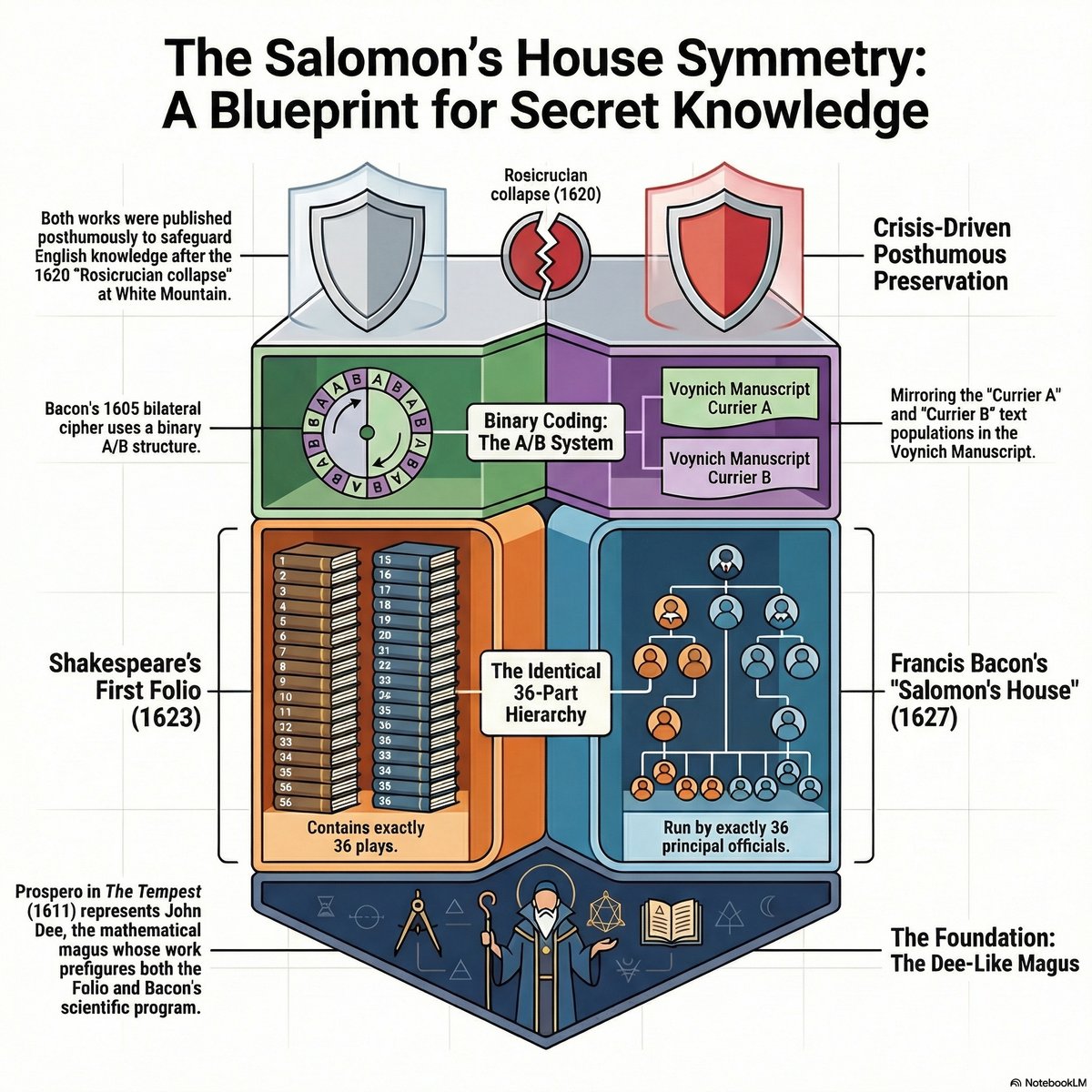
Show Notes
# EP003: The Occult Network Behind Shakespeare's Plays
Summary
What if Shakespeare wasn't a person but a project? This episode examines the authorship question through group theory — not "who wrote the plays" but "what kind of organization could have produced them." The Northumberland Manuscript links Bacon's and Shakespeare's names on the same page. The First Folio contains exactly 36 plays; Bacon's New Atlantis describes exactly 36 officials in Salomon's House. Francis Bacon, John Dee, and Robert Fludd form the visible nodes of an Elizabethan occult network with structural and numerical parallels to the Rosicrucian manifestos and the Voynich Manuscript. The recurring numbers — 126, 19, 36 — keep appearing where they shouldn't.
Show Notes
- The Group Theory Approach — Rather than debating individual candidates, this episode treats the Shakespeare canon as the output of an organized collective and asks what structure that collective would need to have.
- The Northumberland Manuscript — A document discovered in Northumberland House containing both Francis Bacon's and Shakespeare's names, along with references to several plays. Physical evidence placing both names in the same intellectual orbit.
- The 36-Count Alignment — The First Folio (1623) contains exactly 36 plays. Francis Bacon's New Atlantis (1627) describes Salomon's House as governed by exactly 36 officials. Coincidence is one explanation. Design is another.
- Francis Bacon, John Dee, and Robert Fludd — Three figures at the intersection of Elizabethan science, politics, and occultism. Bacon reformed English law and philosophy; Dee advised the Crown on navigation and intelligence; Fludd defended the Rosicrucian manifestos in print. All three operated within overlapping networks.
- Rosicrucian and Voynich Parallels — The same structural and numerical patterns appearing in the Shakespeare question also surface in the Rosicrucian manifestos and the Voynich Manuscript, suggesting a unified clandestine project rather than isolated coincidences.
- The Recurring Numbers: 126, 19, 36 — These numbers function as potential keys across multiple domains — Shakespeare's sonnets, Hermetic traditions, and organizational structures. The episode tracks where they appear and tests whether the pattern holds under scrutiny.
- Literature as Preservation — The thesis that English literature and Western Hermeticism were preserved through the same clandestine channels during a period of European religious and political crisis.
Sources & References
- The Northumberland Manuscript (c. 1596-1597)
- Shakespeare First Folio (1623) — 36 plays
- Francis Bacon — New Atlantis (1627)
- John Dee — personal diaries and court records
- Robert Fludd — Apologia Compendiaria (1616)
- Shakespeare's Sonnets (1609) — Sonnets 1-126
Maxwell's Pendulum: The Plan
Research Brief
Round 3
Summary
The Shakespeare group theory -- the claim that the works attributed to Shakespeare were produced by a collective rather than a single alternative author -- has a documented history stretching from Delia Bacon in 1857 to Gilbert Slater's "Seven Shakespeares" in 1931 and beyond. The evidence for esoteric or Rosicrucian content in the plays rests primarily on Frances Yates's argument that Prospero in The Tempest (1611) represents a Dee-like Rosicrucian magus. The First Folio (1623), containing 36 plays, was published three years after White Mountain and seven years after Shakespeare's death. Francis Bacon's New Atlantis (1627) describes Salomon's House with 36 principal officials in nine categories -- a number that matches the First Folio's play count. Bacon also published the bilateral cipher in 1605, a steganographic A/B binary system. The Northumberland Manuscript (c. 1596-97) is the only known Elizabethan document containing both the names Bacon and Shakespeare. Dee's Monas Hieroglyphica was published in 1564, the year of Shakespeare's birth. The connections to the Rosicrucian network run through Dee, Fludd, and Bacon; the connections to the Voynich run through numbers that the framework will need to evaluate.
As for the research queries: the 6! = 720 test returns a partial hit at 879 AD (Thabit ibn Qurra and the Sabians of Harran, a documented Hermetic transmission node); the vault walls do carry planetary presidencies with Sephirotic correspondences; Fludd's Utriusque Cosmi diagrams show structural parallels with the Voynich noted by multiple researchers; the Currier A/B transition is gradual rather than abrupt, supporting the double-letter model; and the year 1459 is densely significant, with Ficino becoming Argyropoulos's pupil, the Council of Mantua convening, and the Masonic Constitutions of Strasbourg being adopted by 19 German Bauhutten -- a number the framework has been tracking.
Findings
I. The Group Theory: History and Claims
Delia Bacon (1857). The first published group theory. In The Philosophy of the Plays of Shakespeare Unfolded, Delia Bacon proposed that the works were produced by a circle led by Sir Walter Raleigh, including Francis Bacon, Edmund Spenser, Lord Buckhurst, and Edward de Vere. Her argument was philosophical rather than textual: the plays contained political and scientific ideas too advanced for a provincial actor. She went mad before the book was published. Hawthorne wrote the preface. The book was ignored. But the idea of collective authorship entered the literature through her, and it never left. 1
Gilbert Slater, "Seven Shakespeares" (1931). Slater revived the group model with seven named authors: Francis Bacon, Edward de Vere (17th Earl of Oxford), Walter Raleigh, William Stanley (6th Earl of Derby), Christopher Marlowe, Mary Sidney (Countess of Pembroke), and Roger Manners (5th Earl of Rutland). His argument was that the range of knowledge, experience, and social access reflected in the plays exceeded what any single individual could plausibly command. 2
Modern collaborative attribution. Mainstream Shakespeare scholarship now recognizes documented collaboration on multiple plays. Pericles (Shakespeare and George Wilkins), Henry VIII (Shakespeare and John Fletcher), Sir Thomas More (Shakespeare, Anthony Munday, and others), Timon of Athens (Shakespeare and Thomas Middleton). Stylometric analysis has identified collaborative sections in several other plays. Collaboration was standard practice in the Elizabethan theater. The question is whether the collaboration extended further than currently acknowledged, and whether it was organized rather than ad hoc. 3
II. The Northumberland Manuscript
A bundle of manuscripts belonging to Francis Bacon discovered in 1867 at Northumberland House in the Strand, London. The cover page contains multiple references to both "ffrauncis Bacon" and "Shakespeare," with entries for Richard the Second and Richard the Third (both now missing from the bundle). It is the only known Elizabethan document containing both names in the same hand. Mainstream scholars consider it insufficient evidence for authorship claims; it may reflect nothing more than a shared copyist. But it exists, and it is dated to approximately 1596-97, which places it in the period of active production. The manuscript is housed at Alnwick Castle, property of the Duke of Northumberland. Henry Percy, 9th Earl of Northumberland, was Thomas Harriot's patron. (Sources: https://sirbacon.org/links/northumberland.html; https://francisbaconsociety.co.uk/shakespeare-authorship/contemporary-documentary-evidence/)
III. The Elizabethan Occult Network
John Dee (1527-1608). Queen Elizabeth's court astrologer, mathematician, and occultist. His Monas Hieroglyphica was published in Antwerp in 1564, the same year Shakespeare was born (April 23). A series of 24 theorems interpreting an esoteric symbol of Dee's own design, combining astrological symbols with encoded content. Dee influenced the design of the Globe Theatre through his consultation with James Burbage, and his vision of comprehensive knowledge reform prefigures Bacon's program in the Novum Organum (1620) and the New Atlantis. Dee visited Rudolf's court in 1584, where the Plan already has him as the first arrival in the recruitment sequence. He died in 1608, the year Maier arrived at court. (Sources: https://en.wikipedia.org/wiki/John_Dee; https://en.wikipedia.org/wiki/Monas_Hieroglyphica; https://sirbacon.org/links/dblohseven.html)
Francis Bacon (1561-1626). Published the bilateral cipher in 1605: a steganographic system encoding messages as sequences of A and B, hidden within innocuous text using two slightly different typefaces. The cipher is binary; each letter is represented by a unique five-character A/B sequence. Bacon described this as "omnia per omnia" -- anything by anything. The system is explicitly designed to encode secret messages within published works. I note without comment that the Voynich manuscript's two text populations are designated Currier A and Currier B. 13
Thomas Harriot (1560-1621). Mathematician, astronomer, natural philosopher. Connected to Raleigh through the Virginia colony (participated 1585-86), patronized by Henry Percy, 9th Earl of Northumberland. Invented binary arithmetic and notation decades before Leibniz. Part of the alleged "School of Night" (a term first applied by Arthur Acheson in 1903; contemporaries called it the "School of Atheism" in a 1592 Jesuit pamphlet). Published almost nothing in his lifetime despite groundbreaking work: first telescopic moon map (August 1609, before Galileo), independent discovery of the sine law of refraction. A man who made extraordinary discoveries and kept them hidden. 18
Ben Jonson (1572-1637). I expected to find occult connections. Instead, Jonson was a documented skeptic. The Alchemist (1610) satirizes charlatanism and alchemical fraud. He mocked the tradition rather than participating in it. This is relevant because Jonson wrote the dedicatory poem for the First Folio. If there was an esoteric collective behind the works, Jonson either was not in it or was covering for it through satire. Either way, he is not a bridge to the Hermetic underground. 1)
IV. Frances Yates on The Tempest
Frances Yates argued in The Rosicrucian Enlightenment (1972) and Theatre of the World (1969) that Prospero represents a Dee-like Rosicrucian magus. Her specific claim: "It is inevitable and unavoidable in thinking of Prospero to bring in the name of John Dee, the great mathematical magus of whom Shakespeare must have known." She identified Prospero's island as an image of the Rosicrucian project: a controlled space where knowledge of nature produces power, exercised benevolently and ultimately renounced. The Tempest was written around 1611, three years before the Fama was published, which means it cannot be a response to the manifestos. But if the Rosicrucian impulse predated the manifestos (and the 400 pre-primed responses of 1614-1620 suggest it did), then the timing does not disqualify the reading. Yates also identified Hermetic magic in the late romances: Cerimon's medical magic in Pericles, deep Hermetic imagery in The Winter's Tale. She argued Shakespeare chose to "glorify a Dee-like magus" in 1611, three years after Dee's death in poverty and disgrace. (Sources: https://www.patheos.com/blogs/leithart/2006/03/prospero-the-magus/; https://en.wikipedia.org/wiki/Frances_Yates)
V. The First Folio (1623)
36 plays. Not 37 as sometimes cited; the Folio itself contains 36. Seventeen had been previously published in quarto editions; 18 had never been published and would have been lost without this volume. Organized by John Heminges and Henry Condell, two colleagues from the King's Men. Financed by a syndicate of five men headed by Edward Blount and William Jaggard. Printed by Isaac Jaggard. Approximately 1,000 copies printed, over 900 pages. Divided into three categories: comedies, histories, tragedies. Published approximately November 8, 1623, seven years after Shakespeare's death on April 23, 1616. (Sources: https://en.wikipedia.org/wiki/First_Folio; https://www.britannica.com/topic/First-Folio)
The timing. The Battle of White Mountain was fought on November 8, 1620. The First Folio was published in 1623, three years later. White Mountain destroyed the Protestant cause in Bohemia and scattered the Rosicrucian network. The Plan already documents this period as "the second silence," when the Voynich manuscript's custodian lost contact with a functioning network. The First Folio's publication during this same period -- the largest single preservation of English literary knowledge in the seventeenth century -- either coincides with the Rosicrucian collapse or responds to it. I am reporting the proximity. I am not claiming causation. (Sources: https://en.wikipedia.org/wiki/Battle_of_White_Mountain; https://en.wikipedia.org/wiki/First_Folio)
VI. Francis Bacon's New Atlantis and Salomon's House
Published in 1627, one year after Bacon's death. Describes a utopian island governed by an institution called Salomon's House, dedicated to the collection, concealment, and application of universal knowledge.
36 principal officials ("fellows" or "knights") organized in nine categories of specialized function:
- Merchants of Light (12 members) -- travel abroad every 12 years collecting knowledge: "books, instruments, and patterns in every kind"
- Depredators -- extract experiments from existing books
- Mystery-Men -- extract experiments from mechanical arts and liberal sciences
- Pioneers / Miners -- attempt new experiments
- Compilers -- organize results into tables and titles
- Dowry-men / Benefactors -- identify practical applications
- Lamps -- direct new experiments based on compiled findings
- Inoculators -- execute the directed experiments
- Interpreters of Nature -- raise discoveries into axioms and aphorisms
The Father of Salomon's House presides over the institution and explains its philosophy to visitors.
I will state the obvious: 36 officials in Salomon's House. 36 plays in the First Folio. Both published posthumously (Bacon died 1626, Shakespeare died 1616). Both organized into categorical divisions. Both represent the preservation and transmission of comprehensive knowledge. The number match may be coincidence. The structural parallel is harder to dismiss. (Sources: https://en.wikipedia.org/wiki/New_Atlantis; https://grokipedia.com/page/Salomon's_House; https://www.thesquaremagazine.com/mag/article/202210sir-francis-bacon-and-salomons-house/)
VII. Numbers for the framework
Collected from all Shakespeare-related research. Raw material, not interpreted:
| Item | Number | Source |
|---|---|---|
| Plays in First Folio | 36 | First Folio (1623) |
| Officials in Salomon's House | 36 | New Atlantis (1627) |
| Sonnets total | 154 | Sonnets (1609) |
| Sonnets addressed to young man | 126 | Sonnets 1-126 |
| Sonnets addressed to woman | 28 | Sonnets 127-154 |
| Shakespeare born | April 23, 1564 | Stratford parish records |
| Shakespeare died | April 23, 1616 | Stratford parish records |
| Years lived | 52 | 1564-1616 |
| Dee's Monas Hieroglyphica | 1564 | Same year as Shakespeare's birth |
| Theorems in Monas Hieroglyphica | 24 | Dee (1564) |
| Players in 1603 royal patent | 9 | King's Men patent |
| Principal actors in First Folio | 26 | First Folio actor list |
| Financiers of First Folio | 5 | Blount-Jaggard syndicate |
| Unpublished plays preserved by Folio | 18 | First Folio |
| Years Shakespeare dead to Folio | 7 | 1616-1623 |
| Years White Mountain to Folio | 3 | 1620-1623 |
| New Atlantis published | 1627 | One year after Bacon's death |
| Bilateral cipher published | 1605 | Bacon's De Augmentis |
| Merchants of Light | 12 | Salomon's House |
| Knowledge categories in Salomon's House | 9 | New Atlantis |
| Petals on vault ceiling rose | 22 | SRIA vault description |
| Masonic Bauhutten at Strasbourg (1459) | 19 | Constitutions of Strasbourg |
| Slater's proposed authors | 7 | Seven Shakespeares (1931) |
| Jonson's Alchemist | 1610 | Publication date |
| School of Night accusation | 1592 | Parsons's Jesuit pamphlet |
The 126 is going to be a problem. Sonnets 1-126 are addressed to the "fair youth." 126 = 7 x Chai = the same number as the Voynich's botanical illustrations. Flagged this number in Round 1. It appeared in the Hofkammer records (126 book transactions) and the Voynich illustration count (126 botanical images). Its appearance in the sonnet sequence introduces a third independent occurrence. Three is what the framework called the threshold for structural principle versus recurring factor. I am reporting the number. I am not endorsing the conclusion.
The 19 is also going to be a problem. The Masonic Constitutions of Strasbourg (1459) were adopted by 19 German Bauhutten. 1459 is the year the Chemical Wedding is set. the framework identified two previous appearances of 19 as a factor (247 = 13 x 19, and 38 = 2 x 19) and said he needed a third before treating it as a structural principle rather than a recurring factor. If 19 Bauhutten in 1459 counts as the third appearance, then 19/Chavah ("to make manifest") crosses his threshold.
Connections to Plan
-
The 36/36 correspondence. 36 plays in the First Folio, 36 officials in Salomon's House. Both are posthumous preservation projects. Both organize knowledge into categorical divisions. If the Plan frames the First Folio as an act of collective knowledge-preservation analogous to the Rosicrucian vault and Salomon's House, this parallel anchors the Shakespeare topic to the existing architecture.
-
Bacon's bilateral cipher and Currier A/B. Bacon published a steganographic system based on two variants (A and B) of the same text in 1605. The Voynich manuscript contains two text populations designated A and B. the model describes them as "two articulations of one system." Bacon's cipher is, literally, two articulations of one typeface. The parallel is typological, not causal: I am not arguing that the Voynich uses Bacon's cipher. But the Plan has now accumulated three independent instances of A/B binary structures: the Currier populations, the Sefer Yetzirah's double letters, and Bacon's bilateral cipher.
-
The English axis. Dee (1527-1608), Fludd (1574-1637), Bacon (1561-1626), and the theater world occupy the same Elizabethan-Jacobean territory. Dee visited Rudolf in 1584 (the Plan's first court arrival). Fludd defended the Rosicrucians from 1616. Bacon described Salomon's House in 1627. The group theory places the Shakespeare works within a network that overlaps with all three. The Plan can now trace a line from Prague (Dee, 1584) through the Rosicrucian manifestos (1614-1616) through the First Folio (1623) through the New Atlantis (1627), with Maier as the continental hinge and Fludd as the English-continental bridge.
-
The First Folio as parallel to the vault and the manuscript. The vault preserves dead knowledge in 7 x 10 = 70 compartments. The manuscript preserves living knowledge in 7 x 18 = 126 illustrations. The First Folio preserves performed knowledge in 36 plays. Three acts of preservation, three media (stone, vellum, print), three periods of crisis (the vault after Rosenkreutz's death, the manuscript after White Mountain, the Folio after Shakespeare's death).
-
The Tempest as renunciation narrative. If Yates is right that Prospero represents the Rosicrucian magus, then the play's ending -- Prospero drowning his books and breaking his staff -- is a renunciation of the entire Hermetic project. Written 1611, three years before the Fama. The magus gives up his power and returns to the ordinary world. This is either prophecy or coincidence. The Plan does not need to decide which.
Open Questions
-
The 36 = 6 x 6 = 6^2. Is this significant in Kabbalistic or combinatorial terms? 6^3 = 216, which Previously identified as the Voynich-to-Baresch interval and the letter count of the Shem HaMephorash. If 36 is 6^2 and 216 is 6^3, do these powers of 6 form a sequence in the Plan's architecture?
-
The 22 petals. The vault ceiling rose has 22 petals. 22 = the number of Hebrew letters. The Sefer Yetzirah organizes creation through 22 letters (3 mothers + 7 doubles + 12 simples). If the vault ceiling encodes the full alphabet while the walls encode the seven doubles, the vault is a three-dimensional model of the Sefer Yetzirah's creative framework.
-
Harriot and unpublished knowledge. Thomas Harriot invented binary notation, made the first telescopic observations, discovered the law of refraction, and published almost nothing. A man who accumulated extraordinary knowledge and kept it hidden. His patron was the 9th Earl of Northumberland, whose house contained the Northumberland Manuscript. The parallel to the Voynich author -- someone who produced an extraordinary document and left no trace of its purpose -- may be structural rather than causal.
-
The 12 Merchants of Light. 12 members travel abroad every 12 years. The Tubingen circle had approximately 12 members. The Fama Brotherhood had 4 original + 4 later = 8 members, not 12. But 12 appears in the Confessio and in Salomon's House.
-
Bacon's cipher and the Voynich. Has anyone tested the Voynich against Bacon's bilateral cipher? I suspect so, and I suspect the answer is no match. But the question should be documented.
Research Notes
Query 1: The 6! = 720 Falsifiability Test
Result: partial hit at 879 AD. 701 AD and 894 AD do not connect.
720 years before 1599 (barrel sale) = 879 AD. 720 years before 1421 (mean carbon date) = 701 AD. 720 years before 1614 (Fama) = 894 AD.
879 AD: the Sabians of Harran. In 879 AD, the Sabian community of Harran was active as a major node in the transmission of Hermetic knowledge into the Islamic world. The key figure of this period is Thabit ibn Qurra (836-901), a Sabian mathematician, astronomer, and translator who preserved and transmitted Greek and Hermetic texts. The Sabians adopted the name "Sabian" around 830 AD to gain legal protection under Islamic law as "People of the Book," allowing them to practice their Hellenized polytheistic astral religion. They served as a documented bridge between ancient Hermetic texts (particularly those attributed to Hermes Trismegistus) and the later Islamic scholarly tradition that eventually re-transmitted this material to Renaissance Europe. (Sources: https://en.wikipedia.org/wiki/Sabians; https://en.wikipedia.org/wiki/Th%C4%81bit_ibn_Qurra; https://wayofhermes.com/hermeticism/the-sabians-of-harran/)
879 AD is not a single event. It is a period. Thabit was active from approximately 850 to 901. The Sabians of Harran were a persistent transmission mechanism, not a dated occurrence. This is not the clean signal of a documented year like 1599 or 1614. But the Sabians of Harran are the best-documented link between ancient Hermetic texts and the Renaissance Hermetic revival that eventually produced both the Voynich milieu and the Rosicrucian manifestos. The barrel arrives at Rudolf's court exactly 720 years after Thabit's most productive period.
701 AD. No significant event connected to the transmission of Hermetic, Kabbalistic, or Lullian knowledge identified for this year. The Umayyad period was underway; the translation movement was decades away.
894 AD. No significant event found. This is within Thabit's lifetime (he died 901) but I found no specific documented event in 894 connecting to knowledge transmission.
Assessment. This is not the clean failure that the framework requested. It is not a clean extension either. The 879 AD connection to the Sabians of Harran is real and historically significant, but the hit is on a period and a community rather than a dated event. The factorial sequence at 5! (120) connected a mythological interval to documented history. At 6! (720), it connects a documented date (1599) to a documented transmission community (the Sabians) active within that period. The signal degrades as the sequence extends, which is what you would expect from coincidence that thins with distance. It is also what you would expect from a real pattern reaching the limits of the historical record. I cannot distinguish between these two explanations. I report the finding and leave the interpretation open.
Query 2: The Vault's Seven Walls and Knowledge Domains
Result: yes. The vault walls carry planetary presidencies with Sephirotic correspondences.
The seven walls of the Rosicrucian vault are assigned to the seven classical planets: Saturn, Jupiter, Mars, Sun, Mercury, Venus, Moon. This is the standard planetary sequence used in the Sefer Yetzirah's assignment of the seven double letters. Each wall contains ten squares, interpreted by Rosicrucian scholars as the ten Sephiroth, making each wall a complete Tree of Life presided over by one planet.
The knowledge domains preserved within the vault include Magia, Alchemy, Christian Mysticism, and Cabala, along with specific objects: the Vocabularium of Theophrastus, the Itinerarium of Christian Rosenkreutz, the Books M and H, ever-burning lamps, harmonious bells, philosophical eggs, looking-glasses, and mechanisms producing artificial songs.
The vault ceiling features a Rose of 22 petals within a Heptangle. 22 = the number of Hebrew letters. The Triangle at the center represents the Three Supernal Sephiroth; the Heptagram represents the Lower Seven. (Sources: https://sria.org/the-rosicrucian-vault/; https://www.crcsite.org/rosicrucian-library/contemporary-writings/crc-tomb/; https://mysticsymbolism.com/Ceiling-of-the-Vault)
Implications for the vault-manuscript parallel. If the seven walls are planetary and the planetary assignment follows the Sefer Yetzirah's double letters, then the vault is explicitly organized by the same seven double letters that the framework proposes as the organizing principle of the manuscript's A/B structure. The vault walls are the double letters expressed as architecture. This deepens the vault-manuscript parallel from arithmetic (both use 7 as a base) to typology (both use the same seven).
The Voynich manuscript's sections do not map neatly onto planetary categories. The herbal section, the astronomical/astrological section, the balneological section, the pharmaceutical section, and the text-only section give five or six divisions, not seven. But if the model allows two articulations of each domain (A and B), seven domains times two modes gives fourteen, which is closer to the manuscript's folio groupings.
Query 3: Fludd's Utriusque Cosmi Historia Imagery
Result: visual parallels documented by multiple researchers, but not conclusive.
Robert Fludd's Utriusque Cosmi, Maioris scilicet et Minoris, Metaphysica, Physica, atque Technica Historia (1617-1621) contains over 60 intricate engravings depicting correspondences between the Macrocosm (universe) and Microcosm (humanity). The diagrams are circular, concentric, and symbolic, illustrating Paracelsian cosmology through geometric forms.
Multiple Voynich researchers have noted structural parallels between Fludd's published imagery and the Voynich manuscript's circular astronomical diagrams and rosette folio. The parallels are structural and textural rather than specific: both use concentric circles with radiating sections, both embed text within geometric frameworks, both organize cosmological content through visual architecture. Fludd designed his images personally and had them engraved by artisans at the press of Theodore de Bry in Oppenheim. (Sources: https://publicdomainreview.org/essay/robert-fludd-and-his-images-of-the-divine/; https://en.wikipedia.org/wiki/Robert_Fludd)
Assessment. The visual parallels exist but do not constitute evidence of direct connection. Circular cosmological diagrams were a standard format in the period. What is notable is that Fludd, a documented Rosicrucian defender and Maier's ally, produced imagery in the same visual tradition as the Voynich during the same period when the Rosicrucian manifestos were circulating. The Voynich manuscript predates Fludd's work by approximately 200 years (if the carbon dating is accepted), so Fludd cannot have been influenced by the Voynich. But if the visual tradition is continuous, both may draw on a shared visual language for encoding cosmological knowledge. That is exactly the kind of tradition the Plan describes.
Query 4: The Currier A/B Transition Pattern
Result: the transition is gradual, not abrupt. B first appears after approximately folio 25. This supports the double-letter model.
The first 25 folios of the manuscript are definitively Currier A. B begins to appear in the herbal section after folio 25. The transition is not a sharp boundary but a spectrum: some folios show intermediate characteristics, and in Quire 4, a bifolium in Voynich A is physically wrapped around another in Voynich B by different scribes. The herbal section contains long stretches of A with patches of B, sometimes on facing pages. The balneological section is consistently B throughout. (Sources: https://veriarch.com/voynich-manuscript-currier-a-b-dialect-analysis; https://voynich.nu/folios.html; https://voynich.nu/extra/lang.html)
Assessment. A gradual transition with intermediate forms is exactly what the double-letter model predicts. If A and B are two modes of one system (like hard and soft pronunciations of the same letter), you would expect the system to shift from one mode to the other through transitional forms rather than switching abruptly. The physical interleaving of A and B in the same quire suggests that both modes were available to the scribes simultaneously, which is consistent with "two articulations of one system" and inconsistent with "two different scribes using two different languages." The data supports the model more strongly than his original pillar model.
Query 5: Salomon's House Organizational Structure
Covered in Findings, Section VI above. Key points repeated:
- 36 principal officials in 9 categories
- 12 Merchants of Light who travel every 12 years
- Hierarchical progression from data collection through interpretation to axiom-building
- Published 1627, one year after Bacon's death, during the Rosicrucian aftermath
Additional: the year 1459.
Though not a numbered query, the director's notes flagged the organizational parallels between Salomon's House, the Rosicrucian Brotherhood, and Rudolf's court. In the process of researching 1459 (the Chemical Wedding's setting), I found:
-
Ficino becomes Argyropoulos's pupil in 1459. Three years later, Cosimo de' Medici re-founds Plato's Academy at Careggi and installs Ficino as its head. The Hermetic revival that eventually produces the intellectual environment of both the Voynich and the Rosicrucians begins in this pupil-teacher relationship. 35
-
The Council of Mantua (1459). Called by Pope Pius II to organize a crusade against the Ottoman Turks after the fall of Constantinople (1453). Attended by Cardinal Bessarion. The Byzantine intellectual diaspora that carried Greek and Hermetic texts westward was the supply chain for the Renaissance revival. 2)
-
The Masonic Constitutions of Strasbourg (1459). The first assembly of 19 German Bauhutten (masons' guilds) at Regensburg on Easter 1459, with final adoption at Strasbourg. This is a revision of regulations dating to 1275. 37
The 19 Bauhutten number is flagged for the framework. He has identified two previous appearances of 19 as a factor (247 = 13 x 19, and 38 = 2 x 19) and stated that a third appearance would cross the threshold from recurring factor to structural principle.
Footnotes
Footnotes
-
Modern collaborative attribution scholarship: https://en.wikipedia.org/wiki/Shakespeare_attribution_studies ↩
-
The Northumberland Manuscript: https://sirbacon.org/links/northumberland.html ↩
-
Northumberland Manuscript and Bacon-Shakespeare evidence: https://francisbaconsociety.co.uk/shakespeare-authorship/contemporary-documentary-evidence/ ↩
-
Yates biography: https://en.wikipedia.org/wiki/Frances_Yates ↩
-
Yates on Prospero as Rosicrucian magus: https://www.patheos.com/blogs/leithart/2006/03/prospero-the-magus/ ↩
-
First Folio publication details: https://en.wikipedia.org/wiki/First_Folio ↩
-
First Folio overview: https://www.britannica.com/topic/First-Folio ↩
-
New Atlantis and Salomon's House: https://en.wikipedia.org/wiki/New_Atlantis ↩
-
Salomon's House organizational structure: https://grokipedia.com/page/Salomon's_House ↩
-
Salomon's House details: https://www.thesquaremagazine.com/mag/article/202210sir-francis-bacon-and-salomons-house/ ↩
-
Bacon's bilateral cipher: https://en.wikipedia.org/wiki/Bacon%27s_cipher ↩
-
Dee's Monas Hieroglyphica (1564): https://en.wikipedia.org/wiki/Monas_Hieroglyphica ↩
-
John Dee biography: https://en.wikipedia.org/wiki/John_Dee ↩
-
Dee-Bacon connections: https://sirbacon.org/links/dblohseven.html ↩
-
Jonson's The Alchemist (1610): https://en.wikipedia.org/wiki/The_Alchemist_(play) ↩
-
Thomas Harriot biography: https://en.wikipedia.org/wiki/Thomas_Harriot ↩
-
School of Night / School of Atheism: https://en.wikipedia.org/wiki/The_School_of_Night ↩
-
King's Men membership: https://en.wikipedia.org/wiki/King%27s_Men_(playing_company) ↩
-
Sonnet publication and structure: https://en.wikipedia.org/wiki/Shakespeare%27s_sonnets ↩
-
White Mountain 1620: https://en.wikipedia.org/wiki/Battle_of_White_Mountain ↩
-
Sabians of Harran overview: https://en.wikipedia.org/wiki/Sabians ↩
-
Thabit ibn Qurra (836-901): https://en.wikipedia.org/wiki/Th%C4%81bit_ibn_Qurra ↩
-
Thabit biography: https://mathshistory.st-andrews.ac.uk/Biographies/Thabit/ ↩
-
Sabians as Hermetic transmission node: https://wayofhermes.com/hermeticism/the-sabians-of-harran/ ↩
-
Vault planetary attributions and Sephirotic interpretation: https://sria.org/the-rosicrucian-vault/ ↩
-
Vault contents and structure: https://www.crcsite.org/rosicrucian-library/contemporary-writings/crc-tomb/ ↩
-
Vault ceiling: Rose of 22 petals: https://mysticsymbolism.com/Ceiling-of-the-Vault ↩
-
Fludd's Utriusque Cosmi imagery: https://publicdomainreview.org/essay/robert-fludd-and-his-images-of-the-divine/ ↩
-
Fludd biography and works: https://en.wikipedia.org/wiki/Robert_Fludd ↩
-
Currier A/B dialect analysis: https://veriarch.com/voynich-manuscript-currier-a-b-dialect-analysis ↩
-
Currier A/B language comparison: https://voynich.nu/extra/lang.html ↩
-
Voynich folio classifications: https://voynich.nu/folios.html ↩
-
Ficino biography: https://en.wikipedia.org/wiki/Marsilio_Ficino ↩
-
Council of Mantua: https://en.wikipedia.org/wiki/Council_of_Mantua_(1459) ↩
-
Masonic Constitutions of Strasbourg (1459), 19 Bauhutten: https://www.freemasonryresearchforumqsa.com/strasburg-constitutions-1459.php ↩