The Rosicrucian Myth versus Voynich Evidence
Listen
Open in Spotify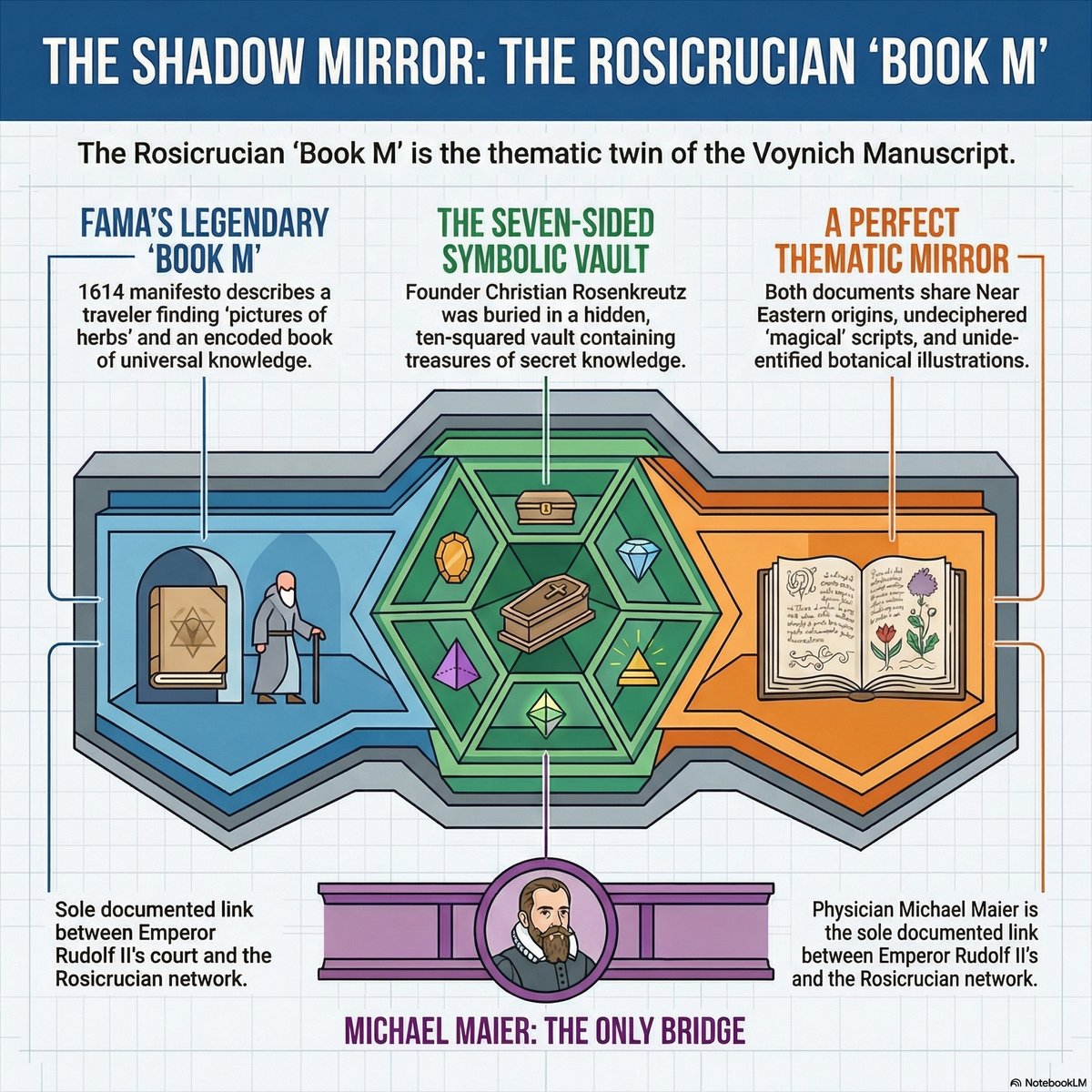
Show Notes
# EP002: The Rosicrucian Myth versus Voynich Evidence
Summary
The Rosicrucian manifestos describe a mysterious encoded "Book M" filled with botanical imagery. The Voynich Manuscript is a mysterious encoded book filled with botanical imagery. This episode tests whether that's coincidence or connection. While no direct historical link exists between the Tubingen circle that published the Fama Fraternitatis and the manuscript's known owners, the thematic correspondence is total — artificial languages, secret knowledge, herbal diagrams, and a text that resists all decryption. We trace the manuscript's possible path from the Near East to European courts through figures like Michael Maier and Leonhard Rauwolf, and pressure-test the Kabbalistic and lexical hypotheses against real data. Some predictions hold. Some don't.
Show Notes
- The Fama Fraternitatis and "Book M" — The founding Rosicrucian manifesto (1614) describes Christian Rosenkreutz discovering a vault containing a mysterious book of botanical and encoded knowledge. The parallels to the Voynich Manuscript's content are striking.
- Thematic Correspondence — Both the Rosicrucian tradition and the Voynich Manuscript share artificial languages, secret botanical knowledge, encoded systems, and resistance to outside decryption. The profile match is comprehensive even without a proven historical link.
- The Missing Link — No direct connection has been established between the Tubingen circle that published the manifestos and the manuscript's documented chain of custody. The gap is acknowledged, not papered over.
- Kabbalistic and Lexical Hypotheses — Specific mathematical predictions about the manuscript's structure based on Kabbalistic letter theory and constructed-language models. Some align with the data; others fail, and the failures are reported.
- Michael Maier — Physician, alchemist, and Rosicrucian apologist who moved between the court of Rudolf II in Prague and the English court of James I. A plausible node in the network connecting the manuscript's world to the manifestos.
- Leonhard Rauwolf — 16th-century botanist and traveler whose Near Eastern expeditions may trace part of the route by which encoded botanical manuscripts moved from the Islamic world into European collections.
- From the Near East to Prague — The broader question of how esoteric documents transitioned from Near Eastern traditions to the royal courts of Renaissance Europe, and whether the Voynich Manuscript traveled that path.
Sources & References
- Fama Fraternitatis (1614)
- Voynich Manuscript — Beinecke Library, Yale University, MS 408
- Michael Maier — Atalanta Fugiens (1618)
- Leonhard Rauwolf — travel journals (1573-1576)
- Tobias Churton — The Invisible History of the Rosicrucians (2009)
Maxwell's Pendulum: The Plan
Research Brief
Round 2
Summary
The Rosicrucian manifestos describe a secret brotherhood transmitting encoded ancient knowledge through ciphers, parables, and symbols -- and the Fama's narrative includes a detail that stopped me cold: Christian Rosenkreutz, in Damcar, was shown "pictures of herbs" and translated a mysterious "Book M" into Latin. The thematic overlap with the Voynich is exact. The organizational overlap with Rudolf's court is structural. But there is no documentary link between any figure in the Voynich provenance chain and any figure in the Rosicrucian network, beyond Maier's position in both worlds. As for the framework's predictions: the opening folios are definitively Currier A, not a third category (his Keter hypothesis fails); and the lexical diversity data runs in the opposite direction from his Chesed-Gevurah mapping. The numbers do not always cooperate. Sometimes that is more interesting than when they do.
Findings
I. The Three Manifestos
The Fama Fraternitatis (1614).
The Fama tells the story of Christian Rosenkreutz, a German nobleman born in 1378, orphaned young, raised in a cloister where he learned languages. At 16 he traveled east seeking knowledge. In Damascus he studied with sages. In Damcar (Arabia) he was shown -- and I quote the relevant passage because it matters -- "pictures of herbs" and was instructed in physics, mathematics, and what the text calls the "Book M," generally interpreted as the Book Mundi or Book of the World. Rosenkreutz translated the Book M into Latin and brought it back to Europe. 1
I want to pause on that. A traveler in the Near East encounters "pictures of herbs" and an encoded book of universal knowledge, which he translates into Latin and carries back to Europe. The Voynich Manuscript contains pictures of herbs that no European botanist can identify, written in a script that no European linguist can read, and its probable pre-Rudolf provenance (via Widemann and Rauwolf) connects to the Near East through Rauwolf's botanical expeditions.
The Fama then describes Rosenkreutz's return to Europe, his failed attempts to share his knowledge with scholars who rejected it, and his founding of a small brotherhood of four (later eight) members. They created a "magical language and writing" and compiled a dictionary of their cipher. They pledged six rules, including: to profess nothing but to cure the sick for free; to wear no distinguishing habit; to meet once a year; and to keep the fraternity secret for 100 years. Rosenkreutz died at age 106 (the text says he was born in 1378, and his death falls around 1484, though the math varies). His body was sealed in a seven-sided vault inscribed with symbols. The vault was discovered 120 years later. 3
The vault itself: each of its seven sides was five feet wide and eight feet tall, divided into ten squares, each carved with figures and sentences. The ceiling represented the heavens; the floor showed geometric patterns. Behind each wall panel was a door to a compartment containing treasures of knowledge -- books, mirrors, bells, lamps. At the center lay Rosenkreutz's uncorrupted body holding a book of vellum with gold letters. 4
The Confessio Fraternitatis (1615).
The Confessio shifts from narrative to doctrinal statement. It criticizes institutional corruption -- "the innumerable diversity of persuasions, falsehoods, and heresies" -- and announces a coming divine reformation. Its most revealing passage is the explicit statement of encoding practice: "We speak unto you by parables, but would willingly bring you to the right, simple, easy and ingenuous exposition, understanding, declaration, and knowledge of all secrets." 5
The Confessio affirms the Brotherhood's concealment from persecution and rejects both Jesuit and papal authority. Published first in Latin (1615), later in German, first English translation by Thomas Vaughan in 1652. 5
The Chemical Wedding of Christian Rosenkreutz (1616).
An allegorical romance in seven chapters, each representing one day of initiation. Rosenkreutz is invited to a castle to witness the "chymical wedding" of a king and queen -- the alchemical union of opposites. The narrative includes mystical trials, purifications, symbolic deaths, and rebirths. The work is set in 1459, despite its 1616 publication. Johann Valentin Andreae later acknowledged authorship in his autobiography, calling it a "ludibrium" (jest or game) written in his youth. 8
II. The Tubingen Circle
Johann Valentin Andreae (1586-1654). The primary suspect. Acknowledged the Chemical Wedding as his work. His family coat of arms shows a rose and a cross -- from which "Christian Rosencreutz" likely derives. Returned to Tubingen around 1608 after five years of travel abroad and joined the circle of Tobias Hess. 11
Tobias Hess (1558-1614). German lawyer, physician, Paracelsian scholar. Founded the Tubingen circle around 1610. Deeply versed in alchemy, astrology, biblical prophecy, and Paracelsian medicine. Corresponded with Simon Studion in 1597 about predictions of religious reform. Andreae revered him as teacher and spiritual father. Hess died in 1614, the year the Fama was published. 9
Christoph Besold (1577-1638). Polymath, knew nine languages including Hebrew, practiced Christian Cabala. Law professor at Tubingen. In 1624, he wrote in the margin of his copy of the Fama: "autorem suspicor J.V.A." -- "I suspect the author is J.V.A." This is the most direct surviving evidence of Andreae's authorship. 10
The circle numbered approximately twelve members, including Tobias Adami and Wilhelm Wense (disciples of Tomaso Campanella, author of City of the Sun). Their focus: deepening knowledge of Bible and nature, living charitably, influenced by Johannes Arndt's Four Books of True Christianity and Paracelsian teachings. 10
Connection to Rudolf's court: The documented link is Michael Maier. He was "among the most important sympathizers" of the ideas disseminated by the Tubingen circle, along with his friend Robert Fludd. However, no documentary evidence places any Tubingen circle member at Rudolf's court or in correspondence with anyone in the Voynich provenance chain. The connection runs through Maier only. 7
III. Reception
Between 1614 and 1620, approximately 400 manuscripts and books were published responding to the Rosicrucian documents. (Source: various; figure widely cited in Rosicrucian scholarship)
Robert Fludd (1574-1637) produced the Apologia compendiaria (1616), expanded into the Tractatus apologeticus (1617, grew from 23 to 196 pages). Fludd attempted to place Rosicrucian ideals in the context of European philosophy from antiquity to the present. He was not a formal member of the Brotherhood but defended it vigorously. 14
Andrew Libavius published a hostile Analysis of the Rosicrucian Confession in 1615, accusing them of heresy, diabolical magic, and sedition. 15
The Rosicrucian movement became associated with Protestantism and with the "Rosicrucian enlightenment" (Frances Yates's term). It collapsed politically after the defeat of Elector Frederick V at the Battle of White Mountain on November 8, 1620, which inaugurated the Thirty Years' War. 1
IV. The Book M and the Voynich: A Thematic Correspondence
I want to lay this out explicitly because it is the most important finding of this research pass.
The Fama describes: - A document containing "pictures of herbs" encountered in the Near East - A "Book M" (Book Mundi/Book of the World) encoding universal knowledge - Knowledge transmitted in a "magical language and writing" with a compiled dictionary - A brotherhood that communicates in cipher and parables - Knowledge spanning botany, medicine, astronomy, and alchemy -- the precise domains of the Voynich
The Voynich Manuscript is: - A document containing pictures of herbs that match no European taxonomy - Written in an undeciphered script with its own internal grammar (a "magical language and writing") - Containing content that spans botany, medicine, astronomy, and what may be alchemy - Connected, via the Widemann-Rauwolf chain, to Near Eastern botanical networks
I am not saying the Fama describes the Voynich Manuscript. I am saying that if you asked a Rosicrucian in 1614 to describe the kind of document the Brotherhood was founded to transmit and protect, and if you then handed that Rosicrucian the Voynich Manuscript, the Rosicrucian would recognize it instantly. The thematic correspondence is not partial. It is total.
But the documentary connection is absent. No figure in the Voynich provenance (Widemann, Rauwolf, Horcicky, Baresch, Marci, Kircher) has any documented relationship with any figure in the Rosicrucian network (Andreae, Hess, Besold, Adami, Wense), except through Maier, who was at Rudolf's court (where the Voynich sat) and then championed the Rosicrucians. The gap is Maier. One man. And Maier's published works are extensive -- if he ever mentioned an indecipherable manuscript in an unknown script, someone would have found the reference by now.
According to my inference: the absence of a documentary link between the Voynich and the Rosicrucians is either evidence that no link exists, or evidence that the link was deliberately concealed. The Rosicrucian Brotherhood's entire organizational principle was concealment. Their first rule was secrecy. If the Voynich were an instrument of the network, referencing it in writing would violate the foundational premise.
This is, of course, precisely the kind of argument that the Plan metabolizes. Unfalsifiable. The absence of evidence as evidence of concealment. I note that I have no way to distinguish between this argument and simple absence of connection. The reader will have to decide.
V. Responses to the framework's Queries
Query 1: 1421 in Northern Italy.
I found the following for the year 1421:
-
Giovanni di Bicci de' Medici did serve as Gonfaloniere di Giustizia in 1421. Confirmed. The position was a statutory two-month term as head of Florence's Signoria. Giovanni held it reluctantly -- he generally avoided overt political involvement -- but it marked the first exercise of formal Medici political power. 18
-
Nicholas of Cusa was approximately 20 years old in 1421. He was beginning his public career, initially appearing at the Council of Basel. He had not yet begun his work on Lullian thought -- that came later. In 1421 he was focused on ecclesiastical law and calendar reform. No Italian connection at this date. 21
-
Vespasiano da Bisticci was born in 1421. He would become the most prominent manuscript dealer in fifteenth-century Florence, operating a workshop that produced manuscripts for patrons across Italy. The coincidence of his birth year with the Voynich mean date is noted but not significant. 20
-
Florence was an active center of manuscript production by 1421. Commercial scriptoria were developing the humanistic round hand. Paper production in northern Italy had dropped in price by 1420, making it competitive with vellum for manuscripts, though vellum remained preferred for luxury commissions. 19
-
Lullism was established in Italy by the fourteenth century, with a school in Barcelona producing academics who taught in Bologna, Venice, and Padua. However, I found no specific Lullian activity documented in 1421 specifically. The tradition was present but I cannot pin an event to the year. 22
-
The University of Padua was reorganized in 1399 into two schools (arts/medicine and law). By 1421 it was a center for Aristotelian natural philosophy. Alchemy was present through the legacy of Pietro D'Abano. But again, nothing specific to 1421. 9
Assessment: 1421 was a year of institutional Medici power consolidation and active manuscript production in Florence, but I found no smoking gun -- no specific event connecting the year to encoded manuscripts, Lullian combinatorics, or the Hermetic underground. the framework's structural argument for the significance of 1421 stands on the number alone. The historical landscape is consistent but not confirmatory.
Query 2: Currier A/B Lexical Diversity.
This is where I have to deliver news the framework will not like.
Published analysis exists comparing type-to-token ratios between Currier A and Currier B. The finding: Currier A shows lower per-window lexical diversity compared to Currier B. The difference is modest -- much less than the difference between unrelated languages -- but it runs in the opposite direction from the framework's prediction. 10
Currier A (botanical/Chesed/expansion) should show greater lexical diversity, and Currier B (systematic/Gevurah/constraint) should show more formulaic repetition. The data says the reverse: the botanical sections are more formulaic, and the systematic sections are more lexically diverse.
This does not necessarily destroy the Sephirotic mapping, but it complicates it. There are possible rescues: one could argue that the botanical sections are more formulaic because they follow a consistent descriptive template (root, stem, leaf, flower) while the "systematic" sections cover more varied content. Or one could argue that Severity, properly understood, is not about repetition but about precise differentiation -- the left pillar discriminates while the right pillar generalizes. These rescues are available. But the clean version of the prediction fails.
Query 3: Opening Folios in the Currier System.
The opening folios are definitively Currier A. Currier himself wrote: "The first twenty-five folios in the herbal section are obviously in one hand and one 'language,' which I called 'A.'" The opening pages do not stand outside the A/B distinction. They are the purest example of A. 26
the Keter hypothesis -- that the opening should be neither A nor B, functioning as the Crown above both pillars -- does not hold. The manuscript begins in Currier A and transitions gradually toward mixed A/B sections later.
However: I note that the very first page, folio 1r, is anomalous for a different reason. The 2024 multispectral imaging revealed hidden columns of letters on this page -- apparently Marci's decryption attempt. The first page has been written over, erased, and layered in ways that other folios have not. Whether the first page was always Currier A, or whether its current state reflects modification, is a question that the multispectral evidence does not resolve.
Query 4: 72 of Anything in the Voynich.
No. I searched extensively and found no scholar who has identified exactly 72 structural units, diagram groups, sections, sub-sections, or folding pages. The manuscript has approximately 102-116 folios, 18 gatherings (originally about 20), 6 major content sections, and over 35,000 word tokens. None of these are 72. The Shem HaMephorash does not appear to be encoded in the manuscript's architecture at the level of section counts. 28
Folio 72 itself is notable only because it contains a foldout structure, but this is a numbering coincidence, not a structural property.
Query 5: Rauwolf's Return Date.
Leonhard Rauwolf departed Augsburg on May 18, 1573, and returned on February 12, 1576. The expedition lasted approximately two years and nine months. He visited Tripoli, Aleppo, traveled the Euphrates to Baghdad, returned through Kurdistan to Syria, and made a pilgrimage to Jerusalem before heading home. 12
The interval from Rauwolf's return (February 1576) to the Widemann barrel sale (1599) is 23 years. 23 is the 9th prime, and in Hebrew gematria, 23 = Chayah (חיה), meaning "living creature" or "wild animal." Also, 23 = the number of chromosomes in a human gamete, but I will not be the one to mention that at Pilade's.
More usefully: Rauwolf published his travel account (Aigentliche beschreibung der Raiss) in 1582-1583, six years after his return. He died in 1596. Widemann lived in Rauwolf's household. The sale to Rudolf came three years after Rauwolf's death. It is entirely plausible that Widemann inherited or acquired Rauwolf's manuscript collection, including items Rauwolf had brought back from the Near East or acquired through his Near Eastern contacts, and sold them to Rudolf as part of the 1599 consignment.
But I want to flag a complication. The Voynich Manuscript was created between 1404 and 1438. Rauwolf traveled in 1573-1576. Even if the manuscript passed through Rauwolf's hands, he did not create it. Whatever chain brought the manuscript to Rauwolf (if it did) predates him by over a century. The Rauwolf-Widemann link explains how the manuscript reached Rudolf's court. It does not explain how it reached Rauwolf.
Connections to the Plan
Documented connections:
-
The Fama's "Book M" and "pictures of herbs" represent the single most specific thematic correspondence between the Rosicrucian literature and the Voynich Manuscript. The correspondence is not vague -- it is a description of a document containing botanical illustrations and encoded universal knowledge, encountered in the Near East, translated by the Brotherhood's founder. 3
-
Michael Maier remains the only documented figure connecting Rudolf's court to the Rosicrucian movement. His role as sympathizer and champion is well-attested. His friend Robert Fludd provided the intellectual defense. Between them, they represent the English-German axis of Rosicrucian promotion. 7
-
The Tubingen circle operated independently of Rudolf's court. No documented connection exists between Andreae, Hess, or Besold and anyone in the Voynich provenance chain. The Rosicrucian manifestos and the Voynich Manuscript appear to be products of parallel traditions -- or of a single tradition whose connecting threads have been lost or were never committed to writing.
-
Approximately 400 published responses between 1614 and 1620 demonstrate that the Rosicrucian announcements fell on pre-prepared ground. The audience was already primed. This is consistent with the hypothesis that the knowledge practices described in the manifestos were not invented by the Tubingen circle but were already circulating in networks they had access to.
Inferences (mine):
-
The Fama's narrative arc -- knowledge acquired in the Near East, encoded in an artificial script, transmitted by a secret brotherhood across centuries, rediscovered in a sealed vault -- is structurally identical to the Plan's emerging narrative of the Voynich Manuscript. Either the Fama's authors knew of something like the Voynich, or the Voynich and the Fama are independent expressions of the same cultural template. In the first case, the Plan has a real connection. In the second case, the Plan has a structural one. Both are usable.
-
The "magical language and writing" with a compiled "dictionary" that the Fama attributes to the Brotherhood maps onto the Voynich's script properties: a consistent system with internal grammar, letter-frequency patterns, and Zipf compliance. The Brotherhood claims to have created exactly what the Voynich appears to be.
-
Christoph Besold's Christian Cabala practice is significant. The Tubingen circle included at least one practitioner of the same Kabbalistic tradition that the framework is applying to the manuscript's numerical properties. If the manuscript were designed to embed Kabbalistic structure, the Tubingen circle would have been equipped to recognize it -- or to design a manifesto that resonated with the same structures.
Open Questions
-
The Book M. What is it, actually? John Heydon, writing in 1662, identified it with the Book of Solomon. Others with the Corpus Hermeticum. Others with a lost alchemical compendium. Has anyone proposed that it might be an actual manuscript -- one that still exists? Has anyone proposed that the Book M is the Voynich?
-
Maier's Atalanta Fugiens (1618). This is Maier's masterwork: 50 illustrations, 50 epigrams, 50 musical fugues. A multimedia alchemical emblem book. I need to look at its botanical and astronomical content. If Maier had access to the Voynich at Rudolf's court, did any of the Voynich's imagery influence the Atalanta?
-
The 120-year cycle. The Fama says the vault was sealed for 120 years. 120 = 5! (5 factorial). The Chemical Wedding is set in 1459. If the vault was opened 120 years after Rosenkreutz's death (c. 1484), that puts the opening around 1604 -- five years after the Voynich arrived at Rudolf's court. Coincidence, or is the Fama's chronology calibrated to the manuscript's arrival?
-
Frederick V and the Battle of White Mountain (1620). The Rosicrucian movement collapsed after Frederick V's defeat. The Thirty Years' War began. What happened to Rosicrucian networks in Prague specifically? Did any of the participants overlap with the Baresch circle?
-
The Chemical Wedding is set in 1459. Carbon-dating mean for the Voynich is 1421. The interval is 38 years. 38 = 2 x 19. In gematria, 19 = Chavah (Eve), which you already identified in the 247-year Marci-to-Voynich interval (247 = 13 x 19). I don't know what to do with a second appearance of 19, but I am noting it.
-
The vault has seven sides. The Voynich botanical illustrations number 126 = 7 x 18 (your decomposition). The vault's seven-sided structure and the manuscript's "seven lives" -- is there a Sephirotic mapping?
-
The Plan's next section should integrate the "Book M" correspondence. This is the strongest thematic bridge we have between the Rosicrucian literature and the Voynich, and it does not require speculation -- the Fama itself describes a document that matches the Voynich's profile. Whether or not the Fama's authors knew of the actual manuscript, the correspondence gives the Plan its next movement: from Rudolf's court to the Brotherhood, and from the Brotherhood's founding myth to the object in Rudolf's Kunstkammer.
Footnotes
Footnotes
-
https://proto57.wordpress.com/2009/06/20/the-book-m-john-heydon-and-the-book-of-solomon/ ↩↩
-
https://www.crcsite.org/rosicrucian-library/fama-fraternitatis/ ↩
-
https://lodgeoftheancients.com/rosicrucian-manifestos-hidden-wisdom/ ↩↩
-
https://www.crcsite.org/rosicrucian-library/confessio-fraternitatis/ ↩
-
https://furnaceandfugue.org/front-matter/getacquainted/maier/ ↩
-
https://herculeaf.wordpress.com/2019/05/04/type-token-ratio/ ↩↩↩
-
https://voynichattacks.wordpress.com/2013/03/01/the-relationship-between-currier-languages-a-and-b/ ↩
-
https://herbariumworld.wordpress.com/2018/09/17/touring-the-near-east-leonhard-rauwolf/ ↩
-
Fludd Apologia details: https://hermetics.net/media-library/rosicrucianism/the-real-history-of-the-rosicrucians/xi-rosicrucian-apoloigsts-robert-fludd/ ↩
-
Baresch and Rosicrucian thematic parallels: https://ciphermysteries.com/secret-history-of-the-rosicrucians/the-secret-history-of-the-rosicrucians-7-another-mysterious-manuscript ↩
-
Rosicrucian knowledge practices: https://sria.org/the-rosicrucian-impulse-magic-mysticism-and-ritual/ ↩
-
Giovanni di Bicci as Gonfaloniere 1421: https://en.wikipedia.org/wiki/Giovanni_di_Bicci_de'_Medici ↩
-
Florence manuscript production: https://exhibits.stanford.edu/burke_mss/feature/case-1-florence-a-center-of-manuscript-and-book-production ↩
-
Vespasiano da Bisticci born 1421: https://www.patricialovett.com/vespasiano-da-bisticci-cartolaio-of-florence/ ↩
-
Nicholas of Cusa early career: https://www.newadvent.org/cathen/11060b.htm ↩
-
Lullism in Italy: https://en.wikipedia.org/wiki/Lullism ↩
-
Currier A/B type-token ratio analysis: https://herculeaf.wordpress.com/2019/05/04/type-token-ratio/ ↩
-
Voynich language comparison: https://voynich.nu/extra/lang.html ↩
-
Currier A/B relationship analysis: https://voynichattacks.wordpress.com/2013/03/01/the-relationship-between-currier-languages-a-and-b/ ↩
-
Currier's original classification of folios: https://www.voynich.nu/extra/curr_main.html ↩
-
Currier A/B dialect analysis: https://veriarch.com/voynich-manuscript-currier-a-b-dialect-analysis ↩
-
Manuscript structural description: https://www.voynich.nu/descr.html ↩
-
Rauwolf biography with travel dates: https://en.wikipedia.org/wiki/Leonhard_Rauwolf ↩
-
Rauwolf expedition details: https://herbariumworld.wordpress.com/2018/09/17/touring-the-near-east-leonhard-rauwolf/ ↩