Secrets of the Unbreakable Voynich Manuscript
Listen
Open in Spotify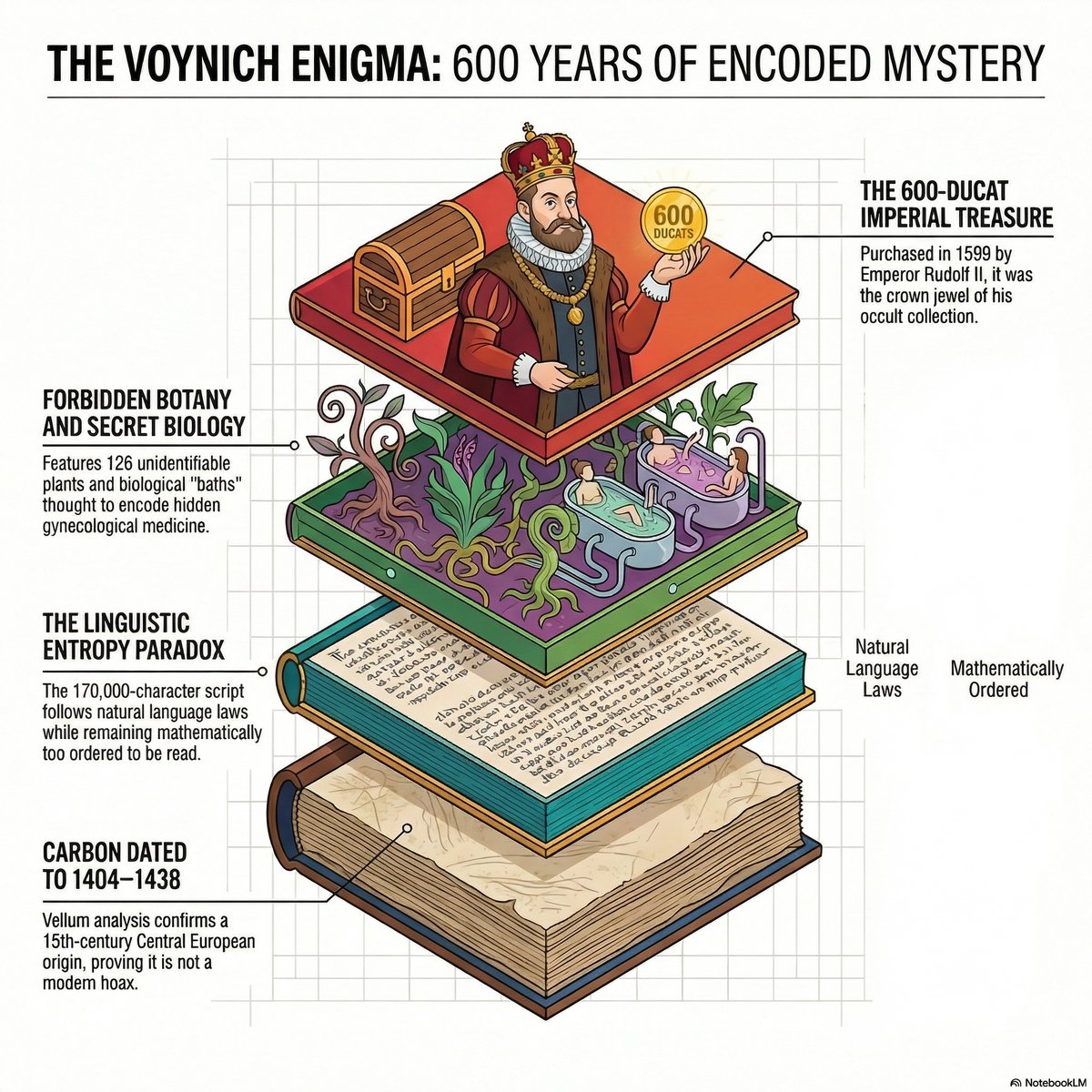
Show Notes
# EP001: Secrets of the Unbreakable Voynich Manuscript
Summary
A genuine early 15th-century codex written in a script no one can read. Carbon-dated to 1404-1438, lost for over a century, then resurfacing in the occult-obsessed court of Emperor Rudolf II — the Voynich Manuscript sits at the crossroads of medieval herbalism and the birth of modern cryptography. We trace its journey from the Renaissance intellectual underground through the hands of alchemists and scholars, to Wilfrid Voynich's 1912 acquisition, and into the labs of 21st-century codebreakers who still can't crack it.
Show Notes
- Carbon-Dated Origins (1404-1438) — Radiocarbon testing confirms the vellum is genuine early 15th-century, ruling out modern forgery and placing the manuscript squarely in the Renaissance.
- The Missing Century — A significant gap exists between the manuscript's creation and its reappearance around 1599 in the occult-focused court of Emperor Rudolf II. Where was it for 150+ years?
- Bizarre Illustrations — Botanical drawings of plants that don't exist, astronomical diagrams, and biological/gynecological imagery. Scholars theorize the text may contain encoded medical or herbal knowledge.
- The Language Paradox — Statistical analysis confirms the writing follows patterns of natural language — Zipf's law, predictable entropy, consistent structure. Yet its unique character properties defy every known writing system. It reads like a language, but isn't one anyone can identify.
- The Alchemist Pipeline — Historical evidence traces the manuscript through a chain of alchemists and scholars before Wilfrid Voynich purchased it from a Jesuit library in 1912, introducing it to the modern world.
- 600 Years of Failure — From Renaissance polymaths to WWII military codebreakers to modern AI, the manuscript has defeated every attempt at decryption. It remains the central enigma of the Renaissance intellectual underground.
Sources & References
- Beinecke Rare Book & Manuscript Library, Yale University — MS 408
- Radiocarbon dating study (University of Arizona, 2009)
- Amancio et al. — "Probing the statistical properties of unknown texts" (2013)
- Rene Zandbergen — voynich.nu (comprehensive research archive)
- Wilfrid Voynich acquisition records, 1912
Maxwell's Pendulum: The Plan
Research Brief
Round 1
Summary
The Voynich Manuscript (Beinecke MS 408) is a genuine early 15th-century artifact whose provenance chain contains a critical 200-year gap between its creation (1404-1438) and its first documentary appearance in Prague (1637). The manuscript's statistical properties suggest neither hoax nor simple cipher but something more sophisticated, and its content -- unidentifiable plants, anomalous astronomical diagrams, and what appears to be encoded gynecological medicine -- places it squarely within the intellectual underground of Renaissance Europe. Recent archival work has identified a probable seller (Carl Widemann, 1599) and a possible origin in the collection of Leonhard Rauwolf, a Bavarian botanist-explorer, but the deeper provenance remains opaque. The milieu into which the manuscript emerged -- Rudolf II's Prague, where Dee, Kelley, Brahe, and Kepler all worked within a few decades of each other -- was the densest concentration of encoded knowledge systems in European history.
Findings
I. The Provenance Chain: What We Know and What We Don't
The documentary record of MS 408's ownership is as follows, working backward from certainty:
Yale University (1969-present). The manuscript was donated by book dealer Hans P. Kraus, who had purchased it in 1961 from Anne Nill, who had inherited it in 1960 from Ethel Voynich, widow of Wilfrid. 1
Wilfrid Voynich (1912-1930). Voynich acquired the manuscript as part of a lot of approximately 30 manuscripts purchased from the Jesuit order for roughly 300,000 Lire. The transaction was secret because the Italian government, which had confiscated Papal States properties after 1870, still legally claimed these manuscripts. Recent research (2023) indicates the actual acquisition site was Villa Torlonia in Castel Gandolfo, not Villa Mondragone in Frascati as long believed. 2
Jesuit Collegio Romano (1666-1912). The manuscript entered the Jesuit collection when Athanasius Kircher received it. It sat there for 246 years. 3
Athanasius Kircher (received 1665/1666). Kircher received the manuscript from Johannes Marcus Marci with a cover letter dated August 19, 1665 (or 1666; the year is disputed). Multispectral imaging has confirmed the letter's authenticity -- it is not a Voynich forgery. 4
Johannes Marcus Marci (c. 1640s-1665). Rector of Charles University in Prague. Inherited the manuscript from Georg Baresch upon Baresch's death. The Marci letter contains the crucial claims: that the manuscript was purchased by Rudolf II for 600 ducats, and that this information came from the late Raphael Mnishovsky. 4
Georg Baresch (documented 1637-death, date uncertain). Prague alchemist. First confirmed owner. Wrote to Kircher in 1637 and again in 1639, enclosing script samples and requesting help with decipherment. Described the contents as suggestive of medicine and alchemy. Kircher never replied but apparently tried to acquire the book, which Baresch refused. 5
Jacobus Horcicky de Tepenec (signature on folio 1r, likely c. 1608-1622). Rudolf II's Imperial Distiller, curator of the Imperial Botanical Gardens, personal physician. Ennobled by Rudolf in 1607. A faded signature reading "Jacobj a Tepenecz" is visible under ultraviolet light on the first folio. However -- and this is important -- the signature does not match other documented examples of Horcicky's handwriting, per Jan Hurych's 2003 comparison. The signature may be a later provenance notation rather than Horcicky's own hand, but it is almost certainly not a modern forgery, given the radiocarbon dating of the parchment. 3
Rudolf II (probable purchase, c. 1599). This is where it gets interesting. The 600-ducat figure from the Marci letter is now corroborated by Stefan Guzy's meticulous 2023 study of Rudolf's imperial account books (Hofkammer records). Guzy examined over 7,000 journal entries, of which 126 involved book transactions. Only one matches the 600-ducat figure: a 1599 purchase from physician Carl Widemann for 500 silver taler (equivalent to 600 gold florin), described as "remarkable/rare books" transported in "a small barrel." 6
Carl Widemann (seller, 1599). Physician, alchemist, and book dealer from Augsburg. He lived in the home of Leonhard Rauwolf, a Bavarian botanist and physician who had traveled extensively in the Near East collecting flora. Widemann may have inherited Rauwolf's collection. 7
Before Widemann: nothing. The trail ends. Between the manuscript's creation (1404-1438) and its probable sale in 1599, there are approximately 160 years of silence.
The Dee myth is dead. Wilfrid Voynich speculated that Rudolf acquired the manuscript from John Dee, who was in Prague in the 1580s. Scholar Rafal Prinke has thoroughly debunked this. Dee's meticulously kept diaries mention no such manuscript. The "Book of Soyga" sometimes conflated with the Voynich is a different book entirely, now identified. 8
II. The Manuscript Itself
Carbon dating. The University of Arizona radiocarbon-dated vellum samples from four folios in 2009, yielding a 95% confidence interval of 1404-1438. The consistent results across samples suggest a single herd of calves in Central Europe. McCrone Associates confirmed the paints are consistent with 15th-century materials. Curiously, no formal peer-reviewed paper on the radiocarbon results has been published -- only press announcements and documentary footage. 9
The script. Over 170,000 characters, approximately 35,000 word tokens, 8,114 unique word types. The script uses 20-25 distinct glyphs. Word lengths cluster between 2 and 10 characters. The text conforms to Zipf's law (word frequency follows a power-law distribution characteristic of natural languages), which is strong evidence against random gibberish. 10
The entropy paradox. At the character level, Voynichese has anomalously low second-order conditional entropy (h2 of approximately 2, compared to 3-4 for natural languages). Characters are far more predictable than in any known language. Yet at the word level, entropy is approximately 10 bits per word -- comparable to English or Latin. And Marcelo Montemurro's 2013 study in PLOS ONE found evidence of semantic clustering: content-bearing words appear in patterns suggesting genuine topic shifts across sections. The text behaves like a real language at the macro level while being too ordered at the micro level. No single hypothesis explains this combination. 11
Currier A and B. Codebreaker Prescott Currier demonstrated in 1976 that the text contains two statistically distinct "languages" or scribal hands, labeled Currier A and Currier B, which correlate with different sections of the manuscript. This remains one of the most robust findings and has never been satisfactorily explained by any decipherment theory.
The botanical illustrations. 126 plant drawings, the vast majority matching no known species. Arthur Tucker and Jules Janick proposed a New World origin (2019, winning the James A. Duke botanical literature award), identifying possible sunflower and armadillo depictions -- species native only to the Western Hemisphere. This conflicts with the Central European vellum dating but is not definitively refuted. The mainstream view remains that the plants are either stylized European herbals or deliberately fictitious. 12
The astronomical diagrams. 17 pages of circular diagrams featuring suns, moons, stars, and zodiacal symbols. A series of 12 diagrams depicts standard zodiac signs. Medieval Latin month names (March through December) appear in spellings that suggest French, northwest Italian, or Iberian provenance -- an important geographical clue. 13
The biological section. Dozens of nude female figures in interconnected green pools linked by pipes and tubular structures. Recent scholarship interprets this as consistent with medieval balneological medicine -- therapeutic bath treatises. A 2024 theory proposes the section encodes gynecological knowledge, with the tubular structures representing the female reproductive system, hidden to avoid religious persecution. 14
The Naibbe cipher (2025). The most significant recent development. Researcher Michael Greshko published in Cryptologia a proof-of-concept demonstrating that a historically plausible 15th-century cipher -- using dice and playing cards to select among six substitution tables -- can produce text with many of Voynichese's statistical properties. Greshko explicitly states this is "almost certainly not the way the manuscript was constructed," but it demonstrates that the text's anomalous properties are achievable with period-appropriate tools. 15
Multispectral imaging (2024). Researchers discovered previously invisible columns of letters on the first page -- two columns of alphabet letters and one of Voynichese characters, apparently added by Marci himself as a decryption attempt. This confirms that the manuscript was already indecipherable in the 17th century. 16
The Rugg hoax hypothesis is unconvincing. Gordon Rugg's 2004 proposal that the text was generated using Cardan grilles has a fatal anachronism: Cardan grilles were not documented until at least 112 years after the manuscript's creation. Furthermore, the method produces text that matches headline statistics but fails to replicate higher-order behaviors -- topic-dependent clustering, Currier A/B distinctions, semantic network structure. 17
III. Rudolf II's Prague: The Ecosystem
Rudolf II moved the imperial capital from Vienna to Prague in 1583 and proceeded to assemble the most ambitious concentration of occult, alchemical, and hermetic expertise in European history. At its peak, his court accommodated approximately 200 alchemists. 18
The Kunstkammer contained 470 paintings, 69 bronze figures, over 300 mathematical instruments, hundreds of vessels and curiosities. It was a theatrum mundi -- an attempt to miniaturize the cosmos in ordered form. Encoded manuscripts were precisely the kind of object that fit this collecting philosophy. 19
John Dee and Edward Kelley arrived in Prague in 1584. On September 3, Dee was granted audience with Rudolf and presented his Five Books of Mystery, speaking of "celestial hierarchies, the Enochian language dictated by angels, and apocalyptic visions." Rudolf listened but withheld patronage. Dee recorded in his diary: "I showed the Emperor... the Book of Mysteries." 20
The Enochian language is significant here not because Dee created the Voynich (he didn't -- the Dee myth is debunked), but because it demonstrates that the creation of artificial encoded language systems was an active project in the exact milieu where the Voynich surfaced. Enochian comprises a 21-character alphabet, rudimentary grammar, vocabulary exceeding 1,000 words, and was presented as "the original prototype of Hebrew: the language with which God spoke to Adam." 21
Tycho Brahe arrived in 1599 -- the same year as the probable Widemann sale of the Voynich to Rudolf. Brahe was simultaneously astronomer and alchemist, calling his studies "ars pyronomica." He worked in the Novy Svet quarter, Prague's alchemists' neighborhood. 22
Johannes Kepler joined Rudolf's court in 1600 as Brahe's assistant, completing his first two laws of planetary motion in Prague. 22
Rabbi Judah Loew ben Bezalel (the Maharal) met privately with Rudolf on February 23, 1592. Their conversation concerned matters "sealed, hidden and concealed" -- clearly Kabbalistic. 23
Michael Maier. Maier was Rudolf's personal physician, raised to hereditary nobility in 1608. After Rudolf's political collapse (abdication 1611, death January 1612), Maier left Prague and became a key defender of the Rosicrucian brotherhood. In 1617, he published Silentium post Clamores, the first formal Rosicrucian defense. He is believed to have had a hand in the publication of the Fama Fraternitatis. 24
The timeline is suggestive: Rudolf dies in January 1612. The Fama Fraternitatis appears in 1614, just two years later, announcing the existence of a secret brotherhood of alchemists and healers possessing ancient suppressed knowledge. Maier, who had been at the center of Rudolf's occult network, becomes Rosicrucianism's public champion. The Rosicrucian manifestos may represent the deliberate reinvention of Rudolf's dismantled court network as a distributed, anonymous brotherhood -- the same knowledge, different organizational form.
IV. The Provenance Gap: 1430-1600
The manuscript was created between 1404 and 1438. It next appears, probably, in a 1599 sale from Carl Widemann to Rudolf II. What was happening in the intellectual underground during those missing years?
The Hermetic revival. Cosimo de' Medici in 1462 ordered Marsilio Ficino to drop his Plato translation and prioritize the newly arrived Corpus Hermeticum -- Greek manuscripts carried west after the fall of Constantinople in 1453. Ficino's translation was printed in 1471 and went through 24 editions before 1600. This inaugurated an entire tradition of syncretic esoteric scholarship. The Platonic Academy of Florence -- Ficino, Pico della Mirandola, Lorenzo de' Medici -- became the institutional center. 25
The cryptographic explosion. Leon Battista Alberti invented the first practical polyalphabetic cipher in 1467 (the cipher disk, described in De Cifris), rendering frequency analysis useless. Johannes Trithemius wrote Steganographia around 1499, a text so thoroughly disguised as a book of spirit-summoning that it was placed on the Index of Forbidden Books in 1609 -- the decryption key, published in 1606, revealed that the entire magical apparatus was covertext for cryptographic instruction. Even the supposedly genuine occult content of the third book proved to be further layers of cipher. Trithemius's students included Agrippa and Paracelsus. 26
The persecution of ideas. Pico della Mirandola's 900 Theses (1486) -- drawing on Hermeticism, Kabbalah, Zoroastrianism -- became the first printed book universally banned by the Church. Girolamo Cardano was imprisoned for heresy in 1570 for casting Christ's horoscope. Agrippa's Three Books of Occult Philosophy (1533) was not reprinted in full after 1651. The pattern is clear: anyone who publicly synthesized heterodox knowledge traditions faced institutional violence. The rational response was encryption. 27
The Kabbalistic diaspora. The 1492 expulsion of Jews from Spain scattered Kabbalistic knowledge across the Mediterranean, into Italian states, the Ottoman Empire, Amsterdam, and eventually Prague. Spain had been the center of Kabbalistic writing; the expulsion paradoxically dispersed it everywhere. Pico della Mirandola had already begun the tradition of Christian Kabbalah -- a tradition that would flourish in precisely the circles surrounding the Voynich. 28
Constructed languages. Ramon Llull's Ars Magna (13th century, rediscovered in the Renaissance by Nicholas of Cusa) demonstrated that combinatorial systems could, in principle, generate all possible knowledge. The Renaissance fascination with hieroglyphs, Chinese script, and "perfect languages" drove attempts at universal notation systems. Trithemius's Polygraphia explicitly aimed to reduce all languages to one. 29
I note that the Voynich Manuscript's creation date (1404-1438) falls in the window between Llull's rediscovery by Cusa and the full flowering of Ficino's Hermeticism. It precedes Alberti's cipher disk by roughly three decades. If the Voynich represents an encoded knowledge system, its creator was working before the cryptographic revolution but after the Lullian combinatorial tradition had resurfaced. This is suggestive but not conclusive.
Connections to the Plan
Documented connections:
-
The Voynich Manuscript was almost certainly in Rudolf II's possession by 1599 (Guzy's archival evidence). Rudolf's court was the nexus point for Dee, Kelley, Brahe, Kepler, Maier, and Rabbi Loew -- all working on systems of encoded, universal, or hidden knowledge.
-
Michael Maier provides a documented bridge from Rudolf's occult court to the Rosicrucian manifestos. The timing (Rudolf dies 1612; Fama appears 1614; Maier publishes the first Rosicrucian defense in 1617) is too tight to be coincidental.
-
The balneological/gynecological interpretation of the biological section, if correct, aligns the manuscript with the tradition of encoded medical knowledge -- the same tradition that Trithemius disguised as demonology and Ficino disguised as Neoplatonic philosophy.
-
The astronomical section's Latin month names in French/Italian/Iberian spellings point toward a southern European origin for the manuscript, consistent with the Italian intellectual underground (Ficino, Pico, the Hermetic revival) rather than a northern European or Central European one.
Inferences (mine, not documented):
-
The Widemann-Rauwolf connection is intriguing. If the manuscript came to Widemann through Rauwolf (a Near Eastern botanical explorer), its pre-1599 provenance may trace through Mediterranean trade-and-knowledge networks rather than through institutional channels. The plants that match no known species may be stylized renderings of Near Eastern or North African flora, filtered through an unfamiliar botanical tradition.
-
The entropy paradox -- too ordered at the character level, language-like at the word level -- might be explained by a system that uses a restricted symbolic alphabet (producing low character entropy) to encode a natural language with normal semantic structure (producing normal word-level entropy). This is precisely what a Lullian combinatorial system modified for encoding purposes might look like.
-
The 200-year gap in provenance (1430s to 1599) coincides almost exactly with the period when encoded knowledge transmission was most necessary and most active in Europe. The manuscript may have survived precisely because it was unreadable -- no censor could condemn what no one could interpret.
Open Questions
-
Carl Widemann's library. What else was in the Widemann collection that Rudolf purchased in 1599? If a manifest exists in the Hofkammer records, it would narrow what traveled alongside the Voynich.
-
Leonhard Rauwolf's travels. Rauwolf explored the Near East in the 1570s-1580s. His published work focused on botany. Are there unpublished papers? Did he collect manuscripts as well as plant specimens? This is a thread worth pulling.
-
The month-name spellings. The astronomical section's Latin month names suggest French, northwest Italian, or Iberian origins. Can the framework do anything with these linguistically or numerologically?
-
The Currier A/B distinction. Two statistically distinct scribal hands or "languages" within a single manuscript. Does this suggest two authors? Two phases of composition? Two different encoding systems applied to different content?
-
Michael Maier's papers. Maier was at Rudolf's court during the period when Horcicky apparently possessed the manuscript. Did Maier ever mention an indecipherable codex? His published works are extensive; his correspondence less thoroughly catalogued.
-
The 2024 multispectral discovery. The hidden alphabet columns on the first page, apparently added by Marci, suggest he attempted systematic decryption. Marci was a rector of Charles University and no fool. If he failed, that tells us something about the system's sophistication.
-
For the framework specifically: The carbon-dating range (1404-1438), the 600-ducat figure, the 1599 transaction date, the 1665 Marci letter -- these are your raw numbers. The Horcicky ennoblement date (1607), Rudolf's death (January 20, 1612), the Fama Fraternitatis publication (1614) -- a sequence worth examining. And the 200-year gap itself: 1438 to 1637 is 199 years. One short of a very interesting number.
-
The narrative spine is emerging. A manuscript created in the Italian Hermetic underground, traveling through botanical-trade networks to Augsburg, purchased by an emperor obsessed with encoded knowledge, passing through his court during the most concentrated period of occult activity in European history, then going silent again until an alchemist in Prague confesses he cannot read it. The Plan's first section should trace this arc. The question to plant: if the manuscript was created by and for a knowledge network, was Rudolf a member of that network, or merely a collector who stumbled onto something he could not control?
Footnotes
-
Beinecke Library catalog entry: https://beinecke.library.yale.edu/collections/highlights/voynich-manuscript ↩
-
Recent scholarship on Voynich's 1912 acquisition location: https://www.voynich.nu/papers/Acquisition_RZ_2023.pdf ↩
-
Wikipedia overview: https://en.wikipedia.org/wiki/Voynich_manuscript ↩↩
-
Transcriptions and analysis of 17th-century letters (Baresch, Marci): https://www.voynich.nu/letters.html ↩↩
-
Georg Baresch biographical record: https://en.wikipedia.org/wiki/Georg_Baresch ↩
-
Stefan Guzy's 2023 archival discovery and academic paper: https://www.theartnewspaper.com/2023/01/13/unknown-history-of-600-year-old-coded-voynich-manuscript-revealed-by-researcher; https://ceur-ws.org/Vol-3313/paper16.pdf ↩
-
History Blog coverage of Guzy findings: https://www.thehistoryblog.com/archives/66173 ↩
-
Rafal Prinke's debunking of the Dee ownership theory: https://proto57.wordpress.com/2015/07/22/the-origins-of-the-dee-myth/ ↩
-
Radiocarbon dating coverage: https://www.sciencedaily.com/releases/2011/02/110210153016.htm; https://www.thehistoryblog.com/archives/9767 ↩
-
Montemurro's statistical analysis: https://journals.plos.org/plosone/article?id=10.1371/journal.pone.0067310 ↩
-
Voynichese entropy analysis and semantic clustering: https://ciphermysteries.com/2016/01/21/voynich-statistics-and-why-voynichese-is-flat; https://journals.plos.org/plosone/article?id=10.1371/journal.pone.0067310 ↩
-
Tucker and Janick botanical study: https://link.springer.com/book/10.1007/978-3-030-19377-5 ↩
-
Astronomical diagrams analysis: https://stephenbax.net/?page_id=727 ↩
-
Balneological and gynecological interpretation: https://spokenpast.com/articles/voynich-manuscript-womens-health-astrology-baths/; https://phys.org/news/2024-04-years-voynich-manuscript-mystery-sex.html ↩
-
Naibbe cipher study in Cryptologia (2025): https://www.tandfonline.com/doi/full/10.1080/01611194.2025.2566408 ↩
-
Multispectral imaging findings: https://www.theartnewspaper.com/2024/09/25/voynich-manuscript-scans-reveal-early-decoding-attempt ↩
-
Gordon Rugg hoax hypothesis criticism: https://ciphermysteries.com/2016/09/14/gordon-rugg-man-cracked-mystery-voynich-manuscript-cracks-not ↩
-
Rudolf II's alchemical court: https://prague-now.com/history/alchemists-rudolph-ii/ ↩
-
Rudolf's Kunstkammer: https://www.habsburger.net/en/chapter/kunst-und-wunderkammer-emperor-rudolf-ii ↩
-
John Dee's Prague activities: https://magicbohemia.com/john-dee-in-bohemia/ ↩
-
Enochian language system: https://en.wikipedia.org/wiki/Enochian_magic ↩
-
Brahe and Kepler in Prague: https://projekter.au.dk/en/tycho-brahe/braheprague; http://www.progetto.cz/tycho-brahe-astronomo-e-alchimista-alla-corte-di-rodolfo-ii/?lang=en ↩↩
-
Rabbi Loew and Rudolf II: https://newworldencyclopedia.org/entry/Judah_Loew_ben_Bezalel ↩
-
Michael Maier biography and Rosicrucian role: https://furnaceandfugue.org/front-matter/getacquainted/maier/ ↩
-
Corpus Hermeticum transmission: https://en.wikipedia.org/wiki/Corpus_Hermeticum ↩
-
Alberti cipher and Trithemius steganography: https://www.cs.trincoll.edu/~crypto/historical/alberti.html; https://trailofthegreenman.com/johannes-trithemius/ ↩
-
Pico della Mirandola 900 Theses and intellectual persecution: https://en.wikipedia.org/wiki/Giovanni_Pico_della_Mirandola; https://plato.stanford.edu/entries/cardano/ ↩
-
Expulsion of Jews from Spain and Kabbalistic transmission: https://en.wikipedia.org/wiki/Expulsion_of_Jews_from_Spain; https://www.myjewishlearning.com/article/kabbalah-in-spain/ ↩
-
Ramon Llull's Ars Magna: https://monoskop.org/Ramon_Llull ↩